
固态电池产业化

Search documents
固态电池商业化面临成本挑战低空应用有望率先破局
Zhong Guo Zheng Quan Bao· 2025-09-14 20:14
Core Viewpoint - The solid-state battery sector is experiencing a surge in market interest, but significant technical and manufacturing challenges remain before widespread commercialization can be achieved [1][2][4]. Industry Trends - The solid-state battery landscape is becoming a competitive focus for both domestic and international players, with advancements in technology and manufacturing processes [2][3]. - Solid-state batteries are viewed as a crucial future direction due to their high energy density and safety, eliminating risks associated with liquid electrolytes [2][4]. Technological Developments - Companies are exploring various technological routes, with semi-solid batteries already being applied in vehicles, while full solid-state battery pilot lines are under construction [1][2]. - Recent breakthroughs include the successful launch of a 10Ah full solid-state battery by Yiwei Lithium Energy, achieving an energy density of 300Wh/kg, targeting high-end applications like humanoid robots and low-altitude flying vehicles [2][3]. Challenges to Commercialization - The transition to full solid-state battery commercialization faces multiple hurdles, including manufacturing processes, cost control, and production stability [3][4]. - Current solid-state battery costs are significantly higher than liquid lithium batteries, with estimates suggesting a potential cost difference of 5-10 times even in the next few years [4][6]. Application Prospects - Solid-state batteries are expected to find early commercial applications in emerging fields such as low-altitude flying vehicles and humanoid robots, where performance and safety are prioritized over cost [6]. - The coexistence of liquid, semi-solid, and full solid-state batteries is anticipated, catering to diverse market needs and specific applications [6].
2024固态电池行业报告:技术路线多元发展,产业化落地加速
Sou Hu Cai Jing· 2025-09-13 18:28
Group 1 - Solid-state batteries are emerging as a key technology in the new energy sector, offering high energy density and safety advantages, thus accelerating their industrialization process [1][2][3] - Current liquid lithium-ion batteries face limitations in energy density, with a maximum of approximately 300Wh/kg, while the industry aims for over 350Wh/kg by 2025 and 400Wh/kg by 2030 [1][14] - The safety issues of liquid batteries are highlighted by a 32% increase in self-ignition rates for new energy vehicles in Q1 2023, with an average of 8 vehicles catching fire daily [2][15] Group 2 - Solid-state batteries can significantly enhance energy density by using lithium metal as an anode and solid electrolytes that can withstand higher voltages [2][22] - The global solid-state battery market is projected to grow from approximately 1GWh in 2023 to 3.3GWh in 2024, and further to 614.1GWh by 2030 [7][35] - In China, the solid-state battery market is expected to expand from around 1 billion yuan in 2023 to 17 billion yuan in 2024, and exceed 200 billion yuan by 2030 [7][35] Group 3 - The solid-state battery technology can be categorized into semi-solid and all-solid batteries, with semi-solid batteries currently leading in industrialization due to their lower electrolyte content [3][29] - Major global players in the solid-state battery sector include Solid Power and QuantumScape in the US, and Toyota and Panasonic in Japan, while Chinese companies like CATL and Guoxuan High-Tech are also making significant advancements [3][4][30] - The core competitiveness of solid-state batteries lies in breakthroughs in electrolyte technology, with polymer, oxide, and sulfide electrolytes being the main types under development [4][41] Group 4 - Interface performance is critical for solid-state battery efficiency, with various modification techniques being explored to enhance contact and reduce resistance [6][41] - The solid-state battery supply chain is similar to that of liquid batteries, with a focus on material costs, which constitute a significant portion of overall expenses [39][41] - The solid-state battery industry is witnessing increased investment and research, with numerous companies and research institutions actively pursuing advancements in this technology [30][39]

电池行业月报:上半年储能电池出货量增长显著,关注固态电池产业化进度-20250912
BOCOM International· 2025-09-12 11:56
Investment Rating - The report assigns a "Buy" rating to several companies in the battery industry, including Ningde Times, Yiwei Lithium Energy, Guoxuan High-Tech, and others, with target prices indicating potential upside [2][17]. Core Insights - The battery industry has seen significant growth in energy storage battery shipments in the first half of 2025, with a year-on-year increase of 106.1%, and is expected to reach a total shipment of 460.0 GWh for the year [4]. - The report highlights the strong demand for energy storage batteries and the commencement of new capacity expansions by leading battery companies, driven by robust orders [4]. - The solid-state battery sector is gaining attention as it progresses towards industrialization, with companies like Yiwei Lithium Energy and Guoxuan High-Tech making advancements in production [4]. Summary by Sections Industry Performance - In August 2025, the total installed capacity of power batteries in China reached 62.5 GWh, marking a year-on-year increase of 32.4% [4]. - The market share of lithium iron phosphate batteries remains high, accounting for 82.5% of the total installed capacity [4]. Company Performance - Ningde Times led the power battery installation with 26.5 GWh in August 2025, holding a market share of 42.4% [14]. - Yiwei Lithium Energy and Guoxuan High-Tech also showed strong performance, with significant increases in their energy storage business revenues [4]. Market Trends - The report notes a notable increase in stock prices for key battery companies, driven by sustained high demand for energy storage orders and advancements in solid-state battery technology [4]. - The solid-state battery market is expected to open new opportunities in emerging applications such as low-altitude flight and robotics [4].




固态电池板块月内涨超17%,产业化进程渐行渐近
Xin Hua Cai Jing· 2025-09-12 09:34
Core Viewpoint - The solid-state battery sector is gaining significant attention in the capital market as a key direction for technological upgrades in high-end manufacturing, with a notable increase in stock performance and fund values [1]. Investment Performance - As of September 12, the solid-state battery sector has seen a rise of over 17% in the past month, with several stocks such as Yinghe Technology, Shanshan Co., and Baili Technology hitting the daily limit [1]. - Funds heavily invested in the solid-state battery field have also experienced substantial gains, with the Yuanxin Yongfeng High-end Manufacturing A fund's net value increasing by over 33% as of September 11 [1]. Industry Outlook - The lithium battery industry is currently in a bottoming phase, with the solid-state battery's industrialization process approaching. The profitability of the supply chain is expected to confirm a bottom recovery by the third quarter of 2024 [1]. - The solid-state battery sector is projected to enter a critical pilot testing phase in 2025, with mass production anticipated in 2026 [1]. - The sector is seen as having significant growth potential and long-term investment value, benefiting from national policy support and being at a crucial juncture for global energy transition and technological self-innovation [1].


孚能科技上市5年累亏45亿 实控人变更后营收下滑存货上升
Xin Lang Cai Jing· 2025-09-12 06:28
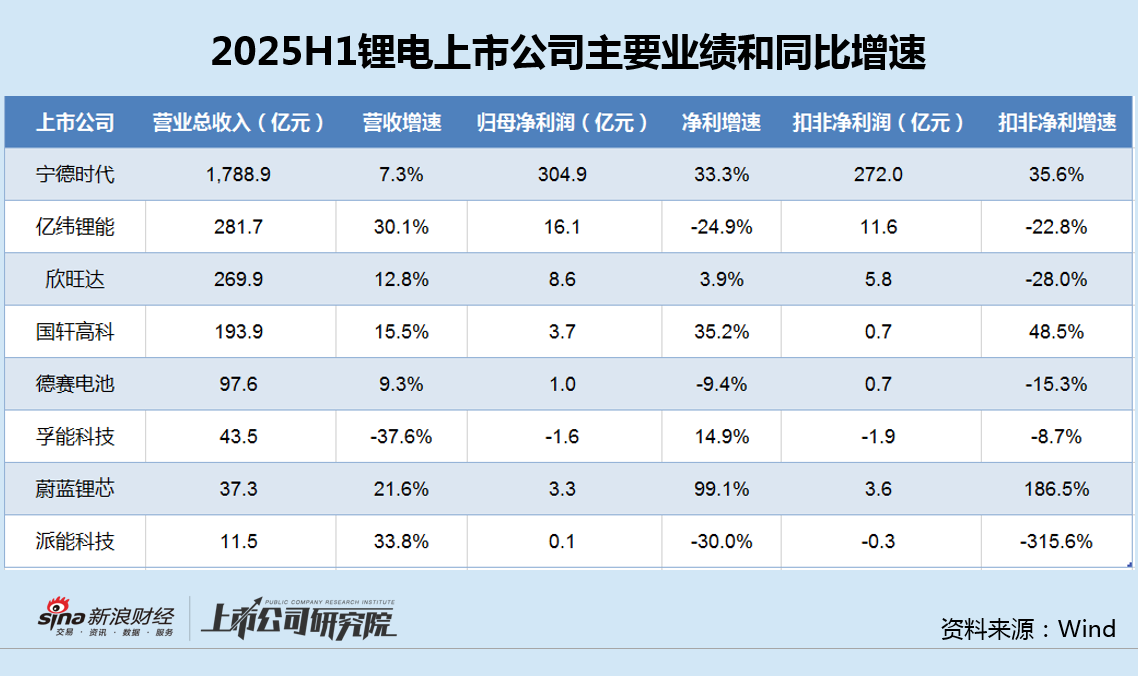
Core Viewpoint - The performance of lithium battery companies listed on the A-share market shows a significant divergence in net profits, with most companies experiencing revenue growth while net profits reveal a stark contrast, particularly for Funeng Technology, which continues to face operational challenges [1][4]. Group 1: Company Performance - Funeng Technology reported a revenue of 4.35 billion yuan in the first half of the year, a year-on-year decline of 37.6%, making it the only major lithium battery company to experience a revenue drop [1][3]. - The company's net profit attributable to shareholders was -160 million yuan, although this loss was reduced by 14.92% compared to the previous year, marking the fifth consecutive year of losses [1][4]. - In contrast, other companies like CATL and EVE Energy showed positive revenue growth, with CATL achieving 178.89 billion yuan in revenue, a 7.3% increase, and a net profit of 30.49 billion yuan, up 33.3% [3]. Group 2: Inventory and Production Issues - Funeng Technology's inventory increased to 3.565 billion yuan, a 58% year-on-year rise, with inventory turnover days extending to 149.27 days, up 71% [4][7]. - Despite the inventory buildup, the company is expanding production capacity, with a projected output of 20 GWh for 2023 and a capacity of 55 GWh by the end of the year [7]. - The company acknowledged that its new production capacity is still in the ramp-up phase, indicating potential underutilization of capacity [7]. Group 3: Ownership and Strategic Changes - In January 2023, Funeng Technology underwent a significant change in control, with the major shareholder shifting to Guangzhou Industrial Investment Holding Group, which is now the actual controller [7][8]. - Following this change, the company received support in terms of funding, financial coordination, and research collaboration, but faces challenges in balancing technological investment with profitability [8]. - The new shareholders have plans to reduce their stakes, indicating a potential shift in strategic focus as the company navigates its financial and operational hurdles [8].
锂电中报|孚能科技上市5年累亏45亿实控人变更后营收下滑存货上升
Xin Lang Cai Jing· 2025-09-12 06:07
Core Viewpoint - The performance of A-share lithium battery listed companies in the first half of 2025 shows a significant divergence in revenue growth and net profit, with some companies thriving while others, like Funeng Technology, are struggling with declining revenues and increasing inventory levels [1][3]. Group 1: Financial Performance - Funeng Technology reported a revenue of 4.35 billion yuan in the first half of 2025, a year-on-year decrease of 37.6%, making it the only major lithium battery listed company to experience a revenue decline [1]. - The company's net profit attributable to shareholders was -160 million yuan, although this loss was reduced by 14.92% compared to the previous year, leading to a cumulative loss of 4.5 billion yuan since its listing in July 2020 [1]. - In the second quarter of 2025, Funeng's revenue dropped to 2.03 billion yuan, a year-on-year decline of 49.92% [1]. Group 2: Inventory and Production Capacity - Despite the revenue decline, Funeng Technology's inventory increased to 3.565 billion yuan, a year-on-year growth of 58%, with inventory turnover days rising to 149.27 days, an increase of 71% [1]. - The company is facing issues with idle production capacity while simultaneously expanding production, indicating a potential mismatch between production capacity and market demand [1][3]. Group 3: Market Position and Future Outlook - Funeng Technology ranked among the top ten globally in terms of shipment volume in 2022, with a total installed capacity of 7.4 GWh, reflecting a year-on-year growth of 215.1% and a market share of 1.4% [2]. - The company is projected to achieve a total shipment volume of 20 GWh in 2023, with production capacity expected to reach 55 GWh by the end of 2023 and 100 GWh by the end of 2024 [2]. - Funeng Technology's recent change in control to Guangzhou Industrial Investment Holding Group has provided financial support and resources for research and development, but the company faces challenges in balancing technological investment with profitability [3].
固态电池有望重塑全球能源产业格局
Zheng Quan Ri Bao Zhi Sheng· 2025-09-11 16:38
Core Viewpoint - The solid-state battery industry is experiencing rapid advancements, with companies like Guoxuan High-Tech and EVE Energy achieving significant milestones in production and technology development, indicating a shift towards commercialization and a potential market boom by 2030 [1][2][10]. Industry Developments - Guoxuan High-Tech has successfully connected its first solid-state battery pilot line, achieving a 90% yield rate in trial production, and is designing a 2GWh production line [1]. - EVE Energy has launched its first batch of 10Ah solid-state batteries at its Longquan No. 2 factory, marking a significant step in production [1]. - The solid-state battery market is projected to reach a shipment volume of 614.1GWh by 2030, with a market size expected to exceed 100 billion yuan [1]. Technological Advancements - Solid-state batteries are recognized for their superior energy density and safety compared to traditional lithium-ion batteries, addressing critical issues such as low-temperature performance and safety hazards [1][2]. - The core structure of solid-state batteries, utilizing solid electrolytes, allows for a significant increase in energy density, enabling electric vehicles to achieve ranges over 1000 km [2][3]. Market Trends - The A-share market has seen a surge in solid-state battery-related stocks, reflecting strong investor interest and the potential for a technological revolution in power batteries [1]. - The introduction of semi-solid batteries, such as the MG4 model from SAIC, represents a practical transition towards full solid-state technology, making advanced battery technology accessible to the mass market [2][3]. Production and Commercialization - Companies like CATL and Gotion High-Tech are actively pursuing both semi-solid and solid-state battery technologies, aiming to optimize production efficiency and market presence [3][4]. - Gotion High-Tech plans to achieve small-scale production of solid-state batteries by 2026-2027, with a focus on establishing a GWh-level production line by 2030 [4]. Industry Collaboration - The solid-state battery sector is witnessing collaborative efforts across the supply chain, with companies like Xiamen Tungsten New Energy Materials and Wuxi XianDai Intelligent Equipment contributing to the development of key materials and production equipment [6]. - The successful signing of a 2.8GWh independent energy storage project by Nandu Power demonstrates the commercial viability of solid-state battery technology in large-scale applications [7]. Policy and Investment Landscape - The solid-state battery industry is supported by various policies aimed at fostering innovation and establishing a robust industrial ecosystem, including plans to create leading global enterprises by 2027 [9][10]. - Significant investment activity is noted, with 27 domestic companies in the solid-state battery field securing 109 rounds of financing, indicating strong market confidence [7][10].
固态电池产业化进程显著提速,电池ETF嘉实(562880)红盘蓄势,成分股科华数据10cm涨停
Xin Lang Cai Jing· 2025-09-11 03:22
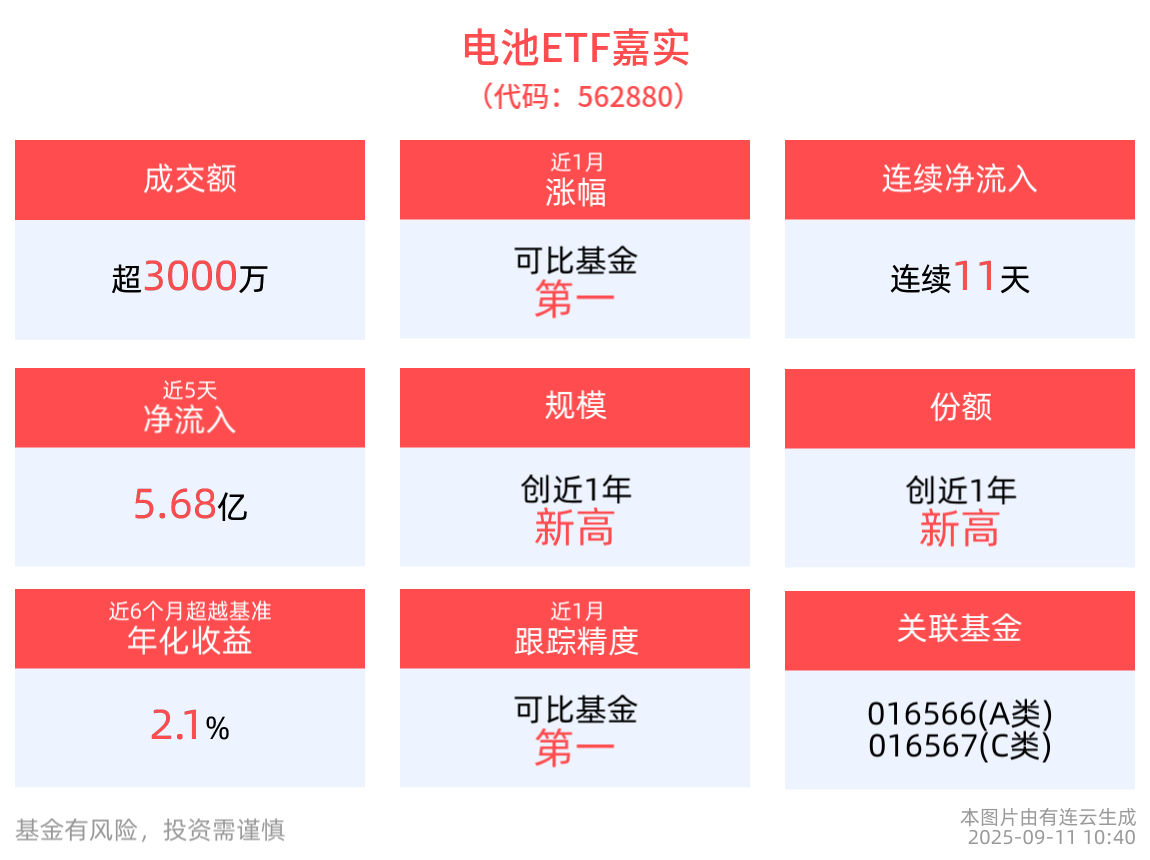
Core Insights - The battery sector is experiencing significant growth, with the China Securities Battery Theme Index rising by 0.86% as of September 11, 2025, and notable increases in individual stocks such as Kehua Data and Keda Technology [1][3] - The Jiashi Battery ETF has seen a remarkable performance, with a weekly increase of 11.42% and a total net inflow of 737 million yuan over the past 11 days [2][3] Market Performance - The Jiashi Battery ETF's trading volume reached 37.93 million yuan with a turnover rate of 3.28%, and its latest scale hit a record high of 1.16 billion yuan [2] - The ETF's net value has increased by 81.44% over the past year, ranking it in the top 19.19% among 3,007 index equity funds [2] Key Developments - Major companies in the battery sector have reported significant advancements, including Guoxuan High-Tech's solid-state battery pilot line achieving a 90% yield and EVE Energy's solid-state battery with an energy density of 300 Wh/kg [3] - The solid-state battery technology is moving towards commercialization, supported by Chinese policies and industry collaboration, as the EU aims for a 400 Wh/kg energy density target by 2030 [3] Investment Opportunities - According to CITIC Securities, the demand for lithium battery materials is expected to grow, particularly for lithium hexafluorophosphate, which is experiencing a price rebound due to tightening supply [3] - Companies capable of producing high-purity lithium sulfide are likely to benefit significantly from the focus on solid-state battery development [3] Top Holdings - As of August 29, 2025, the top ten weighted stocks in the China Securities Battery Theme Index accounted for 53.03% of the index, with notable companies including Sungrow Power, CATL, and EVE Energy [3][5]


国信证券晨会纪要-20250911
Guoxin Securities· 2025-09-11 02:06
Macro and Strategy - The fixed income investment strategy for Q4 indicates a turning point year, with expectations for a cooling economy and potential interest rate cuts [8][11] - The report highlights the ongoing industrialization of solid-state batteries, supported by government policies and advancements in materials and applications [17][18] Textile and Apparel - The textile and apparel sector shows resilience in mid-term performance, with the sports segment leading apparel consumption [3][11] - In September, the retail sales of clothing increased by 1.8% year-on-year, with e-commerce growth rebounding significantly [12][13] - The textile manufacturing segment reported a revenue increase of 7.8% in H1 2025, while the apparel and home textile segment faced a decline of 6.4% [15] Electric Power Equipment and New Energy - The solid-state battery industry is progressing, with significant policy support and material advancements leading to increased production and application [17][18] - Domestic energy storage system tenders surged to 47.2 GWh in August 2025, reflecting a 2158% year-on-year increase, indicating strong demand for new energy systems [18] - The electric power equipment sector is expected to benefit from increased capital expenditures, particularly in AI and cloud infrastructure [18][19] Pharmaceutical and Biotechnology - The pharmaceutical sector is experiencing strong performance, with a notable increase in interest in ANGPTL3-targeted therapies, particularly from multinational corporations [21][22] - The overall biopharmaceutical sector outperformed the market, with a TTM P/E ratio of 40.75x, indicating robust investor interest [20] Non-Banking Financial Sector - The securities industry reported a revenue increase of 11.37% year-on-year in H1 2025, driven by strong performance in brokerage and investment segments [22][23] - Financial investment assets have become the primary growth area for securities firms, accounting for nearly 50% of total assets [24] Social Services Industry - The education and human resources sector showed overall growth, with a revenue increase of 11% and a profit increase of 28% in H1 2025 [26][27] - The K12 education segment continues to recover, with significant demand for skills training and a shift towards quality education [28][30] Internet Industry - The AI agent market is rapidly evolving, with significant growth expected in AI infrastructure and applications, particularly in B2B and B2C sectors [31][34] - Major cloud providers are enhancing their AI capabilities, with Microsoft, Google, and Amazon leading the market [34][35] Agriculture, Forestry, Animal Husbandry, and Fishery - The report recommends focusing on the meat and dairy sectors, highlighting the positive outlook for low-cost pig farming and the overall livestock cycle [36]
固态电池行业深度:固态中试线加速落地,各材料环节全面升级
ZHESHANG SECURITIES· 2025-09-10 11:24
Investment Rating - The industry rating is optimistic [2] Core Insights - Solid-state batteries are expected to achieve a technological breakthrough in electrolyte technology by 2027 and may reach industrialization by 2030, with sulfide solid-state batteries being the most emphasized route domestically and internationally [3][24] - The current focus is on sulfide electrolytes, while composite electrolytes are anticipated to be the best long-term solution [4][33] - High-nickel ternary materials and silicon-carbon anodes are expected to dominate in the short term, with lithium-rich manganese-based and lithium metal anodes being the long-term goals [5][56] - Nickel-coated or nickel-based current collectors are being developed to address corrosion issues, while porous copper foils are being explored for their lightweight and elastic properties [6] - Other materials such as single-walled carbon nanotubes and UV adhesives are also gaining attention for their potential in solid-state battery applications [7] Summary by Sections Solid-State Battery Overview - Solid-state batteries are considered the ultimate form of lithium batteries, balancing safety and energy density [16][18] - The timeline for achieving significant milestones includes 200-300 Wh/kg energy density by 2027 and 400 Wh/kg by 2030 [19][24] Electrolytes - Sulfide electrolytes are currently the focus, with challenges in cost reduction and production scalability [4][39] - The development of halide electrolytes is also being pursued to enhance electrochemical stability and compatibility with high-voltage cathodes [44] Cathode Materials - High-nickel ternary materials are expected to be the primary choice for solid-state batteries, with ongoing modifications to improve performance [45][50] - Lithium-rich manganese-based materials are being developed to enhance energy density and reduce costs [55] Anode Materials - CVD silicon-carbon anodes are emerging as a leading option due to their performance and cost advantages, with significant growth expected in the coming years [61] - Lithium metal anodes are viewed as the ultimate solution, with ongoing research to address associated challenges [64] Investment Recommendations - Focus on leading companies in various material segments, including sulfide electrolytes, high-nickel ternary cathodes, CVD silicon-carbon anodes, and nickel-based current collectors [8]

