
外汇储备

Search documents
人民币:银行间外汇市场动态改善,但人民币升值可能受限
2025-08-25 01:40
Summary of Key Points from the Conference Call Industry Overview - The report focuses on the foreign exchange dynamics in Asia, specifically China, and the implications for the Renminbi (RMB) and capital flows [1][5][6]. Core Insights 1. **Improvement in Trade Settlement**: - China's July net FX trade settlement rose significantly to USD 60.9 billion, up from USD 44.0 billion in June, marking an 87.8% ratio of the reported trade surplus after adjusting for RMB trade settlement [2][3]. 2. **Exporters' FX Remittances**: - Exporters' FX remittances increased to 54.9% of total exports in July, compared to 46.1% in June, indicating a strong recovery in trade flow dynamics [3][4]. 3. **Corporate Demand for FX**: - Corporate demand for foreign exchange also rose, reaching 51.8% of total imports in July, up from 50.4% in June [3]. 4. **BOP Dynamics**: - The balance of payments (BOP) dynamics are improving, driven by exporters' FX remittances and a gradual decline in the USD/CNY fixing [4][6]. 5. **Capital Flow Forecast**: - An improvement in China's major capital flows is expected over the next six months, influenced by the de-escalation of US-China tariff tensions and a softer USD outlook [5][6]. 6. **Foreign Direct Investment (FDI)**: - There is a slight recovery in FDI inflows, although they remain weak, with a slowdown in FDI outflows noted [6][15]. 7. **Portfolio Inflows**: - Foreign portfolio inflows into Chinese equities have increased, with an average of USD 5.3 billion per month in the three months ending in July, attributed to improved sentiment from reduced trade tensions [15][4]. Additional Important Insights 1. **FX Deposits**: - A temporary decline in financial institutions' FX deposits was observed in July, with a modest decrease of USD 16.6 billion, following significant accumulations in previous months [9][11]. 2. **RMB Underperformance Risk**: - The potential for RMB underperformance exists if state banks continue to accumulate FX reserves, especially if the USD weakens further [6][11]. 3. **Tourism Deficit**: - The tourism deficit has remained stable, with projections indicating a slowdown in outflows in the second half of the year [8][6]. 4. **Excess FX Hoarding**: - An estimated excess FX hoarding of approximately USD 78 billion exists, which could impact future FX remittance dynamics [7][6]. 5. **Future Projections**: - The net FX trade settlement is projected to improve to a USD 307 billion surplus over the next six months, with upside risks if corporate FX hoarding is unwound more substantially [7][17]. This summary encapsulates the key points discussed in the conference call, highlighting the current state and future outlook of China's foreign exchange dynamics and capital flows.
乌兹别克斯坦国际储备增至487.4亿美元
Shang Wu Bu Wang Zhan· 2025-08-19 16:00
Core Insights - Uzbekistan's international reserves reached $48.74 billion by the end of July, marking an increase of $194 million or 0.4% compared to June [1] Group 1: International Reserves Breakdown - Gold reserves hit a record high of $38.68 billion [1] - International securities reserves grew to $1.01 billion, reflecting a significant increase of 42.7% [1] - Foreign exchange reserves decreased to $8.48 billion, which includes $1.05 billion in deposits with other central banks and the International Monetary Fund (IMF), as well as $7.42 billion in deposits with foreign commercial banks [1]
3月末我国外储规模达31880亿美元
Xin Hua Wang· 2025-08-12 06:28
Core Insights - As of March 2022, China's foreign exchange reserves stood at $31,880 billion, a decrease of $25.8 billion or 0.8% from the end of February 2022, primarily influenced by valuation factors [1] - The overall cross-border capital inflow in March showed a recovery, with the foreign exchange market maintaining a basic balance in supply and demand [1] - The U.S. dollar index rose by 1.7% to 98.3 in March, while major non-dollar currencies such as the euro, pound, and yen experienced declines of 1.4%, 2.1%, and 5.5% respectively [1] Summary by Sections Foreign Exchange Reserves - China's foreign exchange reserves decreased by $25.8 billion in March 2022, attributed to valuation changes and asset price fluctuations [1] - The reserves are primarily denominated in U.S. dollars, and the decline was influenced by the depreciation of non-dollar currencies when converted to dollars [1] Market Conditions - The international financial market is experiencing increased volatility due to factors such as major countries' monetary policies, geopolitical tensions, and the ongoing COVID-19 pandemic [2] - The S&P 500 index rose by 3.6%, while the Eurozone's STOXX 50 index fell by 0.6%, and the Nikkei 225 index increased by 4.9% in March [1] Future Outlook - The foundation for maintaining stable foreign exchange reserves remains strong, supported by China's resilient economy and long-term positive outlook [2] - However, ongoing geopolitical conflicts and rising prices of commodities may lead to increased volatility in global financial markets, necessitating proactive macroeconomic policies to stabilize market expectations [2]
五月末我国外储规模环比上升
Xin Hua Wang· 2025-08-12 06:26
根据国家外汇管理局6月7日发布的数据,截至2022年5月末,我国外汇储备规模为31278亿美元,较 4月末上升81亿美元,升幅为0.26%。业内人士表示,5月外汇储备规模的回升,主要由估值增加引起。 展望未来,我国经济长期向好的基本面没有改变,将支持外汇储备规模保持总体稳定。 国家外汇管理局副局长、新闻发言人王春英表示,2022年5月,我国外汇市场运行总体平稳,境内 外汇供求保持基本平衡。国际金融市场上,受主要国家货币政策及预期、全球经济增长前景、地缘政治 局势等因素影响,美元指数小幅下跌,主要国家金融资产价格涨跌互现。数据显示,货币方面,美元汇 率指数下跌1.2%至101.8;非美元货币中,欧元上涨1.8%,英镑上涨0.2%,日元上涨0.8%。资产方面, 以美元标价的已对冲全球债券指数下跌0.1%,与上月基本持平;标普500股票指数收平于4132点,欧元 区斯托克50指数下跌0.4%,日经225指数上涨1.6%。 本月外汇储备规模结束了此前连续四个月的回落,为第25个月保持在3.1万亿美元之上。展望未 来,王春英表示,当前外部环境依然复杂严峻,全球经济面临的风险挑战增多,国际金融市场仍存在较 大不确定性。但 ...
上半年我国外汇储备规模稳中有升
Xin Hua Wang· 2025-08-12 06:24
记者:张文 【纠错】 【责任编辑:焦鹏】 【简介】国家外汇管理局副局长、新闻发言人李斌7月22日在国务院新闻办新闻发布会上说,6月 末,我国外汇储备余额为33174亿美元,比2024年末增加了1151亿美元。我国外汇储备规模稳中有升。 新华社国内部出品 ...
8月末我国外汇储备为30549亿美元
Xin Hua Wang· 2025-08-12 06:19
Core Viewpoint - As of the end of August 2022, China's foreign exchange reserves stood at $3,054.9 billion, reflecting a decrease due to factors such as exchange rate adjustments and asset price changes, despite a stable balance in domestic foreign exchange supply and demand [1] Group 1: Foreign Exchange Reserves - China's foreign exchange reserves decreased in August 2022, influenced by the rising US dollar index and overall decline in global financial asset prices [1] - The foreign exchange reserves were reported at $3,054.9 billion as of August 2022 [1] Group 2: Cross-Border Capital Flows - Cross-border capital flows were described as rational and orderly, with domestic foreign exchange supply and demand remaining fundamentally balanced [1] - The trade surplus for August was reported at $79.39 billion, a decrease of $21.88 billion from July but still a year-on-year increase of 34.1% [1] Group 3: Economic Environment - The external environment is becoming increasingly complex and severe, with heightened downward pressure on the global economy and significant volatility in international financial markets [1] - China's effective coordination of pandemic control and economic development, along with the implementation of a comprehensive economic stabilization policy, is expected to support the stability of foreign exchange reserves [1]
3月外汇储备增加134亿美元 黄金储备连增5个月
Xin Hua Wang· 2025-08-12 06:10
Group 1 - As of March 2025, China's foreign exchange reserves reached $32,407 billion, an increase of $134 billion from February, reflecting a growth rate of 0.42% [1] - The increase in foreign exchange reserves is attributed to the decline in the US dollar index and the overall drop in global financial asset prices, influenced by macroeconomic data and monetary policies from major economies [1][2] - China's foreign exchange reserves have remained stable above $3 trillion, making it the largest holder of foreign exchange reserves globally, which is crucial for maintaining economic and financial stability amid rising global uncertainties [1][2] Group 2 - As of March 2025, China's gold reserves increased to 7.37 million ounces, up from 7.361 million ounces in February, marking the fifth consecutive month of gold accumulation by the central bank [2] - The gold market has experienced significant price fluctuations in 2025, with spot gold prices recently dropping below $3,000 per ounce for the first time since March 21 [2] - The central bank's strategy to steadily increase gold reserves is driven by the need to mitigate geopolitical risks and market volatility, while also responding to rising demand for safe-haven assets [2][3]
权威数读·经济半年报丨跨境贸易和投融资继续保持活跃
Xin Hua Wang· 2025-08-12 05:42
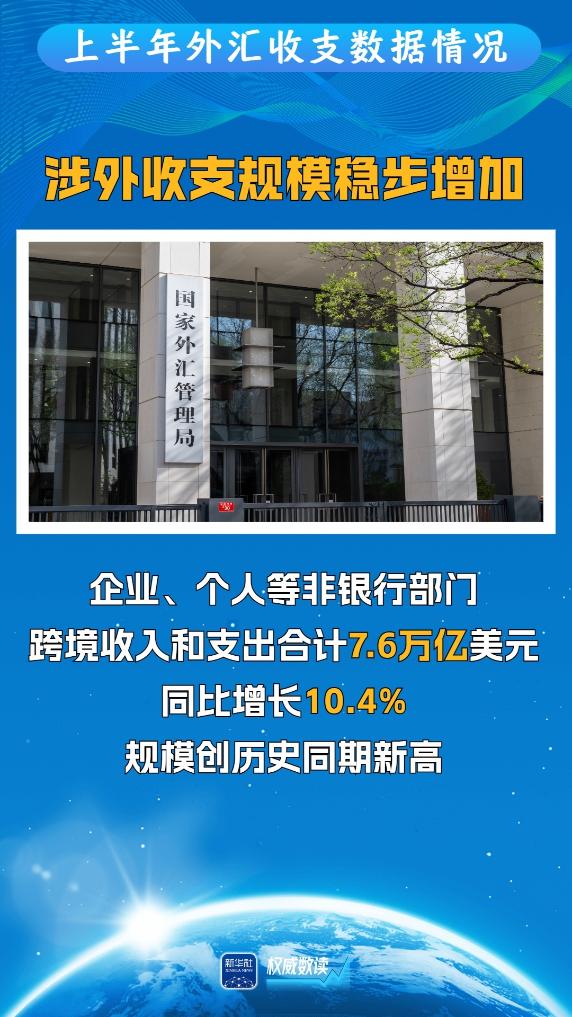
Core Viewpoint - The latest foreign exchange data indicates that China's net cross-border capital inflow reached 127.3 billion USD in the first half of the year, with a 46% quarter-on-quarter increase in the second quarter, continuing the net inflow trend since the second half of last year, reflecting active cross-border trade and investment activities [1][7]. Group 1: Cross-Border Capital Flow - In the first half of the year, the total cross-border income and expenditure of non-bank sectors, including enterprises and individuals, amounted to 7.6 trillion USD, marking a year-on-year growth of 10.4%, the highest for the same period in history [4]. - The net inflow of cross-border funds for enterprises and individuals reached 127.3 billion USD, continuing the net inflow trend since the second half of last year [7]. Group 2: Foreign Exchange Market Activity - The foreign exchange market saw a trading volume of 21 trillion USD in the domestic RMB foreign exchange market, reflecting a year-on-year increase of 10.2% [15]. - The bank's foreign exchange settlement and sales amounted to 25.3 billion USD, indicating rational and orderly trading behavior among enterprises and individuals [11]. Group 3: Foreign Exchange Reserves and Currency Fluctuations - As of the end of June, China's foreign exchange reserves stood at 3.3174 trillion USD, an increase of 115.1 billion USD compared to the end of 2024 [18]. - The RMB appreciated by 1.9% against the USD in the first half of the year, with the exchange rate fluctuating between 7.15 and 7.35 [21].

多家银行响应消费贷贴息,南向资金扫货港股市场 | 财经日日评
吴晓波频道· 2025-08-09 00:30
Group 1: Legal and Economic Environment for Private Enterprises - The Supreme People's Court issued guidelines to implement the Private Economy Promotion Law, aiming to provide judicial support for the development of the private economy through 25 specific measures [2][3] - The guidelines focus on ensuring equal legal treatment, promoting lawful business practices, and enhancing judicial fairness to address issues like debt collection and financing difficulties faced by private enterprises [3] Group 2: Central Bank's Gold Reserves - The People's Bank of China has increased its gold reserves for nine consecutive months, with a total of 7,396 million ounces as of July 2025, reflecting a monthly increase of 6 million ounces [4] - The decline in foreign exchange reserves by $25.2 billion in July is attributed to the strengthening of the US dollar and the depreciation of non-US currencies, indicating normal fluctuations [4] Group 3: Consumer Loan Subsidy Policies - Several banks are responding to the government's consumer loan subsidy policies, aiming to simplify processes and ensure timely benefits for consumers [6][7] - The subsidy rates for personal consumption loans in regions like Sichuan and Chongqing are around 1.5% to 2%, which helps reduce borrowing costs for consumers while maintaining bank profitability [6][7] Group 4: Semiconductor Industry Performance - SMIC reported a 1.7% decrease in revenue for Q2 2025, with total sales of $2.209 billion, while the gross margin was 20.4%, down 2.1% from the previous quarter [10] - The company achieved a wafer shipment of 2.3902 million pieces, with a year-on-year revenue growth of 22% for the first half of 2025, indicating stable performance despite challenges in the AI chip sector [10][11] Group 5: Market Trends and Investment Opportunities - Southbound capital has significantly flowed into the Hong Kong stock market, with a cumulative net purchase of 894.528 billion HKD this year, surpassing the total for 2024 [14] - The Hang Seng Index has risen by 26.49% over the past three months, reflecting a strong recovery compared to the A-share market, driven by improved liquidity and investor interest [14][15]


6月末我国外汇储备规模为33174亿美元
Jin Rong Shi Bao· 2025-08-08 07:57
Core Insights - As of June 2025, China's foreign exchange reserves reached $3,317.4 billion, an increase of $32.2 billion from the end of May, marking a rise of 0.98% [1] - The increase in foreign exchange reserves is attributed to factors such as exchange rate adjustments and asset price changes, with a total increase of $115.1 billion in the first half of the year [1] - The foreign exchange reserves have reached the highest level since January 2016, indicating strengthened capacity to mitigate various shocks under open conditions [1] Summary by Categories Foreign Exchange Reserves - China's foreign exchange reserves stood at $3,317.4 billion as of June 2025, reflecting a monthly increase of $32.2 billion [1] - The reserves have recorded six consecutive monthly increases, with a total rise of $115.1 billion in the first half of the year [1] Economic Factors - The increase in reserves is influenced by the fiscal and monetary policies of major economies, as well as the outlook for economic growth, leading to a decline in the US dollar index and an overall rise in global financial asset prices [1] - The positive valuation effect from the appreciation of non-US dollar currencies against the dollar and rising asset prices contributed to the increase in reserves [1] Future Outlook - The external environment is becoming more complex and severe, with weakened global economic momentum and continued volatility in international financial markets [1] - However, China's economy is expected to maintain steady growth, and resilient foreign trade, along with global investors' optimism towards new opportunities in the Chinese capital market, will support the stability of foreign exchange reserves [1]