中韩自贸区

Search documents
青岛港跌0.69%,成交额1.10亿元,近5日主力净流入-1186.72万
Xin Lang Cai Jing· 2025-11-05 12:28
Core Viewpoint - Qingdao Port is strategically positioned in the Bohai Sea region and benefits from the China-South Korea Free Trade Agreement, enhancing its operational advantages in the Northeast Asia port network [2] Company Overview - Qingdao Port International Co., Ltd. was established on November 15, 2013, and listed on January 21, 2019. Its main business includes loading and unloading various goods such as containers, metal ores, coal, and crude oil, along with logistics and port value-added services [6] - The revenue composition of the company is as follows: 56.72% from loading and related services, 36.96% from logistics and port value-added services, 3.25% from oil, electricity, and other sales, 1.95% from rental income, and 1.13% from engineering and labor services [6] - As of September 30, 2025, Qingdao Port achieved an operating income of 14.238 billion yuan, a year-on-year increase of 1.86%, and a net profit attributable to shareholders of 4.180 billion yuan, a year-on-year increase of 6.33% [6] Dividend Information - Since its A-share listing, Qingdao Port has distributed a total of 12.818 billion yuan in dividends, with 5.687 billion yuan distributed over the past three years [7] Institutional Holdings - As of September 30, 2025, the top ten circulating shareholders of Qingdao Port include Southern S&P China A-Share Large Cap Dividend Low Volatility ETF, holding 25.5069 million shares, and Hong Kong Central Clearing Limited, holding 22.3567 million shares, both showing increases in holdings compared to the previous period [8] Market Activity - On November 5, Qingdao Port's stock price decreased by 0.69%, with a trading volume of 110 million yuan and a turnover rate of 0.24%, resulting in a total market capitalization of 56.148 billion yuan [1] - The stock has seen a net outflow of 3.9516 million yuan from main funds today, with a ranking of 21 out of 35 in its industry [3]

辽港股份跌0.59%,成交额2.85亿元,近3日主力净流入-3650.58万
Xin Lang Cai Jing· 2025-11-04 10:20
Core Viewpoint - The company, Liaoning Port Co., Ltd., is positioned as a leading logistics platform for port operations in Dalian, leveraging its strategic location and operational advantages to enhance its role in the Northeast Asia International Shipping Center and the development of the Liaoning Coastal Economic Belt [2][3]. Company Overview - Liaoning Port Co., Ltd. was established on November 16, 2005, and listed on December 6, 2010. Its main business includes oil/liquid chemical products terminals and related logistics, container terminals and related logistics, automobile terminals and related logistics, bulk cargo terminals and related logistics, grain terminals and related logistics, passenger roll-on/roll-off terminals and related logistics, as well as port value-added and support services [8][9]. Business Operations - The company operates as a unified platform for port logistics in Dalian, with a focus on various terminal operations including oil, containers, automobiles, bulk goods, and passenger services. It is the largest comprehensive terminal operator in Northeast China, with 70 near-sea routes [3][4]. - The company has strengthened its market development for container terminals, adding 10 new routes in the year, and is actively integrating into national strategies such as the Belt and Road Initiative and the construction of the Liaoning Free Trade Zone [4]. Financial Performance - For the period from January to September 2025, the company achieved operating revenue of 8.426 billion yuan, representing a year-on-year growth of 5.99%. The net profit attributable to the parent company was 1.3 billion yuan, reflecting a year-on-year increase of 37.51% [9][10]. Shareholder Information - As of September 30, 2025, the number of shareholders was 211,800, a decrease of 5.54% from the previous period. The average trading cost of the stock is 1.61 yuan, with the stock price approaching a resistance level of 1.69 yuan [6][9].
市场情绪监控周报(20251027-20251031):深度学习因子10月超额-0.07%,本周热度变化最大行业为有石油石化、综合-20251103
Huachuang Securities· 2025-11-03 12:54
Quantitative Models and Construction - **Model Name**: DecompGRU **Model Construction Idea**: The model improves information interaction between time-series and cross-sectional data by introducing two simple de-mean modules on the GRU baseline model[18] **Model Construction Process**: 1. The DecompGRU model architecture is based on GRU as the baseline 2. Two de-mean modules are added to enhance the interaction between time-series and cross-sectional data 3. The model is trained using IC and weighted MSE loss functions[18] **Model Evaluation**: The model demonstrates improved interaction between time-series and cross-sectional data, enhancing prediction accuracy[18] Model Backtesting Results - **DecompGRU TOP200 Portfolio**: - Cumulative absolute return: 41.11% - Excess return relative to WIND All A equal-weight index: 13.98% - Maximum drawdown: 10.08% - Weekly win rate: 64.52% - Monthly win rate: 100% - October absolute return: 1.78%, excess return: -0.07%[11] - **ETF Rotation Portfolio**: - Cumulative absolute return: 19.06% - Excess return relative to benchmark: -2.00% - Maximum drawdown: 7.82% - Weekly win rate: 62.50% - Monthly win rate: 57.14% - October absolute return: -2.04%, excess return: -1.18%[14][15] Quantitative Factors and Construction - **Factor Name**: Sentiment Heat Factor **Factor Construction Idea**: The factor aggregates stock-level sentiment heat metrics (e.g., browsing, self-selection, and clicks) to represent broader market sentiment[19] **Factor Construction Process**: 1. Individual stock sentiment heat is calculated as the sum of browsing, self-selection, and click counts 2. The sentiment heat is normalized by dividing by the total market sentiment on the same day and multiplying by 10,000 3. Aggregated sentiment heat is used as a proxy for market sentiment at the index, industry, and concept levels[19] **Factor Evaluation**: The factor effectively captures market sentiment and its impact on pricing errors[19] Factor Backtesting Results - **Broad-based Index Sentiment Heat Rotation Strategy**: - Annualized return since 2017: 8.74% - Maximum drawdown: 23.5% - 2025 portfolio return: 38.5% - Benchmark return: 32.9%[28] - **Concept Sentiment Heat BOTTOM Portfolio**: - Annualized return: 15.71% - Maximum drawdown: 28.89% - 2025 portfolio return: 42.1%[41][44]



连云港跌1.03%,成交额2.52亿元,后市是否有机会?
Xin Lang Cai Jing· 2025-10-31 07:25
Core Viewpoint - The company, Jiangsu Lianyungang Port Co., Ltd., is a state-owned enterprise primarily engaged in port operations, including cargo handling, storage, and port management, and plays a significant role in the Belt and Road Initiative [2][3][7]. Company Overview - Jiangsu Lianyungang Port Co., Ltd. was established on October 15, 2001, and listed on April 26, 2007. Its main business includes cargo handling, storage, and port management services, with major cargo types including coal, nickel ore, iron ore, aluminum oxide, and grain [7]. - The company's revenue composition is as follows: cargo handling and related services account for 76.88%, comprehensive logistics and other services for 17.98%, financial services for 3.55%, and other income for 1.58% [7]. - As of September 30, 2025, the company reported a revenue of 1.87 billion yuan, a year-on-year decrease of 3.45%, and a net profit attributable to shareholders of 106 million yuan, down 25.90% year-on-year [7]. Market Position and Strategic Importance - Lianyungang is a crucial node in the Belt and Road Initiative, having established logistics transfer bases and operational platforms for Central Asia and Europe, and is committed to becoming an indispensable core and strategic leading area of the initiative [2][7]. - The company is controlled by the Lianyungang Municipal Government's State-owned Assets Supervision and Administration Commission, emphasizing its state-owned enterprise status [3]. Financial and Trading Analysis - The stock experienced a decline of 1.03% on October 31, with a trading volume of 252 million yuan and a turnover rate of 3.52%, resulting in a total market capitalization of 7.134 billion yuan [1]. - The average trading cost of the stock is 5.99 yuan, with recent buying activity noted, although the buying strength is not strong. The stock price is near a support level of 5.70 yuan, indicating potential for a rebound or further decline if the support is broken [6]. Shareholder and Dividend Information - The company has distributed a total of 516 million yuan in dividends since its A-share listing, with 199 million yuan distributed over the past three years [8]. - As of September 30, 2025, the number of shareholders decreased by 20.48% to 101,400, while the average circulating shares per person increased by 25.76% to 12,234 shares [7][8].

辽港股份跌4.47%,成交额5.85亿元,近3日主力净流入-230.77万
Xin Lang Cai Jing· 2025-10-31 07:25
Core Viewpoint - The company, Liaoport Co., Ltd., is experiencing a decline in stock price and trading volume, indicating potential market volatility and investor sentiment concerns [1] Company Overview - Liaoport Co., Ltd. is a unified operational platform for port logistics in Dalian, leveraging its advantageous natural conditions and management strengths to play a leading role in the development of the Northeast Asia International Shipping Center and the Liaoning Coastal Economic Belt [2][3] - The company operates various terminal and logistics services, including oil/liquid chemical products, container, automobile, bulk cargo, grain, and passenger roll-on/roll-off services, making it a key maritime gateway in Northeast Asia [2][3][9] Business Performance - For the period from January to September 2025, Liaoport Co., Ltd. achieved a revenue of 8.426 billion yuan, representing a year-on-year growth of 5.99%, and a net profit attributable to shareholders of 1.3 billion yuan, reflecting a significant increase of 37.51% [9] - The company has a diversified revenue structure, with 96.37% coming from services, 3.06% from other sources, and 0.57% from goods [9] Strategic Initiatives - The company is enhancing its market development for container terminals, adding 10 new shipping routes to align with national strategies such as the Belt and Road Initiative and the construction of the Liaoning Free Trade Zone [4] - Liaoport Co., Ltd. is actively exploring new markets in Southeast Asia and the Russian Far East, with plans to add 7 new Southeast Asia routes, 1 Far East route, and 2 domestic routes [4] Shareholder Information - As of September 30, 2025, the number of shareholders for Liaoport Co., Ltd. was 211,800, a decrease of 5.54% from the previous period [9] - The company has distributed a total of 5.342 billion yuan in dividends since its A-share listing, with 1.439 billion yuan distributed in the last three years [10]
A股市场大势研判:沪指失守4000点
Dongguan Securities· 2025-10-30 23:34
Market Overview - The Shanghai Composite Index has fallen below 4000 points, closing at 3986.90, down 0.73% [2][4] - The Shenzhen Component Index closed at 13532.13, down 1.16%, while the ChiNext Index fell 1.84% to 3263.02 [2][4] Sector Performance - The top-performing sectors included Steel (+0.90%), Non-ferrous Metals (+0.79%), and Utilities (+0.13%) [3] - The worst-performing sectors were Communication (-2.83%), Electronics (-2.23%), and Defense & Military Industry (-1.95%) [3] Market Trends - The market experienced fluctuations with the three major indices showing collective declines, particularly the ChiNext Index which dropped nearly 2% [6] - The trading volume in the Shanghai and Shenzhen markets reached 2.42 trillion, an increase of 165.6 billion from the previous trading day [6] Future Outlook - The Federal Reserve's decision to lower the benchmark interest rate by 25 basis points to 3.75%-4.00% is expected to attract international capital to emerging markets, including China [5][6] - Positive policy signals from recent meetings are anticipated to enhance market risk appetite, with a focus on sectors such as dividends, TMT (Technology, Media, and Telecommunications), New Energy, and Non-ferrous Metals [6]
601628 大动作!北向资金逆市大幅净买入5股
Zheng Quan Shi Bao Wang· 2025-10-30 14:39
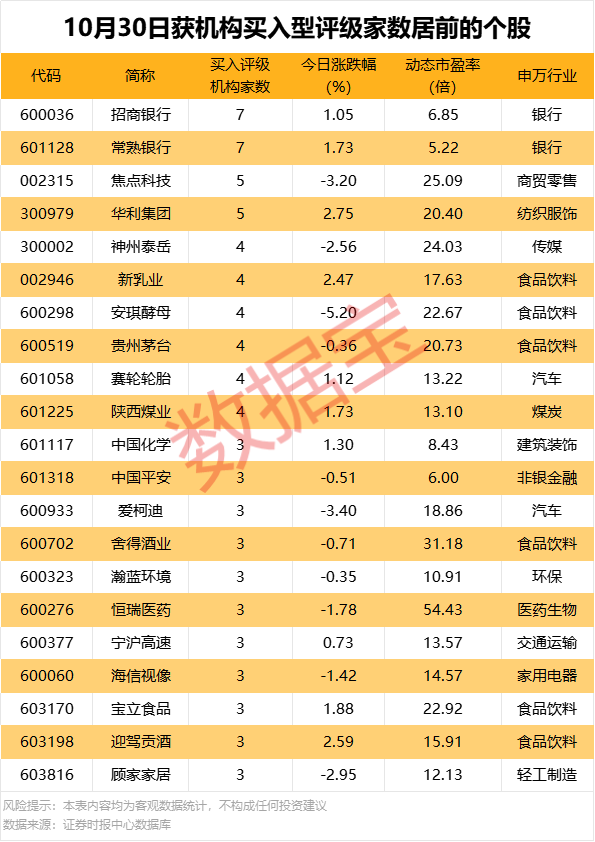
Market Overview - The three major A-share indices collectively retreated on October 30, with the Shanghai Composite Index falling below the 4000-point mark. The market turnover reached 24,642.94 billion yuan, an increase of over 170 billion yuan compared to the previous trading day. More than 1200 stocks closed higher, with 62 stocks hitting the daily limit up [1]. Institutional Ratings - A total of 436 buy ratings were issued by institutions today, covering 304 stocks. China Merchants Bank and Changshu Bank received the most attention, each receiving buy ratings from 7 institutions. Among the stocks rated by institutions, 9 stocks have an upside potential exceeding 50%, with Kweichow Moutai having the highest upside potential of 82.23% based on a target price of 2600 yuan [2][3]. Sector Performance - The food and beverage sector was the most favored by institutions, with 26 stocks, including New Dairy and Angel Yeast, making it to the buy rating list. The basic chemicals and electronics sectors also attracted institutional interest, with 25 and 24 stocks respectively [2]. Northbound Capital Flow - In the northbound trading, 13 stocks saw net buying from northbound funds, with Guodun Quantum, Penghui Energy, and Keda Guokai being the top three in terms of net buying amount, each exceeding 120 million yuan. Conversely, Samsung Medical faced a net selling of over 100 million yuan [4][6][7]. Corporate Announcements - China Life Insurance plans to invest 2 billion yuan in a fund investment plan, primarily targeting sectors such as semiconductors, digital energy, and smart electric vehicles. The total fundraising for this plan is 2.01 billion yuan [8]. - QY Technology intends to acquire a 25% stake in Zhongtong Tianhong for 37.5 million yuan, enhancing resource efficiency and reducing procurement costs [8]. - Jiaozuo Wanfang is set to invest approximately 3.8 billion yuan in a project to produce 400,000 tons of recycled aluminum annually, with a focus on various aluminum products [8]. - Trina Solar's subsidiary has signed a sales contract for over 1 GWh of energy storage products, while the company reported a net loss of 1.283 billion yuan for the third quarter [9].

每日复盘-20251030
Guoyuan Securities· 2025-10-30 14:18
- The report does not contain any quantitative models or factors related to construction, testing, or evaluation[2][3][4] - The report primarily focuses on market performance, sector analysis, and fund flows without discussing quantitative models or factors[15][21][25] - No relevant quantitative content is available for summarization based on the provided documents[29][32][34]
10月30日沪深两市强势个股与概念板块
2 1 Shi Ji Jing Ji Bao Dao· 2025-10-30 13:58
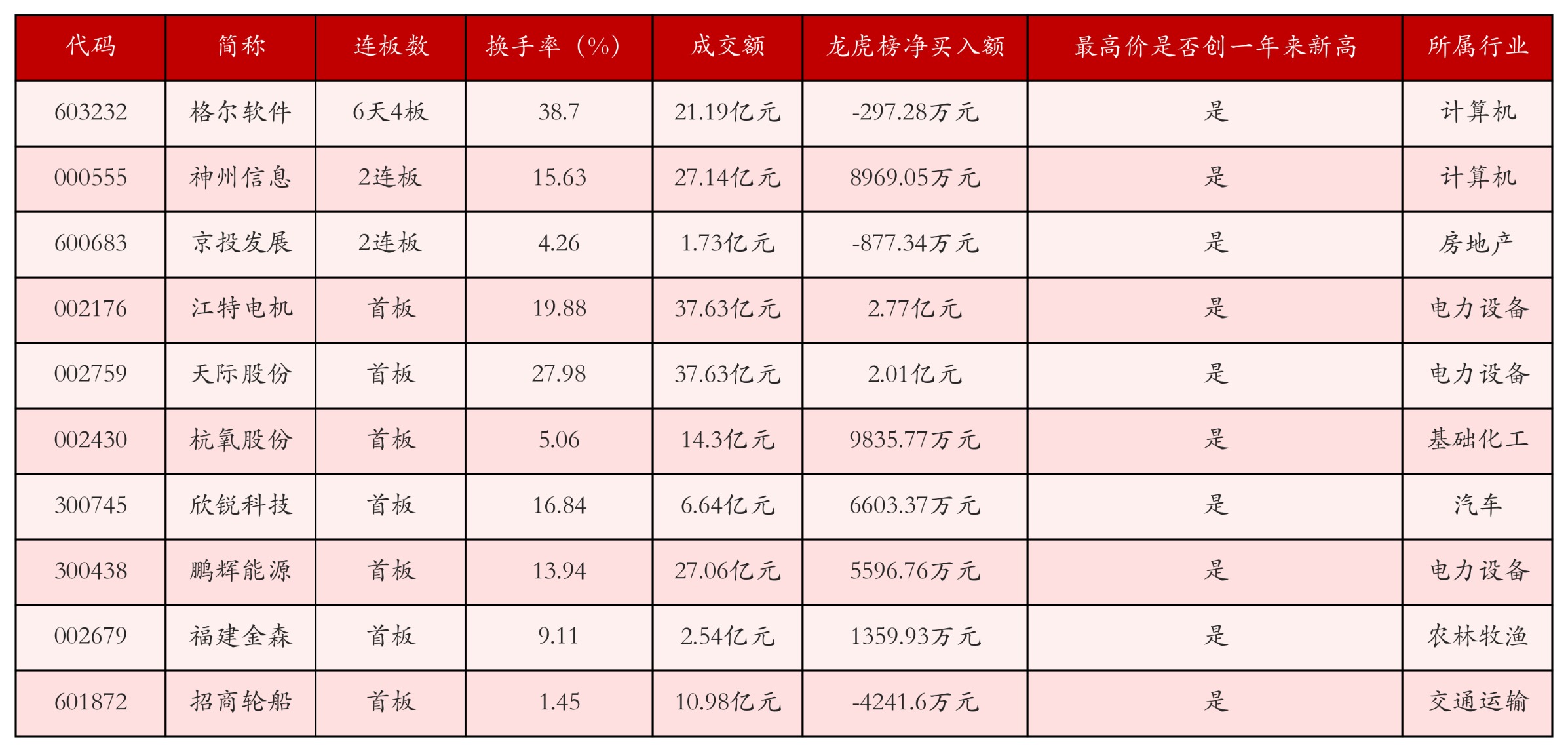
Group 1: Strong Individual Stocks - As of October 30, the Shanghai Composite Index fell by 0.73% to 3986.9 points, the Shenzhen Component Index decreased by 1.16% to 13532.13 points, and the ChiNext Index dropped by 1.84% to 3263.02 points [1] - A total of 62 stocks in the A-share market hit the daily limit up, with the top three strong stocks being: Geer Software (603232), Shenzhou Information (000555), and Jingtou Development (600683) [1] - The detailed performance of the top 10 strong stocks includes: - Geer Software: 6 consecutive boards, turnover rate of 38.7%, and closing price of 21.1 [1] - Shenzhou Information: 2 consecutive boards, turnover rate of 15.63%, and closing price of 27.1 [1] - Jingtou Development: 2 consecutive boards, turnover rate of 4.26%, and closing price of 1.73 [1] Group 2: Strong Concept Sectors - The top three concept sectors with the highest gains in the A-share market are: China-Korea Free Trade Zone, Quantum Technology, and Cultivated Diamonds [2] - The detailed performance of the top 10 concept sectors includes: - China-Korea Free Trade Zone: increased by 1.45% [3] - Quantum Technology: increased by 1.27% [3] - Cultivated Diamonds: increased by 1.26% [3]


动力电池回收概念涨0.53%,主力资金净流入这些股
Zheng Quan Shi Bao Wang· 2025-10-30 10:09
Core Viewpoint - The power battery recycling sector has shown a positive performance, with a 0.53% increase, ranking seventh among concept sectors, indicating growing investor interest and potential opportunities in this area [1][2]. Group 1: Market Performance - As of October 30, the power battery recycling concept saw 37 stocks rise, with notable gainers including Xinwangda (up 10.14%), Tianqi Lithium (up 9.67%), and Fangyuan Co. (up 9.05%) [1]. - The sector experienced a net inflow of 1.92 billion yuan, with 43 stocks receiving net inflows, and 11 stocks exceeding 100 million yuan in net inflow [2]. Group 2: Key Stocks - Tianqi Lithium led the net inflow with 1.382 billion yuan, followed by Huayou Cobalt (410 million yuan), Ganfeng Lithium (387 million yuan), and Fulongma (377 million yuan) [2]. - The highest net inflow ratios were observed in Kangsheng Co. (29.02%), Yuanda Environmental Protection (22.44%), and Tianqi Lithium (14.14%) [3]. Group 3: Sector Comparison - The power battery recycling sector's performance contrasts with other sectors, such as the military equipment restructuring concept, which fell by 2.91%, and the optical packaging concept, which decreased by 2.87% [2].