
债务违约

Search documents
知名房企巨头上海总部大楼被6折甩卖,公司3年巨亏400亿元
Mei Ri Jing Ji Xin Wen· 2025-10-07 05:21
Core Viewpoint - The auction of Sunshine City Headquarters at Binjiang International Plaza concluded with a final price of 1.31 billion yuan, significantly lower than its initial auction price of 2.1 billion yuan, reflecting ongoing financial difficulties faced by the company [1][4]. Group 1: Auction Details - The auction for Binjiang International Plaza started at 1.13 billion yuan and went through 37 rounds before closing at 1.31 billion yuan [1]. - The property, previously known as "Sunshine Holdings Building," is located in Shanghai's Yangpu District and features a prime view of the Huangpu River [1][4]. - This property had previously been auctioned four times without success, with starting prices ranging from 2.1 billion yuan to 1.31 billion yuan [4]. Group 2: Financial Background - The building was mortgaged by Sunshine City Group as collateral for a debt of 933 million yuan, which it failed to repay, leading to the auction [4]. - Sunshine City has been actively selling assets to alleviate its debt burden, including the sale of shares in Industrial Bank and over 20 other valuable assets, recovering more than 45 billion yuan to pay off debts [6]. - As of September 25, 2023, Sunshine City had overdue debts totaling 65.734 billion yuan, with additional unpaid bonds amounting to 2.244 billion USD in the overseas market and 16.463 billion yuan in the domestic market [13]. Group 3: Company History and Performance - Sunshine City was established in 2002 and began its rapid expansion in 2010, achieving significant sales growth and entering the top tier of Chinese real estate companies [8][10]. - The company reached a sales peak of 211.031 billion yuan in 2019, ranking among the top 15 real estate firms in China [7][10]. - However, the aggressive expansion led to high debt levels, with total liabilities exceeding 274.6 billion yuan by the end of 2022, and a significant portion of this debt was due within a year [10][11]. Group 4: Recent Developments - Since 2022, Sunshine City has faced substantial losses, with net profits reported at -12.55 billion yuan in 2022 and -19.56 billion yuan in 2024 [11]. - The company's stock was delisted from the Shenzhen Stock Exchange in August 2023 due to continuous low trading prices [11]. - Recent management changes occurred in March 2024, with the founder stepping down amid ongoing financial struggles [11].

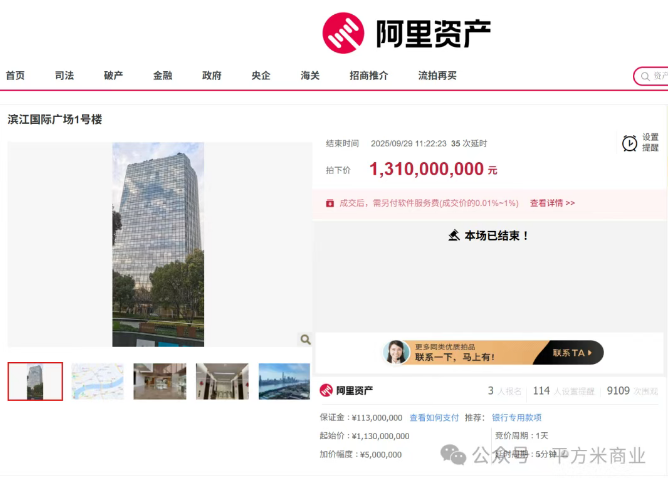
知名房企巨头上海总部大楼被6折甩卖,“坐拥黄浦江一线江景”!公司3年巨亏400亿元,到期未付债务超650亿元,创始人被限制高消费
Mei Ri Jing Ji Xin Wen· 2025-10-07 04:32
Core Viewpoint - The auction of Sunshine City's headquarters building, Binjiang International Plaza, concluded with a final price of 1.31 billion yuan, significantly lower than its initial auction price of 2.1 billion yuan, reflecting the company's ongoing financial struggles and previous failed auction attempts [1][3][5]. Group 1: Auction Details - The starting price for the auction was 1.13 billion yuan, and it went through 37 rounds of bidding before selling for 1.31 billion yuan [1]. - The final sale price was only 60% of the initial auction price, indicating a decline in asset value [3]. - The property had previously been auctioned four times without success, with starting prices of 2.1 billion yuan, 1.981 billion yuan, 1.457 billion yuan, and 1.312 billion yuan [3]. Group 2: Company Background and Financial Issues - Binjiang International Plaza was originally the headquarters of Sunshine City Group, which relocated there in 2017 [5]. - The building was mortgaged as collateral for a debt of 933 million yuan, which Sunshine City was unable to repay, leading to the auction [5][6]. - Sunshine City has been facing severe financial difficulties, with overdue debts exceeding 65 billion yuan as of September 25, 2023, including 2.244 billion USD in offshore bonds and 16.463 billion yuan in domestic bonds [13]. Group 3: Debt and Asset Management - Sunshine City has been actively selling assets to alleviate its debt burden, including shares in Industrial Bank and over 20 other high-quality assets, raising more than 45 billion yuan for debt repayment [7]. - The company's total liabilities exceeded 650 billion yuan, with an asset-liability ratio of 111.68% as of mid-2024 [12][13]. - The company has reported significant losses in recent years, with net profits of -12.55 billion yuan in 2022 and -19.56 billion yuan projected for 2024 [11].
贝森特:美财政部准备买阿根廷美元债,正讨论200亿美元货币互换额度
Hua Er Jie Jian Wen· 2025-09-24 16:45
Core Points - The U.S. Treasury Secretary, Becerra, announced support for Argentina, revealing details of a $20 billion currency swap agreement and plans to purchase Argentine dollar bonds to assist President Milei during a critical election period [1][3] - Following Becerra's announcement, Argentina's financial markets rebounded, with the peso appreciating against the dollar and dollar bonds rising significantly, alleviating liquidity concerns [1] - Analysts believe U.S. financial support will enhance Argentina's chances of returning to the international bond market by early 2026, reducing uncertainties surrounding Milei's economic plan [1][4] Group 1 - The U.S. is negotiating a $20 billion currency swap with Argentina and is prepared to provide significant backup credit through a currency stabilization fund [3] - Becerra emphasized that the U.S. will not allow market volatility to hinder Milei's major economic reforms, indicating confidence in Milei's leadership despite recent market turbulence [3][4] - Argentina's central bank reduced the one-day repo rate by 10 percentage points to 25%, which limited the peso's gains, reflecting a delicate balance between exchange rate stability and inflation pressures [2] Group 2 - The $20 billion swap exceeds the $18 billion swap agreement with the Chinese central bank, highlighting geopolitical considerations in Latin America [5] - Some U.S. economists criticize Washington's support for Milei's economic policies, warning of potential pitfalls similar to those faced by the IMF in the past [6] - Argentina has faced three debt defaults since 2001 and has struggled to comply fully with IMF program requirements, raising concerns about the sustainability of Milei's market interventions [6]
一周债市看点|金科地产发行人重整计划获批并进入执行阶段,时代控股未能偿还到期债务86.87亿元
Xin Lang Cai Jing· 2025-08-31 09:12
Group 1: Jin Ke Real Estate - Jin Ke Real Estate Group announced that its restructuring plan has been approved by the court and has entered the execution phase, with a total of 2.628 billion yuan in restructuring investment funds received [1] - The company reported a significant loss of 31.97 billion yuan in 2024, compared to a loss of 8.732 billion yuan in 2023, representing a year-on-year decline of 266.11% [1] - Jin Ke Real Estate has 98 records of being executed in the past year, with a total amount of 1.256388 billion yuan involved [1] Group 2: Taihe Group - Taihe Group was fined 6 million yuan by the China Securities Regulatory Commission for failing to disclose major lawsuits and significant omissions in its annual report [2] - The company reported an undistributed profit of -32.888 billion yuan as of December 31, 2024, with unmade losses exceeding one-third of the total paid-in capital of 2.4889 billion yuan [2] - The major reasons for the losses include large investment losses due to asset auctions, increased financing costs, and provisions for asset impairment and expected liabilities [2] Group 3: New Light Holdings - New Light Holdings announced that it has completed cash distribution according to the court-approved restructuring plan, involving amounts of 1 billion yuan, 1 billion yuan, and 710 million yuan for its bonds [3] - The restructuring plan for New Light Holdings and 35 other companies has entered the execution phase, with a trust plan established on November 18, 2024 [3] - The company previously applied for bankruptcy in April 2019 [3] Group 4: Times Holdings Group - Times Holdings Group announced that it has failed to repay due debts of 8.687 billion yuan, leading to its inclusion on the list of dishonest executors [4] - The company reported a significant loss of 13.655 billion yuan in 2024, compared to a loss of 3.565 billion yuan in 2023, representing a year-on-year decline of 283.01% [4] - The company is facing a major lawsuit involving the freezing of assets valued at 651.85 million yuan [4] Group 5: ST Dongshi - ST Dongshi announced that its subsidiary's bank account has been frozen with an amount of 292.5 million yuan due to historical legal disputes [5] - The company expects a net loss of between 126 million yuan and 105 million yuan for the first half of 2025, primarily due to declining revenue and high fixed costs [6] - The company reported a continuous loss of 900.3 million yuan in 2024, compared to a loss of 362 million yuan in 2023 [6] Group 6: R&F Properties - R&F Properties expects a net loss of approximately 4.08 billion yuan for the first half of 2025, compared to a net loss of 2.33 billion yuan in the same period last year [6] - The company reported a continuous loss of 15.405 billion yuan in 2024, compared to a loss of 19.95 billion yuan in 2023 [7]
阳光城:截至8月26日,已到期未支付的债务本金合计655.66亿元
Sou Hu Cai Jing· 2025-08-27 04:48
Group 1 - The company has overdue debts totaling 655.66 billion yuan, including 22.44 billion USD in offshore bonds and 164.63 billion yuan in onshore bonds that have not been paid on time [2] - The company is actively coordinating with various parties to raise funds and is discussing multiple solutions to address the debt issues, with support from local governments and financial regulatory agencies [2] - The company has received court execution documents for ongoing cases amounting to 0.36 billion yuan over the past twelve months, and it is considering whether to raise objections based on the execution content [2] Group 2 - The company and its subsidiaries are negotiating matters totaling approximately 176.48 billion yuan with financial institutions or other partners, aiming for a comprehensive resolution [3] - The total amount involved in ongoing court execution documents and negotiations with financial institutions or partners is 544.57 billion yuan, and the company has been listed as a dishonest executor by relevant courts due to these disputes [3]
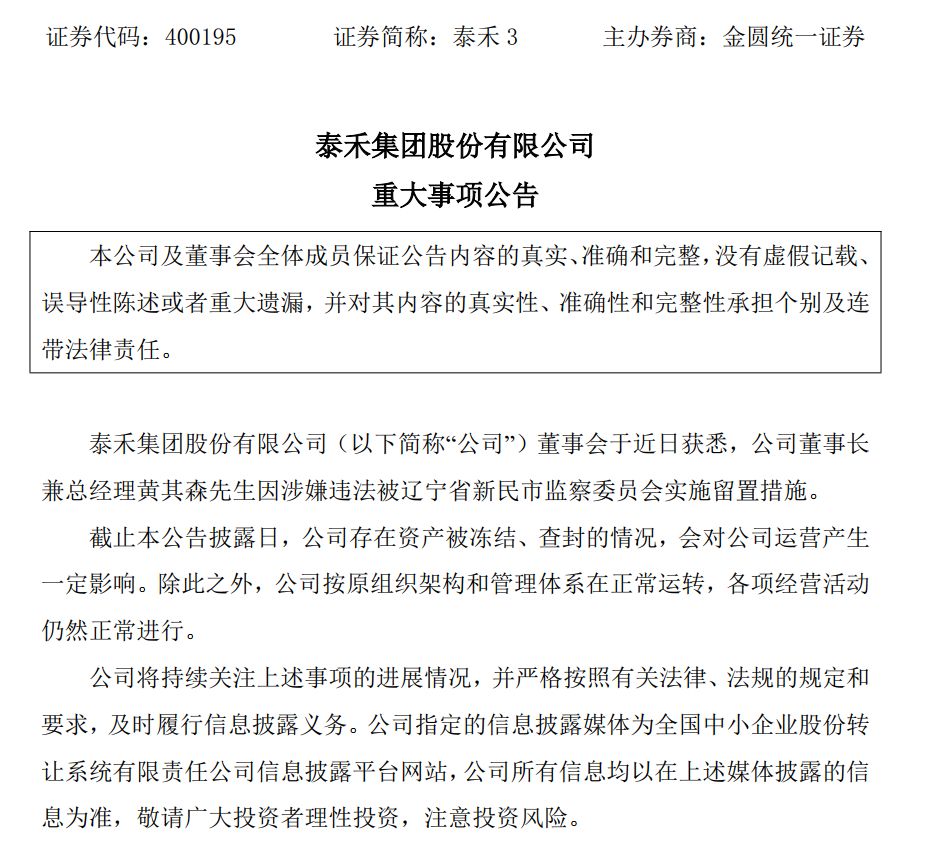
突发!昔日千亿房企泰禾集团董事长黄其森被留置!公司3年年度报告存在重大遗漏,收到千万级罚单
Mei Ri Jing Ji Xin Wen· 2025-08-22 13:48
Core Viewpoint - The chairman of Taihe Group, Huang Qisen, has been placed under detention by the Liaoning Provincial New Min City Supervisory Committee due to suspected illegal activities, which has led to asset freezes and potential operational impacts on the company [1][3]. Group 1: Legal and Regulatory Issues - Taihe Group has received an administrative penalty decision from the Fujian Regulatory Bureau of the China Securities Regulatory Commission (CSRC) for violations related to information disclosure [3][5]. - The company failed to disclose significant lawsuits from July 6, 2020, to December 13, 2022, with a total claim amount of 967.37 million yuan, accounting for 48.21% of the company's audited net assets in 2020 [3][4]. - The company did not disclose 22 lawsuits in its annual reports for 2020, 2021, and 2022, violating multiple provisions of the Securities Law [5][6]. Group 2: Financial Penalties - The Fujian Regulatory Bureau imposed a total fine of 6 million yuan on Taihe Group and issued warnings to several executives, including Huang Qisen, who received a fine of 3 million yuan [6][7]. - Other executives, including the former financial director and supervisors, received fines ranging from 80,000 to 250,000 yuan for their roles in the violations [6][7]. Group 3: Company Background and Performance - Taihe Group, established in 1996 and listed in 2010, is a prominent player in residential and commercial real estate development, particularly in Fujian Province [7]. - The company experienced rapid growth, achieving over 100 billion yuan in sales within five years from 2013 to 2017, and was recognized as one of the top 20 real estate companies in China [7][8]. - However, the company faced financial difficulties starting in 2020, culminating in a debt default when it failed to repay a medium-term note [8][9]. Group 4: Stock Market Impact - On July 28, 2023, the Shenzhen Stock Exchange announced the termination of Taihe Group's stock listing due to its stock price falling below 1 yuan for 20 consecutive trading days [9].
中国玻璃(03300.HK)违反借贷协议
Ge Long Hui· 2025-08-20 13:05
Core Viewpoint - China Glass (03300.HK) is facing potential default on a loan agreement due to weak demand for construction glass products, which has negatively impacted accounts receivable and cash flow [1] Financing Agreement - On July 8, 2022, the company entered into a financing agreement with a syndicate of lenders represented by Standard Chartered Bank (Hong Kong) [1] - The financing is secured by the company's accounts and has an outstanding principal of 141.7 million USD, due on August 15, 2025 [1] Default Risk - The company is unable to fulfill its repayment obligations by the due date due to the ongoing downturn in the real estate sector, leading to a breach of the financing agreement [1] - This default could have negative implications for the company's operations [1] Mitigation Efforts - The company is actively seeking professional advice to address the current situation and is in discussions with financial advisors and potential financing sources to raise funds for repayment [1] - The board is exploring various options to resolve, extend, or restructure the existing bank financing and is in ongoing negotiations with lenders [1] - An emergency plan is being developed to ensure the company's debt repayment capability remains intact in case refinancing is not completed in a timely manner [1]
“白武士”输血拯救未果 华南城“清盘”背后的困局
Xin Jing Bao· 2025-08-19 14:21
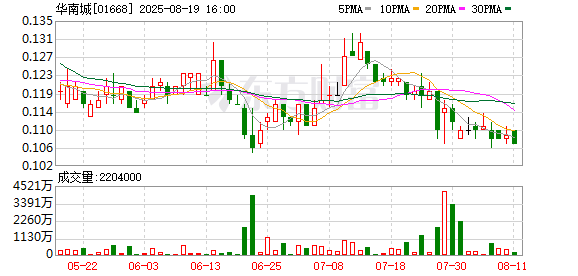
Core Viewpoint - The recent court-ordered liquidation of South China City Holdings Limited marks another significant event in the ongoing debt crisis affecting major developers in Hong Kong, following the case of Evergrande. Despite attempts at restructuring and support from a state-owned enterprise, the company was unable to avert liquidation due to insufficient creditor support and a lack of viable debt restructuring proposals [2][3][6]. Group 1: Company Background and Financial Status - South China City primarily engaged in the development and operation of large-scale logistics and trade centers, expanding rapidly across several cities in China after its successful IPO in 2009 [3]. - At its peak, the company's market capitalization reached 30 billion HKD, but by the time of its suspension, it had plummeted to just 1.22 billion HKD, representing a decline of over 90% [2]. - As of the end of 2024, South China City reported total interest-bearing debt of 30.22 billion HKD, with cash and bank deposits amounting to only 717.7 million HKD, indicating severe liquidity issues [4]. Group 2: Debt Crisis and Attempts at Restructuring - The debt crisis for South China City began in 2022, leading to the introduction of a state-owned major shareholder, Shenzhen Special Zone Construction Development Group, which attempted to provide financial support [6][7]. - Despite multiple capital injections and restructuring efforts, including a 60 billion HKD loan agreement with major banks, the company still faced a default announcement in February 2024 [7][8]. - The company failed to reach an agreement with bondholders regarding a restructuring plan, culminating in a court-ordered liquidation on August 11, 2024 [3][9]. Group 3: Implications for Stakeholders - The involvement of the state-owned enterprise, while initially seen as a lifeline, ultimately led to legal repercussions for the major shareholder, which faced a lawsuit for breach of obligations under a "standstill agreement" [9]. - The financial losses incurred by the major shareholder were significant, with reported losses of 1.09 billion HKD and a substantial impairment provision of 3.78 billion HKD, reflecting the broader impact of South China City's liquidation on its stakeholders [9].
“港资房企”路劲4.35亿美元债违约,暂停支付所有离岸债务 | 快讯
Hua Xia Shi Bao· 2025-08-15 04:12
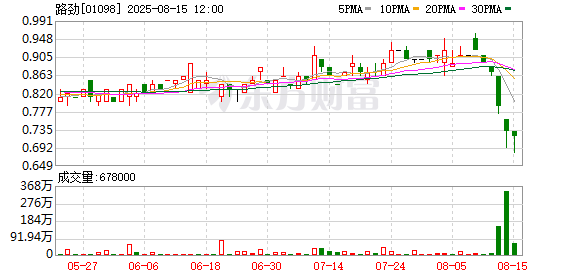
Core Viewpoint - The company, Road King Infrastructure Limited, has announced a suspension of payments on all offshore bank debts, notes, and perpetual securities, indicating a significant financial distress situation [2][3]. Group 1: Debt Situation - As of the announcement, the total offshore debt of the company is approximately $1.51 billion, with unpaid interest totaling around $22.62 million [2]. - The company holds perpetual bonds amounting to about $890.5 million and deferred distributions of approximately $56.46 million [2]. - The default is not an unexpected event, as the company's offshore bonds had already matured on July 12, 2025, and it has a 30-day grace period following the default [2]. Group 2: Debt Restructuring - The recent default marks a new default after the company's debt extension, where it had previously announced the successful tender of five dollar bonds totaling approximately $49.6 million [3]. - The company has initiated a comprehensive restructuring process, emphasizing fair treatment of creditors and adherence to international and Hong Kong debt handling standards [3]. - The restructuring plan prioritizes using proceeds from the sale of specified assets to cover restructuring costs rather than for forced redemption of notes or perpetual securities [3].
港资房企路劲宣布债务违约,“香港公路王”为何走到悬崖边缘?
Feng Huang Wang· 2025-08-14 11:34
Core Viewpoint - The announcement of a suspension of offshore debt payments by Kwan Hung Infrastructure marks a significant default for the company, reflecting the ongoing challenges in the real estate market and the company's inability to adapt its business model to the changing environment [1][2][6]. Group 1: Company Overview - Kwan Hung Infrastructure, established 31 years ago, has been a prominent player in the Hong Kong real estate market, previously known as the "King of Highways" due to its extensive highway investments [2][10]. - The company has faced a decline in sales and cash flow, with reported sales figures dropping from 42.02 billion HKD in 2022 to 12.46 billion HKD in 2024, representing a decrease of 19.9%, 34.2%, and 55% respectively [11]. Group 2: Debt Situation - The total offshore debt of Kwan Hung is approximately 1.51 billion USD, with unpaid interest of about 22.62 million USD and additional perpetual securities amounting to 890.5 million USD [2][11]. - The company has been unable to meet its debt obligations, leading to a formal declaration of default on August 14, after failing to secure necessary agreements from bondholders for a proposed debt restructuring plan [6][12]. Group 3: Market Conditions - The real estate market has been under significant pressure, with over 70 companies experiencing debt defaults, indicating a broader industry crisis [2][7]. - Kwan Hung attributes its default to weak sales, financing difficulties, and obstacles in asset disposal, particularly the sale of its Indonesian toll road assets, which were expected to be a key source of funds for debt repayment [7][8]. Group 4: Future Actions - Following the default, Kwan Hung plans to initiate a comprehensive debt restructuring process, which will involve forming a creditor group, conducting due diligence, and evaluating potential solutions, including asset sales [13][14]. - The company aims to maintain operational stability and continue efforts to sell its Indonesian toll road assets, which are valued at over 5 billion USD and could cover its offshore debt [8][13].