全体人民共同富裕

Search documents
新思想引领新征程丨深入推进城乡融合发展 促进城乡共同繁荣
Yang Guang Wang· 2025-12-29 10:36
Group 1 - The core viewpoint emphasizes the integration of new urbanization and comprehensive rural revitalization to promote a new pattern of urban-rural integration and development [1][2] - Since the "14th Five-Year Plan," various regions have been planning and implementing urban and rural development as a whole, ensuring that urban and rural residents share a high-quality life [1][3] - The urbanization rate of the resident population has increased to 67%, and the income ratio between urban and rural residents has decreased from 2.56:1 in 2020 to 2.34:1 in 2024 [3] Group 2 - The government is accelerating the application of new information technologies such as 5G and big data in rural areas, optimizing the allocation of land and talent resources [2] - In Guangdong, the "Hundred Counties, Thousand Towns, and Ten Thousand Villages High-Quality Development Project" has led to GDP growth in 57 counties exceeding the provincial average for two consecutive years [3] - Nationwide, the rural water supply coverage has reached 94%, and the average reliability of rural power supply is 99.9% [3][4]
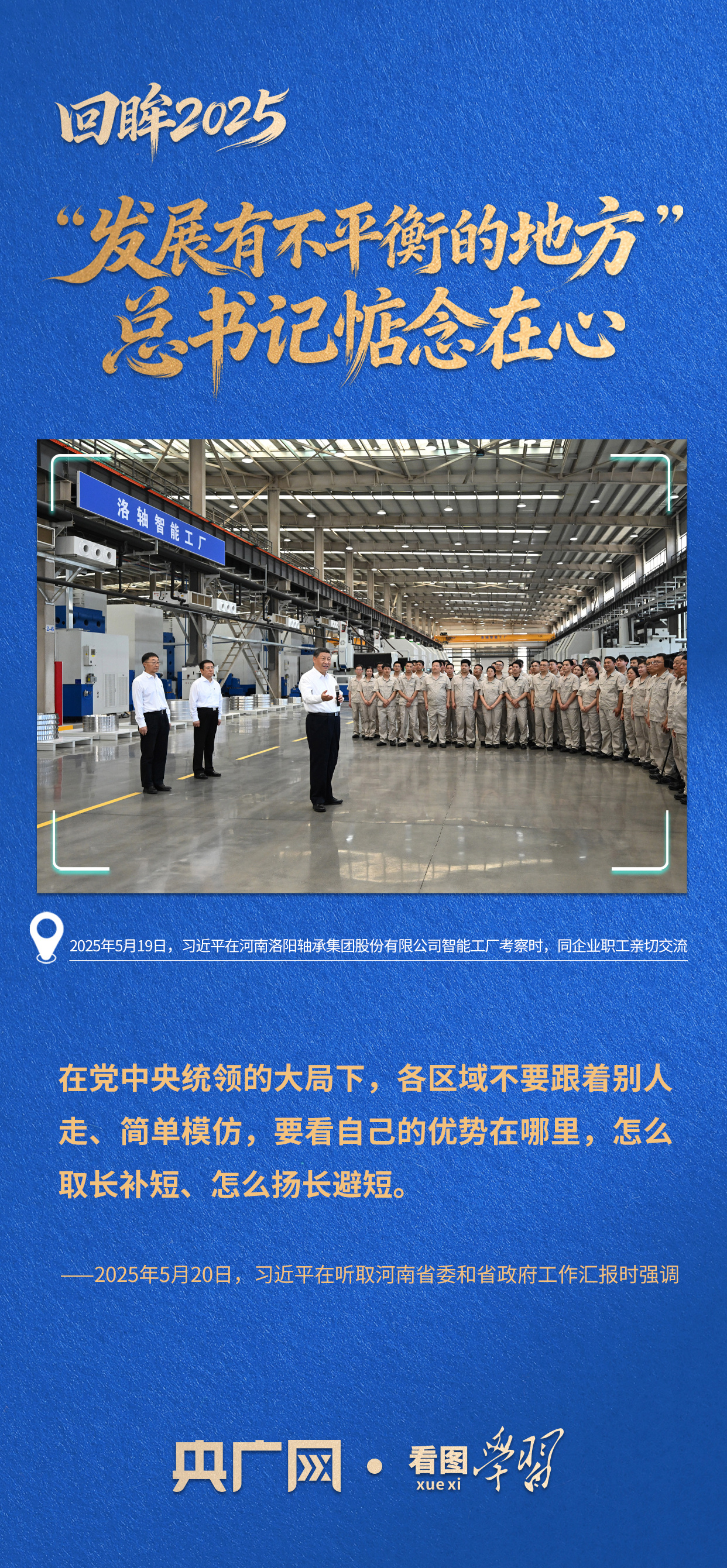
看图学习·回眸2025丨“发展有不平衡的地方” 总书记一直惦念在心
Yang Guang Wang· 2025-12-26 00:38
Core Viewpoint - The article emphasizes the importance of coordinated regional development in Guangdong, highlighting the need to address imbalances in growth across different areas of the province, as articulated by General Secretary Xi Jinping during his visits to various locations [1][5]. Group 1: Regional Development Initiatives - Guangdong has been implementing tailored development strategies to promote regional coordination, with specific examples including Meizhou's focus on the pomelo industry and Shantou's emphasis on the textile and apparel sector [1]. - The "Hundred Million Project" and "Thousand Project" initiatives are driving urban and rural transformation in Guangdong, focusing on county-level development and rural revitalization [9]. Group 2: National Development Goals - The central economic work conference has identified "coordinated development" and "promoting urban-rural integration and regional linkage" as key tasks for the upcoming year, aligning with the broader goal of achieving common prosperity for all [9]. - The article outlines a clear path for reducing urban-rural, regional, and income disparities as a primary focus for achieving common prosperity in a nation with over 1.4 billion people [8][9].

对话张军:中国经济下一程,钱会更多投向这些领域
Guan Cha Zhe Wang· 2025-12-24 11:05
Core Viewpoint - The article emphasizes the shift in China's economic focus from "investment in physical capital" to "investment in human capital" as a response to the changing economic landscape and the need for improved social welfare and equity [1][3][5]. Group 1: Economic Development and Human Investment - Over the past four decades, China has achieved remarkable economic growth through substantial investments in physical infrastructure, leading to a comprehensive industrial system [1]. - The current economic stage necessitates a focus on "investment in people," which aims to enhance wages, employment, education, healthcare, housing, and pensions [1][3]. - The emphasis on human development reflects a recognition that economic growth alone is insufficient to address disparities in income and wealth among different social groups [5][6]. Group 2: Transition from Physical to Human Capital - Fixed asset investment in China has reached 50 trillion yuan, indicating that the previous model of heavy investment in physical capital is experiencing diminishing returns [6][8]. - As the growth rate of fixed asset investment declines, there is a clear shift towards allocating resources to improve human conditions, which is seen as a long-term investment in human capital [8]. - The balance between material capital accumulation and human capital development is crucial, with the latter gaining priority as the economy matures and capital accumulation levels are already high [8].
促进高质量充分就业 健全社会保障体系——访人力资源社会保障部党组书记、部长王晓萍(权威访谈·学习贯彻党的二十届四中全会精神)
Ren Min Ri Bao· 2025-12-19 22:09
Core Viewpoint - The article emphasizes the importance of employment as a fundamental aspect of people's livelihoods and its critical role in economic and social development, highlighting strategic deployments for promoting high-quality and sufficient employment as well as improving the social security system during the 14th Five-Year Plan period [1][2]. Employment Strategy - The employment landscape during the 14th Five-Year Plan period is characterized by both strategic opportunities and challenges, with a complex development environment. The government aims to enhance policy support, service supply, group assistance, and rights protection to effectively improve employment quality and achieve reasonable growth in employment quantity [2][3]. - The government will implement an employment-first strategy, integrating high-quality employment into national economic and social development planning, and promoting new growth drivers in digital, green, and silver economies [3][4]. Structural Employment Issues - There is a need to address structural employment contradictions by establishing a human resource demand forecasting mechanism and aligning training programs with industry needs. The government will focus on skill training in key sectors such as elderly care, advanced manufacturing, and modern services [3][4]. Targeted Employment Policies - The government will implement differentiated policies to promote employment for key groups, including youth, migrant workers, and those facing employment difficulties, ensuring dynamic support for zero-employment families [3][4]. Fair Employment Environment - A unified and standardized human resources market system will be established to eliminate barriers affecting labor mobility and ensure equal employment rights for workers [4]. Social Security System Optimization - The goal of optimizing and making the social security system more sustainable is to enhance public confidence in social welfare. This involves addressing shortcomings in various areas and ensuring the long-term stability of the social security system [5][6]. - The government will accelerate the development of a multi-tiered pension insurance system and improve the mechanisms for determining and adjusting benefits, with a focus on low-income groups [6][7]. Investment in Human Resources - The government will prioritize investment in human resources by enhancing talent development and training mechanisms, particularly for young scientific and technological talents, and implementing large-scale vocational skills training initiatives [8][9]. - Efforts will be made to improve the matching efficiency of human resources supply and demand, with a focus on creating a national employment information resource database and public service platform [10].
新华社评论员:努力为人民群众多办实事
Xin Lang Cai Jing· 2025-12-19 14:22
转自:北京日报客户端 来源:新华社 中央经济工作会议明确提出,坚持民生为大,努力为人民群众多办实事。学习贯彻中央经济工作会议精 神,做好明年经济工作,要坚持以人民为中心的发展思想,围绕不断增进民生福祉,加大保障和改善民 生力度,不断满足人民对美好生活的向往。 让人民生活幸福是"国之大者"。党的十八大以来,以习近平同志为核心的党中央坚持不忘初心,站在人 民立场上考虑问题,把人民对美好生活的向往作为奋斗目标,以"民之所忧,我必念之;民之所盼,我 必行之"的信念扎实做好民生工作,不断把为人民造福事业推向前进。"十四五"时期,每年城镇新增就 业稳定在1200万人以上,居民收入增长与经济增长基本同步,全球规模最大的教育、医疗和社会保障体 系持续巩固,人民群众获得感、幸福感、安全感持续增强,全体人民共同富裕稳步推进。实践告诉我 们,坚持发展为了人民、发展依靠人民、发展成果由人民共享,经济社会发展就会拥有最坚实的依托、 最强大的底气、最澎湃的动力。 中国式现代化,民生为大。实现人民对美好生活的向往是中国式现代化的出发点和落脚点。党的二十届 四中全会把"坚持人民至上"作为"十五五"时期经济社会发展必须遵循的原则之一,把"人民 ...
雷海潮:加快建设健康中国
Ren Min Ri Bao· 2025-12-18 00:57
加快建设健康中国(学习贯彻党的二十届四中全会精神) 雷海潮 人民健康是社会主义现代化的重要标志,也是广大人民群众的共同追求。党的二十届四中全会通过的 《中共中央关于制定国民经济和社会发展第十五个五年规划的建议》(以下简称《建议》),作出"加快 建设健康中国"的重大决策部署,对增进人民健康福祉、推进中国式现代化将产生深远影响,要深刻领 会精神实质,准确把握原则要求,认真落实各项任务。 (三)牢牢把握夯实基础、全面发力的阶段要求。从现在到2035年建成健康中国还有10年时间。要抓住卫 生健康服务发展不平衡不充分的主要矛盾,坚持有效市场和有为政府相结合,坚持尽力而为、量力而 行,坚持先立后破、不立不破,不断夯实中国特色基本医疗卫生制度基础,在缩小城乡间、区域间、人 群间服务差距上全面发力,在健全维护公益性的医疗卫生服务体系及其运行保障、监督管理机制上下功 夫,筑牢全方位全周期保障人民生命健康防线。 一、深刻认识加快建设健康中国的重大战略意义 党的十八大以来,习近平总书记就建设健康中国作出一系列重要论述和重要指示批示,为推进健康中国 建设指明了方向,提供了根本遵循。以习近平同志为核心的党中央作出实施健康中国战略部署, ...
加快建设健康中国(学习贯彻党的二十届四中全会精神)
Ren Min Ri Bao· 2025-12-17 22:11
Core Viewpoint - The construction of a healthy China is a significant strategic task that aligns with the modernization goals of socialism and aims to enhance the health and well-being of the population, as outlined in the "Suggestions" from the 20th Central Committee [1][2]. Group 1: Strategic Significance - Accelerating the construction of a healthy China is crucial for the overall strategy of Chinese-style modernization, providing sustainable human support for economic and social development [3]. - It is a major strategic decision related to promoting common prosperity for all people, emphasizing equitable and high-quality healthcare services [3][4]. - The initiative is also vital for gaining strategic advantages in the context of global changes, enhancing public health and biosecurity, and participating in global health governance [4]. Group 2: Overall Requirements - The "15th Five-Year Plan" period is critical for laying the foundation for achieving socialist modernization, requiring alignment with the central government's decisions [5]. - The work must adhere to principles of innovation and public welfare, ensuring that healthcare services are equitable and accessible [5][6]. - Emphasis on a coordinated approach is necessary to balance various relationships, including government and market dynamics, efficiency and equity, and domestic and international considerations [6]. Group 3: Key Tasks - The goal is to increase the average life expectancy of residents to around 80 years by 2030, with major health indicators reaching high-income country levels [8]. - Strengthening public health capabilities is essential, including improving disease monitoring, emergency response, and healthcare integration [9]. - Reforming public hospitals with a focus on public welfare and enhancing the quality of medical services is a priority [10]. - Developing a comprehensive service system for chronic disease prevention and management is crucial, particularly for major chronic diseases [12]. - Promoting traditional Chinese medicine alongside modern healthcare practices is part of the strategy to enhance healthcare diversity [13]. - Improving population health services and supporting family planning and child-rearing initiatives are necessary for high-quality population development [14]. - Enhancing the capabilities and ethical standards of the healthcare workforce is vital for improving service delivery and patient care [15].
关于《中共江苏省委关于制定江苏省国民经济和社会发展第十五个五年规划的建议》的说明
Xin Hua Ri Bao· 2025-12-10 23:15
Group 1 - The core viewpoint of the article emphasizes the importance of the Jiangsu Provincial Party Committee's suggestions for the 15th Five-Year Plan, highlighting the need for comprehensive planning and strategic deployment for economic and social development in Jiangsu [1][5][8] - The drafting process of the suggestions involved extensive research, public consultation, and feedback collection, resulting in nearly 15,000 opinions and suggestions that informed the final document [2][3][4] - The suggestions are guided by Xi Jinping's thoughts on socialism with Chinese characteristics and aim to align with the spirit of the 20th National Congress of the Communist Party, focusing on Jiangsu's strategic positioning and responsibilities in national development [3][5][6] Group 2 - The suggestions outline a systematic approach to economic and social development, addressing opportunities and challenges while emphasizing the importance of problem-oriented and goal-oriented strategies [5][6][7] - The document is structured into three main sections: an overview of achievements and challenges, detailed strategic tasks across various sectors, and concluding remarks on governance and leadership [7][8] - Key development goals include enhancing productivity, increasing domestic demand, and ensuring synchronized growth of income and economy, with a focus on achieving common prosperity for all citizens [9][12][13] Group 3 - The suggestions stress the importance of green development and the establishment of new productive forces, aiming to integrate ecological sustainability into economic growth [11][12] - There is a strong emphasis on the need for safety and risk management, particularly in light of increasing uncertainties in the coming years, with specific measures proposed to enhance public safety and governance [13][14] - The document underscores the necessity of maintaining the Party's leadership as a fundamental guarantee for advancing modernization, with a focus on strengthening grassroots governance and party organization [14]
署名文章 | 深入学习贯彻党的二十届四中全会精神 以高质量发展新成效谱写中国式现代化新篇章
国家能源局· 2025-12-04 03:51
Core Viewpoint - The article emphasizes the importance of the "15th Five-Year Plan" in promoting China's economic and social development, building a solid foundation for achieving socialist modernization, and ensuring high-quality development in the coming years [3][4]. Group 1: Achievements of the "14th Five-Year Plan" - The "14th Five-Year Plan" has led to significant achievements, with an average economic growth rate of 5.5% over the first four years, contributing approximately 30% to global economic growth [5]. - The total economic output is expected to reach around 140 trillion yuan this year, with high-tech manufacturing value-added growing at an annual rate of 9.2% [5]. - The plan has also seen improvements in employment, with over 12 million new urban jobs created annually, and a 5.5% annual increase in per capita disposable income [5]. Group 2: Development Environment for the "15th Five-Year Plan" - The "15th Five-Year Plan" will face complex changes in the development environment, including strategic opportunities and risks, necessitating a focus on consolidating advantages and addressing weaknesses [6][8]. - The global landscape is characterized by intensified great power competition, rising unilateralism, and challenges to international economic order, while economic globalization remains an unstoppable trend [7]. - China's economic foundation is strong, with significant market potential and a complete industrial system, although challenges such as unbalanced development and risks in key areas persist [8]. Group 3: Strategic Tasks for the "15th Five-Year Plan" - The article outlines key strategic tasks for the "15th Five-Year Plan," including promoting high-quality development, constructing a new development pattern, and advancing common prosperity [9][10]. - Emphasis is placed on building a modern industrial system, enhancing traditional industries, and fostering emerging sectors such as new energy and aerospace [10]. - The plan aims to strengthen domestic circulation while ensuring effective integration with international markets, enhancing the socialist market economy, and expanding high-level opening-up [11]. Group 4: Improving People's Livelihoods - The article stresses the importance of improving and safeguarding people's livelihoods, with a focus on increasing income distribution equity and enhancing social welfare systems [12]. - It highlights the need to address rural revitalization and regional development disparities, ensuring that agricultural productivity and quality are prioritized [12]. Group 5: National Security and Governance - Strengthening national security capabilities is a priority, focusing on food and energy security, risk management in key sectors, and enhancing public safety governance [13]. - The article advocates for a comprehensive approach to governance that aligns with the principles of socialism with Chinese characteristics [13]. Group 6: Leadership and Implementation - The article calls for strong leadership and active participation from all sectors of society in implementing the "15th Five-Year Plan," ensuring that the strategic goals are translated into actionable plans [14]. - It emphasizes the need for detailed planning and coordination to ensure the successful execution of the plan and the achievement of modernization goals [14].

郑栅洁:提高居民收入在国民收入分配中的比重
财联社· 2025-12-02 09:15
Core Viewpoint - The article emphasizes the importance of high-quality development and the implementation of the "15th Five-Year Plan" to achieve socialist modernization in China, focusing on improving people's livelihoods and promoting common prosperity [2][3][4]. Group 1: Achievements of the "14th Five-Year Plan" - The "14th Five-Year Plan" has laid a solid foundation for the "15th Five-Year Plan," with significant achievements in economic strength, technological advancement, and overall national power [4][5]. - The average economic growth rate during the first four years of the "14th Five-Year Plan" reached 5.5%, contributing approximately 30% to global economic growth [5]. - The manufacturing sector's added value exceeded 30 trillion yuan, with high-tech manufacturing growing at an annual rate of 9.2% [5]. Group 2: Development Environment for the "15th Five-Year Plan" - The "15th Five-Year Plan" period is characterized by both strategic opportunities and challenges, necessitating a focus on consolidating advantages and addressing weaknesses [6][7]. - China's economic foundation remains strong, with significant market potential and a complete industrial system, although challenges such as unbalanced development and risks in key areas persist [8]. Group 3: Strategic Tasks for the "15th Five-Year Plan" - The article outlines key strategic tasks, including promoting high-quality development, enhancing domestic and international dual circulation, and ensuring the well-being of all citizens [9][10][11]. - Emphasis is placed on building a modern industrial system, fostering innovation, and achieving green transformation in economic development [10][12]. Group 4: Enhancing People's Livelihoods - The article stresses the need to improve and guarantee people's livelihoods, with a focus on employment, income distribution, and social security systems [12]. - It highlights the importance of rural revitalization and regional coordinated development to address disparities between urban and rural areas [12]. Group 5: National Security and Governance - Strengthening national security capabilities and improving public safety governance are critical components of the development strategy [13]. - The article calls for a comprehensive approach to risk management in key sectors, including real estate and local government debt [13].