
唐罗主义

Search documents
新华网国际看点|美新一届政府执政近一年,给世界带来了什么?
Xin Hua She· 2026-01-15 13:52
Core Viewpoint - The new U.S. government has intensified political polarization and governance disorder, prioritizing "America First" over international norms, leading to global instability and uncertainty [2][3]. Foreign Policy - The U.S. government has adopted extreme unilateralism and alliance restructuring, withdrawing from international agreements like the Paris Accord and the WHO, resulting in fragmented global governance [2][3]. - The U.S. is implementing "Monroe Doctrine 2.0," threatening Latin American countries with military intervention while attempting to undermine China-Russia cooperation [3][4]. - The U.S. is pushing for "de-globalization" and "friend-shoring," causing disruptions in global supply chains and increasing logistics and production costs, which ultimately burden American consumers [3][4]. - The new national security strategy emphasizes a transactional approach to alliances, requiring allies to share defense responsibilities and aligning them with U.S. economic and security interests [4][5]. Economic Policy - The U.S. government has enacted significant tax cuts and expanded oil and gas production, projected to increase the deficit by $3.3 trillion over the next decade [3][4]. - Tariff policies have created high uncertainty, leading to negative impacts on global supply chains and market volatility [4][5]. Military Strategy - The U.S. military strategy is characterized by a withdrawal from regions like the Middle East and Europe, focusing resources on the Western Hemisphere and the Indo-Pacific, which may exacerbate local tensions [3][4]. Domestic Policy - The government has initiated drastic administrative reforms, including significant layoffs and budget cuts in various federal agencies, leading to a historic government shutdown and declining public trust [8][9]. - Immigration policies have become more extreme, resulting in the largest-scale deportations in U.S. history, which may negatively impact labor supply and GDP [8][9]. - Social and educational policies have intensified divisions between "red" and "blue" states, exacerbating cultural conflicts [9][10]. Overall Governance Characteristics - The governance style of the U.S. government is described as "bulldozer governance," marked by extreme unilateralism, strong administrative control, economic bullying, strategic contraction, and populist governance [12][13]. - The government acknowledges the end of the unipolar era and is shifting towards a new isolationist realism, focusing on maintaining dominance in the Western Hemisphere and the Indo-Pacific [13][14]. Future Policy Directions - In 2026, the U.S. is expected to prioritize national security in domestic policies, emphasizing "Western Hemisphere first" and using economic tools as leverage in trade negotiations [14][15]. - The government aims to control resources and political security in the Western Hemisphere, potentially leading to increased tensions with regional countries [15][16].


国泰海通|策略:美国对委特别行动,伊朗局势悄然生变
国泰海通证券研究· 2026-01-15 12:07
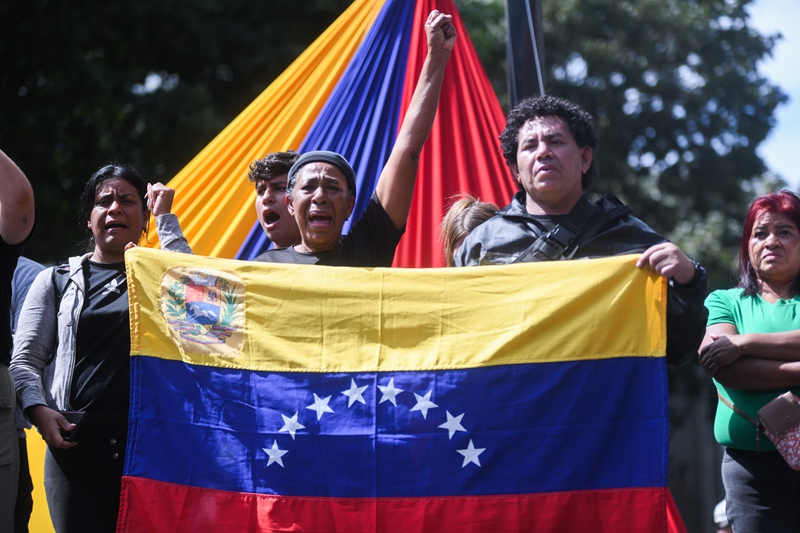
Global Geopolitical Developments - Venezuelan President Maduro was captured by U.S. Delta Force on January 5, 2026, and appeared in court in New York [1] - Protests and unrest have erupted in Iran since December 28, 2025, due to rising prices and currency devaluation, resulting in casualties among security personnel and civilians [1] - The changes in regions like Syria, Venezuela, and Iran are attributed to a "vacuum of influence" in Russia's traditional sphere amid the Ukraine conflict [1] Domestic Economic and Industrial Policies - On January 6, 2026, the Ministry of Commerce announced a ban on the export of dual-use items to Japanese military users, including rare earth elements [2] - On January 7, 2026, the Ministry of Industry and Information Technology and eight other departments issued a notice on the implementation of the "AI + Manufacturing" special action plan [2] - On January 9, 2026, the National Medical Products Administration published a plan for two recommended industry standards for medical devices using brain-computer interface technology [2] - On January 10, 2026, the Radio Innovation Institute submitted an application for an additional 203,000 satellites to the International Telecommunication Union, with over 190,000 from this new institution [2] Capital Market Dynamics - On December 29, 2025, the China Banking and Insurance Asset Management Association released a guide for data classification and grading in the insurance asset management industry [3] - On December 31, 2025, the Financial Supervisory Authority introduced the "Commercial Bank M&A Loan Management Measures," while the China Securities Association released two self-regulatory rules for commercial real estate REITs [3] - On January 5, 2026, the China Securities Index Company launched 15 new comprehensive bond indices covering core domestic bond varieties, enhancing market index tools [3] Global Geopolitical and Economic Tracking - The U.S. has been increasingly taking military actions and threats against several countries, including the capture of Maduro and threats against Colombia and Mexico [4] - The Federal Reserve's expectations for a rate cut in January have cooled, with ADP data showing a private sector job increase of 41,000 in December, reversing the previous month's decline [4] - As of January 3, 2026, initial jobless claims in the U.S. were reported at 208,000, slightly below expectations, indicating resilience in the labor market [4]

美新一届政府执政近一年,给世界带来了什么?
Xin Hua Wang· 2026-01-15 09:28
Core Viewpoint - The new U.S. government has intensified political polarization and governance disorder, prioritizing "America First" over international norms, leading to global instability and uncertainty [1] Foreign Policy - The U.S. government has adopted extreme unilateralism and alliance restructuring, withdrawing from international agreements like the Paris Accord and the WHO, resulting in fragmented global governance [2][3] - The implementation of "Monroe Doctrine 2.0" or "Tangro Doctrine" involves military interventions in Latin America while attempting to undermine China-Russia cooperation [2][4] - The U.S. has emphasized transactional relationships with allies, demanding greater defense responsibilities and linking economic and security issues [3][11] Economic Policy - The U.S. continues to enforce hegemonic interventions and tariffs, causing supply chain disruptions and increased costs for consumers, which are expected to lead to a $3.3 trillion deficit over the next decade [2][3] - The government's focus on "de-globalization" and "friend-shoring" has resulted in localized supply chain paralysis and rising logistics costs [2][3] Military Strategy - The U.S. military strategy shows a trend of strategic contraction, reallocating resources from the Middle East and Europe to focus on the Western Hemisphere and the Indo-Pacific [2][3] - The new national security strategy prioritizes the Western Hemisphere, indicating a shift in military focus and potential reallocation of U.S. military resources [3][12] Domestic Policy - The government has implemented drastic administrative reforms, including significant layoffs and budget cuts, leading to a historic government shutdown and a decline in public trust [7][8] - Immigration policies have become more extreme, resulting in the largest-scale deportations in U.S. history, which may negatively impact GDP by 1-4.9% due to labor shortages [7][8] - The administration's approach to education and social issues has exacerbated divisions between "red" and "blue" states, leading to increased cultural conflicts [7][9] Overall Governance Characteristics - The governance style is characterized as "bulldozer-style," marked by extreme unilateralism, strong administrative control, economic bullying, strategic contraction, and populist governance [11][16] - The U.S. government acknowledges the end of the unipolar era and is shifting towards a new isolationist realism, focusing on protecting its core interests while viewing China as a primary competitor [11][16]
王辉耀谈“唐罗主义”:专家称美国在下一盘更大的棋
Xin Lang Cai Jing· 2026-01-14 14:28
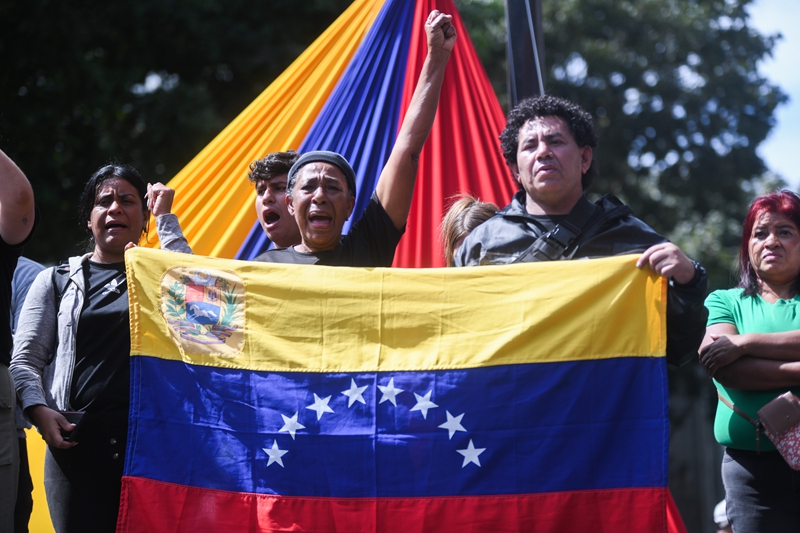
Core Viewpoint - The concept of "Tang-Luoism" introduced by Trump signifies a strategic shift in the U.S. towards establishing a "United States of the Western Hemisphere," moving away from previous focuses on Asia and the Middle East [1] Group 1 - The U.S. strategy is evolving beyond merely re-engaging with Asia and the Middle East, indicating a broader geopolitical ambition [1] - There is a growing international opposition to U.S. strategies, suggesting a potential backlash against American influence [1] - The descendants of Spanish and South American heritage in the U.S. may play a role in supporting Trump's vision, indicating a demographic factor in U.S. politics [1]
新华网国际看点丨美新一届政府执政近一年,给世界带来了什么?
Xin Hua She· 2026-01-14 14:27
Core Viewpoint - The new U.S. government has intensified political polarization and governance disorder, prioritizing "America First" over international norms, leading to global instability and uncertainty [1][12]. Foreign Policy - The U.S. government has adopted extreme unilateralism and alliance restructuring, withdrawing from international agreements like the Paris Accord and the WHO, resulting in fragmented global governance [1][2]. - The implementation of "Monroe Doctrine 2.0" or "Tangro Doctrine" involves military interventions in Latin America while attempting to undermine China-Russia cooperation [2][4]. - The U.S. has emphasized transactional relationships with allies, demanding greater defense responsibilities and linking economic and security issues [3][12]. Economic Policy - The U.S. continues to impose tariffs and engage in hegemonic interventions, causing supply chain disruptions and increased costs for consumers, which are expected to lead to a $3.3 trillion deficit over the next decade [2][12]. - The government's focus on "de-globalization" and "friend-shoring" has resulted in local supply chain paralysis and rising logistics and production costs [2][12]. Military Strategy - The U.S. military strategy shows a trend of strategic contraction, reallocating resources from the Middle East and Europe to focus on the Western Hemisphere and the Indo-Pacific, exacerbating local tensions [2][3]. Domestic Policy - The government has implemented drastic administrative reforms, including significant layoffs and budget cuts, leading to a historic government shutdown and a decline in public trust [8][9]. - Immigration policies have become more extreme, resulting in the largest-scale deportations in history, which may shrink U.S. GDP by 1-4.9% due to labor shortages [8][9]. - Social and educational policies have intensified divisions, particularly between "red" and "blue" states, exacerbating cultural conflicts [8][10]. Overall Assessment - The global perception of the U.S. government is largely negative, with significant concerns over unpredictability, retreat from multilateral cooperation, and the transactional nature of alliances [5][6][12].
“唐罗主义”推升全球地缘政治风险 面对动荡时局应如何布仓
Xin Lang Cai Jing· 2026-01-14 12:31
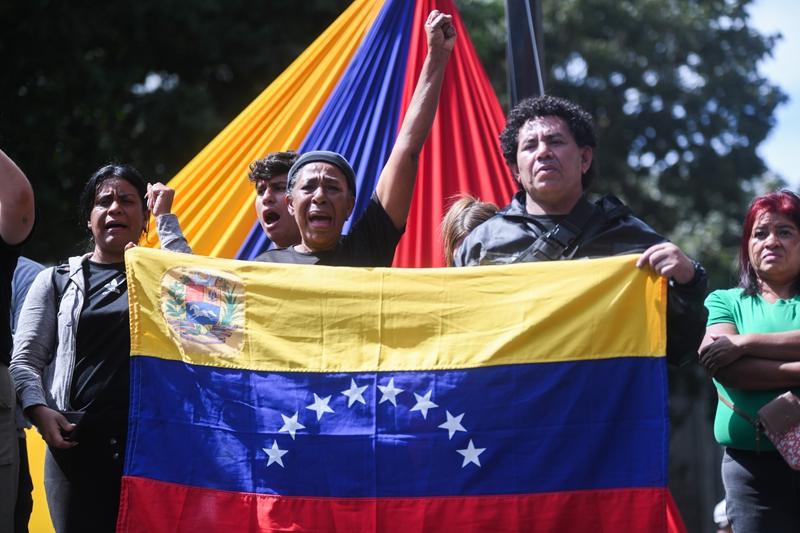
Geopolitical Risks and Market Impact - The U.S. is experiencing a shift towards "Trumpism," reviving a 200-year-old foreign policy aimed at projecting American dominance, which is causing investors to prepare for increased geopolitical risks in the coming year [1][9] - Trump's unpredictable actions could affect various asset classes, including energy prices and imports of AI chips, as outlined in a recent national security strategy [9][10] - Despite geopolitical tensions, the stock market has shown resilience, with the recent ousting of Venezuela's Nicolás Maduro being a minor event in the context of rising U.S. stock prices [10] Defense Sector - Defense stocks have shown volatility due to Trump's social media posts, but they may provide relative protection in the long term amid potential global conflicts and increased military spending [11] - Defense contractors like L3Harris Technologies Inc. and Huntington Ingalls Industries Inc. have seen stock price increases of 16% and 21% respectively this year [11] - Investment managers suggest that larger defense companies, such as Raytheon and General Dynamics, may be viewed as stable investments in an unstable environment [11] Energy Sector - Following Trump's warnings to Iran, oil prices have risen for four consecutive days, drawing investor attention to potential military actions against the oil-rich nation [14] - The recent rise in oil prices has not significantly changed skepticism regarding the core tenet of "Trumpism," particularly concerning drilling in Venezuela, which ExxonMobil has labeled as "uninvestable" [15] - Refining companies are expected to benefit the most from Trump's actions in Venezuela, as they typically perform better when oil prices are low [15] Materials Sector - The mining and metals sector has seen significant gains, particularly after discussions about potential U.S. military actions to acquire Greenland, which is rich in critical minerals [17] - Companies involved in rare earth minerals and lithium exploration, such as Critical Metals Corp., have experienced stock price surges, with an 84% increase noted [17] - However, there are risks associated with chasing raw material stocks, as market reactions may be influenced by geopolitical tensions, particularly regarding China's potential responses to U.S. actions [17]
地缘风险或成市场动荡导火索 解码美股四大板块危与机
智通财经网· 2026-01-14 12:12
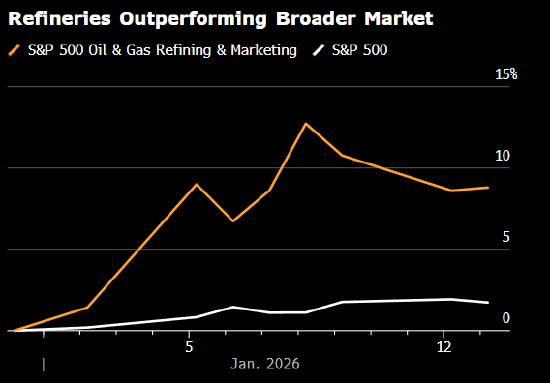
Geopolitical Risks and Market Impact - The revival of the "Donroe Doctrine" by the White House aims to strengthen the U.S. dominance in the Western Hemisphere and beyond, leading investors to prepare for a year of heightened geopolitical risks [1] - The unpredictability of former President Trump's policy shifts could trigger chain reactions across various asset classes, affecting everything from energy prices to core chip imports in the AI industry [1] - Increased military spending calls have driven defense stocks up, while investors are focusing on potential U.S. actions in regions like Greenland, Iran, and Cuba, weighing responses from China and Russia [1] Technology Sector - The U.S. technology sector, particularly companies like Nvidia (16% of revenue from Taiwan), is likely to face significant impacts due to geopolitical tensions surrounding Taiwan [3] - The focus on Taiwan will center on TSMC, which supplies major U.S. tech firms including Apple, Nvidia, and Amazon [3] - Companies with contracts with the Pentagon, such as Palantir Technologies, may benefit from rising geopolitical risks, while Intel's stock has risen over 28% this year as investors buy into U.S. chip manufacturers [3] Defense Sector - U.S. defense stocks, despite recent volatility due to Trump's social media posts, may offer relative protection in the long term as global conflict possibilities increase [4] - Proposed increases in U.S. military spending have led to strong performance in the defense sector, with contractors like L3Harris Technologies and Huntington Ingalls Industries seeing stock price increases of 16% and 21% respectively this year [4] - Major defense stocks like Raytheon Technologies and General Dynamics are viewed as stable investment choices amid geopolitical instability [4] Energy Sector - Oil prices surged following Trump's warning to Iran, raising concerns about potential military actions affecting oil-rich regions [5] - Skepticism remains regarding the viability of drilling in Venezuela, especially after ExxonMobil deemed the country "not investable," which displeased Trump [5] - Refiners are expected to be the biggest beneficiaries in the energy sector, particularly those along the Gulf Coast, as increased heavy crude oil supply is anticipated [5] Materials Sector - The metals and mining sector has seen significant gains, particularly with companies like Critical Metals Corp. experiencing an 84% stock price increase due to discussions about Greenland's mineral assets [6] - Other mining companies, including MP Materials Corp. and USA Rare Earth Inc., have also seen stock price increases amid geopolitical tensions [6] - The rise in gold and silver prices following Maduro's ousting indicates that investors are seeking hedges against anticipated geopolitical turmoil [6]

厄瓜多尔专家:“唐罗主义”加剧全球动荡
Xin Hua She· 2026-01-14 09:44
Group 1 - The core viewpoint of the article highlights that the current U.S. government's "Trumpism" policy reveals characteristics of unilateralism, hegemony, and disregard for international rules, which may exacerbate global turmoil [1] Group 2 - The analysis suggests that the approach of prioritizing power over rules could lead to increased instability in international relations [1]
特朗普关税敲打伊朗,格陵兰岛成美囊中之物,加拿大紧急转向中国
Sou Hu Cai Jing· 2026-01-14 07:19
Group 1: Iran Issue - Trump's announcement of a 25% tariff on countries trading with Iran is a strategic move linked to Iran's recent suppression of protests and potential military intervention by the U.S. [1][3] - The tariff increase from 20% to 45% will significantly impact Chinese export companies, reflecting a broader trend of rising global authoritarianism and geopolitical tensions [3][5] Group 2: Greenland Dispute - The U.S. may consider military action regarding Greenland, which is tied to economic and military interests, and the internal divisions within Western countries on this issue [3][5] - If the U.S. were to control Greenland, it could lead to significant economic benefits and commercial opportunities, particularly in relation to Arctic shipping routes [5] Group 3: Canada-China Relations - Canadian Prime Minister Carney's upcoming visit to China marks a shift in Canada-China relations, influenced by U.S. tariff pressures and threats of U.S. annexation of Canada [5][7] - The evolving relationship between Canada and China reflects a mutual interest in resisting U.S. economic pressures, indicating a potential for increased cooperation [7]
黄金基金ETF(518800)涨超0.7%,近10日净流入超16亿元,地缘政治风险上升推动金价
Mei Ri Jing Ji Xin Wen· 2026-01-14 06:41
Core Viewpoint - The recent rise in geopolitical risks has led to an increase in gold prices, with the gold ETF (518800) rising over 0.7% and a net inflow of over 1.6 billion yuan in the past 10 days [1]. Geopolitical Risks - Multiple regions are experiencing heightened geopolitical risks, which have increased the risk premium for gold [1]. - Investment institutions are engaging in "Donroe trade," anticipating that U.S. international interventions may extend beyond Venezuela to Colombia, Cuba, and Greenland, prompting early trading in related financial products [1]. Gold Price Outlook - In the medium to long term, the central price of gold is expected to rise, suggesting that investors may consider participating in future pullbacks and gradually accumulating positions [1]. - Direct investment in physical gold and tax-exempt gold ETF (518800) are recommended, along with gold stock ETF (517400) that covers the entire gold industry chain [1].