央行降息

Search documents
罕见!美欧日加四大央行“同时开会”
财联社· 2025-10-29 01:14
Core Viewpoint - The simultaneous meetings of major central banks, including the Federal Reserve, are expected to have significant implications for global markets, particularly in terms of monetary policy and economic conditions [1][2]. Group 1: Central Bank Meetings - The Federal Reserve is anticipated to announce a 25 basis point rate cut during its two-day meeting, which concludes at 2 AM Beijing time on Thursday [1]. - The Bank of Canada is also expected to announce a rate decision shortly before the Fed, with similar expectations for a rate cut [3]. - The European Central Bank and the Bank of Japan will hold meetings concurrently, with decisions expected on Thursday [1]. Group 2: Market Implications - The coordinated actions of these central banks could lead to a more accommodative global funding environment, especially with the Fed's involvement, which influences the value of the US dollar [2]. - A weaker dollar could reduce the price competitiveness of US goods overseas, as 54% of global trade invoices are denominated in dollars [2]. Group 3: Economic Conditions - Despite the potential for coordinated rate cuts, there is no clear indication of synchronized economic shifts among the countries involved [2]. - The Fed is expected to cut rates to support a weakening US job market, while the European Central Bank is likely to maintain its current policy stance due to persistent inflation in the services sector [2][4]. - The Bank of Canada faces a challenging decision regarding rate cuts due to strong employment data and stubborn inflation [3]. Group 4: Diverging Priorities - Different central banks are prioritizing various economic issues, with some focusing on economic support and others on inflation control [4]. - The potential for further rate cuts by the Fed, combined with strong corporate earnings, may support risk assets in the market [4].


本周前瞻:央行决议超级周聚焦美联储降息
Sou Hu Cai Jing· 2025-10-27 08:51
Core Viewpoint - This week marks the last week of October, featuring a "super week" of central bank decisions, with the Federal Reserve's interest rate decision being the focal point. Other central banks, including the Bank of Canada, the Bank of Japan, and the European Central Bank, will also announce their rate decisions. A series of important economic data will be released, including GDP figures from the Eurozone and Germany, as well as the U.S. GDP and core PCE price index. The earnings reports from major tech companies such as Microsoft, Meta, Apple, Alphabet, and Amazon will also be significant events that could impact global financial markets [1]. Economic Data and Events Summary - **Monday**: Focus on Germany's IFO Business Climate Index, which may show a second consecutive month of slowdown, indicating further challenges for the German economy. The U.S. will release September durable goods orders data, with investors watching for a continuation of the previous mild growth trend. The Dallas Fed Business Activity Index for October is expected to remain negative, reflecting ongoing low business activity in the region [3]. - **Tuesday**: Attention will be on the U.S. Conference Board Consumer Confidence Index for October, with expectations that it may further decline to around 90, reflecting consumer concerns about the economic outlook. The Richmond Fed Manufacturing Index will also be monitored for signs of continued pressure on U.S. manufacturing [4]. - **Wednesday**: The Bank of Canada will announce its interest rate decision, with a high probability (over 86%) of a 25 basis point cut, bringing the benchmark policy rate down to 2.25%. This follows unexpected inflation rise (September CPI at 2.4%) and warnings from the central bank governor about economic risks [6]. - **Thursday**: The Federal Reserve is expected to announce a 25 basis point rate cut amid a lack of significant economic signals due to the recent government shutdown. The decision is anticipated to create notable market volatility. The Bank of Japan will also announce its rate decision, with new uncertainties introduced by the recent election of Prime Minister Suga. The Eurozone and Germany's Q3 GDP data will be closely watched, with the Eurozone needing to maintain over 1% annual growth to support optimistic economic outlooks [7][9]. - **Friday**: The Eurozone will release CPI data, expected to remain at 2.2%, above the ECB's target. The U.S. core PCE price index for September will also be released, with market attention on whether it remains around 3%. Any unexpected data could lead to market fluctuations [10][11].

【环球财经】加拿大9月通胀高于预期 对加拿大央行降息影响有限
Xin Hua Cai Jing· 2025-10-21 13:45
Group 1 - Canada's inflation rate in September rose to 2.4% year-on-year, exceeding market expectations of 2.3%, driven by narrowing declines in gasoline prices and rising food prices [1] - The core inflation indicator also increased, with September's core CPI rising to 2.8% year-on-year from 2.6% previously, indicating persistent inflationary pressures [1] - The Bank of Canada is expected to maintain a cautious stance ahead of its upcoming interest rate meeting, with the probability of a rate cut in October dropping to 74% from 86% prior to the inflation data release [1] Group 2 - Ongoing trade tensions between the US and Canada prompted the Bank of Canada to lower its policy rate by 25 basis points to 2.5% in September, marking the first rate cut in six months [2] - Analysts suggest that the recent inflation data may have limited impact on the Bank of Canada's decision-making, as the central bank is focused on economic growth and employment risks stemming from tariff policies [2] - Key indicators highlight the weakness in the Canadian economy, including negative sales expectations and high levels of layoff plans, while wage growth expectations have halved from a peak of 5.8% in May 2022 to 3%, the lowest in four years [2]
瑞达期货纯碱玻璃产业日报-20251020
Rui Da Qi Huo· 2025-10-20 09:47
Report Industry Investment Rating No relevant content provided. Core Viewpoints of the Report - For soda ash, supply is expected to be ample, demand to decline, and prices to have limited upside potential. However, if there is an interest - rate cut expectation, prices may rebound slightly. It is recommended to buy soda ash futures contracts on dips in the short - term [2]. - For glass, it is expected to stop falling and stabilize. If the central bank cuts interest rates, it will support real - estate demand; otherwise, real - estate may continue to drag down glass demand. It is recommended to buy glass futures contracts on dips in the short - term [2]. Summary by Relevant Catalogs Futures Market - Soda ash主力合约收盘价is 1219 yuan/ton (up 10), glass主力合约收盘价is 1091 yuan/ton (down 4), and the price difference between soda ash and glass is 128 yuan/ton (up 14) [2]. - Soda ash主力合约持仓量is 1369450 lots (down 36196), glass主力合约持仓量is 1624204 lots (up 65583) [2]. - Soda ash前20名净持仓is - 267165 (up 2374), glass前20名净持仓is - 196704 (up 40447) [2]. - Soda ash交易所仓单is 10773 tons (up 1490), glass交易所仓单is 455 tons (unchanged) [2]. - Soda ash基差is - 73 yuan/ton (down 1), glass基差is - 19 yuan/ton (down 12) [2]. - The price difference between January and May glass contracts is - 140 (down 4), and that of soda ash contracts is - 85 (unchanged) [2]. Spot Market - North China heavy soda ash price is 1162 yuan/ton (up 2), Central China heavy soda ash price is 1300 yuan/ton (unchanged) [2]. - East China light soda ash price is 1250 yuan/ton (unchanged), Central China light soda ash price is 1145 yuan/ton (unchanged) [2]. - Shahe glass price is 1112 yuan/ton (down 4), Central China glass price is 1180 yuan/ton (down 20) [2]. Industry Situation - Soda ash装置开工率is 84.93% (down 3.48), float glass企业开工率is 76.35% (up 0.34) [2]. - Glass在产产能is 16.12 million tons/year (up 0.05), glass在产生产线条数is 226 (up 1) [2]. - Soda ash企业库存is 171.07 million tons (up 1.02), glass企业库存is 6427.6 million heavy boxes (up 145.2) [2]. Downstream Situation - Real - estate新开工面积累计值is 39801.01 million square meters (up 4595.01), real - estate竣工面积累计值is 27693.54 million square meters (up 2659.54) [2]. Industry News - Hunan Lengshuijiang Jinfuyuan's soda ash plant is shut down, with a light soda ash quote of 1400 yuan/ton [2]. - Jiangsu Kunshan Jingang's soda ash plant is operating normally, with a light soda ash ex - factory quote of 1200 - 1250 yuan/ton [2]. - Hubei Shuanghuan's soda ash plant has restarted and is in the production - increasing stage, with a light soda ash quote of 1160 yuan/ton [2]. - Henan Haohua Junhua's soda ash plant is operating stably with stable prices [2]. - Inner Mongolia Boyuan Yingen Chemical's 5 million tons/year soda ash plant is operating normally [2]. - Tangshan Sanyou's 2.3 million tons/year soda ash plant is operating at a reduced capacity of about 70% [2]. - Shandong Haitian Biological Chemical's 1.5 million tons/year soda ash plant has resumed production [2].
固收 债市周周谈:债市继续进攻
2025-10-19 15:58
Summary of Key Points from Conference Call Industry Overview - The conference call primarily discusses the **Chinese bond market** and its dynamics in the context of macroeconomic factors and market sentiment [1][2][3]. Core Insights and Arguments 1. **Impact of US-China Trade Relations**: The trade tensions between the US and China have a limited negative impact on the bond market, with the best-case scenario being the maintenance of the current status or a formal agreement [1][2]. 2. **Stock Market Influence**: A significant decline in stock market trading volume and the Hang Seng Technology Index indicates a decrease in risk appetite, leading institutional funds to potentially flow back into the bond market [1][3]. 3. **Banking Sector's Role**: Banks have played a crucial role in stabilizing the bond market by increasing their investments in government bonds, with the ten-year government bond yield stabilizing around 1.75% [1][4][5]. 4. **Economic Contribution**: In the first three quarters, the banking system increased bond investments by 11.4 trillion RMB, accounting for over 80% of new loan growth, significantly contributing to the economy [1][6]. 5. **Future Market Expectations**: The stock market is expected to decline slowly, with a further decrease in risk appetite, leading to a potential shift towards safer bond assets [1][7]. 6. **Fourth Quarter Bond Market Outlook**: A positive outlook for the 30-year government bond is anticipated, with expectations of a yield increase of over 20 basis points due to reduced primary issuance and increased demand from insurance companies [1][9][10]. 7. **Yield Projections**: The central yield for the 30-year government bond is projected at 2%, with an expected range of 1.7% to 2.3% over the next year [1][11]. 8. **Investment Strategies in Low-Rate Environment**: In a low-interest-rate environment, it is suggested to focus on long-duration bonds to capture capital gains, as short-term bonds offer limited opportunities [1][12]. 9. **Economic Growth Challenges**: The GDP growth rate for the fourth quarter is expected to be challenging, with estimates around 4.7%-4.8%, influenced by weak consumption and investment [1][14]. 10. **Real Estate Market Risks**: Significant risks in the real estate market could negatively impact the banking sector, with property prices having dropped substantially in many areas [1][15]. 11. **Potential for Interest Rate Cuts**: The likelihood of further interest rate cuts by the People's Bank of China is high, with expectations of a 10 to 20 basis point reduction due to easing domestic economic pressures [1][16][17]. 12. **Investment Opportunities**: The bond market is viewed as having potential investment opportunities, particularly in the 30-year government bonds and long-term capital bonds from state-owned enterprises [1][18]. 13. **Sales Fee Regulations**: New sales fee regulations are expected to have a limited impact on the bond market, as the market has already priced in these changes [1][19]. Other Important but Overlooked Content - The call emphasizes the importance of monitoring the bond market closely in the fourth quarter, as it presents a critical opportunity for investors to capitalize on potential market movements [1][19].
菲律宾央行意外降息25个基点 以刺激经济增长
Xin Hua Cai Jing· 2025-10-09 07:03
Core Viewpoint - The Bangko Sentral ng Pilipinas (BSP) unexpectedly lowered the benchmark interest rate by 25 basis points to 4.75%, continuing a monetary easing cycle aimed at stimulating economic activity [1]. Group 1: Monetary Policy Actions - The rate cut is part of a broader trend in the region, with central banks in countries like New Zealand and Indonesia also reducing rates to support economic growth [1]. - A survey of 26 economists revealed that only 7 predicted the rate cut, indicating a general expectation that the BSP would maintain the key rate [1]. Group 2: Regional Central Bank Trends - The BSP's decision aligns with actions taken by other central banks in the region, while the U.S. Federal Reserve appears poised to lower rates further in 2025 [1]. - In contrast, Thailand's central bank unexpectedly chose to pause its rate cuts this week, highlighting differing monetary policy approaches within the region [1].
菲律宾比索兑美元汇率跌0.3%,报58.15
Mei Ri Jing Ji Xin Wen· 2025-10-09 06:49
Group 1 - The Philippine peso depreciated by 0.3% against the US dollar, reaching an exchange rate of 58.15 [1] - This depreciation follows an unexpected 25 basis points interest rate cut by the Philippine central bank [1]
【环球财经】土耳其通胀意外反弹 央行宽松路径受考验
Xin Hua Cai Jing· 2025-10-09 00:46
Group 1 - Turkey's inflation rate unexpectedly rebounded in September, marking the first increase in 16 months, with the annual inflation rate rising from 32.95% to 33.29% [1] - The Central Bank of Turkey has lowered interest rates by 300 and 250 basis points in July and September respectively, leading to discussions about a more cautious approach to future rate cuts [1][2] - The market anticipates that the remaining two monetary policy meetings this year will implement smaller rate cuts due to the unexpected rise in inflation, increasing the likelihood of year-end inflation falling between 25% and 29% [1][2] Group 2 - Analysts suggest that the Turkish population is facing a "cost of living" crisis, where nominal wages are rising but are outpaced by soaring inflation, leading to a decrease in real purchasing power [3] - The current economic situation complicates the Central Bank's decision-making regarding interest rate cuts, as effective measures to alleviate living costs could create more favorable conditions for future rate reductions [3] - The financial market is in a cautious state, with investors waiting for the outcomes of each Central Bank meeting, and concerns about the complexity of the Turkish lira's short-term performance [2]
土耳其通胀意外反弹 央行宽松路径受考验
Xin Hua Wang· 2025-10-08 15:53
Core Viewpoint - Turkey's inflation rate has unexpectedly rebounded in September, raising concerns about the central bank's ability to meet its inflation targets and prompting discussions on future interest rate cuts [1] Inflation Data - The annual inflation rate in Turkey increased from 32.95% in August to 33.29% in September, marking the first rise in 16 months [1] - This unexpected rise in inflation poses a risk of exceeding the central bank's original target by the end of the year [1] Central Bank Actions - The Central Bank of Turkey has cut interest rates by 300 basis points in July and 250 basis points in September, surpassing many institutions' expectations [1] - Market analysts predict that the central bank may adopt a more cautious and gradual approach to interest rate cuts in the remaining monetary policy meetings of the year [1] Market Analysis - Financial analyst Selpil Tuncer suggests that the central bank's future policies must balance multiple objectives, including controlling price increases, maintaining a reasonable positive interest rate, and ensuring financial market stability [1] - The complexity of these objectives significantly increases the operational challenges for the central bank [1]
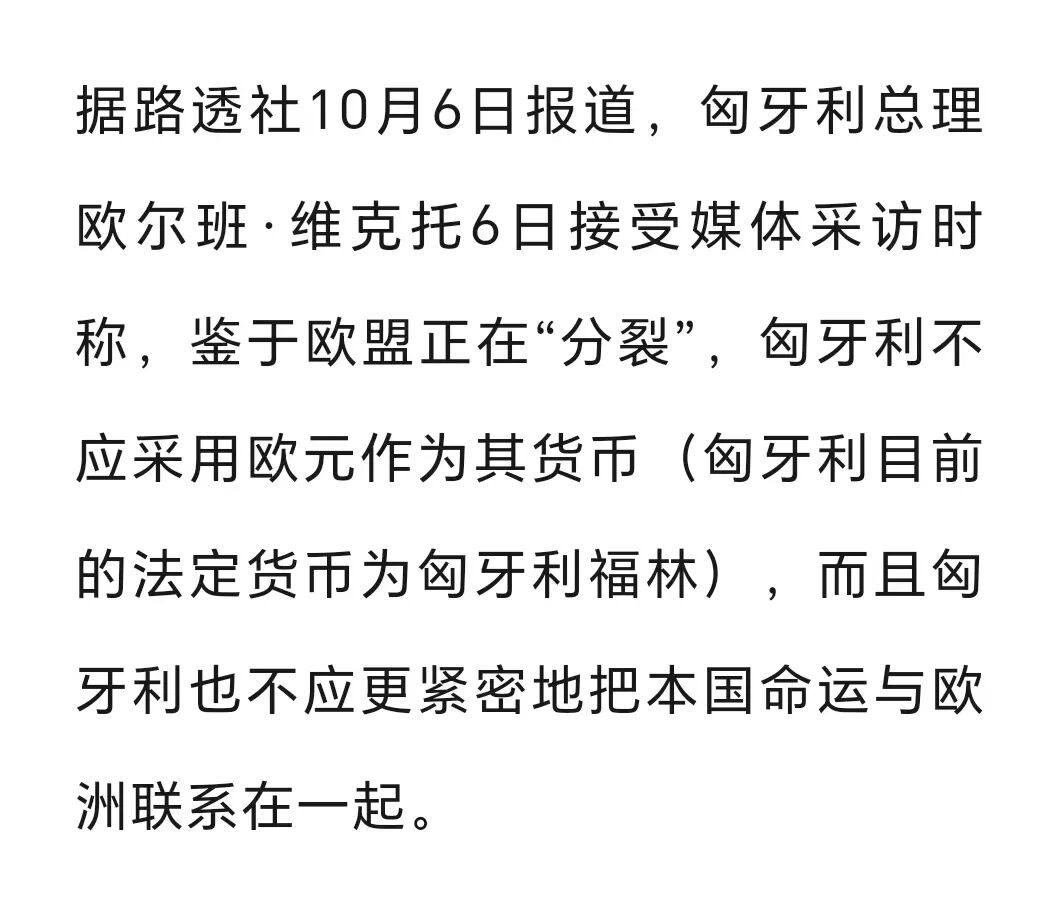
匈牙利总理:匈牙利不打算加入欧元区
Zhong Guo Ji Jin Bao· 2025-10-07 00:57
Core Viewpoint - The Hungarian central bank's current interest rate of 6.5% is considered "higher than it should be," and the pace of interest rate cuts is slower than desired due to the cautious nature of the central bank governor [1] Group 1 - The Hungarian central bank's interest rate stands at 6.5% [1] - The central bank governor, Varga Mihály, is described as cautious, impacting the speed of potential interest rate cuts [1] - There is a general expectation for a faster reduction in interest rates, which is not being met [1]