
居民消费价格指数(CPI)

Search documents
国家统计局:1月CPI同比上涨0.2%,PPI环比上涨0.4%,涨幅比上月扩大0.2个百分点
Jin Rong Jie· 2026-02-11 02:38
Group 1 - The core viewpoint of the articles indicates that consumer demand is recovering, with the Consumer Price Index (CPI) showing a slight increase of 0.2% month-on-month and year-on-year in January 2026, while the core CPI, excluding food and energy, rose by 0.8% year-on-year [1][6][20] - The CPI's year-on-year growth rate has declined primarily due to the high base effect from the previous year's Spring Festival, with food prices decreasing by 0.7%, impacting the CPI by approximately 0.11 percentage points [2][8] - The core CPI continues to show a moderate increase, with a month-on-month rise of 0.3%, the highest in six months, driven by price increases in air tickets and travel services [3][6] Group 2 - The Producer Price Index (PPI) increased by 0.4% month-on-month in January 2026, marking the fourth consecutive month of growth, with the year-on-year decline narrowing to 1.4% [4][20] - The increase in PPI is attributed to the ongoing construction of a unified national market and rising demand in certain industries, with notable price increases in sectors such as cement manufacturing and lithium-ion battery production [4][5] - Year-on-year, the prices in the non-ferrous metal mining industry rose by 22.7%, while the prices in the education, culture, and entertainment products manufacturing sector increased by 21.2% [5][29]

为什么开展价格指数基期轮换?涉及哪些内容?国家统计局权威解读→
Yang Shi Xin Wen· 2026-02-11 02:00
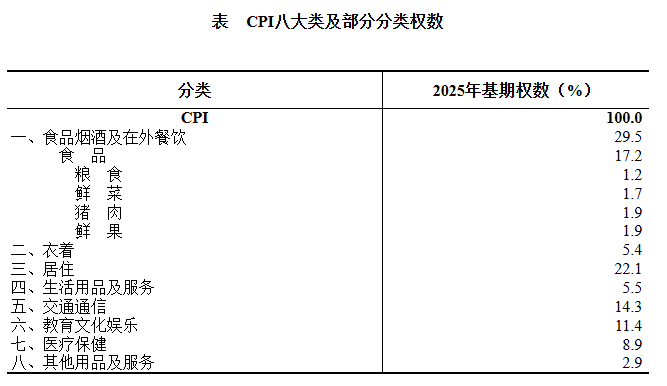
Core Viewpoint - The National Bureau of Statistics of China released the Consumer Price Index (CPI) and Producer Price Index (PPI) data based on the 2025 benchmark, marking the first data release after the benchmark rotation [1] Group 1: Purpose of Benchmark Rotation - Benchmark rotation is a fundamental task in compiling price indices, aimed at adapting to changes in the structure of goods and services in production, circulation, and consumption [2] - The CPI reflects the price level changes of goods and services consumed by residents over a certain period, requiring adjustments to the "fixed basket" of goods to accurately represent current consumption patterns [2] Group 2: Changes in CPI Survey - The CPI benchmark rotation involves revising the survey classification directory, survey points, representative specifications, classification weights, and price comparison benchmarks [3] - The current benchmark includes new categories such as housing security equipment, elderly products, dishwashers, and internet medical services, reflecting new consumption trends [3][4] Group 3: Survey Coverage and Data Collection - Approximately 120,000 survey points and about 620,000 representative specifications were included in the current benchmark, expanding the coverage compared to the previous benchmark [4] - The data collection methods have been optimized, with increased use of big data applications such as online transaction prices and electronic data from enterprises [4] Group 4: CPI Weight Calculation - CPI weights are derived from household expenditure surveys and are adjusted to ensure they accurately reflect the consumption structure [5] - The weights for the eight major categories in the 2025 benchmark are: Food, Alcohol, and Dining Out (29.5%), Clothing (5.4%), Housing (22.1%), Household Goods and Services (5.5%), Transportation and Communication (14.3%), Education, Culture, and Entertainment (11.4%), Healthcare (8.9%), and Other Goods and Services (2.9%) [5][7] Group 5: Impact of Benchmark Rotation - The benchmark rotation will affect the CPI and PPI data, with an average impact of approximately 0.06 and 0.08 percentage points on the monthly year-on-year indices for CPI and PPI, respectively [9]
国家统计局解读:1月份CPI同比上涨 PPI同比降幅收窄
智通财经网· 2026-02-11 02:00
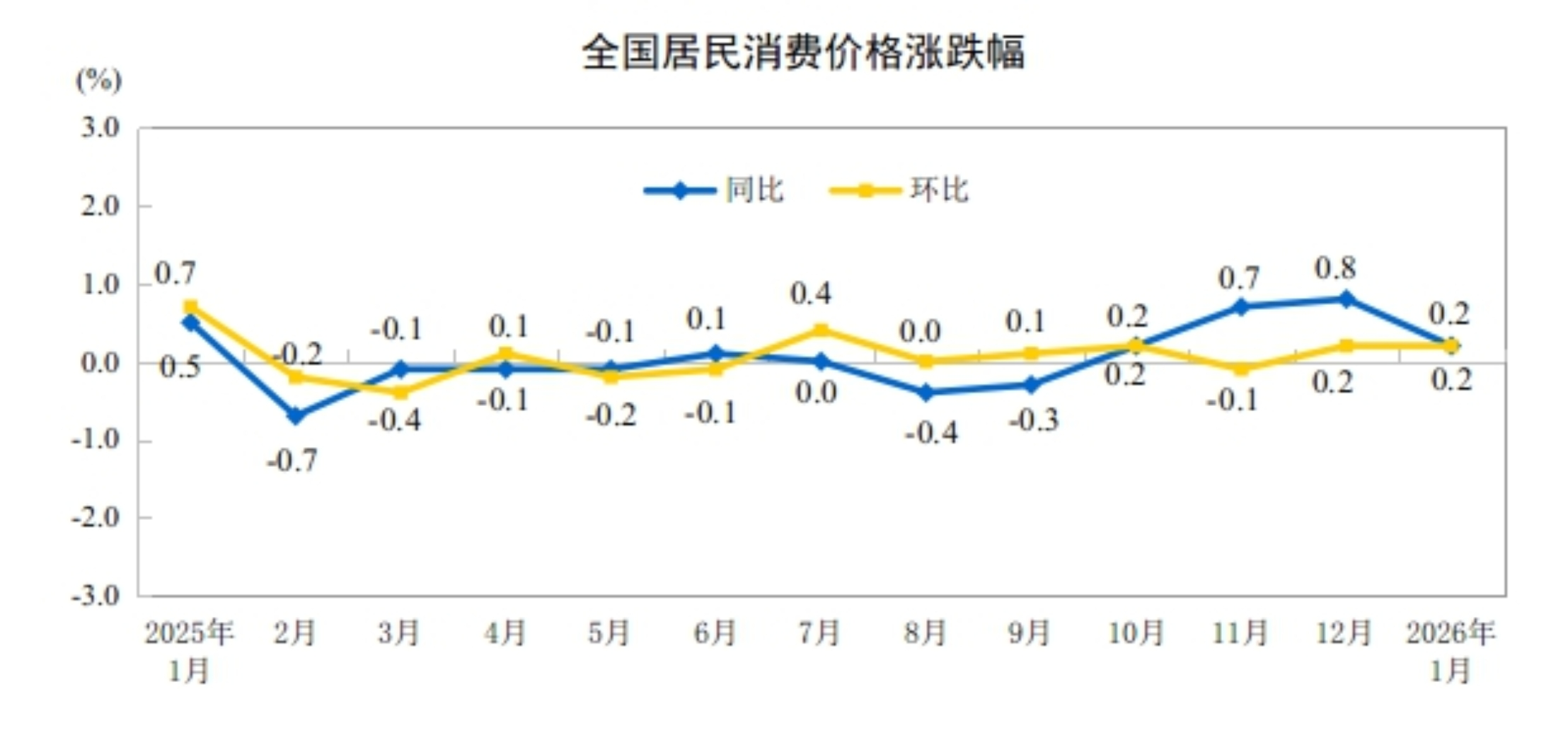
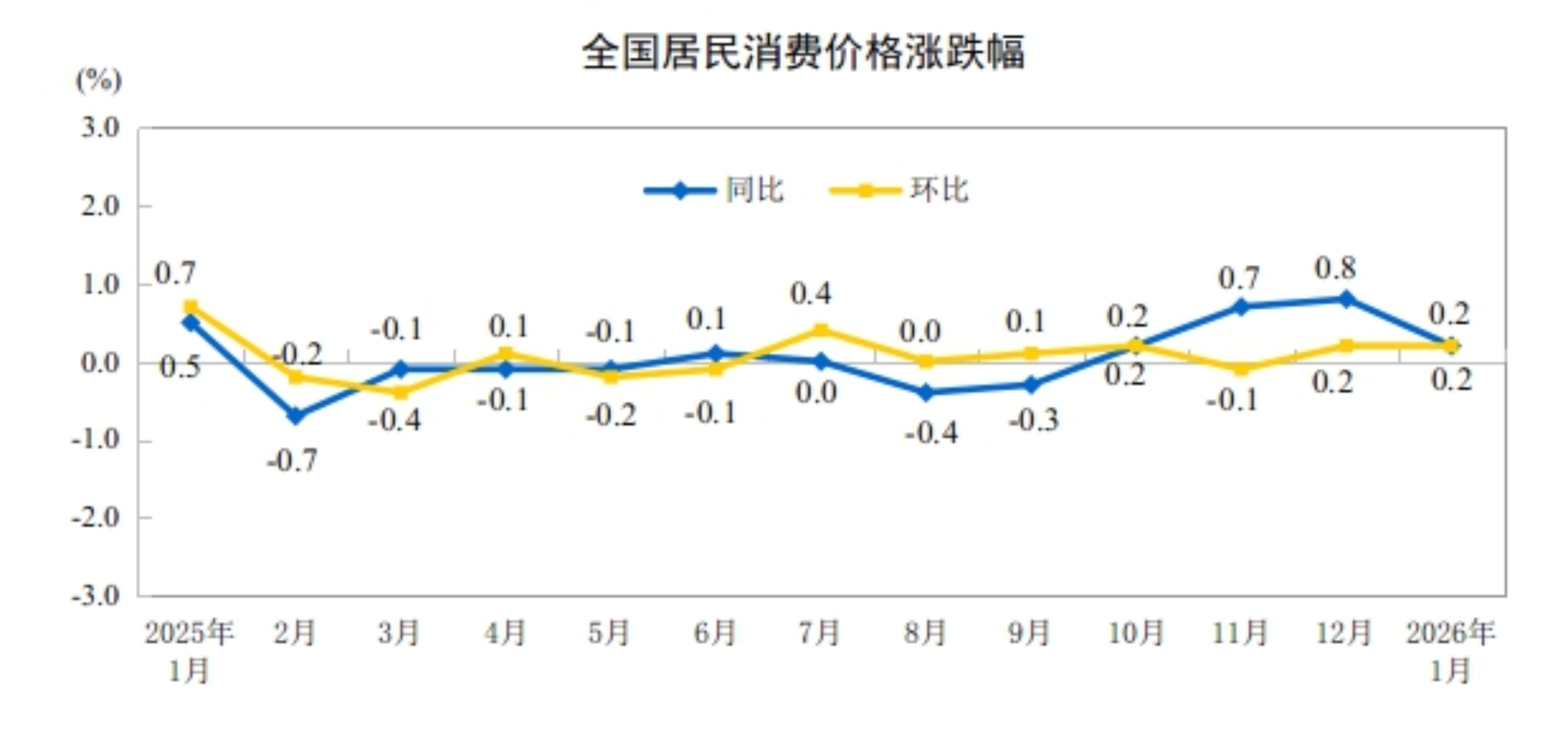
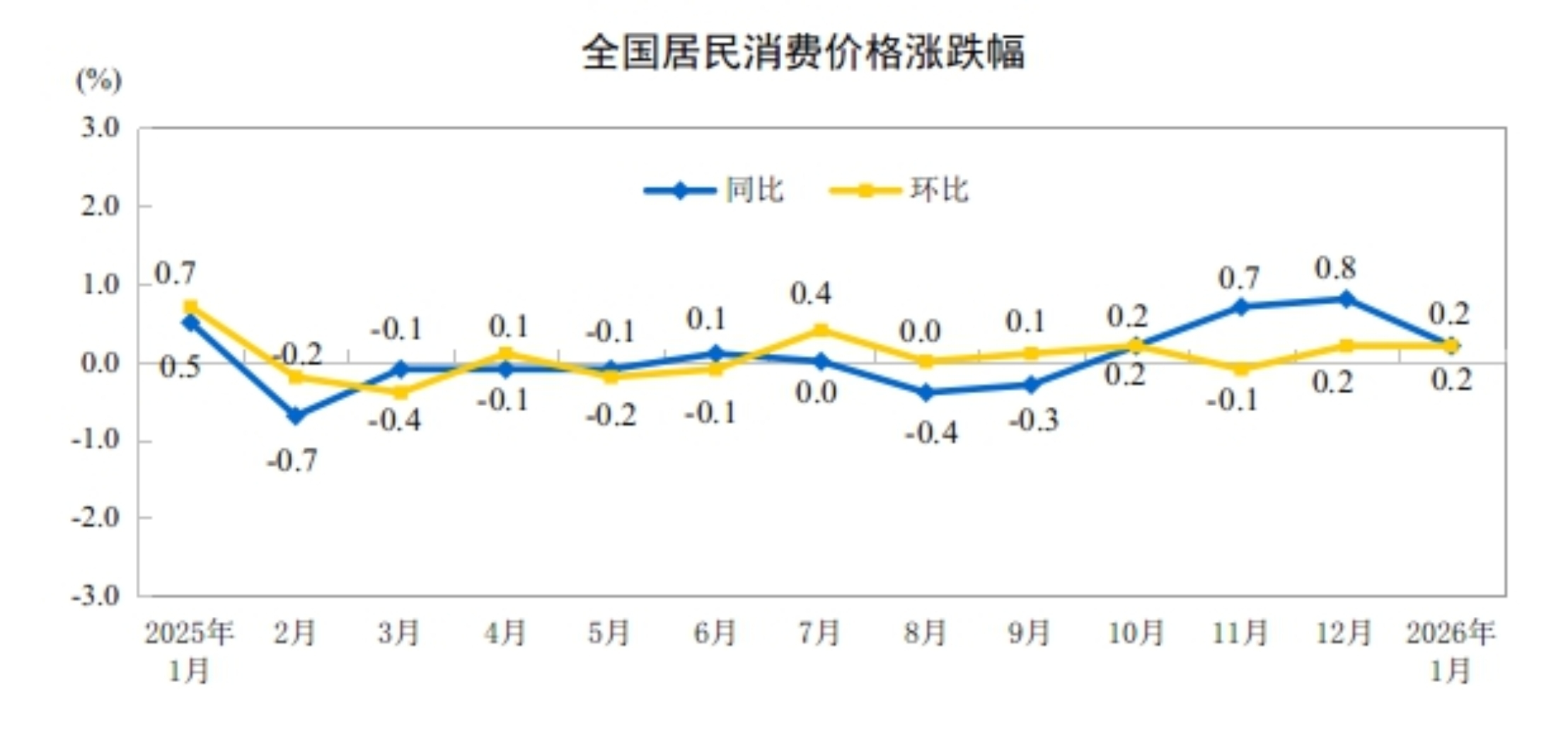
智通财经APP获悉,2月11日,国家统计局城市司首席统计师董莉娟解读2026年1月份CPI和PPI数据。1 月份,居民消费需求持续恢复,居民消费价格指数(CPI)环比上涨0.2%,同比上涨0.2%,扣除食品和 能源价格的核心CPI同比上涨0.8%。受全国统一大市场建设持续推进、部分行业需求增加及国际大宗商 品价格传导等因素影响,工业生产者出厂价格指数(PPI)环比上涨0.4%,同比下降1.4%。 全文如下: 2026年1月份CPI同比上涨 PPI同比降幅收窄 ——国家统计局城市司首席统计师董莉娟解读2026年1月份CPI和PPI数据 居民消费需求持续恢复,核心CPI温和上涨的态势没有改变。一是核心CPI环比继续上涨。扣除食品和 能源价格的核心CPI环比上涨0.3%,为近6个月最高。其中,飞机票和旅行社收费价格环比分别上涨 5.7%和2.0%;家政服务、美发、电影及演出票价格涨幅在0.4%—2.8%之间;数据存储设备和计算机价 格分别上涨8.0%和2.6%;家用器具、家庭日用杂品、个人护理用品价格涨幅在0.7%—1.4%之间。二是 扣除能源的工业消费品价格同比涨幅持续扩大。扣除能源的工业消费品价格同比上涨2.6 ...
国家统计局:1月份居民消费价格同比上涨0.2%
智通财经网· 2026-02-11 01:46
Core Viewpoint - In January 2026, the national consumer price index (CPI) increased by 0.2% year-on-year, with urban areas rising by 0.2% and rural areas by 0.1% [1][2] Year-on-Year Price Changes - Food prices decreased by 0.7%, while non-food prices increased by 0.4% [2][4] - The CPI was influenced by various categories: - Egg prices fell by 9.2%, contributing to a 0.05 percentage point decrease in CPI - Pork prices dropped by 13.7%, impacting CPI by a 0.28 percentage point decrease - Fresh vegetables rose by 6.9%, adding 0.12 percentage points to CPI - Fresh fruits increased by 3.2%, contributing 0.06 percentage points to CPI [4] Month-on-Month Price Changes - In January, the CPI rose by 0.2% month-on-month, with urban and rural areas both increasing by 0.2% [2][7] - Food prices remained stable, while non-food prices increased by 0.2% [2] - Specific month-on-month changes included: - Egg prices rose by 2.7%, contributing 0.01 percentage points to CPI - Fresh fruits increased by 2.0%, adding 0.04 percentage points to CPI - Fresh vegetables decreased by 4.8%, leading to a 0.10 percentage point drop in CPI [7] Price Changes by Category - The food, tobacco, and dining out category saw a year-on-year decrease of 0.2%, affecting CPI by approximately 0.06 percentage points [4] - Other categories showed varied changes: - Other goods and services increased by 13.2% - Clothing and healthcare rose by 1.9% and 1.7%, respectively - Transportation and communication prices fell by 3.4% and 0.1% [4][11]
国家统计局:1月CPI同比上涨0.2%
Guo Jia Tong Ji Ju· 2026-02-11 01:39
其他七大类价格同比四涨一平两降。其中,其他用品及服务、生活用品及服务价格分别上涨13.2%和2.6%,衣着、医疗保健价格分别上涨1.9%和1.7%;教育 文化娱乐价格持平;交通通信、居住价格分别下降3.4%和0.1%。 2026年1月份,全国居民消费价格同比上涨0.2%。其中,城市上涨0.2%,农村上涨0.1%;食品价格下降0.7%,非食品价格上涨0.4%;消费品价格上涨0.3%, 服务价格上涨0.1%。 1月份,全国居民消费价格环比上涨0.2%。其中,城市上涨0.2%,农村上涨0.2%;食品价格持平,非食品价格上涨0.2%;消费品价格上涨0.2%,服务价格上 涨0.2%。 1月份,食品烟酒及在外餐饮类价格同比下降0.2%,影响CPI(居民消费价格指数)下降约0.06个百分点。食品中,蛋类价格下降9.2%,影响CPI下降约0.05 个百分点;畜肉类价格下降6.1%,影响CPI下降约0.26个百分点,其中猪肉价格下降13.7%,影响CPI下降约0.28个百分点;鲜菜价格上涨6.9%,影响CPI上涨 约0.12个百分点;鲜果价格上涨3.2%,影响CPI上涨约0.06个百分点;水产品价格上涨0.7%,影响CPI上涨 ...
国家统计局城市司负责人就CPI等价格指数基期轮换有关情况接受中国信息报专访
Guo Jia Tong Ji Ju· 2026-02-11 01:39
Core Viewpoint - The National Bureau of Statistics released the Consumer Price Index (CPI) and Producer Price Index (PPI) data based on the 2025 benchmark, marking the first data release after the benchmark rotation [1] Group 1: Purpose of Benchmark Rotation - Benchmark rotation is a fundamental task in compiling price indices, aligning with international practices to adapt to changes in the structure of goods and services transactions in production, circulation, and consumption [2] - The CPI reflects the price level changes of goods and services consumed by residents over a certain period, requiring timely adjustments to the "fixed basket" of goods to accurately represent market price changes [2] Group 2: Changes in CPI Survey - The CPI benchmark rotation involves revising the survey classification directory, survey points, representative specifications, classification weights, and price comparison benchmarks [3] - The current CPI survey classification directory has been adjusted based on comprehensive market research, adding new categories such as housing security equipment, elderly products, and internet medical services, while maintaining 8 major categories and 268 basic classifications [3][4] Group 3: Survey Points and Data Collection - Approximately 120,000 survey points and about 620,000 representative specifications were selected for the current benchmark, expanding the coverage compared to the previous benchmark [4] - New retail formats and data collection methods, including online transaction prices and big data applications, have been incorporated to better reflect new consumption patterns [4] Group 4: CPI Weight Calculation - CPI weights are determined based on household expenditure surveys and other macro data, ensuring they accurately reflect the consumption structure [5] - The weights for the eight major categories in the 2025 benchmark are as follows: Food, Alcohol, and Dining Out (29.5%), Clothing (5.4%), Housing (22.1%), Household Goods and Services (5.5%), Transportation and Communication (14.3%), Education, Culture, and Entertainment (11.4%), Medical Care (8.9%), and Other Goods and Services (2.9%) [6][7] Group 5: Impact of Benchmark Rotation - The benchmark rotation will influence the CPI and PPI indices due to changes in survey classifications, survey points, and weights, with an estimated average impact of approximately 0.06 and 0.08 percentage points on the monthly year-on-year indices for CPI and PPI, respectively [9]
中国1月CPI同比上涨0.2%,环比上涨0.2%
Guo Jia Tong Ji Ju· 2026-02-11 01:37
2026年1月份,全国居民消费价格同比上涨0.2%。其中,城市上涨0.2%,农村上涨0.1%;食品价格下降0.7%,非食品价格上涨0.4%;消费品价格上涨0.3%, 服务价格上涨0.1%。 1月份,全国居民消费价格环比上涨0.2%。其中,城市上涨0.2%,农村上涨0.2%;食品价格持平,非食品价格上涨0.2%;消费品价格上涨0.2%,服务价格上 涨0.2%。 一、各类商品及服务价格同比变动情况 1月份居民消费价格分 (%) 3.0 2.5 2.0 1.5 0.9 1.0 0.5 0.0 0.0 0.0 -0.2 -0.5 衣着 居住 食品烟酒及 年提出 在外餐饮 及服务 1月份,食品烟酒及在外餐饮类价格同比下降0.2%,影响CPI(居民消费价格指数)下降约0.06个百分点。食品中,蛋类价格下降9.2%,影响CPI下降约0.05 个百分点;畜肉类价格下降6.1%,影响CPI下降约0.26个百分点,其中猪肉价格下降13.7%,影响CPI下降约0.28个百分点;鲜菜价格上涨6.9%,影响CPI上涨 约0.12个百分点;鲜果价格上涨3.2%,影响CPI上涨约0.06个百分点;水产品价格上涨0.7%,影响CPI上涨约0 ...
为什么要开展价格指数基期轮换?国家统计局回应
Guo Jia Tong Ji Ju· 2026-02-11 01:33
Group 1 - The National Bureau of Statistics released the Consumer Price Index (CPI) and Producer Price Index (PPI) data based on 2025 as the new base year, marking the first data release after the base year rotation [1] - The base year rotation is an essential foundational work for compiling price indices, aligning with international practices to adapt to changes in the structure of transactions in production, circulation, and consumption [1] - CPI and PPI undergo base year rotation every five years in China, with the new indices starting from 2026 based on the 2025 base year [1] Group 2 - CPI reflects the price level changes of goods and services consumed by residents over a certain period, using a representative "fixed basket" of goods and services to observe overall price changes [2] - The consumer structure is evolving with economic development, necessitating timely adjustments to the CPI's "fixed basket" to accurately reflect current consumption patterns, such as the inclusion of electric power for new energy vehicles [2] - The CPI base year rotation involves adjusting the "fixed basket" and the price comparison base year to enhance the representativeness of the price index and more accurately reflect market price changes [2]
2026年1月份居民消费价格同比上涨0.2%
Guo Jia Tong Ji Ju· 2026-02-11 01:30
Core Viewpoint - In January 2026, the national consumer price index (CPI) increased by 0.2% year-on-year, with urban areas rising by 0.2% and rural areas by 0.1% [1][9]. Price Changes Year-on-Year - The prices of food, tobacco, and dining out decreased by 0.2%, contributing to a 0.06 percentage point decline in CPI [3]. - Within food, egg prices fell by 9.2%, impacting CPI by a decrease of approximately 0.05 percentage points; pork prices dropped by 13.7%, affecting CPI by a decrease of about 0.28 percentage points [3]. - Fresh vegetables saw a price increase of 6.9%, contributing approximately 0.12 percentage points to CPI, while fresh fruits rose by 3.2%, adding about 0.06 percentage points [3]. - Other categories showed mixed results, with significant increases in other goods and services (13.2%) and living goods and services (2.6%), while transportation and communication prices fell by 3.4% and housing prices by 0.1% [3]. Price Changes Month-on-Month - In January, the prices of food, tobacco, and dining out remained stable [6]. - Egg prices increased by 2.7%, contributing approximately 0.01 percentage points to CPI; fresh fruit prices rose by 2.0%, adding about 0.04 percentage points [6]. - Fresh vegetables experienced a significant decline of 4.8%, impacting CPI by a decrease of approximately 0.10 percentage points [6]. - Other categories showed five increases, one stable, and one decrease, with other goods and services rising by 2.7% and living goods and services by 0.9% [6]. Summary of Key Data - CPI increased by 0.2% month-on-month and year-on-year, with urban and rural areas showing similar trends [9]. - Food prices remained unchanged month-on-month but decreased by 0.7% year-on-year, while non-food prices increased by 0.2% month-on-month and 0.4% year-on-year [9][10]. - The CPI excluding food and energy rose by 0.3% month-on-month and 0.8% year-on-year [10].
2025年山东居民消费价格指数运行平稳 核心CPI持续回升
Feng Huang Wang Cai Jing· 2026-02-06 07:50
Group 1 - The core viewpoint of the news is that the overall consumer price index (CPI) in Shandong Province for 2025 shows a stable trend with a slight decrease of 0.1% year-on-year, indicating a resilient consumer market and effective policies promoting consumption [1][2] - The core CPI, excluding food and energy prices, increased by 0.7% year-on-year, with a growth rate that expanded by 0.3 percentage points compared to the previous year, reflecting a recovery in consumer demand [5][6] - The food prices in Shandong Province primarily decreased by 1.9% year-on-year, with a structure showing 10 categories declining and 4 categories increasing, which alleviated the burden on residents' food consumption [3][4] Group 2 - The prices of major food items, such as eggs and pork, decreased by 11.3% and 9.6% respectively, contributing significantly to the overall decline in food prices [3][4] - Service prices increased by 0.4% year-on-year, with stable growth in areas such as home services, tourism, education, and healthcare, indicating a rising demand for high-quality services [5] - Industrial consumer goods prices, excluding energy, rose by 1.3% year-on-year, with notable increases in gold jewelry prices by 44.3%, reflecting changes in international market prices and production costs [6][7]