
衣着

Search documents
什么消费最先“稳定”?
一瑜中的· 2026-03-31 12:51
Group 1: Core Viewpoint - The article discusses the stabilization of essential consumer goods in the retail sector, indicating that these goods may have returned to a stable growth phase starting in 2024, with growth rates around 4% for 2024 and 2025 [2][3][12]. Group 2: Consumer Segmentation - The retail sector is divided into four categories: subsidy-related retail (7.9 trillion, 16% of total), real estate-related retail (0.2 trillion, 0.2%), price-volatile retail (2.6 trillion, 5.2%), and essential retail (39 trillion, 79%) [2][11]. - Essential retail has historically been the most stable segment, with an average annual growth rate fluctuation of only 0.6 percentage points from 2009 to 2019 [11][12]. Group 3: Economic Observations - The weekly economic activity index (WEI) rose to 5.49% as of March 22, 2026, up from 4.98% the previous week, indicating an upward trend in economic activity [4][20]. - Retail sales of passenger cars showed a significant narrowing of decline, with a year-on-year decrease of 7% as of March 22, compared to a previous decline of 19% [4][27]. - Real estate sales saw a rebound, with residential sales in 67 cities increasing by 12% year-on-year as of March 28, 2026 [4][27]. Group 4: Production and Infrastructure - Cement shipment rates improved to 32.8% as of March 27, 2026, although the rate of improvement has slowed [4][31]. - The overall operating rates in various industries showed mixed results, with some sectors performing better than last year while others lagged [4][31]. Group 5: Trade and Exports - China's port container throughput showed a significant rebound, with a week-on-week growth of 3.7% as of March 22, 2026 [4][38]. - The number of cargo ships from China to the U.S. saw a year-on-year decline of 22.4% as of March 27, 2026, indicating a worsening trend in direct trade flow [4][39]. Group 6: Price Trends - Oil prices continued to rise, with Brent crude at $112.6 per barrel, while gold prices fell to $4,492 per ounce, down 1.8% [4][58]. - Domestic coal prices increased, with Shanxi thermal coal priced at 761 yuan per ton, up 3.5% [4][59].


通胀数据点评:为何2月通胀“再超预期”?
Shenwan Hongyuan Securities· 2026-03-09 15:20
Inflation Data Summary - February CPI increased to 1.3% year-on-year, up from 0.2% in January and exceeding the expected 0.9%[1] - February PPI recorded a year-on-year decline of -0.9%, an improvement from -1.4% in January, with a month-on-month increase of 0.4%[1][7] Key Drivers of Inflation - The rise in February CPI was primarily driven by the timing of the Spring Festival and a significant increase in service CPI, which rose by 1.1% month-on-month[3] - Core service CPI showed strong performance, with notable price increases in airfares (31.1%), vehicle rentals (24.7%), travel agency fees (15.8%), and accommodation (7.3%)[3][15] PPI Analysis - The year-on-year increase in PPI was influenced by rising international prices of non-ferrous metals and crude oil, contributing 0.4% to the month-on-month PPI increase[2][8] - Domestic coal and steel prices had minimal impact on PPI, contributing 0% to the month-on-month change[2][10] Future Outlook - If international oil prices remain above $100 per barrel, PPI could return to around 0% year-on-year in March and potentially turn positive in April, with an annual forecast adjustment to 0.2%[4][27] - CPI forecast for the year has been revised upward to approximately 0.8%, driven by oil price transmission and improved service consumption[4][27] Risks - Potential risks include tighter-than-expected food supply and energy supply constraints due to geopolitical factors[5][44]
2026年1月份居民消费价格同比上涨0.2%
Guo Jia Tong Ji Ju· 2026-02-11 01:30
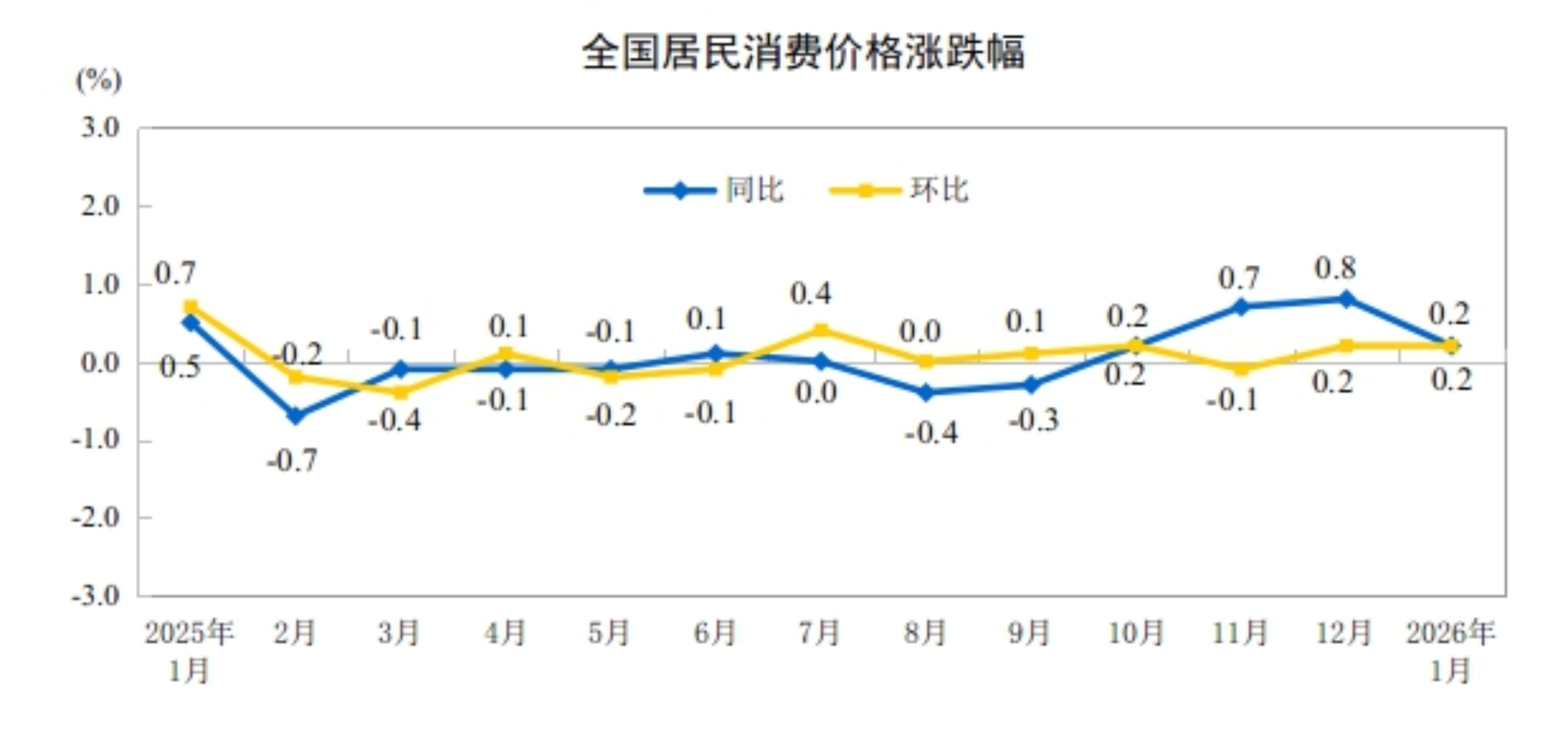
Core Viewpoint - In January 2026, the national consumer price index (CPI) increased by 0.2% year-on-year, with urban areas rising by 0.2% and rural areas by 0.1% [1][9]. Price Changes Year-on-Year - The prices of food, tobacco, and dining out decreased by 0.2%, contributing to a 0.06 percentage point decline in CPI [3]. - Within food, egg prices fell by 9.2%, impacting CPI by a decrease of approximately 0.05 percentage points; pork prices dropped by 13.7%, affecting CPI by a decrease of about 0.28 percentage points [3]. - Fresh vegetables saw a price increase of 6.9%, contributing approximately 0.12 percentage points to CPI, while fresh fruits rose by 3.2%, adding about 0.06 percentage points [3]. - Other categories showed mixed results, with significant increases in other goods and services (13.2%) and living goods and services (2.6%), while transportation and communication prices fell by 3.4% and housing prices by 0.1% [3]. Price Changes Month-on-Month - In January, the prices of food, tobacco, and dining out remained stable [6]. - Egg prices increased by 2.7%, contributing approximately 0.01 percentage points to CPI; fresh fruit prices rose by 2.0%, adding about 0.04 percentage points [6]. - Fresh vegetables experienced a significant decline of 4.8%, impacting CPI by a decrease of approximately 0.10 percentage points [6]. - Other categories showed five increases, one stable, and one decrease, with other goods and services rising by 2.7% and living goods and services by 0.9% [6]. Summary of Key Data - CPI increased by 0.2% month-on-month and year-on-year, with urban and rural areas showing similar trends [9]. - Food prices remained unchanged month-on-month but decreased by 0.7% year-on-year, while non-food prices increased by 0.2% month-on-month and 0.4% year-on-year [9][10]. - The CPI excluding food and energy rose by 0.3% month-on-month and 0.8% year-on-year [10].
国家统计局:2025年居民消费价格与上年持平
Zhong Guo Jing Ji Wang· 2026-01-19 03:25
Core Viewpoint - The consumer price index (CPI) in China is projected to remain flat in 2025 compared to the previous year, indicating a stable inflation outlook for consumers [1] Group 1: Consumer Price Index (CPI) Analysis - Food and tobacco prices are expected to decrease by 0.7%, while clothing prices will increase by 1.5% [1] - Housing prices are projected to rise by 0.1%, and prices for daily necessities and services are expected to increase by 0.9% [1] - Transportation and communication prices are forecasted to decline by 2.6%, while education, culture, and entertainment prices will rise by 0.8% [1] - Healthcare prices are anticipated to increase by 0.8%, and other goods and services are expected to rise significantly by 9.3% [1] - Within the food and tobacco category, pork prices are expected to decrease by 6.1%, fresh vegetable prices by 3.9%, and grain prices by 1.0%, while fresh fruit prices will increase by 1.2% [1] - The core CPI, excluding food and energy prices, is projected to rise by 0.7%, an increase of 0.2 percentage points compared to the previous year [1] - In December, the year-on-year CPI increased by 0.8%, a rise of 0.1 percentage points from the previous month, with a month-on-month increase of 0.2% [1] Group 2: Industrial Producer Price Index (PPI) Analysis - The industrial producer price index is expected to decline by 2.6% in 2025 compared to the previous year [1] - In December, the year-on-year PPI decreased by 1.9%, with a month-on-month increase of 0.2% [1] - The annual industrial producer purchase price is projected to decline by 3.0%, with a year-on-year decrease of 2.1% in December and a month-on-month increase of 0.4% [1]
2025年江苏CPI同比微降0.2%
Xin Hua Ri Bao· 2026-01-13 21:14
Core Insights - In December 2025, Jiangsu's consumer prices increased by 0.8% year-on-year, with urban prices rising by 0.8% and rural prices by 0.6% [1] - The overall consumer price index for the year 2025 showed a decline of 0.2% compared to the previous year [1] Price Changes by Category - In December 2025, prices for eight major categories of goods and services showed "five increases, two decreases, and one stable" year-on-year [1] - Clothing prices increased by 2.7% - Prices for daily necessities and services rose by 2.4% - Education, culture, and entertainment prices increased by 1.1% - Medical care prices rose by 3.8% - Other goods and services saw a significant increase of 20.0% - Housing prices decreased by 0.4% - Transportation and communication prices fell by 2.8% - Food, tobacco, and alcohol prices remained stable [1] Food Price Dynamics - Within the food category, specific price changes included: - Fresh vegetable prices increased by 13.8% - Fresh mushroom prices rose by 5.1% - Freshwater fish prices increased by 4.2% - Beef prices rose by 2.9% - Conversely, egg prices decreased by 17.7% - Pork prices fell by 15.3% - Lamb prices decreased by 2.4% [1] Monthly Price Changes - In December 2025, the month-on-month price changes for the eight major categories were "three increases, three decreases, and two stable" [2] - Daily necessities and services prices increased by 0.6% - Education, culture, and entertainment prices rose by 0.1% - Other goods and services prices increased by 3.4% - Food, tobacco, and alcohol prices decreased by 0.2% - Housing prices fell by 0.1% - Transportation and communication prices decreased by 0.2% - Clothing and medical care prices remained stable [2] Specific Food Price Changes - In the food category for December 2025, notable price changes included: - Fresh fruit prices increased by 2.0% - Fresh mushroom prices decreased by 3.2% - Fresh vegetable prices fell by 2.5% - Pork prices decreased by 2.3% [2]
2025年中国上海零售行业政策、发展历程、销售规模、竞争格局、业态结构及发展趋势研判:行业整体仍保持在较高水平,节假日期间消费活力显著提升[图]
Chan Ye Xin Xi Wang· 2026-01-12 01:26
Core Insights - Shanghai has established itself as one of the top three "Best Business Cities in Mainland China" since 2014, showcasing strong performance in the retail sector [6][7] - In 2024, Shanghai's total retail sales of consumer goods reached 17,940.19 billion yuan, with a slight decline of 3.1% year-on-year [7] - The retail sales structure is dominated by brand specialty stores, online retail, and specialty shops, indicating a shift in consumer preferences [7][8] Retail Industry Overview - The retail industry is defined as the sale of goods directly to consumers for personal or public consumption, encompassing various formats such as supermarkets, convenience stores, and online shops [2] - Shanghai's retail sector is characterized by a diverse and multi-layered structure, catering to different consumer needs [4] Current Development Status - The retail industry plays a crucial role in the economy, influencing production, consumption, and employment [6] - In 2024, the retail sales figures for food, clothing, daily necessities, and fuel were 3,721.33 billion yuan, 4,341.81 billion yuan, 9,354.46 billion yuan, and 522.60 billion yuan respectively, with food sales showing a 1.6% increase year-on-year [7] Sales Trends and Consumer Behavior - Major retail formats such as brand specialty stores and online retail are experiencing growth, with online sales showing a significant increase during key holidays [8] - During the Spring Festival, total online and offline consumption reached 56.9 billion yuan, marking a notable year-on-year increase [8] Policy Environment - Shanghai has implemented various policies to optimize the retail environment, including the launch of a pilot program for retail innovation [9] - The city aims to enhance the retail sector's contribution to the economy through multi-dimensional reforms [9] Competitive Landscape - The retail market in Shanghai is highly competitive, with both international giants like Carrefour and local players like Bailian Group vying for market share [12] - The rise of e-commerce platforms such as Tmall and JD.com has intensified competition, impacting traditional retail businesses [12] Future Development Trends - The retail industry in Shanghai is expected to evolve towards "refined operations," "green sustainability," and "instant retail," driven by changing consumer demographics and preferences [12][16] - The increasing share of online retail sales indicates a significant shift in consumer shopping habits and a transformation in the retail landscape [16]


同比上涨0.8%
中国基金报· 2026-01-09 02:26
Core Viewpoint - In December 2025, the national consumer price index (CPI) increased by 0.8% year-on-year, with urban areas rising by 0.9% and rural areas by 0.6% [2][4]. Group 1: Year-on-Year Price Changes - In December, the prices of food, tobacco, and alcohol rose by 0.8%, contributing approximately 0.24 percentage points to the CPI [5]. - Fresh vegetable prices surged by 18.2%, impacting the CPI by about 0.39 percentage points, while fresh fruit prices increased by 4.4%, contributing 0.09 percentage points [5]. - Prices for eggs decreased by 12.7%, negatively affecting the CPI by 0.09 percentage points, and pork prices fell by 14.6%, contributing a decline of 0.20 percentage points [5]. - Other categories showed mixed results, with healthcare prices rising by 1.8% and clothing prices by 1.7%, while transportation and housing prices fell by 2.6% and 0.2%, respectively [5]. Group 2: Month-on-Month Price Changes - In December, food, tobacco, and alcohol prices increased by 0.2%, contributing approximately 0.05 percentage points to the CPI [7]. - Fresh fruit prices rose by 2.6%, impacting the CPI by 0.05 percentage points, while fresh vegetable prices increased by 0.8%, contributing 0.02 percentage points [7]. - Prices for other categories showed four increases, two stable, and one decrease, with other goods and services rising by 2.8% and living goods and services by 0.4% [7]. Group 3: Overall CPI Performance - The overall CPI for 2025 remained unchanged compared to the previous year [4]. - The CPI for urban areas increased by 0.1%, while rural areas saw a decline of 0.2% [9]. - Food prices decreased by 1.5% year-on-year, while non-food prices increased by 0.4% [9].

国家统计局:12月CPI同比上涨0.8%
Guo Jia Tong Ji Ju· 2026-01-09 01:43
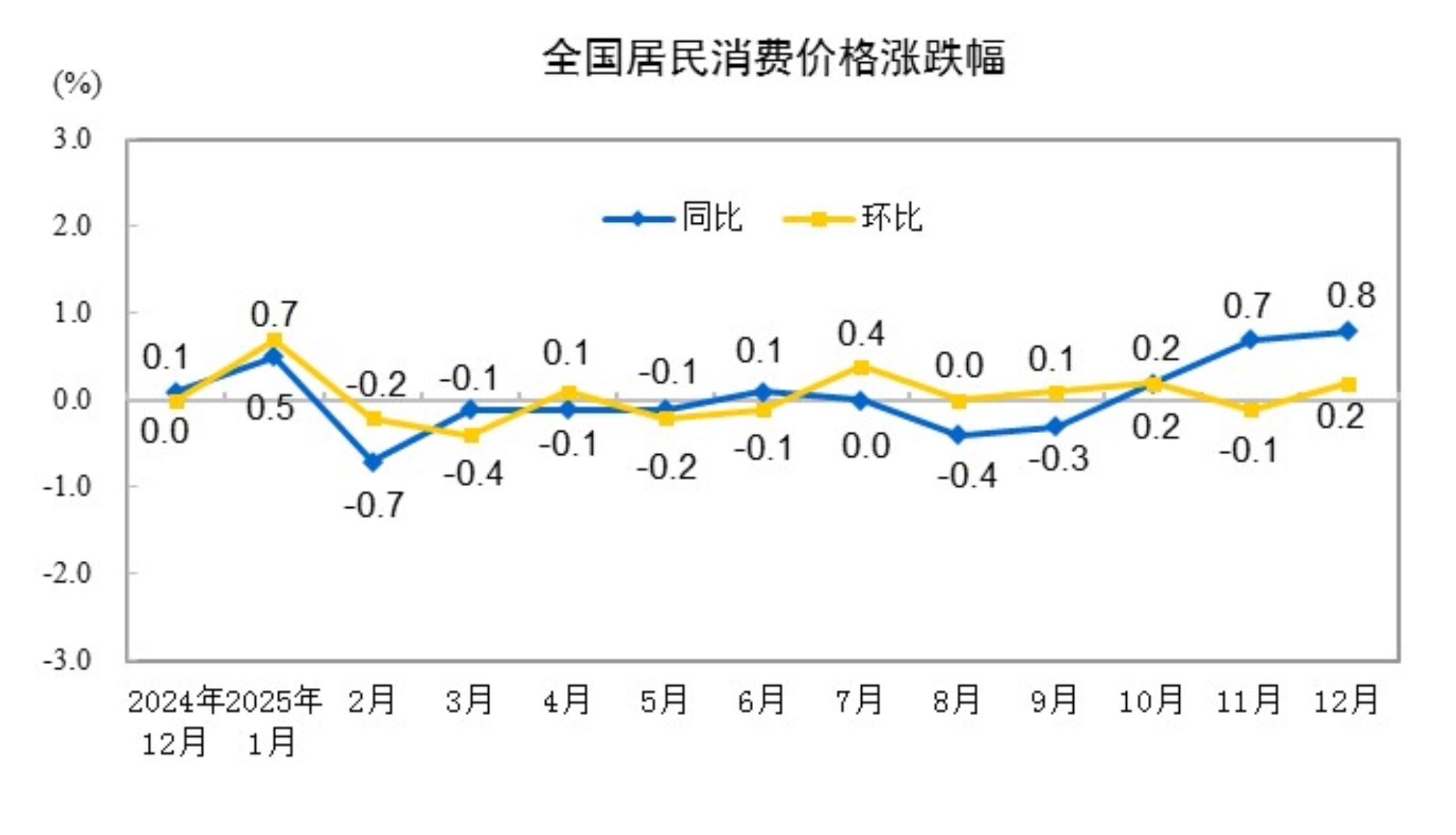
Core Insights - In December 2025, the national consumer price index (CPI) increased by 0.8% year-on-year, with urban areas rising by 0.9% and rural areas by 0.6% [1] - Monthly, the CPI rose by 0.2% in December, with both urban and rural areas experiencing the same increase [1] - For the entire year of 2025, the national CPI remained flat compared to the previous year [1] Group 1: Year-on-Year Price Changes - In December, the prices of food, tobacco, and alcohol increased by 0.8%, contributing approximately 0.24 percentage points to the CPI [3] - Fresh vegetable prices surged by 18.2%, impacting the CPI by approximately 0.39 percentage points [3] - Fresh fruit prices rose by 4.4%, contributing about 0.09 percentage points to the CPI [3] - Prices for aquatic products increased by 1.6%, adding around 0.03 percentage points to the CPI [3] - Egg prices fell by 12.7%, reducing the CPI by approximately 0.09 percentage points [3] - Meat prices decreased by 6.1%, impacting the CPI negatively by about 0.19 percentage points, with pork prices specifically dropping by 14.6% [3] - Grain prices declined by 0.3%, contributing a minor decrease of about 0.01 percentage points to the CPI [3] Group 2: Month-on-Month Price Changes - In December, food, tobacco, and alcohol prices increased by 0.2%, contributing approximately 0.05 percentage points to the CPI [6] - Fresh fruit prices rose by 2.6%, impacting the CPI by about 0.05 percentage points [6] - Fresh vegetable prices increased by 0.8%, contributing approximately 0.02 percentage points to the CPI [6] - Meat prices decreased by 0.8%, negatively affecting the CPI by about 0.02 percentage points, with pork prices specifically declining by 1.7% [6] - Among other categories, prices for other goods and services rose by 2.8%, while living goods and services increased by 0.4% [6] - Education, culture, and entertainment, as well as healthcare prices, both rose by 0.1% [6] - Clothing and transportation communication prices remained stable, while housing prices decreased by 0.1% [6]
国家统计局:2025年12月份CPI同比上涨0.8% 环比上涨0.2%
智通财经网· 2026-01-09 01:43
Core Insights - In December 2025, the national consumer price index (CPI) increased by 0.8% year-on-year, with urban areas rising by 0.9% and rural areas by 0.6% [1][2] - The overall CPI for the year 2025 remained unchanged compared to the previous year [2] Price Changes by Category - Food and tobacco prices rose by 0.8% year-on-year, contributing approximately 0.24 percentage points to the CPI increase [4] - Fresh vegetable prices surged by 18.2%, impacting the CPI by about 0.39 percentage points, while fresh fruit prices increased by 4.4%, contributing 0.09 percentage points [4] - Prices for aquatic products rose by 1.6%, adding 0.03 percentage points to the CPI, whereas egg prices fell by 12.7%, reducing the CPI by 0.09 percentage points [4] - Meat prices decreased by 6.1%, with pork prices specifically dropping by 14.6%, leading to a CPI reduction of 0.20 percentage points [4] - Other categories showed mixed results, with healthcare prices increasing by 1.8% and clothing prices by 1.7%, while transportation and housing prices fell by 2.6% and 0.2%, respectively [4] Month-on-Month Price Changes - In December, the CPI rose by 0.2% month-on-month, with urban and rural areas both increasing by 0.2% [2][8] - Food prices increased by 0.3% month-on-month, while non-food prices rose by 0.1% [8] - The prices of other goods and services saw varied changes, with other supplies and services rising by 2.8% and healthcare by 0.1%, while housing prices decreased by 0.1% [6][8]
11月江苏CPI同比上涨0.6%
Xin Hua Ri Bao· 2025-12-11 22:11
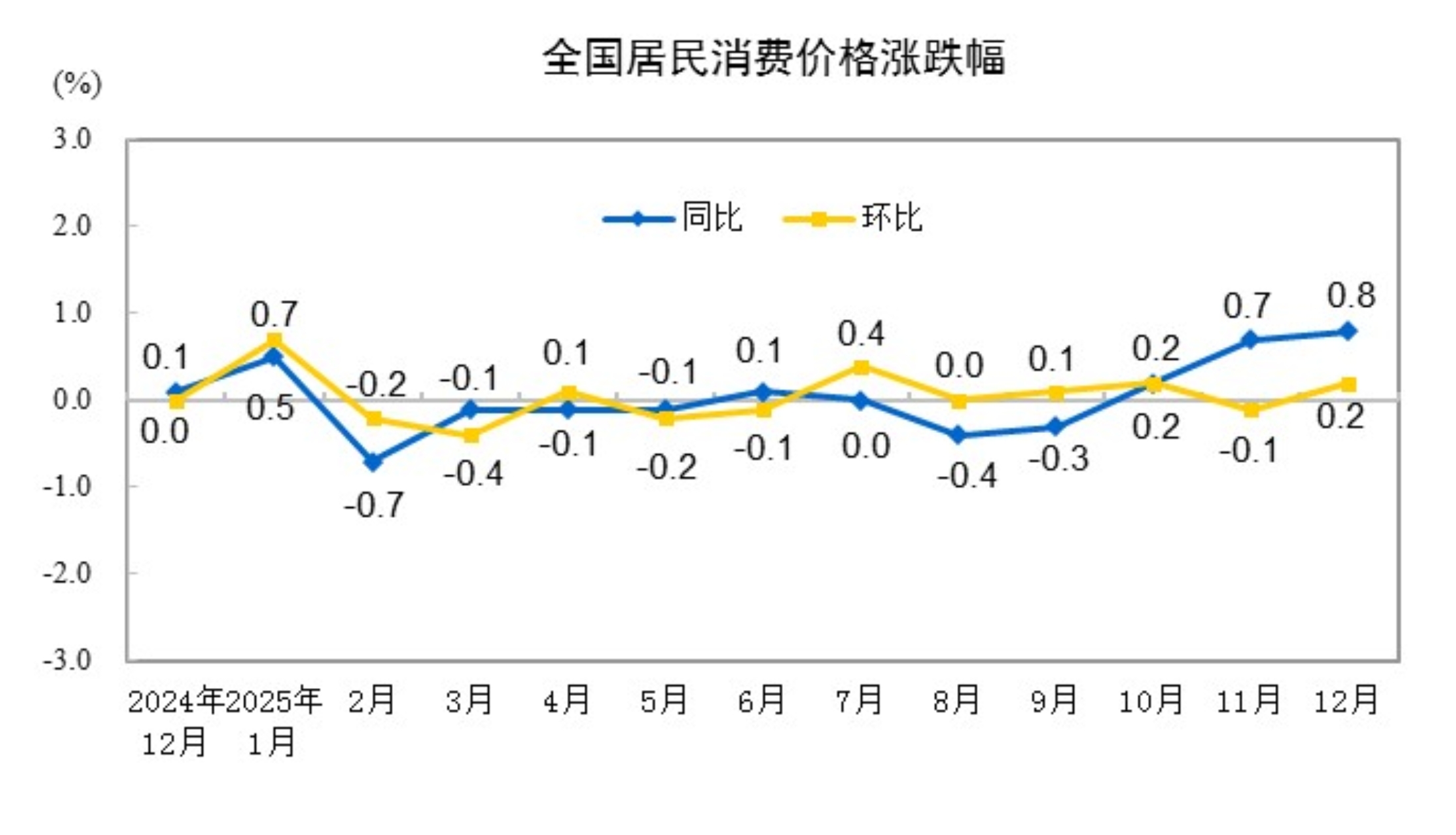
Core Viewpoint - In November, Jiangsu's consumer price index increased by 0.6% year-on-year, with prices of eight major categories showing a trend of "five increases and three decreases" [1] Group 1: Consumer Price Changes - Urban consumer prices rose by 0.6%, while rural prices increased by 0.4% [1] - Food prices decreased by 0.7%, whereas non-food prices increased by 0.9% [1] - Consumer goods prices rose by 0.4%, and service prices increased by 0.9% [1] Group 2: Price Changes by Category - Clothing prices increased by 2.5% [1] - Prices for daily necessities and services rose by 2.2% [1] - Education, culture, and entertainment prices increased by 1.1% [1] - Medical care prices rose by 3.7% [1] - Other goods and services saw a significant increase of 16.1% [1] - Prices for food, tobacco, and alcohol decreased by 0.4% [1] - Housing prices decreased by 0.3% [1] - Transportation and communication prices fell by 2.3% [1] Group 3: Food Price Changes - Fresh vegetable prices increased by 11.4% [1] - Fresh mushroom prices rose by 8.6% [1] - Freshwater fish prices increased by 3.2% [1] - Beef prices rose by 2.5% [1] - Egg prices decreased by 7.9% [1] - Pork prices fell by 6.0% [1] - Fresh fruit prices decreased by 2.1% [1]