
工业生产者出厂价格指数(PPI)

Search documents
CPI同比上涨0.8%,回升至2023年3月份以来最高
2 1 Shi Ji Jing Ji Bao Dao· 2026-01-09 04:35
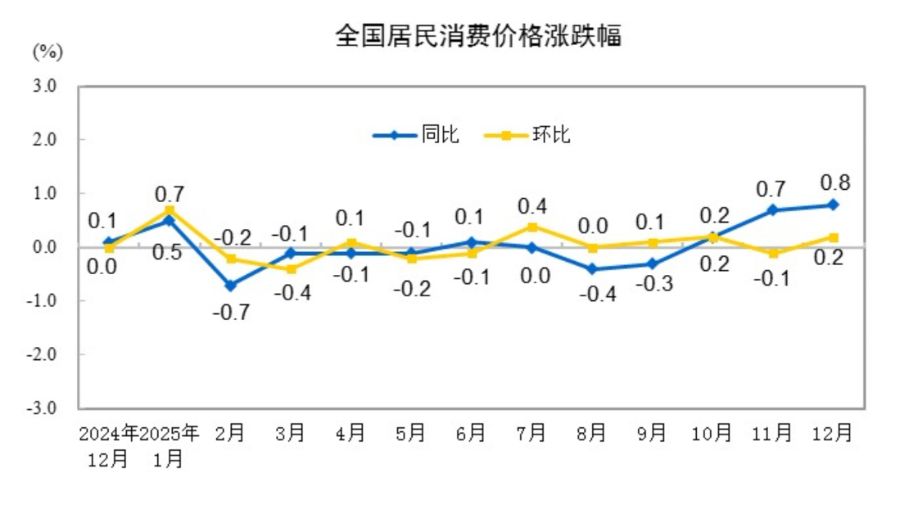
Core Insights - In December 2025, the Consumer Price Index (CPI) increased by 0.8% year-on-year and 0.2% month-on-month, while the Producer Price Index (PPI) decreased by 1.9% year-on-year and increased by 0.2% month-on-month [1][4]. Consumer Prices - The rise in CPI was attributed to effective policies promoting consumption and increased demand due to the upcoming New Year [4]. - Food prices rose by 1.1%, contributing approximately 0.17 percentage points to the CPI increase, with fresh vegetables and fruits seeing significant price hikes of 18.2% and 4.4%, respectively [4][5]. - Core CPI, excluding food and energy, rose by 1.2%, maintaining above 1% for four consecutive months [5]. Producer Prices - PPI saw a month-on-month increase of 0.2%, marking three consecutive months of growth, driven by improved supply-demand dynamics in certain industries [5][6]. - Year-on-year, PPI decreased by 1.9%, but the decline was less severe than the previous month, indicating some positive changes in industry pricing [6]. - Key industries such as coal mining and lithium-ion battery manufacturing experienced price increases, with coal mining prices rising for five consecutive months [5][6]. Market Dynamics - The construction of a unified national market is progressing, leading to a narrowing of price declines in various sectors [6]. - Consumption potential is being effectively released, with notable price increases in cultural and quality goods, such as a 23.3% rise in the manufacturing of arts and crafts products [6].

权威数读丨扩内需促消费持续显效,CPI同比涨幅继续扩大
Xin Hua Wang· 2026-01-09 03:48
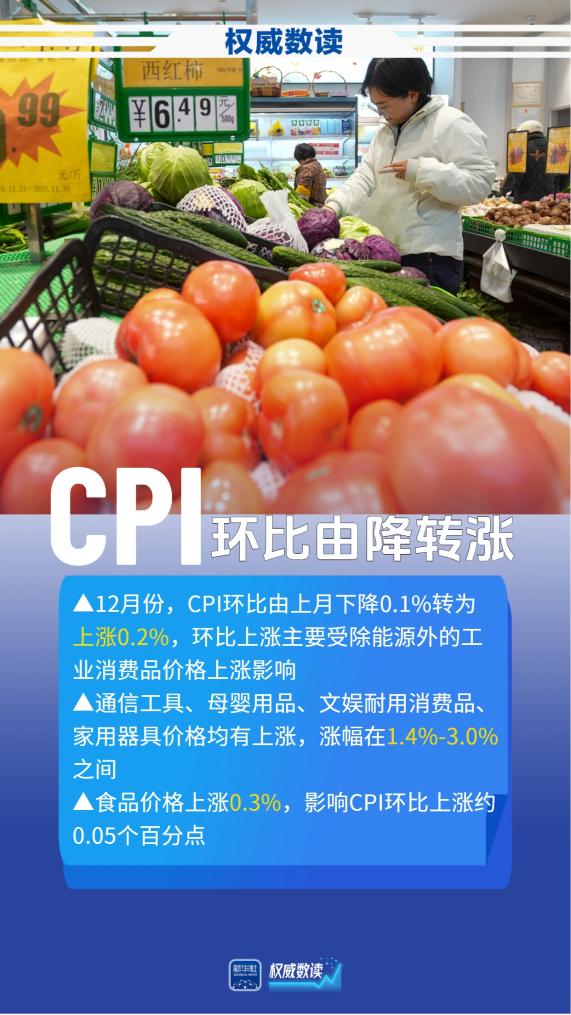
Group 1 - In December, the Consumer Price Index (CPI) increased by 0.2% month-on-month and 0.8% year-on-year, driven by effective policies to boost domestic demand and consumption, along with rising consumer demand as the New Year approached [1] - The month-on-month CPI increase was primarily influenced by rising prices of industrial consumer goods, excluding energy, with prices of communication tools, baby products, entertainment durable goods, and household appliances rising between 1.4% and 3.0% [2] - Year-on-year, the CPI's increase of 0.8% marked a 0.1 percentage point rise from the previous month, reaching the highest level since March 2023, largely due to an increase in food prices [3] Group 2 - The Producer Price Index (PPI) rose by 0.2% month-on-month in December, marking the third consecutive month of increase, with the growth rate expanding by 0.1 percentage points from the previous month [4] - Prices in the coal mining and washing industry and coal processing rose by 1.3% and 0.8% month-on-month, respectively, both showing increases for five consecutive months [4] - International prices of non-ferrous metals have risen, leading to increases in domestic prices for non-ferrous metal mining and selection, as well as non-ferrous metal smelting and rolling industries, with month-on-month increases of 3.7% and 2.8%, respectively [4]
2025年12月份CPI同比上涨0.8%!
Zheng Quan Ri Bao Wang· 2026-01-09 03:12
Group 1 - The core consumer price index (CPI) increased by 0.2% month-on-month and 0.8% year-on-year, with core CPI (excluding food and energy) rising by 1.2% year-on-year, indicating a recovery in consumer demand driven by policies to boost consumption and the upcoming New Year holiday [1][2][3] - Food prices rose by 1.1% year-on-year, with significant increases in fresh vegetables (18.2%) and fresh fruits (4.4%), contributing to the overall CPI increase [3][2] - Energy prices decreased by 3.8% year-on-year, with gasoline prices dropping by 8.4%, while the overall CPI was positively impacted by a 0.3% rise in food prices [3][2] Group 2 - The producer price index (PPI) increased by 0.2% month-on-month, marking the third consecutive month of growth, with a narrowing year-on-year decline of 1.9% [4][5] - Key industries such as coal mining and lithium-ion battery manufacturing saw price increases due to improved supply-demand dynamics and ongoing capacity management policies [4][6] - The prices of non-ferrous metals rose significantly due to international price increases, while oil-related industries experienced price declines due to falling crude oil prices [4][6]
2025年12月份工业生产者出厂价格同比降幅收窄 环比涨幅扩大
Guo Jia Tong Ji Ju· 2026-01-09 01:33
Group 1: Yearly Overview - In December 2025, the national industrial producer's ex-factory prices decreased by 1.9% year-on-year, with a narrowing decline of 0.3 percentage points compared to the previous month; month-on-month, there was a 0.2% increase, which is an expansion of 0.1 percentage points from last month [1] - For the entire year of 2025, the industrial producer's ex-factory prices fell by 2.6%, while the industrial producer's purchase prices decreased by 3.0% [1] Group 2: Year-on-Year Changes - In December, the prices of production materials decreased by 2.1%, contributing approximately 1.53 percentage points to the overall decline in ex-factory prices; within this category, mining industry prices fell by 4.7%, raw materials industry prices decreased by 2.6%, and processing industry prices dropped by 1.6% [4] - The prices of living materials decreased by 1.3%, impacting the overall ex-factory price level by about 0.35 percentage points; food prices fell by 1.5%, clothing prices decreased by 0.1%, while general daily necessities prices increased by 1.4%, and durable consumer goods prices dropped by 3.5% [4] Group 3: Month-on-Month Changes - In December, the ex-factory prices of production materials increased by 0.3%, contributing approximately 0.24 percentage points to the overall increase in ex-factory prices; mining industry prices rose by 0.8%, raw materials industry prices increased by 0.6%, and processing industry prices went up by 0.2% [8] - Living materials prices remained stable; food prices decreased by 0.1%, clothing prices increased by 0.2%, general daily necessities prices rose by 0.5%, and durable consumer goods prices fell by 0.2% [8] Group 4: Purchase Price Changes - In the industrial producer's purchase prices, building materials and non-metallic prices decreased by 6.4%, fuel and power prices fell by 5.7%, chemical raw materials prices dropped by 4.9%, agricultural products prices decreased by 4.1%, black metal materials prices fell by 3.3%, and textile raw materials prices decreased by 1.9%; however, prices for non-ferrous metal materials and wires increased by 10.5% [7]

11月份北京CPI同比上涨0.6%,PPI同比下降1.3%
Bei Jing Shang Bao· 2025-12-16 02:50
Economic Overview - In November, Beijing's consumer price index (CPI) increased by 0.6% year-on-year, with the growth rate expanding by 0.5 percentage points compared to the previous month, while it decreased by 0.2% month-on-month [1] - From January to November, the CPI in Beijing decreased by 0.3% year-on-year, with the decline rate consistent with that of the first ten months [1] Price Changes - Food prices fell by 2.4%, while non-food prices rose by 0.1% [1] - Consumer goods prices decreased by 0.5%, and service prices remained stable [1] - Among the eight categories of goods and services that constitute the CPI, four categories saw price increases while four experienced declines [1] Specific Price Movements - Prices for other goods and services, living goods and services, clothing, and housing rose by 12.1%, 1.9%, 0.2%, and 0.1% year-on-year, respectively [1] - Conversely, transportation and communication, food and tobacco, education and cultural entertainment, and medical care prices fell by 2.2%, 1.5%, 1.2%, and 0.5% year-on-year, respectively [1] Industrial Price Trends - In November, the producer price index (PPI) for industrial producers decreased by 1.3% year-on-year, with the decline rate narrowing by 0.1 percentage points compared to the previous month, and a month-on-month decrease of 0.2% [1] - The purchasing price index also saw a year-on-year decline of 1.7%, with the decline rate narrowing by 0.3 percentage points compared to the previous month, and a month-on-month decrease of 0.1% [1] - From January to November, both the PPI and purchasing prices decreased by 1.7% year-on-year, with the decline rates remaining consistent with those of the first ten months [1]
11月份核心CPI同比上涨1.2%!创2024年3月以来新高
Zheng Quan Shi Bao Wang· 2025-12-15 05:16
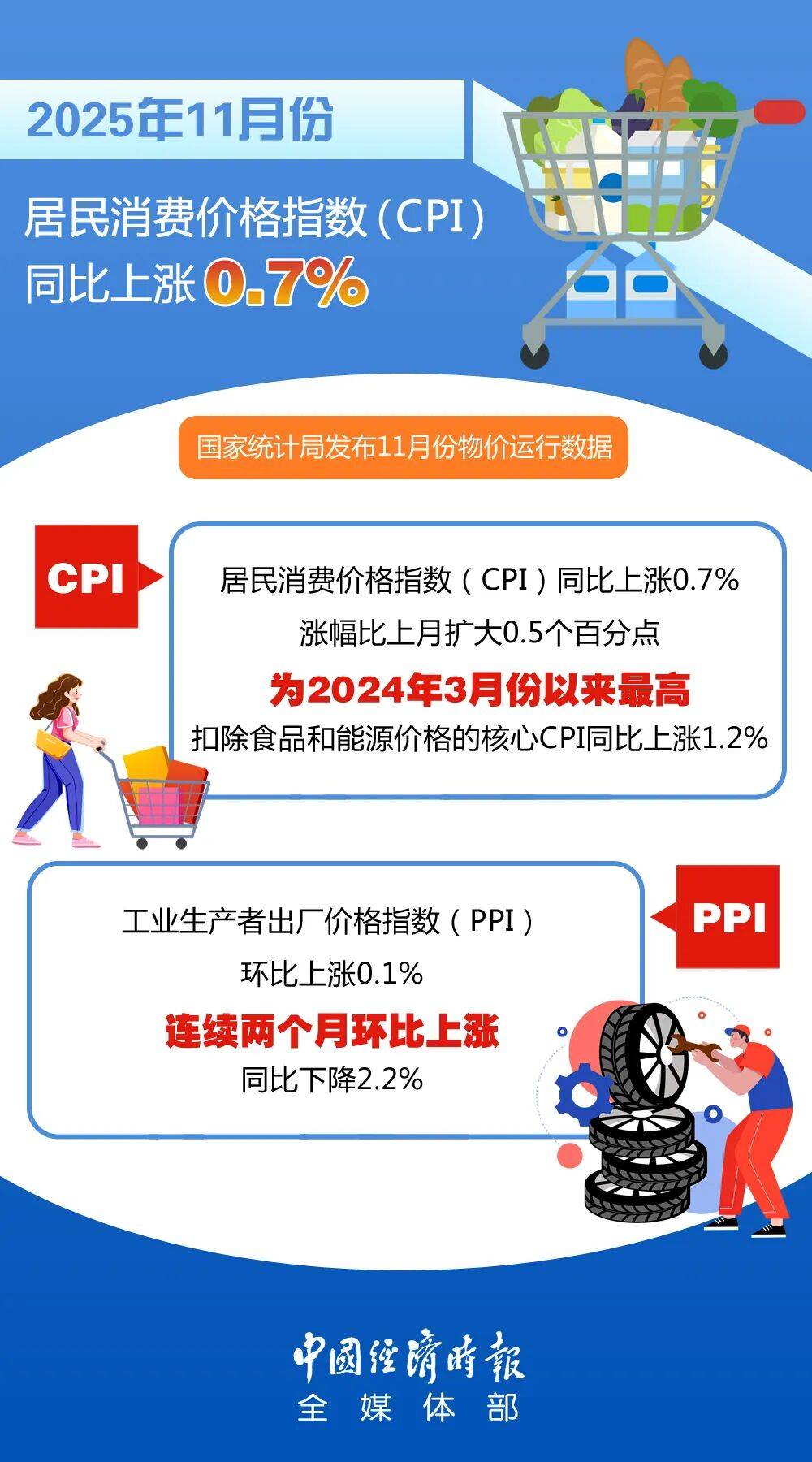
Group 1 - In November, the Consumer Price Index (CPI) increased by 0.7% year-on-year, with the growth rate expanding by 0.5 percentage points compared to the previous month, marking the highest increase since March 2024 [2] - The core CPI, excluding food and energy prices, rose by 1.2% year-on-year, maintaining a growth rate above 1% for three consecutive months [3] - The Producer Price Index (PPI) decreased by 2.2% year-on-year, with the decline rate widening by 0.1 percentage points compared to the previous month, influenced by a high comparison base from the previous year [4] Group 2 - Food prices contributed to the CPI increase, with fresh vegetable prices rising by 14.5% year-on-year after a nine-month decline, significantly impacting the CPI [2] - The prices of coal mining and washing, photovoltaic equipment manufacturing, and lithium-ion battery manufacturing have shown a narrowing decline in year-on-year prices, indicating the effectiveness of measures against "involution" competition [4][5] - Emerging industries are driving price increases in related sectors, with prices for external storage devices and components rising by 13.9% year-on-year, and integrated circuit manufacturing prices increasing by 1.7% [4][5]
下周一,重要预告!
券商中国· 2025-12-12 07:31
Economic Overview - The State Council Information Office will hold a press conference on December 15, 2025, to discuss the national economic operation for November 2025, presented by Fu Linghui, spokesperson of the National Bureau of Statistics [1] Consumer and Producer Price Index - In November, the Consumer Price Index (CPI) increased by 0.7% year-on-year, with the growth rate expanding; the core CPI, excluding food and energy, rose by 1.2%, maintaining a growth rate above 1% for three consecutive months [3] - The Producer Price Index (PPI) saw a month-on-month increase of 0.1%, marking two consecutive months of growth; however, it decreased by 2.2% year-on-year, with the decline rate widening by 0.1 percentage points compared to the previous month [3] - Notably, the effects of comprehensive rectification of "involution-style" competition are becoming evident, as industries such as coal mining, photovoltaic equipment manufacturing, and lithium-ion battery manufacturing have experienced a narrowing of year-on-year price declines for several months [3] - The price trends in certain industries reflect the rapid development of emerging industries and the effective release of consumer potential [3]

发布会预告,就在下周一!
证券时报· 2025-12-12 04:26
Group 1 - The core viewpoint of the article highlights the upcoming press conference by the State Council Information Office on December 15, 2025, where the National Bureau of Statistics will present the economic performance for November 2025 [1] - In November, the Consumer Price Index (CPI) increased by 0.7% year-on-year, with the core CPI (excluding food and energy) rising by 1.2%, maintaining a growth rate above 1% for three consecutive months [2] - The Producer Price Index (PPI) saw a month-on-month increase of 0.1%, marking two consecutive months of growth, while the year-on-year decline was 2.2%, with the decline rate widening by 0.1 percentage points compared to the previous month [2] Group 2 - The article notes that the effects of comprehensive measures to address "involution" competition are becoming evident, with industries such as coal mining, photovoltaic equipment manufacturing, and lithium-ion battery manufacturing experiencing a narrowing of price declines over several months [2] - The price trends in certain industries reflect the rapid development of emerging sectors and the effective release of consumer potential [2]

视说丨11月CPI同比上涨0.7% 涨幅为2024年3月份以来最高
Sou Hu Cai Jing· 2025-12-11 07:02
Group 1 - The Consumer Price Index (CPI) increased by 0.7% year-on-year in November, marking the highest growth since March 2024, with an increase of 0.5 percentage points compared to the previous month [2][3] - The core CPI, excluding food and energy prices, rose by 1.2% year-on-year [2][3] - The Producer Price Index (PPI) increased by 0.1% month-on-month, marking the second consecutive month of increase, while it decreased by 2.2% year-on-year [2][3]
食品价格回升拉动 CPI涨幅创近21个月新高
Zheng Quan Shi Bao· 2025-12-10 18:54
Group 1 - The Consumer Price Index (CPI) increased by 0.7% year-on-year in November, marking the highest growth since March 2024, primarily driven by a turnaround in food prices [1][2] - The core CPI, excluding food and energy, rose by 1.2% year-on-year, maintaining a growth rate above 1% for three consecutive months [2] - Food prices increased by 0.2% year-on-year, while non-food prices rose by 0.8%, with fresh vegetable prices experiencing a significant increase of 14.5% after a decline of 7.3% in the previous month [1][3] Group 2 - The Producer Price Index (PPI) saw a month-on-month increase of 0.1% for two consecutive months, but the year-on-year decline expanded to 2.2%, influenced by high comparison bases from the previous year [2] - The narrowing of year-on-year price declines in certain industries, such as coal mining and photovoltaic equipment manufacturing, indicates the effectiveness of macroeconomic policies [3] - Emerging industries are driving price increases, with external storage devices and components seeing a year-on-year price rise of 13.9%, and arts and crafts manufacturing prices increasing by 20.6% [3]