推理模型

Search documents
专为实际应用场景设计,旨在追赶美中,欧洲首个AI推理模型来了
Huan Qiu Shi Bao· 2025-06-11 22:33
Group 1 - Mistral AI, a French AI startup, launched its first reasoning model, marking Europe's first breakthrough in this area, aiming to compete with US and Chinese counterparts [1][2] - The company released two versions of the new model: Magistral Small for the open-source community and a more powerful version, Magistral Medium, designed for enterprise clients [1][2] - The reasoning model is intended for practical applications in fields such as law, finance, healthcare, and engineering, with claims of superior performance in mathematical operations and programming [1][2] Group 2 - The traditional method of building larger language models through increased data and computing power is showing limitations, making reasoning models a potential breakthrough for enhancing AI capabilities [2] - Mistral AI is valued at $6.2 billion, and the shift in the industry from "scale expansion" to other directions may provide opportunities for the company to catch up with better-funded competitors [2] - Despite the launch, Mistral is reportedly lagging in the development of reasoning models, with its Magistral Medium performing below competitors like Google's Gemini 2.5 Pro and Anthropic's Claude Opus 4 in various benchmarks [4] Group 3 - Mistral AI was founded in 2023 by three former researchers from Meta and Google DeepMind, and has released a series of open-source AI models and the Le Chat chatbot platform [5] - The company is expected to surpass $100 million in revenue for the first time this year, benefiting from Europe's strategy to cultivate local tech leaders amid increasing demand for alternatives to US suppliers [5] - Although Mistral is seen as a leading representative of European AI competitors, it still lags behind in market share and revenue compared to its US and Chinese rivals [5]


OpenAI发布最强模型o3-pro
第一财经· 2025-06-11 05:29
Core Viewpoint - OpenAI has launched its new model o3-pro, which outperforms competitors in various benchmarks, while also significantly reducing the pricing of its previous model o3, indicating a strategic shift in the competitive landscape of AI models [1][3][4]. Model Launch and Performance - OpenAI announced the official launch of o3-pro, which is now available to Pro and Team users, with enterprise and educational users gaining access the following week [1]. - In internal tests, o3-pro surpassed Google's Gemini 2.5 Pro in the AIME 2024 math benchmark and outperformed Anthropic's Claude 4 Opus in the GPQA Diamond test, showcasing its leading performance in reasoning models [3]. - Despite its advanced capabilities, users reported slow response times, indicating potential issues with the model's speed [3]. Pricing Strategy - OpenAI has reduced the pricing of the previous o3 model by 80%, with input costs dropping from $10 per million tokens to $2, and output costs from $40 to $8 per million tokens [3]. - The new o3-pro model charges $20 per million tokens for input and $80 for output, which is 87% cheaper than the previous o1-pro model [3]. Cloud Services Collaboration - OpenAI has entered a cloud services partnership with Google to utilize its computing resources, marking a strategic move to reduce reliance on Microsoft [4]. - This collaboration is seen as a significant win for Google's cloud services business [4]. Future Projections - OpenAI's CEO outlined a timeline for future AI developments, predicting the emergence of cognitive agent systems by 2025, systems capable of novel insights by 2026, and robots capable of executing real-world tasks by 2027 [5]. - The 2030s are expected to bring unprecedented advancements in intelligence, energy, and creativity, potentially revolutionizing productivity and research capabilities [5]. Energy Consumption Insights - The average energy consumption for a ChatGPT query is approximately 0.34 watt-hours, comparable to the energy used by an oven in just over a second or a compact fluorescent bulb in a few minutes [5]. - Each query also consumes about 0.000085 gallons of water, equivalent to roughly one-fifteenth of a teaspoon [5]. Technological Advancement and Societal Impact - The pace of technological advancement is expected to accelerate, leading to significant societal changes, including job displacement in certain sectors, but also increased wealth and new policy considerations [6]. - OpenAI's CEO emphasized the exponential nature of technological progress, suggesting a smooth curve of advancement that appears vertical when looking forward [7]. Upcoming Model Developments - OpenAI is developing the next-generation foundational model, GPT-5, which is expected to significantly outperform GPT-4, with a tentative release date set for this summer, although this may change based on performance evaluations [8]. - The company plans to invest more time in public weight models, with updates anticipated later in the summer rather than in June [8].
WWDC前夕,苹果论文“炮轰”AI推理模型“假思考”,测试方法遭质疑
Mei Ri Jing Ji Xin Wen· 2025-06-09 11:06
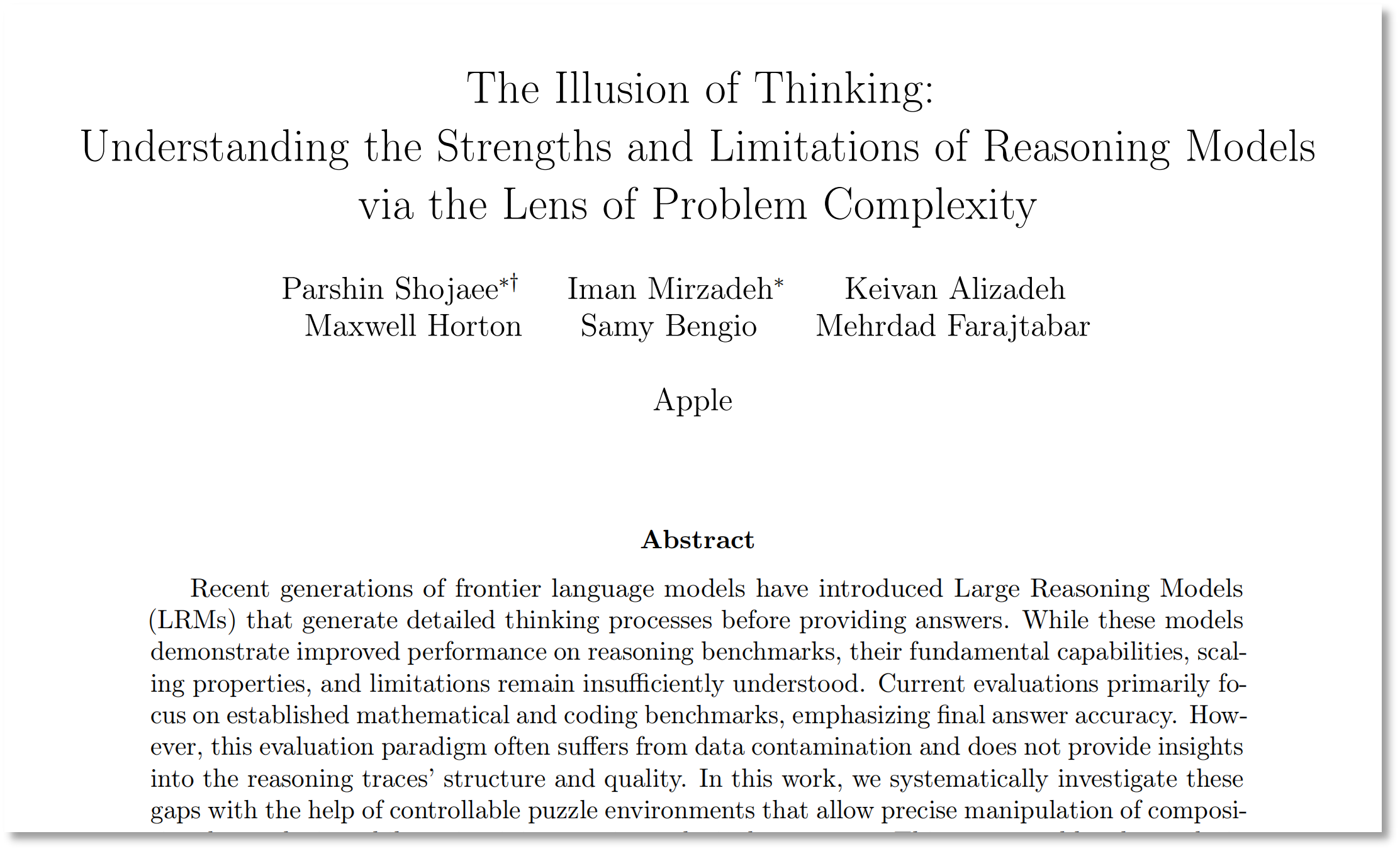
Core Viewpoint - The paper published by Apple's Machine Learning Research Center argues that existing reasoning models create an illusion of "thinking" without a stable and understandable thought process, suggesting that their reasoning capabilities are fundamentally flawed [1][4][6] Group 1: Paper Findings - The paper critiques the reasoning models developed by companies like OpenAI, Anthropic, Google, and DeepMind, claiming that these models do not possess a reliable reasoning process [4][6] - Apple's team designed four types of puzzle environments to test reasoning models, including Tower of Hanoi, checkers exchange, river crossing, and block world, to evaluate their reasoning capabilities under controlled difficulty [4][6] - Experimental results indicate that non-reasoning models outperform reasoning models in low-complexity tasks, while reasoning models show advantages in moderately complex tasks [6][7] Group 2: Limitations of Reasoning Models - Both reasoning and non-reasoning models experience a significant drop in performance when task complexity exceeds a certain threshold, with accuracy dropping to zero [7][9] - As problem complexity increases, reasoning models initially invest more thinking tokens, but their reasoning ability collapses when faced with overly difficult problems, leading to reduced effort in thinking [9][10] - In simpler problems, models often find correct solutions early but engage in unnecessary thinking later, while in high-complexity problems, reasoning becomes chaotic and incoherent [10][11] Group 3: Controversy and Reactions - The paper has sparked controversy, with some researchers arguing that the failure of models in tests is due to output token limitations rather than a lack of reasoning ability [12] - Critics suggest that Apple's focus on the limitations of current methods may reflect frustration over its own AI advancements, especially with the upcoming WWDC event expected to yield limited AI updates [13][14] - Internal challenges at Apple, including leadership styles and privacy policies, have reportedly hindered progress in AI development, contributing to the perception of stagnation in their AI initiatives [14][15]

苹果炮轰推理模型全是假思考!4个游戏戳破神话,o3/DeepSeek高难度全崩溃
量子位· 2025-06-08 03:40AI Processing

数据中心:英伟达对行业的启示
2025-06-02 15:44
Summary of Key Points from the Conference Call Industry Overview - The conference call primarily discusses the **Data Center** industry, with a focus on **NVIDIA (NVDA)** and its implications for AI adoption and computing power demand [1][2]. Core Insights - **NVIDIA's Outlook**: NVDA maintains a positive outlook on the rapid adoption of AI technologies, emphasizing that the demand for computing power is increasing as training and reasoning models evolve [1]. - **AI Adoption Risks**: There are concerns regarding the pace of AI adoption potentially not leading to the expected increase in data center leasing. Key risks include: 1. The anticipated volume of data center leasing may not materialize as expected. 2. The deployment of AI inferencing workloads in colocation facilities may be lower than anticipated. 3. A potential lull in leasing activity or continued efficiency gains could result in excess supply [2]. - **Performance Metrics**: In Q1, Microsoft processed over **100 trillion tokens**, marking a **five-fold increase** year-over-year, indicating a significant surge in inference demand driven by AI [7]. Infrastructure Development - **Early Phase of Build-Out**: The industry is still in the early stages of necessary infrastructure development for AI, similar to past infrastructure expansions for electricity and the internet [8]. - **Enterprise AI Deployment**: NVDA anticipates that AI will increasingly be integrated into enterprise environments due to data access control and latency concerns, as much data remains on-premises [8]. Technological Advancements - **Chip Performance Improvements**: NVDA expects continued enhancements in chip performance, with recent software optimizations improving the performance of the Blackwell chip by **1.5 times** in just one month [8]. - **Latency Importance**: As AI models become more complex, latency becomes crucial for performance, with NVDA's Grace Blackwell chip designed to significantly enhance inference performance [8]. Company Ratings and Recommendations - **Digital Realty Trust, Inc. (DLR)**: Rated **Underweight** with a closing price of **$169.58**. The price target is set at **$139**, based on a **20x multiple** of the 2026 AFFO estimate [44][51]. - **Equinix, Inc. (EQIX)**: Rated **Equal Weight** with a closing price of **$880.62**. The price target is set at **$837**, using a **21x multiple** of the 2026 AFFOps estimate [52][59]. - **Iron Mountain Inc. (IRM)**: Rated **Overweight** with a closing price of **$97.29**. The price target is set at **$121**, based on a **22x multiple** of the 2026E AFFO per share [61][68]. Additional Considerations - **Market Conditions**: Changes in macroeconomic conditions, such as fluctuations in the US dollar, energy costs, and interest rates, could significantly impact the earnings and valuations of the companies discussed [51][60][69]. - **AI's Role in Future Infrastructure**: There is a growing recognition of AI as a critical infrastructure component for industries and societies, which presents numerous opportunities for growth [8]. This summary encapsulates the key points from the conference call, highlighting the current state and future outlook of the data center industry, particularly in relation to AI advancements and the associated risks and opportunities.




英伟达20250529
2025-05-29 15:25
Key Points Summary of NVIDIA's Earnings Call Company Overview - **Company**: NVIDIA - **Date of Call**: May 29, 2025 Core Industry Insights - **Industry**: Semiconductor and AI Technology - **Market Impact**: U.S. export controls are expected to significantly affect NVIDIA's revenue, particularly in the Chinese market, with an anticipated loss of $2.5 billion in revenue due to restrictions on the H20 data center GPU [2][4][26]. Financial Performance - **Q1 2026 Revenue**: NVIDIA reported a strong performance with total revenue of $44 billion, a 69% year-over-year increase. Data center revenue reached $39 billion, up 73% year-over-year [4]. - **H20 Revenue**: Confirmed $460 million in H20 revenue, but faced a $4.5 billion expense due to inventory and procurement obligations write-downs [4][26]. - **Gaming Revenue**: Achieved a record $3.8 billion in gaming revenue, a 42% increase year-over-year [2][18]. - **Network Business**: Revenue grew 64% year-over-year to $5 billion, with the Spectrum X product line exceeding $8 billion in annual revenue [2][13][16]. Product and Technology Developments - **Blackwell Product Line**: Contributed nearly 70% of data center computing revenue, with rapid growth and deployment of NVL 70 dual racks [5][6]. - **AI Factory Deployment**: Nearly 100 AI factories are operational, doubling GPU usage across various industries [7]. - **Nemo Microservices**: Widely adopted across industries, enhancing model accuracy and response times significantly [9]. - **Spectrum X and Quantum X**: New products launched to enhance AI factory scalability and efficiency [16]. Market Challenges and Opportunities - **Export Controls**: Anticipated to create an $8 billion negative impact in Q2, with a total estimated impact of $15 billion [3][26]. - **China Market**: Data center revenue from China is expected to decline significantly due to export restrictions, although over 99% of data center computing revenue comes from U.S. customers [2][17]. - **AI Spending Growth**: Projected near $1 trillion in AI spending over the next few years, driven by infrastructure investments [27]. Strategic Partnerships and Collaborations - **Partnerships**: Collaborated with Yum Brands to implement AI in 500 restaurants, with plans to expand to 61,000 [10]. - **Cybersecurity Solutions**: Leading companies like Checkpoint and CrowdStrike are utilizing NVIDIA's AI-driven security solutions [11][12]. Future Outlook - **Growth Confidence**: Despite challenges, NVIDIA maintains confidence in sustained growth for the year, driven by the removal of AI diffusion rules and strong performance in non-China business segments [30][31]. - **Investment in AI Infrastructure**: Significant investments in domestic manufacturing and AI infrastructure are underway, including new facilities in Arizona and Texas [24]. Additional Insights - **Gaming and AI PC Growth**: The gaming sector continues to thrive with a user base of 100 million, and new AI PC products are being introduced [18]. - **Automotive Sector**: Revenue from automotive reached $567 million, a 72% increase, driven by demand for autonomous driving solutions [20]. - **Professional Visualization**: Revenue in this segment was $509 million, with strong demand for AI workstations [19]. This summary encapsulates the key points from NVIDIA's earnings call, highlighting the company's financial performance, product developments, market challenges, and future outlook.
英伟达CEO黄仁勋谈及Deepseek,称:推理模型要求更大的算力(支持),这正驱动推理需求。
news flash· 2025-05-28 21:41
Core Viewpoint - NVIDIA CEO Jensen Huang discussed the increasing demand for inference models, emphasizing that these models require greater computational power, which is driving the demand for inference capabilities [1] Group 1 - The need for enhanced computational support is a key factor in the growing demand for inference models [1]
Google搜索转型,Perplexity入不敷出,AI搜索还是个好赛道吗?
Founder Park· 2025-05-27 12:20
Core Viewpoint - The article discusses the transformation of Google's search business towards AI-driven search modes, highlighting the challenges faced by traditional search engines in the face of emerging AI technologies and competition from Chatbot-integrated platforms [4][24]. Group 1: Google's AI Search Transformation - Google announced the launch of its AI Mode powered by Gemini, which allows for natural language interaction and structured answers, moving away from traditional keyword-based searches [2][4]. - In 2024, Google's search business is projected to generate $175 billion, accounting for over half of its total revenue, indicating the significant financial stakes involved in this transition [4]. - Research suggests that Google's search market share has dropped from over 90% to between 65% and 70% due to the rise of AI Chatbots, prompting the need for a strategic shift [4][24]. Group 2: Challenges for AI Search Engines - Perplexity, an AI search engine, saw its user visits increase from 45 million to 129 million, a growth of 186%, but faced a net loss of $68 million in 2024 due to high operational costs and reliance on discounts for subscription revenue [9][11]. - The overall funding for AI search products has decreased, with only 10 products raising a total of $893 million from August 2024 to April 2025, compared to 15 products raising $1.28 billion in the previous period [11][12]. - The competitive landscape for AI search engines has worsened, with many smaller players struggling to secure funding and differentiate themselves from larger companies [11][12][25]. Group 3: Shift Towards Niche Search Engines - The article notes a trend towards more specialized search engines, focusing on specific industries or use cases, as general AI search engines face increasing competition from integrated Chatbot functionalities [13][25]. - Examples of niche search engines include Consensus, a health and medical search engine, and Qura, a legal search engine, both of which cater to specific professional audiences [27][30]. - The overall direction for AI search engines is towards being smaller, more specialized, and focused on delivering unique value propositions to specific user groups [13][26]. Group 4: Commercialization Challenges - The commercialization of AI search remains a significant challenge, with Google exploring ways to integrate sponsored content into its AI responses while facing potential declines in click-through rates for traditional ads [43]. - The article emphasizes the need for AI search engines to deliver more reliable and usable results, either through specialized information or direct output capabilities, to remain competitive [43][24].


Llama核心团队「大面积跑路」:14人中11人出走,Mistral成主要去向
Founder Park· 2025-05-27 04:54
Core Insights - Meta is facing significant talent loss in its AI team, with only 3 out of 14 core members of the Llama model remaining employed [1][2][5] - The departure of key researchers raises concerns about Meta's ability to retain top AI talent amidst competition from faster-growing open-source rivals like Mistral [2][4][5] - Meta's Llama model, once a cornerstone of its AI strategy, is now at risk due to the exodus of its original creators [2][6] Talent Loss and Competition - The AI team at Meta has seen a severe talent drain, with 11 out of 14 core authors of the Llama model having left the company, many joining competitors [1][2][5] - Mistral, a startup founded by former Meta researchers, is developing powerful open-source models that directly challenge Meta's AI projects [4][5] - The average tenure of the departed researchers was over five years, indicating they were deeply involved in Meta's AI initiatives [8] Leadership Changes and Internal Challenges - Meta is experiencing internal pressure regarding the performance and leadership of its largest AI model, Behemoth, leading to delays in its release [5][6] - The recent restructuring of the research team, including the departure of Joelle Pineau, raises questions about Meta's strategic direction in AI [5][6] - Meta's inability to launch a dedicated "reasoning" model has widened the gap between it and competitors like Google and OpenAI, who are advancing in complex reasoning capabilities [8] Declining Position in Open Source - Meta's once-leading position in the open-source AI field has diminished, as it has not released a proprietary reasoning model despite investing billions [8] - The Llama model's initial success has not translated into sustained leadership, with the company now struggling to maintain its early advantages [6][8]


DeepSeek用的GRPO有那么特别吗?万字长文分析四篇精品论文
机器之心· 2025-05-24 03:13
Core Insights - The article discusses recent advancements in reasoning models, particularly focusing on GRPO and its improved algorithms, highlighting the rapid evolution of AI in the context of reinforcement learning and reasoning [1][2][3]. Group 1: Key Papers and Models - Kimi k1.5 is a newly released reasoning model that employs reinforcement learning techniques and emphasizes long context extension and improved strategy optimization [10][17]. - OpenReasonerZero is the first complete reproduction of reinforcement learning training on a foundational model, showcasing significant results [34][36]. - DAPO explores improvements to GRPO to better adapt to reasoning training, presenting a large-scale open-source LLM reinforcement learning system [48][54]. Group 2: GRPO and Its Characteristics - GRPO is closely related to PPO (Proximal Policy Optimization) and shares similarities with RLOO (REINFORCE Leave One Out), indicating that many leading research works do not utilize GRPO [11][12][9]. - The core understanding is that current RL algorithms are highly similar in implementation, with GRPO being popular but not fundamentally revolutionary [15][6]. - GRPO includes clever modifications specifically for reasoning training rather than traditional RLHF scenarios, focusing on generating multiple answers for reasoning tasks [13][12]. Group 3: Training Techniques and Strategies - Kimi k1.5's training involves supervised fine-tuning (SFT) and emphasizes behavior patterns such as planning, evaluation, reflection, and exploration [23][24]. - The training methods include a sequence strategy that starts with simpler tasks and gradually increases complexity, akin to human learning processes [27][28]. - The paper discusses the importance of data distribution and the quality of prompts in ensuring effective reinforcement learning [22][41]. Group 4: DAPO Improvements - DAPO introduces two distinct clipping hyperparameters to enhance the learning dynamics and efficiency of the model [54][60]. - It also emphasizes dynamic sampling by removing samples with flat rewards from the batch to improve learning speed [63]. - The use of token-level loss rather than per-response loss is proposed to better manage learning dynamics and avoid issues with long responses [64][66]. Group 5: Dr. GRPO Modifications - Dr. GRPO aims to improve learning dynamics by modifying GRPO to achieve stronger performance with shorter generated lengths [76][79]. - The modifications include normalizing advantages across all tokens in a response, which helps in managing the learning signal effectively [80][81]. - The paper highlights the importance of high-quality data engineering in absorbing the effects of these changes, emphasizing the need for a balanced distribution of problem difficulty [82][89].