
美元储备货币地位

Search documents
每日机构分析:6月12日
Xin Hua Cai Jing· 2025-06-12 08:21
Group 1 - The core viewpoint suggests that Powell's stance in the upcoming June FOMC meeting may lean hawkish, potentially disappointing investors expecting rate cuts [1] - The recent sell-off of U.S. assets is attributed more to tariff policy impacts rather than a loss of confidence in the dollar's reserve currency status, although long-term trends could weaken this status [2] - Analysts predict a further decline in U.S. Treasury yields over the next few months, with the 10-year yield expected to drop to 4.35% in three months and 4.29% in six months from the current 4.48% [2] Group 2 - The decline in UK GDP provides another reason for the Bank of England to consider a rate cut in August, with April's GDP shrinking by 0.3% [3] - The current low volatility in the foreign exchange market may trigger a rebound in the dollar, as interest rate differentials become more pronounced [3] - Despite concerns over excess supply in the U.S. Treasury market, most economists expect the Federal Reserve to only cut rates two times or less this year [2]
牛津经济研究院:长期美国资产抛售可能损害美元的储备货币地位
news flash· 2025-06-11 11:55
Core Viewpoint - The recent sell-off of U.S. assets is more likely a result of President Trump's tariff policies rather than a loss of confidence in the dollar's status as a reserve currency [1] Group 1 - If the current cyclical pressures on U.S. assets evolve into a long-term trend, the dollar's status as a reserve currency may be weakened [1] - Trade protectionism would need to be exacerbated by other drastic policy changes to reach this stage [1] - The U.S. would have to take measures to directly restrict capital flows and allow public debt dynamics to become unsustainable [1]
市场激辩美元应该贬多少?这是三个“关键假设”
Hua Er Jie Jian Wen· 2025-06-11 04:58
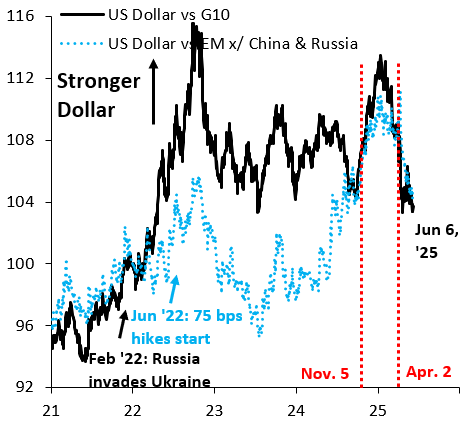
今年前五个月,美元累计下跌8.4%,创下兑一篮子全球货币的有史以来最差"开年表现"。美元后续该如 何走?知名经济学家Robin Brooks详细分析了市场当前正在激烈辩论的三种假设。 在6日10日发表的一篇题为《围绕美元的意志之战》分析文章中,前国际金融协会首席经济学家、现美 国智库布鲁金斯学会高级研究员Robin Brooks认为,针对美元持续走软现象,市场的激烈辩论并非毫无 头绪的口水战,而是围绕着三个核心的"假设"展开: 第一种是最温和的,认为这只是暂时的周期性回调;第二种则比较令人忧虑,担心美联储的 独立性可能动摇;而第三种则是最极端的,认为美元的全球储备货币地位将不保。 Brooks认为,当前围绕美元方向的辩论主要集中在两种假设之间,预测美元仍处于可能持续数十年的多 周期强化进程中。 美元下跌的真实幅度:数据胜过恐慌 许多人对美元近期走势的担忧可能被夸大了。他认为,"多年来,美元首次经历持续下跌",这种不寻常 的现象引发了各种过度解读和夸大其词的分析。 Brooks通过具体数据为读者厘清了现实情况:自11月5日大选以来,美元兑其他发达经济体货币仅下跌 4%,而兑新兴市场货币篮子基本持平。 Brook ...

英国央行行长贝利:美元失去储备货币地位将会对市场造成不稳定,不认为这种情况会发生。
news flash· 2025-06-03 10:01
英国央行行长贝利:美元失去储备货币地位将会对市场造成不稳定,不认为这种情况会发生。 ...
问题在于美元的武器化,而不是美国的国债
Sou Hu Cai Jing· 2025-05-30 05:17
Group 1 - The core argument is that Elon Musk and DOGE have reportedly prevented the theft of $175 billion from American taxpayers, which was allegedly funneled to fraudulent companies benefiting political allies [2] - The article emphasizes the contrast between Trump's military spending and his portrayal as a peace president, suggesting that internal and external threats are manipulated for political gain [3] - It argues that as long as the dollar remains the world's reserve currency, the U.S. deficit is not a significant issue, as foreign central banks are happy to hold U.S. debt [4] Group 2 - The article highlights that the real danger to U.S. debt financing comes from sanctions, which have led to the rise of BRICS nations seeking alternatives to the dollar [5] - It warns that losing the status of the world's reserve currency could have catastrophic consequences, drawing a parallel to the decline of Britain post-World War II [6]
美国达拉斯联储主席Logan:大多数指标表明长期通胀预期得到锚定。美元作为储备货币使美国受益匪浅。
news flash· 2025-05-30 01:00
Core Insights - The majority of indicators suggest that long-term inflation expectations are anchored [1] - The status of the US dollar as a reserve currency provides significant benefits to the United States [1]
英国央行行长贝利:询问美元是否仍将作为储备货币并无太大意义,未来可能会出现一些调整,但离美元失去其地位还为时尚早。
news flash· 2025-05-29 21:10
英国央行行长贝利:询问美元是否仍将作为储备货币并无太大意义,未来可能会出现一些调整,但离美 元失去其地位还为时尚早。 ...
前日本央行官员:由于无可替代资产,日本很可能并未抛售美债
智通财经网· 2025-05-29 09:14
Group 1 - The former Bank of Japan official Sayuri Shirai stated that Japan is unlikely to sell its substantial U.S. Treasury holdings due to the dollar's status as a global reserve currency [1] - Japan and China are the two largest holders of U.S. Treasuries, and their actions are closely monitored, especially during times of rising U.S. Treasury yields [1] - Shirai emphasized that Japan has no other viable investment options, reinforcing the dollar's unshakeable position as a reserve currency due to the depth of U.S. capital markets and the country's technological competitiveness [1] Group 2 - European Central Bank President Christine Lagarde suggested that the euro could potentially rival the dollar if Eurozone governments strengthen their financial and security frameworks [2] - Shirai expressed skepticism about the euro's ability to replace the dollar, citing political divisions in Europe and insufficient depth in the region's capital markets [2] - In Asia, Shirai believes the renminbi is more likely to emerge as a potential competitor to the dollar, as China increases the use of its currency in trade [2] - The dollar's share in international reserves has been on a declining trend, currently at 58%, the lowest in decades, while the euro holds 20%, and the renminbi accounts for 2% [2]
特朗普关税引爆“多米诺骨牌”!美银预警:美元跌势远未结束
Jin Shi Shu Ju· 2025-05-23 05:20
Group 1 - The core viewpoint of the articles indicates that the US dollar is facing downward pressure due to concerns over tariffs, recession risks, and unsustainable fiscal policies, despite its status as the world's reserve currency appearing secure for now [1][2] - Analysts from Bank of America suggest that the dollar may continue to weaken, as it is currently "overvalued" compared to other widely traded currencies, and the ongoing tariff situation is likely to lead to price increases and economic slowdown [1] - The ICE dollar index has declined nearly 4% since the announcement of tariffs on April 2, indicating a significant impact on the dollar's value [1] Group 2 - Dario Perkins from TS Lombard notes that the historical dominance of the dollar as a reserve currency began in 1944 with the Bretton Woods Agreement, which linked currencies to the dollar and the dollar to gold [2] - Perkins argues that despite the collapse of the Bretton Woods system, the dollar has maintained its position in the international monetary system, as global demand for dollar-denominated assets remains strong [2] - The current US administration appears to view the dollar's reserve status as a burden, which Perkins believes is a fundamental misunderstanding of how dollar hegemony operates [2][3] Group 3 - Perkins predicts that the current administration's actions may lead to a weaker dollar, which could inadvertently strengthen other economies [3] - He emphasizes that while the dollar's reserve currency status will not be lost immediately, the era of US exceptionalism is over, and the dollar's exchange rate is on a downward trend [3]