
财政改革

Search documents
日本财务大臣加藤胜信:超长期利率已大幅上升。将密切关注金融市场动态,包括超长期债券交易。旨在推动经济增长的同时实施财政改革。将与市场参与者进行全面沟通。
news flash· 2025-05-29 05:39
Group 1 - The Japanese Finance Minister, Kato Katsunobu, stated that ultra-long-term interest rates have significantly increased [1] - The government will closely monitor financial market dynamics, including ultra-long-term bond trading [1] - The aim is to promote economic growth while implementing fiscal reforms [1] - There will be comprehensive communication with market participants [1]
“大美丽法案”初探
Orient Securities· 2025-05-28 00:15
Legislative Developments - The "One Big Beautiful Tax Cut" bill was passed by the House of Representatives with a narrow margin of 215 votes in favor and 214 against, with all Democrats and two Republicans opposing it[14] - The bill is projected to increase the deficit by $3-4 trillion over the next 10 years, with $1 trillion in spending cuts and $4-5 trillion in tax reductions[19] Key Provisions - The bill includes tax reforms such as extending the Tax Cuts and Jobs Act (TCJA) provisions, reducing medical and food assistance, and increasing military spending[15][18] - It proposes to raise the debt ceiling by $4 trillion, allowing for increased government borrowing[19] Market Reactions - The U.S. stock market experienced a pullback, with the Nasdaq and S&P 500 indices declining by 2.47% and 2.61% respectively during the week of May 17-24, 2025[6] - Long-term U.S. Treasury yields rose significantly, reflecting ongoing concerns about debt demand and inflation[6] Economic Indicators - The S&P Global PMI for May showed better-than-expected expansion, with manufacturing and services PMIs both at 52.3, indicating economic resilience despite tariff risks[31] - Natural gas prices surged by 11.16%, contributing to a general increase in commodity prices, while Bitcoin rose by 3.78%[6] Risks and Uncertainties - Economic fundamentals remain uncertain, with potential for a hard landing if employment and consumption metrics deteriorate significantly[34] - Policy uncertainties persist, particularly regarding the Trump administration's fiscal strategies and potential changes in tariff negotiations[34]
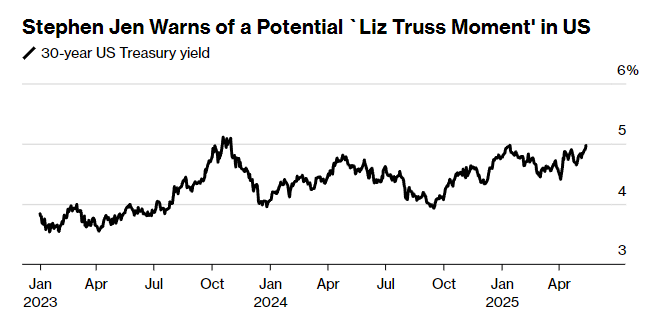
美债收益率逼近5%临界点!市场元老:或需一场“特拉斯式崩盘”倒逼财政改革
智通财经网· 2025-05-14 23:42
Group 1 - The core viewpoint is that the U.S. government may need a significant market crisis, similar to the one experienced in the UK under former Prime Minister Liz Truss, to prompt necessary fiscal reforms and address the rising budget deficit [1][2]. - Stephen Jen expresses concern over the current trajectory of U.S. fiscal policy, indicating that despite hopes for cost-cutting measures, the government is not moving in the right direction [1][2]. - The U.S. fiscal deficit is at a dangerous level, with deficit rates exceeding 6% for the past two years, which is unusual outside of economic downturns or wartime [2]. Group 2 - The long-term U.S. Treasury yields are rising, with the 10-year Treasury yield approaching 5%, driven by concerns over the debt situation exacerbated by proposed tax cuts [2]. - The House of Representatives' proposed legislation could increase the U.S. debt burden by at least $3.3 trillion by 2034, pushing the annual deficit rate above 7% [2]. - A report co-authored by Jen outlines the potential for meaningful cost reductions of up to $500 billion through the DOGE initiative, alongside an additional $300 billion from increased tariffs, yet this would still leave a $1.2 trillion deficit gap that only spending cuts could address [5].

墨西哥财政部长:墨西哥在未来一年半内不需要进行财政改革。
news flash· 2025-05-12 15:01
Core Viewpoint - The Mexican Finance Minister stated that Mexico does not require fiscal reforms in the next year and a half [1] Group 1 - The Finance Minister's assertion indicates a stable fiscal outlook for Mexico in the short term [1]
宋雪涛:川普百日维新的“化债蓝图”
雪涛宏观笔记· 2025-05-09 11:27
Core Viewpoint - The article discusses the implications of Trump's debt management strategies, highlighting the risks associated with potential U.S. debt defaults and the impact on market confidence [1][17]. Group 1: Economic Strategies and Implications - Trump's focus has been on "debt management" since taking office, aiming to reduce fiscal deficits while navigating complex reforms in healthcare, social security, and military spending [3]. - A weak dollar, weak U.S. stock market, and a weak economy can serve political purposes, benefiting certain voter demographics while allowing for necessary economic adjustments [5][6]. - Short-term economic downturns and stock market corrections are viewed as necessary for fiscal reform and debt reduction, with the potential for recovery before the midterm elections [9]. Group 2: U.S. Debt Situation - As of April 25, the total U.S. debt stood at $36.2 trillion, with interest payments projected to reach $881 billion in the 2024 fiscal year, accounting for 13% of total government spending [12][14]. - High interest rates have suppressed financing demand and contributed to liquidity issues in the banking sector, exemplified by the collapse of Silicon Valley Bank [10]. - Trump's administration faces significant challenges in managing debt levels and ensuring fiscal sustainability, with spending cuts progressing slower than planned [14]. Group 3: Market Reactions and Risks - The market reacted negatively to Trump's tariff announcements, with the S&P 500 index dropping 10% and 10-year Treasury yields rising significantly [23]. - Concerns about the credibility of U.S. debt have emerged, particularly in light of Trump's threats to replace the Federal Reserve Chair, which could undermine the independence of the central bank [20][21]. - The potential for a "credit crisis" looms if market confidence in U.S. debt continues to erode, as the perception of U.S. Treasury securities as "risk-free" is challenged [19]. Group 4: Demand and Supply Dynamics of U.S. Debt - Recent rumors about a $6 trillion debt maturity in June were clarified, indicating that most of this debt is short-term and will be rolled over, thus not posing an immediate threat [24][26]. - The demand for U.S. debt remains relatively stable, with domestic institutions absorbing much of the issuance despite some reductions in holdings by traditional foreign investors [26][28]. - Alternatives to U.S. debt, such as gold and other high-rated government bonds, are limited in scale and yield, maintaining investor reliance on U.S. Treasuries in the short term [30][28].
历史性财政改革方案将显著提振德国经济
Cai Jing Wang· 2025-04-11 07:49
五年宏观展望:德国赤字扩张与增长路径 基于对国防和基建支出增速的保守假设,德银预测德国结构性财政赤字将从2025年的2%逐步扩大至2026年的2.7%, 2027 年达到4.1%。 由于利息支出持续侵蚀财政预算空间,累计财政刺激规模可能略低于GDP的2%。但考虑到原债务刹车机制本将导致未 来几年的财政紧缩,实际政策宽松力度可能被低估。 经济增长方面,实际GDP增速预计将从2026年的1.5%加速至2027年的2.0%,随后在2029年回落至1%的潜在增长率水 平。相较于此前基于温和改革假设的2026年1%增速预测,新方案允许更大规模的财政刺激。 德国联邦议院近日表决通过了对"债务刹车"机制的历史性改革方案,相关宪法修正案已在慕尼黑安全会议期间完成立 法程序。尽管财政扩张的具体规模与实施时点仍存在较大不确定性,但这一财政体制的重大转变已值得纳入宏观经济 预测框架。 近日,德意志银行集团(以下简称"德银")德国首席经济学家Robin Winkler及其团队在研报中指出,该财政刺激方案将 在未来数年显著提振德国经济,预计德国2026年实际GDP增速将升至1.5%,2027年将进一步达到2.0%。 鉴于财政政策传导存 ...
