通用人工智能(AGI)

Search documents
谷歌高层回应AI泡沫质疑:这是工业革命,但速度快10倍、规模大10倍
Hua Er Jie Jian Wen· 2026-02-20 12:16
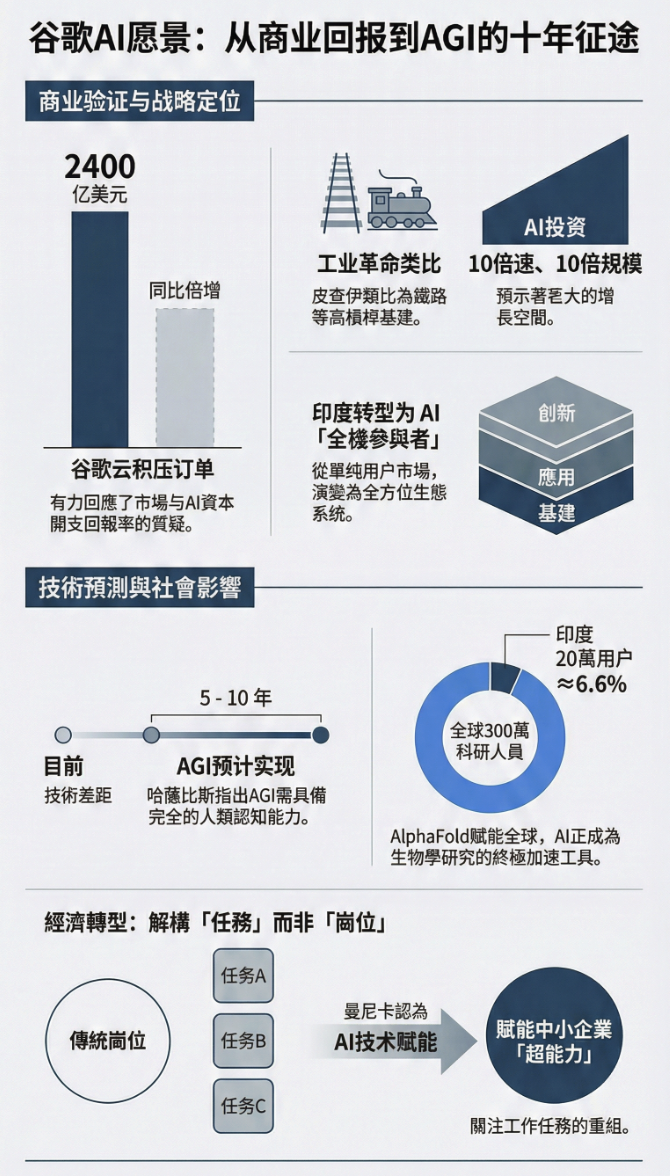
Core Insights - Google executives, including CEO Sundar Pichai, emphasized that the current AI wave is akin to a "10x faster industrial revolution" during the AI summit in India, addressing concerns about massive capital expenditures and AI investment returns [3][5][26] - Pichai revealed that Google's cloud business backlog has doubled year-over-year, reaching $240 billion, indicating significant growth potential and justifying ongoing investments in AI [5][26] Group 1: AI Investment and Economic Impact - Pichai compared current AI investments to historical infrastructure projects like the U.S. railway system, highlighting their potential for high leverage and substantial growth [5][26] - The executives discussed the importance of investing in foundational elements such as research and infrastructure to ensure AI benefits reach the general population, including farmers and students [17][26] Group 2: AGI Development Timeline - Demis Hassabis, CEO of Google DeepMind, set a timeline of at least 5 to 10 years for achieving Artificial General Intelligence (AGI), emphasizing the need for systems to exhibit human-like cognitive abilities [6][7][29] - Hassabis noted that over 3 million researchers globally are using AlphaFold, with more than 200,000 in India, showcasing AI's impact on scientific discovery [21][29] Group 3: Employment and Task Transformation - James Manyika introduced a framework separating "tasks" from "jobs," suggesting that while some jobs may decline, many will grow or transform due to AI [8][24] - Manyika highlighted the potential for AI to empower small and medium enterprises (SMEs) by enabling them to leverage technology without needing to be tech experts [33] Group 4: India's Strategic Positioning - Pichai redefined India's role in the AI landscape from merely a large user market to a "full-stack player," recognizing its potential in AI infrastructure and innovation [9][16] - The executives expressed optimism about India's unique advantages in AI, driven by a vibrant developer ecosystem and local AI model development [37]


“源神”启动!阿里杀手锏——全新架构千问3.5来了,最强性能x最低成本
硬AI· 2026-02-16 09:32
Core Viewpoint - Alibaba's Qwen 3.5 model represents a significant leap in AI architecture, emphasizing efficiency and performance over sheer parameter size, positioning itself as a leading open-source model in the industry [3][19][32]. Group 1: Model Performance and Architecture - Qwen 3.5 features a total of 397 billion parameters, activating only 17 billion during inference, resulting in a 60% reduction in deployment memory usage and a 19-fold increase in inference throughput compared to its predecessor [4][20]. - The model's API pricing is set at 0.8 yuan per million tokens, making it significantly cheaper than competitors like Gemini 3 Pro, which is 18 times more expensive for similar performance [7][20]. - The model's architecture incorporates a mixed expert framework, allowing for dynamic attention allocation and efficient processing of long texts, enhancing both efficiency and accuracy [21][22]. Group 2: Multi-Modal Capabilities - Qwen 3.5 evolves from a language model to a native multi-modal model, capable of understanding and integrating text, visuals, and audio seamlessly, unlike many existing multi-modal solutions that rely on separate modules [11][12]. - The model's training involves joint learning from mixed data types from the outset, enabling it to understand deep semantics from images and construct corresponding visuals from text [12][13]. - This native integration allows for advanced capabilities such as pixel-level visual localization and understanding complex video content over extended durations [15][18]. Group 3: Market Position and Ecosystem - Alibaba's strategy includes a dual approach of releasing state-of-the-art models while maintaining an open-source ecosystem, allowing developers worldwide to access and utilize these models freely [24][30]. - The company has established a significant presence in the AI cloud market, with a projected market share increase from 33% to 36% by 2025, driven by the demand for AI-related products [26][27]. - Recent financial reports indicate a 34% year-over-year growth in Alibaba Cloud's public cloud revenue, with AI-related product revenues maintaining triple-digit growth for nine consecutive quarters [28]. Group 4: Industry Impact - The launch of Qwen 3.5 signifies a paradigm shift in the AI industry, moving from high-cost, high-complexity models to more accessible and efficient solutions that democratize AI technology [31][32]. - The model's success is expected to redefine industry standards, making AI a productivity tool available to a broader audience, thus reshaping the global AI landscape [32].


马斯克:未来3-7年普通人最难熬!
Sou Hu Cai Jing· 2026-02-16 06:27
Core Insights - The transformation brought by artificial intelligence (AI) is unprecedented for ordinary people, with a significant transition period expected in the next three to seven years, as warned by Tesla CEO Elon Musk [1][4][11] - Musk describes the upcoming technological wave as a "supersonic tsunami," driven by the maturity of Artificial General Intelligence (AGI) and embodied intelligent robots, which will fundamentally alter the job landscape [4][5] Impact on Employment - AGI is predicted to achieve breakthroughs by 2026, enabling AI to handle over 90% of tasks across economic sectors, leading to significant job displacement, particularly in white-collar roles such as writing, financial analysis, and legal documentation [4][5] - The risk of automation is notably high in office and administrative support roles, with up to 46% of tasks at risk, while blue-collar jobs face only a 1% risk due to their complexity [5] - The traditional perception that blue-collar jobs are more vulnerable to automation is challenged, as white-collar jobs are expected to face the most severe impacts in the coming years [5] Educational and Cognitive Shifts - The long-standing equation of high education equating to high income and security is being disrupted, as AI democratizes access to knowledge, diminishing the value of traditional degrees [7] - Companies like Musk's prioritize problem-solving abilities over formal education, indicating a shift towards valuing practical skills and critical thinking [7] Energy as a New Currency - Musk posits that in the future, energy will become the new currency, with the ability to control cheaper and larger energy sources becoming the key to wealth [8] - The implications of AI on social structure may lead to a more pronounced wealth disparity, with a small elite controlling resources while the majority serve them [9] Skills for the Future - To thrive in the AI era, individuals must develop two core competencies: the ability to ask precise questions to AI and human-centric skills such as trust-building, empathy, and creativity, which are difficult for AI to replicate [9] - The transition period will involve significant societal upheaval, but it also presents opportunities for those who adapt and embrace lifelong learning [11]

马斯克和黄仁勋的66条核心观点,你不能不看
Sou Hu Cai Jing· 2026-02-14 15:34
Group 1: Elon Musk's Perspectives on AI - The ultimate control of "digital superintelligence" cannot be achieved, similar to how chimpanzees cannot control humans, but the construction and values embedded in AI are crucial [4] - The key to AI safety is the "maximum pursuit of truth," avoiding the imposition of false beliefs on AI [5][6] - The danger of "thought viruses" being implanted in AI is not yet fully recognized by most [7] - AI will significantly transform the nature of work, with many current jobs being replaced by AI and robotics, leading to a future where work may become optional [10][11][12] - By 2026, true Artificial General Intelligence (AGI) is expected to emerge, with AI intelligence surpassing human intelligence by 2030 [17][21] - AI will revolutionize productivity, leading to unprecedented efficiency in the production of goods and services, potentially resulting in a significant drop in prices and an increase in purchasing power [24][32] Group 2: Jensen Huang's Insights on AI Infrastructure - The value of computer infrastructure accumulated over the past decade, approximately $10 trillion, is being modernized to adapt to the new computing methods of the AI era [26] - Open-source models are disrupting the AI industry, with explosive growth in downloads as various stakeholders seek to participate in the AI revolution [27] - The core of physical AI is to enable AI to understand the "rules of the real world," with a focus on creating data to train AI through simulation and synthetic data [29][30] - The AI revolution is not just about artificial intelligence but also about generative AI leading a new era, with Nvidia's AI generator producing tokens that can transform various industries [32][33] - The next generation of AI will be rooted in an understanding of physical laws, requiring the development of physics-based AI that can integrate into daily life [37][41]

从Gemini到豆包:全球两大AI巨头为何走上同一条路?
Di Yi Cai Jing Zi Xun· 2026-02-14 15:27
Core Insights - ByteDance officially launched Doubao-Seed-2.0, a significant upgrade to its AI model, which has evolved over the past year and a half, enhancing capabilities in text, multimodal understanding, deep reasoning, and agent execution [1][2] Model Features - Doubao-Seed-2.0 offers a full-stack model matrix, multimodal understanding, enterprise-level agent capabilities, and cost efficiency, positioning it among the global leaders in AI [1] - The flagship Doubao-2.0 Pro targets deep reasoning and long-chain task execution, directly competing with models like GPT 5.2 and Gemini 3 Pro [2] Model Variants - The Doubao-2.0 series includes Pro, Lite, and Mini versions, all featuring upgraded multimodal understanding and enhanced LLM and agent capabilities for real-world task execution [3] - The Pro version achieved top scores in various competitions, showcasing its advanced mathematical and reasoning abilities [3] Performance Metrics - Doubao-2.0 Pro excels in instruction following, tool invocation, and search agent evaluations, achieving a score of 54.2 in the HLE-Text test, significantly outperforming other models [4] - The model's pricing structure offers a competitive edge, with input costs at 3.2 yuan per million tokens for inputs under 32k and 16 yuan per million tokens for outputs, making it more cost-effective than competitors [4] Multimodal Understanding - The model's multimodal capabilities have been significantly enhanced, achieving top scores in visual reasoning, spatial perception, and long-context understanding tests [7] - Doubao-2.0's ability to process complex visual inputs and generate interactive content aligns closely with the advancements seen in Gemini 3 Pro [7][8] Strategic Positioning - The development of Doubao-2.0 reflects a broader industry trend towards creating AI that can understand and interact with the physical world, moving beyond mere language processing to executing complex real-world tasks [6][8]

从Gemini到豆包:全球两大AI巨头为何走上同一条路?
第一财经· 2026-02-14 15:19
Core Viewpoint - ByteDance has officially launched the Doubao Model 2.0 series, which includes significant upgrades in multi-modal understanding, enterprise-level agent capabilities, and cost efficiency, positioning it among the global leaders in AI models [1][2]. Version Iteration Updates - The Doubao 2.0 series features three different sizes: Pro, Lite, and Mini, with enhanced multi-modal understanding and improved capabilities for real-world long-chain tasks, achieving top-tier performance in high-value economic and research tasks [4][7]. Technical Advancements - Doubao 2.0 Pro is designed for deep reasoning and long-chain task execution, directly competing with models like GPT 5.2 and Gemini 3 Pro, indicating a strategic alignment among leading AI laboratories towards achieving general artificial intelligence (AGI) [2][4]. Performance Metrics - The Doubao 2.0 Pro flagship model has achieved gold medal results in IMO, CMO mathematics competitions, and ICPC programming contests, showcasing its top-tier mathematical and reasoning capabilities [4][5]. Multi-Modal Understanding - The model has significantly upgraded its multi-modal understanding capabilities, excelling in visual reasoning, spatial perception, and long-context understanding, achieving the best performance in authoritative tests [5][8]. Cost Efficiency - Doubao 2.0 Pro pricing is based on input length, with costs of 3.2 RMB per million tokens for input and 16 RMB per million tokens for output, offering a substantial cost advantage over competitors like Gemini 3 Pro and GPT 5.2 [6][7]. Real-World Task Execution - The core focus of Doubao 2.0's upgrade is its ability to execute complex real-world tasks, supported by breakthroughs in multi-modal understanding, allowing the model to evolve from a "test-taker" to an "executor" [7][9]. Competitive Landscape - The competition between Doubao 2.0 and Gemini centers on multi-modal capabilities, with both aiming to create AI that comprehends and interacts with the complexities of the physical world, moving beyond mere language processing [9].

Anthropic掌门人重磅访谈:AI正处于指数级增长尾声,2026年将迎“数据中心里的天才国度”,营收正以10倍极速狂飙
硬AI· 2026-02-14 11:37
Core Viewpoint - The CEO of Anthropic, Dario Amodei, predicts that by 2026-2027, AI will evolve into a "Country of Geniuses in a Datacenter," with intelligence comparable to thousands of Nobel laureates working together [2][8][9] - Anthropic is experiencing a staggering annual revenue growth of 10 times, expecting to reach $10 billion by 2025, driven by advancements in AI capabilities [2][11] Group 1: AI Growth and Predictions - Amodei asserts that AI is nearing the end of its exponential growth phase, with significant qualitative changes expected in the next 2-3 years [5][6] - The transition from "smart high school student" to "professional-level" AI models has been rapid, with improvements in programming and mathematical capabilities [6][8] - Amodei expresses high confidence in achieving the vision of a genius AI nation within the next decade, citing a 90% certainty for a 10-year timeline and a 50/50 chance for the next 1-2 years [9][42] Group 2: Revenue Growth and Financial Strategy - Anthropic's revenue trajectory is described as "bizarre 10x per year growth," with projections of $1 million in 2023, $10 million in 2024, and $9-10 billion in 2025 [11][12] - Amodei explains the cautious approach to capital investment in computing power, emphasizing the need for revenue growth to align with capacity expansion to avoid bankruptcy risks [13][14] Group 3: AI in Software Engineering - Amodei outlines three stages of AI evolution in software engineering, with the first stage already achieved where models write 90% of code lines [16][50] - The second stage will see models handling 90% of end-to-end tasks, while the third stage will involve models taking over complex engineering tasks [18][53] - The expectation is that AI will significantly enhance productivity in software engineering without leading to mass unemployment among engineers [20][54] Group 4: Challenges and Future Developments - Amodei acknowledges potential geopolitical risks and societal upheavals as variables that could impact the timeline for achieving advanced AI capabilities [9][13] - The company is actively researching continuous learning capabilities for AI, which may be realized in the next couple of years [108][109] - There is an ongoing discussion about the efficiency of AI in learning and adapting compared to human learning processes, with a focus on the need for models to achieve a level of contextual understanding [100][101]

聚焦具身智能灵巧操作底层能力建设,临界点再获数亿元融资
机器人圈· 2026-02-14 09:48
Core Insights - The article discusses the recent funding round completed by AGILINK, a company specializing in embodied intelligence and dexterous manipulation technology, which raised several hundred million yuan with participation from leading internet firms and top-tier venture capital [2] - The funding will primarily be used to accelerate the development of dexterous hands and gripper product lines, enhance control systems and development toolchains, and build delivery capabilities for industrial clients [2] - AGILINK aims to transition dexterous hands from "laboratory equipment" to "engineered products" by focusing on stability, usability, and scalable delivery capabilities [2] Group 1 - AGILINK has completed a new funding round led by major internet companies, with participation from top venture capital firms and industry capital [2] - The company was established in January 2026 and has a team with expertise in robotics, control algorithms, systems engineering, and industrialization [2] - The funding will support the development of a large model for dexterous operations and ensure rapid deployment of dexterous hand products [2] Group 2 - AGILINK will continue to focus on dexterous manipulation technology and the application of embodied intelligence in humanoid robots and industrial scenarios [3] - The company aims to build a reusable and scalable product and technology system, becoming a key link between algorithms, hardware, and real-world applications [3] - AGILINK's mission is to empower robots and accelerate intelligent productivity across various industries and households, defining the "last 10 centimeters" of embodied intelligence in factories and homes [3]
Anthropic掌门人重磅访谈:AI正处于指数级增长尾声,2026年将迎“数据中心里的天才国度”,营收正以10倍极速狂飙
Hua Er Jie Jian Wen· 2026-02-14 08:17
Core Insights - Anthropic's CEO Dario Amodei predicts that by 2026, AI will evolve into a "Country of Geniuses in a Datacenter," where AI systems will exhibit intelligence comparable to thousands of top minds working together [3][107] - The company is experiencing an extraordinary revenue growth trajectory, with expectations of reaching $10 billion in 2024 and $90-100 billion in 2025, marking a bizarre 10x annual growth rate [4][42] - Amodei emphasizes the importance of responsible investment in computational power, linking it to revenue growth and the accuracy of predictions to avoid catastrophic risks [6][8] Group 1: AI Growth and Evolution - Amodei asserts that AI is nearing the end of its exponential growth phase, transitioning from "smart high school students" to "PhD-level" capabilities, with significant advancements in programming and mathematics [2][10] - The rapid advancements in AI capabilities are not merely about increasing parameters but represent a fundamental upgrade in intelligence, moving from data fitting to autonomous generalization [2][4] Group 2: Revenue Projections - Anthropic's revenue is projected to grow from $0 to $100 million in 2023, from $100 million to $1 billion in 2024, and to $90-100 billion in 2025, indicating a remarkable growth curve [4][42] - The company has already added several billion dollars in revenue in the first month of 2023, reinforcing the expectation of continued rapid growth [4][44] Group 3: Financial Strategy - Amodei explains that the expansion of computational power must align with revenue growth and predictive accuracy to mitigate the risk of bankruptcy [6][8] - The current strategy is described as "responsibly aggressive," allowing for sufficient computational investment to capture significant upside while maintaining survival through high margins and cash flow [8] Group 4: AI in Software Engineering - Amodei outlines three stages of AI evolution in software engineering, predicting that within 1-3 years, AI will handle all responsibilities of senior software engineers, leading to a massive productivity boost [9][33] - The first stage has already been achieved, with models writing 90% of code lines, and the next stages will involve handling end-to-end tasks and understanding complex codebases [11][33] Group 5: Future Predictions and Challenges - Amodei expresses high confidence (90%) in achieving the vision of a "Country of Geniuses" within ten years, with a 50/50 chance of significant advancements occurring in the next 1-2 years [3][21] - Potential geopolitical risks, such as disruptions in the chip supply chain, are noted as the only significant uncertainties that could impact this timeline [3][21]

当Anthropic数钱时,谷歌突然发起奇袭
3 6 Ke· 2026-02-13 12:06
Group 1 - Anthropic has completed a $30 billion Series G funding round, achieving a post-money valuation of $380 billion, making it the second-largest private financing in tech history [1] - The funding round was led by Singapore's sovereign wealth fund GIC and hedge fund Coatue, along with several prominent investors including D.E. Shaw, Dragoneer, Founders Fund, and major tech companies like Microsoft and Nvidia [1] - Anthropic is preparing for an IPO in the second half of 2026, with annual revenue reaching $14 billion, 80% of which comes from enterprise clients [2][3] Group 2 - Google has announced a significant upgrade to its Gemini 3 Deep Think, which includes a new math research agent capable of solving open mathematical problems autonomously [4][5] - Gemini 3 Deep Think has achieved a Codeforces Elo rating of 3455, surpassing 99.992% of human programmers, and can tackle complex problems in advanced data structures and algorithms [7][8] - Google aims to challenge Anthropic's position in both academic and programming domains, emphasizing the importance of defining how AI should work [10][42] Group 3 - Anthropic's Claude Code has seen a rapid increase in revenue, with its annual revenue surpassing $2.5 billion, and has driven a surge in product development, likened to a "Cambrian explosion" in AI products [13][18] - The success of Claude Code is attributed to its ability to redefine AI's role from a mere conversational agent to an active problem-solving agent [20][21] - Investors are recognizing that if AI can automate complex tasks, the value proposition of traditional SaaS companies may diminish significantly [22] Group 4 - Google claims to have reduced the service unit cost of Gemini AI by 78%, making it a more cost-effective option for enterprises compared to Anthropic's offerings [39] - The competition between Anthropic and Google is not just about model performance but about who can define the operational framework of AI [42][54] - Both companies represent different strategic priorities: Anthropic focuses on context understanding and task execution, while Google emphasizes foundational reasoning and generalization capabilities [43][44]