谷歌云业务

Search documents
再投12400亿!谷歌,冲击全球AI“王座”
Sou Hu Cai Jing· 2026-02-22 00:34
Core Insights - The valuation methods previously used for the internet may lead to missing significant opportunities in the AI large model sector, but not all companies in this space will receive premium valuations [1] - The gap between leading tech companies and smaller firms is widening, particularly in the AI sector, where competition is intensifying and requires substantial investment [3][11] Group 1: AI Industry Dynamics - The AI industry is characterized by a lack of belief in the ability of smaller companies to compete with giants like Google, OpenAI, and Amazon, due to their superior computational power and resources [3] - Current market valuations for some small AI companies are deemed irresponsible, especially when their revenues are below $1 billion yet they receive valuations in the hundreds of billions [3] - The competition in AI has reached a critical point, with leading tech companies increasing capital expenditures significantly, indicating a no-turning-back scenario [3][5] Group 2: Capital Expenditure Trends - Google’s parent company, Alphabet, plans to raise $20 billion through bond issuance, exceeding initial expectations, with significant investor interest [4] - Major tech companies, including Google, Meta, Microsoft, and Amazon, are projected to spend a total of $650 billion this year on AI infrastructure [5] - Alphabet's capital expenditures are expected to reach between $175 billion and $185 billion in 2026, significantly higher than previous analyst estimates [15] Group 3: Investment Movements - Berkshire Hathaway has made a significant investment in Google, marking a shift in its investment strategy towards tech stocks [8] - Other private equity firms, such as景林资产, have also increased their stakes in Google, indicating a trend of institutional investment in leading AI companies [9] - The focus on AI investments is expected to continue, with industry leaders emphasizing the long-term potential of AI technologies [11][12] Group 4: Financial Performance of Alphabet - Alphabet reported a fourth-quarter revenue of $113.83 billion, a year-on-year increase of 18%, surpassing market expectations [13] - The company’s cloud business revenue reached $17.66 billion in the fourth quarter, growing 48% year-on-year, driven by demand for AI infrastructure [15] - For the full year, Alphabet's revenue exceeded $400 billion for the first time, reaching $402.84 billion, with a net profit of $132.17 billion [14]



“谷歌天团”反击AI泡沫质疑:这是工业革命,但速度快10倍、规模大10倍
华尔街见闻· 2026-02-21 00:25
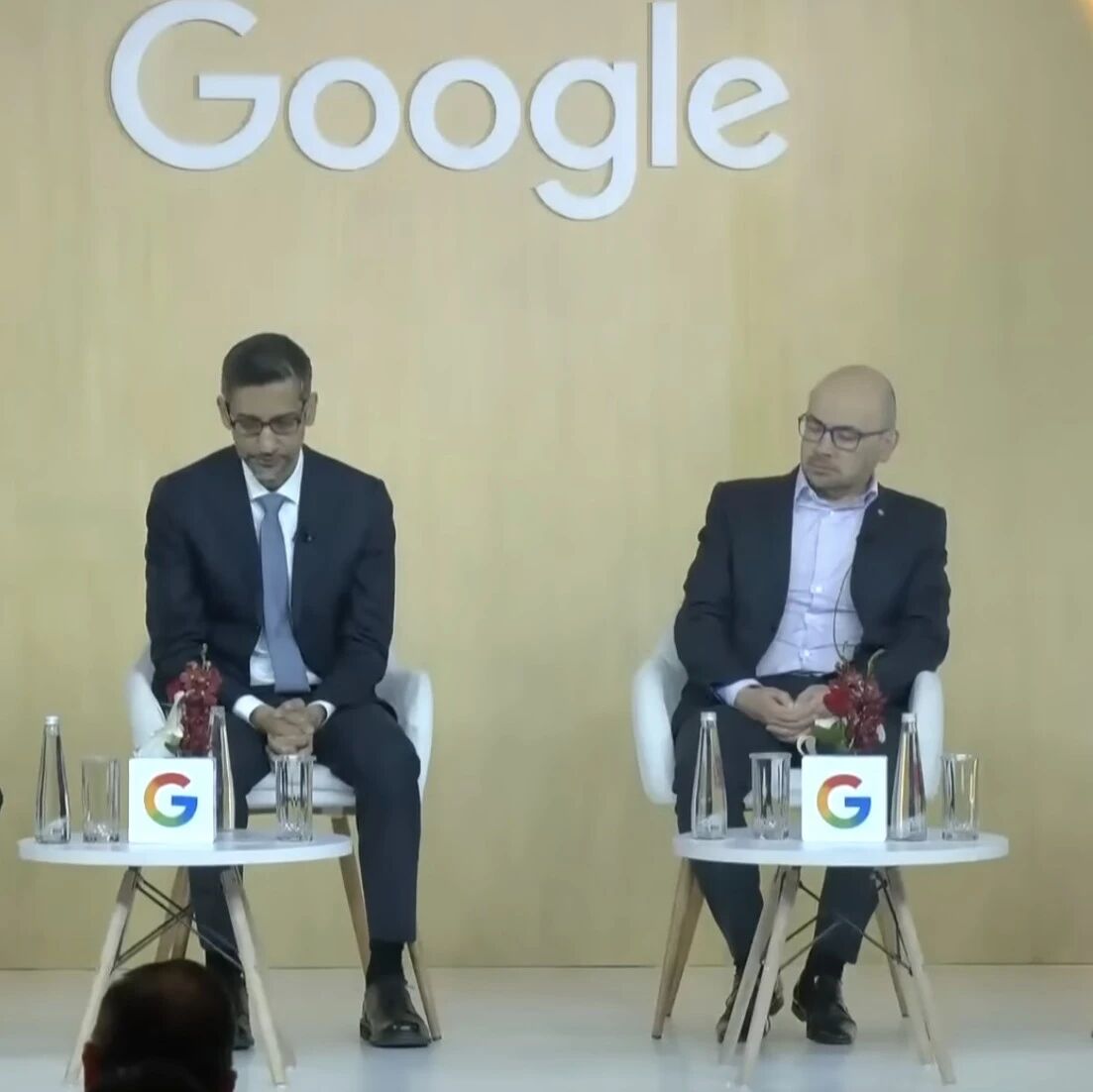
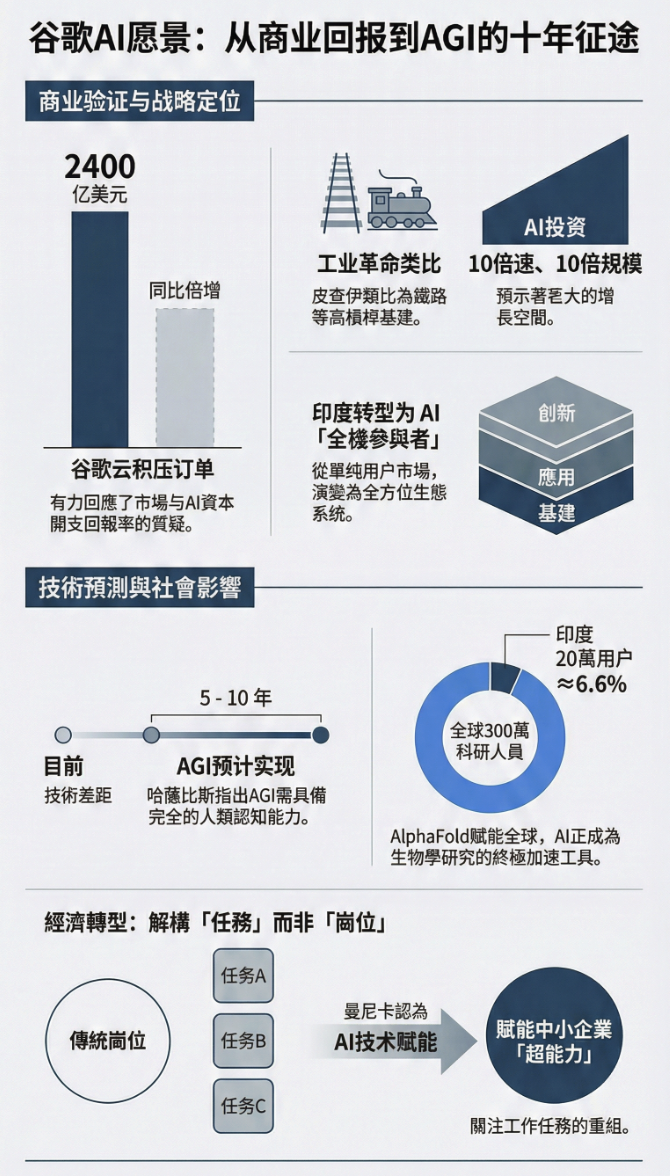
Core Insights - Google executives, including CEO Sundar Pichai, emphasized that the current AI wave is akin to a "10 times faster industrial revolution" during an AI summit in India, addressing concerns over massive capital expenditures and AI investment returns [3][5][6] Group 1: AI Investment and Business Growth - Pichai revealed that Google's cloud business backlog has doubled year-over-year, reaching $240 billion, indicating significant return potential from AI investments [6] - The current AI investment is compared to historical infrastructure projects like the U.S. railway and highway systems, which are expected to drive substantial growth and value [5][6] Group 2: AGI Development Timeline - Demis Hassabis, CEO of Google DeepMind, set a timeline for Artificial General Intelligence (AGI) development, estimating it will take at least 5 to 10 years to achieve the necessary cognitive capabilities [7] Group 3: Employment and Economic Impact - James Manyika introduced a framework distinguishing between "tasks" and "jobs," suggesting that while some jobs may decrease, many will grow or change due to technological advancements [7] - Manyika noted that AI provides unprecedented capabilities to small businesses, enabling them to build technical systems without needing to be tech experts [7] Group 4: Strategic Positioning in India - Pichai redefined India's role from merely a large user market to a "full-stack player" in the AI field, highlighting the potential for comprehensive growth in AI infrastructure, applications, and innovation [8]
“谷歌天团”反击AI泡沫质疑:这是工业革命,但速度快10倍、规模大10倍
Xin Lang Cai Jing· 2026-02-20 14:30
Core Insights - Google executives assert that the current AI wave is akin to a "10 times faster industrial revolution" and emphasize the transformative potential of AI investments [2][25] - Alphabet's CEO Sundar Pichai revealed that the backlog of Google Cloud orders has doubled year-over-year, reaching $240 billion, indicating strong demand and potential returns from AI investments [3][25] Group 1: AI Investment and Economic Impact - Pichai compares current AI investments to historical infrastructure projects like the U.S. railway system, highlighting their high leverage effect on growth and value [2][25] - The executives argue that the ongoing AI investment cycle is not a bubble but a necessary foundation for future economic growth [2][25] - Pichai emphasizes that investments in AI are justified due to the observed technological advancements and opportunities [25] Group 2: General Artificial Intelligence (AGI) Timeline - Demis Hassabis, CEO of Google DeepMind, estimates that achieving AGI will take at least 5 to 10 more years, setting high standards for cognitive capabilities [4][27] - Hassabis highlights the significant impact of tools like AlphaFold, which is currently used by over 3 million researchers globally, including more than 200,000 in India [4][19] Group 3: Employment and Task Transformation - James Manyika introduces a framework distinguishing between "tasks" and "jobs," suggesting that while some jobs may decline, many will evolve or grow [5][22] - Manyika notes that AI can empower small businesses by enabling them to leverage technology without needing to be tech experts, enhancing their operational capabilities [6][32] Group 4: India's Strategic Positioning - Pichai redefines India's role in the AI landscape from merely a large user market to a "full-stack player" in AI development [7][14] - The executives express optimism about India's potential to lead in AI applications across various sectors, including agriculture and creative industries [19][24]
“谷歌天团”反击AI泡沫质疑:这是工业革命 但速度快10倍、规模大10倍
Zhi Tong Cai Jing· 2026-02-20 12:39
Core Insights - Google executives assert that the current AI wave is akin to an industrial revolution, but with ten times the speed and scale [2][25] - The company emphasizes the significant growth in its cloud business, with backlog orders doubling to $240 billion year-over-year [3][25] - Google positions itself as a full-stack player in the AI field, particularly in the Indian market, which is seen as having immense potential for AI infrastructure and innovation [7][14] Group 1: AI Investment and Economic Impact - Google executives addressed concerns about the return on investment in AI, comparing it to historical infrastructure investments like the U.S. railway system [2][25] - The company believes that the current AI investments will drive substantial growth and value, as evidenced by the doubling of cloud business backlog orders [3][25] - The executives highlighted the importance of investing in foundational elements such as research and infrastructure to ensure AI benefits reach the broader population [15][25] Group 2: General Artificial Intelligence (AGI) and Future Outlook - DeepMind's CEO, Demis Hassabis, provided a timeline for achieving AGI, estimating it will take at least 5 to 10 more years [4][27] - Hassabis emphasized that AGI should exhibit all human cognitive abilities, including creativity and long-term planning, which current systems do not yet possess [4][27] - The potential of AI and AGI is viewed as a tool for accelerating scientific discovery and addressing global challenges [27][28] Group 3: Employment and Task Transformation - James Manyika introduced a framework separating "tasks" from "jobs," indicating that while some jobs may decline, many will evolve or grow [5][22] - The executives acknowledged the lag effect in job creation and loss due to technological changes, stressing the need for investment in skills and infrastructure [22][23] - Manyika highlighted the transformative potential of AI for small and medium enterprises, enabling them to leverage technology without needing to be tech experts [6][32] Group 4: Regional Strategy and Market Positioning - Google has shifted its view of India from merely a large user market to a full-stack participant in the AI landscape [7][14] - The executives noted the significant progress in India's digital transformation over the past decade, positioning it for a decade-long AI revolution [9][14] - The company is actively working on projects to enhance AI accessibility for small businesses, particularly through language translation initiatives [6][32]
谷歌高层回应AI泡沫质疑:这是工业革命,但速度快10倍、规模大10倍
Hua Er Jie Jian Wen· 2026-02-20 12:16
Core Insights - Google executives, including CEO Sundar Pichai, emphasized that the current AI wave is akin to a "10x faster industrial revolution" during the AI summit in India, addressing concerns about massive capital expenditures and AI investment returns [3][5][26] - Pichai revealed that Google's cloud business backlog has doubled year-over-year, reaching $240 billion, indicating significant growth potential and justifying ongoing investments in AI [5][26] Group 1: AI Investment and Economic Impact - Pichai compared current AI investments to historical infrastructure projects like the U.S. railway system, highlighting their potential for high leverage and substantial growth [5][26] - The executives discussed the importance of investing in foundational elements such as research and infrastructure to ensure AI benefits reach the general population, including farmers and students [17][26] Group 2: AGI Development Timeline - Demis Hassabis, CEO of Google DeepMind, set a timeline of at least 5 to 10 years for achieving Artificial General Intelligence (AGI), emphasizing the need for systems to exhibit human-like cognitive abilities [6][7][29] - Hassabis noted that over 3 million researchers globally are using AlphaFold, with more than 200,000 in India, showcasing AI's impact on scientific discovery [21][29] Group 3: Employment and Task Transformation - James Manyika introduced a framework separating "tasks" from "jobs," suggesting that while some jobs may decline, many will grow or transform due to AI [8][24] - Manyika highlighted the potential for AI to empower small and medium enterprises (SMEs) by enabling them to leverage technology without needing to be tech experts [33] Group 4: India's Strategic Positioning - Pichai redefined India's role in the AI landscape from merely a large user market to a "full-stack player," recognizing its potential in AI infrastructure and innovation [9][16] - The executives expressed optimism about India's unique advantages in AI, driven by a vibrant developer ecosystem and local AI model development [37]

谷歌2026年财报发布,AI与云业务成增长引擎
Jing Ji Guan Cha Wang· 2026-02-13 19:30
Financial Performance - The company reported a record annual revenue of $402.836 billion for 2025, marking a 15% year-over-year increase. The fourth-quarter revenue reached $113.828 billion, up 18% year-over-year. The Google Cloud business emerged as a core growth engine, with fourth-quarter revenue soaring 47.75% to $17.664 billion [2]. Capital Expenditure - The company announced a significant increase in its capital expenditure budget for 2026, raising it to a range of $175 billion to $185 billion, which represents an over 91% increase from the $91.447 billion allocated in 2025. This investment will primarily focus on AI computing capabilities and cloud infrastructure expansion, with management anticipating a tight supply of AI computing power throughout 2026 [3]. Product Development - The company has announced plans for the release of the next-generation mobile operating system, Android 17 (codenamed "Cinnamon Roll"). The first beta version is set to be released soon, with the official version expected in the second quarter of 2026 (around June). This will represent a significant iteration of the world's largest mobile operating system [4]. Dividend Announcement - The company's board has declared a quarterly cash dividend of $0.21 per share, which will be paid on March 16, 2026, to shareholders on record as of March 9, 2026 [5]. Strategic Initiatives - The self-developed Gemini series AI models remain a key focus for the company. As of the fourth quarter of 2025, the monthly active users of Gemini applications have surpassed 750 million. The company will continue to advance the integration and application of AI technology in core products such as search and cloud services [6].
Alphabet Q4营收1138.28亿超预期 Gemini月活破7.5亿 2026资本支出上看1850亿远超市场预估
Jin Rong Jie· 2026-02-04 23:58
Core Insights - Alphabet's Q4 2025 revenue reached $113.828 billion, a year-over-year increase of 18%, surpassing market expectations of $111.4 billion [1] Group 1: Financial Performance - Google Services segment revenue was $95.86 billion, reflecting a 14% year-over-year growth [1] - Google Cloud business showed significant performance with revenue of $17.66 billion, a substantial increase of 48% year-over-year, exceeding market forecasts [1] Group 2: User Growth - The user base for AI model Gemini expanded significantly, with monthly active users surpassing 750 million in Q4, up from 650 million in the previous quarter [1] Group 3: Capital Expenditure Guidance - Alphabet disclosed a capital expenditure guidance for 2026, estimating annual spending between $175 billion and $185 billion, nearly double the total capital expenditure for 2025, which was previously expected to be $119.5 billion [1] - The capital will primarily be allocated for AI infrastructure development, including data center expansion and dedicated AI chip research and deployment [1]
计算机行业2025年12月投资策略暨财报总结:2025Q3:海外大厂业绩均超预期,资本开支持续上行
Guoxin Securities· 2025-12-04 07:17
Core Insights - The report indicates that major overseas tech companies have exceeded market expectations in their Q3 2025 earnings, showcasing strong revenue growth and robust cloud business performance [1][11][33] - Capital expenditures (CapEx) for these companies continue to rise significantly, driven by investments in AI and cloud infrastructure, raising concerns about profit margins and return on investment [2][58][61] Company Summaries Microsoft - Microsoft reported Q1 FY26 revenue of $77.67 billion, a year-on-year increase of 18%, slightly above market expectations [11] - The intelligent cloud segment generated $30.9 billion in revenue, growing 28% year-on-year, with Azure cloud services seeing a remarkable 40% growth [12][15] - Capital expenditures reached $34.9 billion, a 74.5% increase year-on-year, primarily focused on AI and infrastructure investments [14][15] Meta - Meta's Q3 2025 revenue was $51.24 billion, up 26.25% year-on-year, surpassing both the upper limit of guidance and market expectations [19] - The company faced a significant drop in net profit due to a one-time tax asset impairment, but adjusted net profit was $18.6 billion [19][21] - Capital expenditures totaled $19.37 billion, primarily for servers and data centers, exceeding market expectations [23][26] Google - Google achieved Q3 2025 revenue of $102.35 billion, a 15.95% increase year-on-year, with net profit rising 32.99% [33][36] - The Google Cloud segment reported revenue of $15.16 billion, growing 33.51% year-on-year, driven by strong demand for AI products [36][42] - Capital expenditures for Q3 were $23.95 billion, with a forecasted increase for the full year to $91-93 billion [42] Amazon - Amazon's Q3 2025 revenue reached $180.17 billion, a 13% year-on-year increase, with net profit rising 38% [43][46] - AWS revenue was $33.01 billion, marking a 20% year-on-year growth, the highest quarterly growth rate in 2023 [46][52] - Capital expenditures were $34.2 billion, a 61% increase year-on-year, with expectations for continued growth in FY2026 [52][56] Market Trends - The report highlights a trend of increasing capital expenditures across major tech firms, indicating a competitive "arms race" in AI and cloud infrastructure [58][61] - Investors are advised to monitor financial performance indicators such as revenue growth, gross margins, and changes in CapEx guidance, as these will impact long-term cash flow and profitability [3][62]


计算机行业 2025 年12 月投资策略暨财报总结:2025Q3:海外大厂业绩均超预期,资本开支持续上行
Guoxin Securities· 2025-12-04 01:51
Core Insights - The report indicates that major overseas tech companies have reported better-than-expected earnings for Q3 2025, with significant revenue growth driven by cloud services and AI investments [1][2][3] - Capital expenditures (CapEx) for these companies continue to rise sharply, reflecting a focus on AI infrastructure and cloud capabilities, which has become a central concern for investors [2][58] Company Summaries Microsoft - Microsoft reported Q1 FY26 revenue of $77.67 billion, a year-on-year increase of 18%, slightly exceeding market expectations [11][12] - The intelligent cloud segment generated $30.9 billion in revenue, up 28% year-on-year, with Azure cloud services growing at 40% [12][15] - Capital expenditures reached $34.9 billion, a significant increase of 74.5% year-on-year, primarily for AI and infrastructure investments [14][15] Meta - Meta's Q3 2025 revenue was $51.24 billion, a 26.25% increase year-on-year, surpassing both guidance and market expectations [19][21] - The company faced a net profit decline of 82.73% due to a one-time tax asset impairment, but adjusted net profit was $18.6 billion [19][20] - Capital expenditures rose to $19.37 billion, primarily for servers and data centers, exceeding expectations [23][27] Google - Google reported Q3 2025 revenue of $102.35 billion, a 15.95% increase year-on-year, with net profit rising 32.99% [33][36] - The Google Cloud segment achieved $15.16 billion in revenue, growing 33.51% year-on-year, driven by strong demand for AI products [36][42] - Capital expenditures for Q3 were $23.95 billion, with an upward revision of the annual CapEx guidance to $91-93 billion [42] Amazon - Amazon's Q3 2025 revenue reached $180.17 billion, a 13% increase year-on-year, with net profit up 38% [43][46] - AWS revenue was $33.01 billion, marking a 20% year-on-year growth, the highest quarterly growth rate since 2023 [46][52] - Capital expenditures for Q3 were $34.2 billion, a 61% increase year-on-year, with expectations for continued growth in FY2026 [52][56] Industry Trends - The report highlights a trend of increasing capital expenditures across major tech firms, indicating a competitive "arms race" in AI and cloud infrastructure [58][61] - The demand for AI capabilities is driving significant revenue growth in cloud services, with all major players reporting double-digit growth in this segment [57][58] - Investors are closely monitoring the impact of rising CapEx on profit margins and return on investment (ROIC), as increased spending on AI infrastructure may pressure short-term profitability [61][62]
巴菲特,退休前大动作!罕见大举买入
Mei Ri Jing Ji Xin Wen· 2025-11-16 06:55
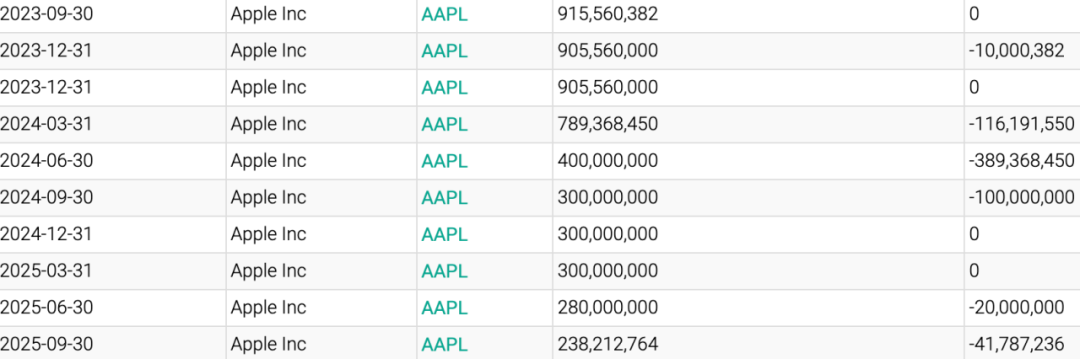
Core Insights - Berkshire Hathaway, led by Warren Buffett, has continued to sell off shares of Apple while investing $4.3 billion in Alphabet, Google's parent company [1][6] - The company's total stock holdings increased to $267 billion in Q3, up 3.4% from the previous quarter [2] - Berkshire has reduced its Apple holdings significantly, from 905 million shares to 238 million shares, decreasing its stake from over 50% to 22.69% [4][5] Group 1: Stock Transactions - In Q3, Berkshire increased its holdings in six stocks and reduced its holdings in five, including a complete exit from D.R. Horton [3] - The company sold 37.19 million shares of Bank of America, reducing its stake by nearly 45% over the past year [5] - Berkshire's new investment in Alphabet consists of 17.84 million shares, making it the company's tenth-largest holding [6] Group 2: Market Context and Strategy - The ongoing sell-off of stocks by Berkshire over the past 12 quarters may indicate Buffett's concerns about high valuations in the U.S. stock market [4] - Buffett's traditional valuation metric, the ratio of total market capitalization to GNP, has reached a historical high, which he describes as "playing with fire" [4] - Despite the sell-offs, Apple remains Berkshire's largest holding, valued at approximately $60.66 billion [4] Group 3: Leadership Transition - Warren Buffett is set to step down as CEO by the end of the year, passing the role to Greg Abel, who has expressed regret over not investing in Google earlier [1][8] - Buffett's recent public letter expressed confidence in Abel's leadership and optimism about Berkshire's future [8] - The company holds a record $381.6 billion in cash, indicating a strong liquidity position despite market challenges [9]