A股市场调整

Search documents
突发宣布大幅降息!8月9日,下周A股走势或已成为定局
Sou Hu Cai Jing· 2025-08-10 06:49
Group 1 - The Bank of England unexpectedly announced a 25 basis point interest rate cut, marking the fifth rate cut in this cycle [1] - A-shares have seen a significant increase, with market turnover reaching 1.74 trillion, an increase of 116.2 billion compared to the previous trading day [1] - The Shanghai Composite Index hit a new yearly high during the day, although over 2800 stocks declined, indicating a mixed market performance [1] Group 2 - There is speculation that the A-share market may face a significant adjustment next week, with a potential for a major correction if the index does not adjust soon [3] - The market is currently experiencing a strong upward trend, with hopes for a rapid breakthrough of the 3800-point level, potentially reaching 4000 points [3] Group 3 - The market index reached a new high of 3645.37 points during the day but closed lower at 3635.13 points, indicating a pullback after a five-day rally [5] - The trading volume was 17 trillion, slightly lower than the previous day, suggesting that the current level is not necessarily risky but may require a correction [5] Group 4 - The Shanghai Composite Index fell by 0.12%, the Shenzhen Component by 0.26%, and the ChiNext Index by 0.38%, reflecting a broader market decline despite some blue-chip stocks rallying [7] - The market experienced a rebound led by blue-chip stocks, but the overall number of declining stocks outnumbered those that rose, indicating underlying weakness [7] - The current upward trend may require a volume correction, as the previous high of 3674 points was supported by a trading volume of around 3.5 trillion, compared to the current 1.7 trillion [7]

【金融工程】A股迎来调整,市场风格波动上升——市场环境因子跟踪周报(2025.08.07)
华宝财富魔方· 2025-08-07 10:33
Market Overview - The Shanghai Composite Index is expected to maintain a volatile pattern in the short term due to a vacuum in incremental policy, with the Politburo meeting removing references to "rate cuts," indicating a lower probability of new stimulus policies [2][5] - The A-share market's profitability may decline amid overseas disturbances, despite a high likelihood of an extension of the US-China tariff exemption period [2][5] - Investment strategies should focus on two main areas: defensive stocks such as banks and non-bank financials, and opportunities in rare earths due to US-China tensions and price increases [2][5] Stock Market Factors - Last week, small-cap stocks outperformed, with a balanced preference for value and growth styles; however, volatility in both large and small-cap stocks increased [7] - The dispersion of excess returns among industry indices slightly increased, while the speed of industry rotation remained stable, with a significant decline in the proportion of rising constituent stocks [7] - Trading concentration remained consistent, with the top 100 stocks and the top five industries maintaining their previous levels of trading volume [7] Market Activity - Market volatility rose sharply last week, and turnover rates continued to increase [8] Commodity Market Factors - In the commodity market, the strength of trends across all sectors slightly decreased; however, the basis momentum for precious metals increased, while other sectors remained stable [15] - Volatility across all sectors rose, and liquidity in the non-ferrous metals sector declined rapidly [15] Options Market Factors - Implied volatility for the SSE 50 and CSI 1000 indices, which had been rising, began to decline, indicating that many market participants are starting to take risk precautions after a period of continuous gains [22] Convertible Bond Market Factors - The convertible bond market demonstrated its defensive characteristics as the equity market adjusted, with the premium rate for bonds exceeding 100 yuan continuing to rise, surpassing the May peak [24] - The proportion of bonds with low conversion premiums has increased, indicating structural differences, while the trading volume in the convertible bond market remained stable [24]

500质量成长ETF(560500)整固蓄势,成分股杰瑞股份10cm涨停
Sou Hu Cai Jing· 2025-08-07 07:21
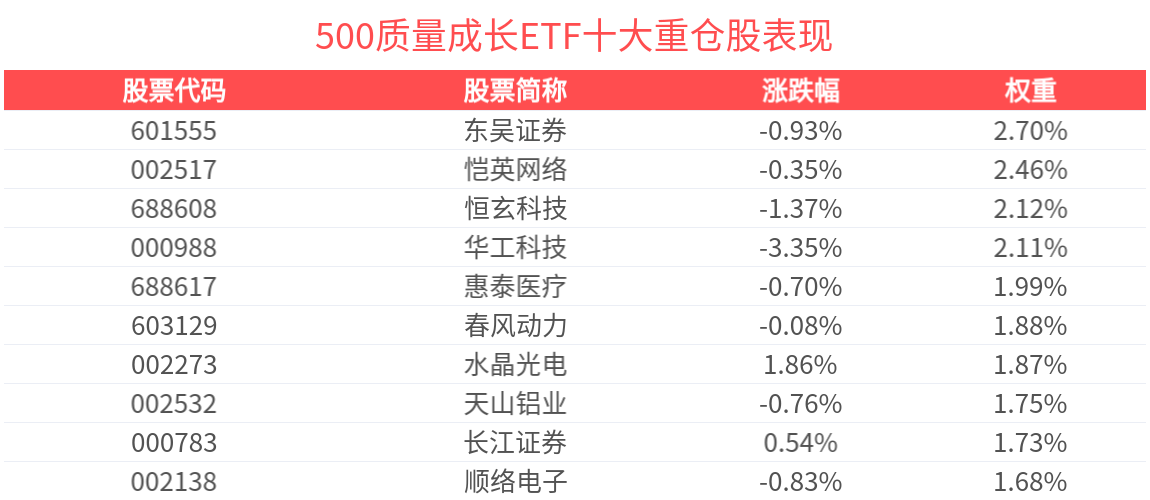
Group 1 - The core viewpoint of the news indicates that the CSI 500 Quality Growth Index has experienced a slight decline of 0.32%, with mixed performance among constituent stocks, highlighting both gainers and losers in the market [1] - The top-performing stocks include Jerry Holdings, which hit the daily limit up, Yunda Holdings with a rise of 9.23%, and Guai Bao Pet with an increase of 5.21% [1] - Conversely, Huahai Pharmaceutical led the decline, followed by Kanghong Pharmaceutical and Huagong Technology [1] Group 2 - The CSI 500 Quality Growth Index is composed of 100 listed companies selected for their high profitability, sustainable earnings, and strong cash flow, providing diverse investment options for investors [2] - As of July 31, 2025, the top ten weighted stocks in the CSI 500 Quality Growth Index include Dongwu Securities, Kaiying Network, and Huagong Technology, collectively accounting for 20.47% of the index [2] - The latest price-to-book ratio (PB) of the CSI 500 Quality Growth Index is 1.96, indicating that the valuation is at a historical low, being below 80.19% of the time over the past three years, suggesting attractive valuation [1]

A股短期还会继续调整吗?
2025-06-23 02:09
Summary of Conference Call Records Industry Overview - The A-share market is currently facing fundamental pressures, with May export growth unexpectedly declining, and the pace of policy implementation likely slowing down. It is expected that fundamental pressures may ease around mid to late July [1][2] - Structural pressures exist in the A-share mid-year report performance, particularly for high-earning expectations in new consumer sectors and thematic stocks, which may face valuation adjustment risks [1][3] - Ongoing geopolitical risks, such as the Iran nuclear conflict, are suppressing market sentiment and increasing uncertainty [1][4] Core Insights and Arguments - **Market Performance**: The A-share market is expected to continue its weak performance in the short term, with a potential for stabilization only by mid to late July if positive fundamental and policy factors emerge [2][3] - **Key Factors for Weakness**: 1. **Fundamental Pressure**: Export growth is anticipated to continue declining from June to August, increasing economic growth pressure [3] 2. **Mid-Year Report Performance**: While overall performance is stable, certain sectors may face significant structural pressures [3] 3. **Geopolitical Risks**: Ongoing geopolitical tensions are expected to further suppress market sentiment [4] Important Policies and Measures - Recent policies from the Lujiazui Forum have positively impacted market sentiment, including measures from the central bank related to foreign exchange and the introduction of more favorable conditions for technology innovation companies to list [6] - The introduction of new listing standards for the Sci-Tech Innovation Board and the Growth Enterprise Market is expected to facilitate the entry of more innovative companies into the capital market, although the immediate impact on the market's weak state is limited [8] Macro Environment Impact - The current macro environment is characterized by weak economic recovery and declining exports, which historically correlates with weak A-share performance [7][10] - The liquidity environment is neutral to slightly positive, but potential dollar rebounds and geopolitical tensions could impact global liquidity negatively [9] Industry Allocation Recommendations - A balanced allocation strategy is recommended, focusing on defensive sectors and high-potential technology sub-sectors, such as artificial intelligence and robotics, as well as undervalued blue-chip stocks in banking, construction, transportation, and electricity [11][13] - High-performing sectors historically during weak economic phases include high-growth industries and defensive sectors, such as low-valuation blue-chip stocks [12] Investment Opportunities - From a value investment perspective, sectors with low historical PE percentiles, such as non-bank financials, transportation, and non-ferrous metals, are highlighted as attractive for short-term allocation [14] - Short-term investment strategies should include a balanced mix of growth and blue-chip stocks, with a focus on undervalued sectors and those that have undergone significant adjustments [15]
A股全线重挫:三大指数齐跌,超4000股飘绿
Sou Hu Cai Jing· 2025-06-10 10:00
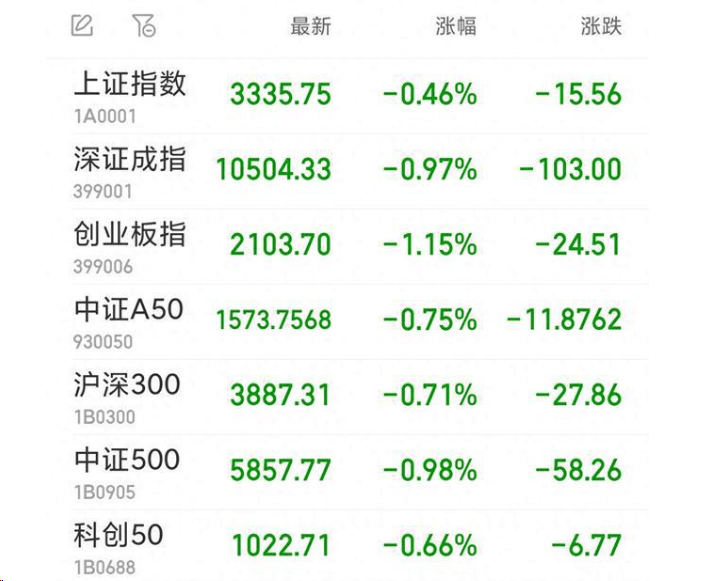
Market Overview - The A-share market experienced a significant adjustment, with all three major indices declining collectively. The Shanghai Composite Index fell by 0.46% to 3335.75 points, the Shenzhen Component Index decreased by 0.97% to 10504.33 points, and the ChiNext Index dropped by 1.15% to 2103.70 points. Over 4000 stocks declined, with less than 500 stocks rising, indicating a pessimistic market sentiment [1][2]. Reasons for Decline - External factors impacting the market include changes in the Federal Reserve's policy expectations, which have cooled interest rate cut anticipations, leading to pressure on global risk assets and foreign capital outflow from A-shares. Additionally, geopolitical tensions have heightened risk aversion, prompting some funds to withdraw from the stock market [3]. - Internal economic data has shown weakness, with recent PMI, consumption, and industrial value-added data falling short of expectations, raising concerns about the strength of economic recovery. Certain sectors, such as real estate and consumer electronics, have reported declining performance, negatively affecting related sectors [3]. - There is pressure on the funding side, with northbound capital experiencing a net outflow exceeding a specified amount, and margin trading balances declining, indicating reduced activity of leveraged funds [3]. Sector Performance - Leading sectors that faced declines include: - New Energy: Major stocks like CATL and LONGi Green Energy fell due to rumors of industry overcapacity. - Consumer Electronics: Stocks within the Apple supply chain collectively retreated. - Brokerage: The brokerage sector faced pressure due to low market trading activity [5]. - Defensive sectors, such as agriculture and pharmaceuticals, remained relatively stable, while high-dividend assets like banks and public utilities attracted risk-averse funds [5]. Investment Strategies - Companies suggest that the market may continue to experience fluctuations in the short term, advising investors to focus on policy catalysts and firms with strong earnings certainty. It is recommended to control positions to avoid blind bottom-fishing and to wait for market stabilization signals [4][5]. - Attention should be given to policy developments, such as increased growth stabilization measures or favorable capital market reforms, and to prioritize defensive sectors like consumer goods and pharmaceuticals that are undervalued [5].
突发!A股尾盘大跳水,市场在担忧什么?
Hua Xia Shi Bao· 2025-05-23 11:05
Market Overview - On May 23, A-share market experienced a significant drop, with the Shanghai Composite Index falling over 0.9% and more than 4,200 stocks declining [2][5] - The market's risk appetite sharply decreased, leading to a notable rise in gold stocks as investors sought safe-haven assets [2][7] Market Dynamics - The decline in the A-share market was attributed to multiple factors, including a flash crash in the North Stock 50 index and a strong demand for capital outflow [10] - The trading volume of the CSI 2000 index recently surpassed its three-month high, indicating extreme congestion in micro-cap stock trading [10] - There was a notable shift in main capital from previously popular tech stocks to high-dividend sectors like banking and electricity [10] Global Influences - Increased global financial uncertainty, particularly concerns over the U.S. debt crisis and rising U.S. Treasury yields, has pressured risk asset valuations [10] - The 20-year U.S. Treasury yield has surpassed 5.1%, contributing to a risk-off sentiment among global investors [10] Future Outlook - Analysts believe the current market adjustment is more of a phase rather than a trend, with A-share valuations at relatively low historical levels [11][12] - There is potential for a structural market rally supported by policy measures and liquidity easing [11][12] - The average P/E ratios for the Shanghai Composite and ChiNext indices are at 13.85 and 36.44, respectively, indicating a suitable environment for medium to long-term investments [12]