
AI智能眼镜

Search documents
9月15日国际晨讯 | 法国主权评级被下调,本周四大央行议息
Sou Hu Cai Jing· 2025-09-15 02:53
Market Review - Major global stock indices strengthened last week, with the Dow Jones Industrial Average rising 0.95%, the Nasdaq increasing by 2.03%, and the S&P 500 up by 1.59%. The Nasdaq reached a record closing high, while the S&P 500 briefly surpassed 6600 points for the first time [1] - Leading tech stocks in the US, particularly Tesla, saw significant gains, with Tesla rising over 7% on Friday and approximately 14% over the last two trading days. Other tech giants like Micron Technology, Microsoft, and Apple also performed well, although the Dow was slightly affected by weak employment data [1] - European stock indices had mixed results, with the German DAX down 0.02%, the French CAC40 up 0.02%, and the UK FTSE 100 down 0.15% on Friday. For the week, the DAX rose 0.43%, the CAC40 increased by 1.96%, and the FTSE 100 was up 0.82%. European stocks were influenced by rising expectations of a Federal Reserve rate cut and political-economic uncertainties [1] - Gold prices in London reached a historical high of $3674.78 per ounce before showing volatility at elevated levels. International oil prices rebounded, with WTI crude oil futures closing at $62.69 per barrel, up 1.32% for the week, and Brent crude oil futures at $66.99 per barrel, up 2.27% [1] International Macro - Fitch Ratings downgraded France's sovereign credit rating from AA- to A+ due to a lack of a credible fiscal consolidation plan supported by a majority, amid political and fiscal crises [2] - The US Consumer Price Index (CPI) for August met market expectations, with a month-on-month increase of 0.4% and a year-on-year increase of 2.9%. The core CPI also remained steady at a year-on-year growth of 3.1% [2] Upcoming Events - The Federal Open Market Committee (FOMC) is set to announce its September interest rate decision and economic projections, with a 96.4% probability of a 25 basis point rate cut [4] - Other central banks, including Canada, the UK, and Japan, will also announce their interest rate decisions in the coming days [5] - The Meta Connect conference is scheduled for September 18-19, where Meta is expected to unveil its new AI glasses, "Hypernova," and CEO Mark Zuckerberg will deliver a keynote on "AI Smart Glasses" [5]
国泰海通|中小与股权研究:大朋发布Vision Ray AI智能眼镜
国泰海通证券研究· 2025-09-11 14:05
Core Viewpoint - DPVR has officially launched its first AI smart glasses, Vision Ray, marking its entry into the wearable device market while leveraging its expertise in virtual reality technology [2][4]. Product Overview - Vision Ray integrates multiple innovative features aimed at enhancing user experience in outdoor photography, daily recording, and smart interaction [3]. - The glasses are equipped with the "Hey Sunny" AI assistant, developed on DPVR's proprietary DPAI model, supporting functions like smart translation, memo creation, meeting minutes, and AI visual recognition [3]. - The design is lightweight and stylish, weighing only 46g without lenses, making it comfortable for prolonged wear [3]. Features and Specifications - The core imaging system includes a 12MP Sony IMX681 sensor, F2.2 aperture, and 5P high-transmittance lens, capable of capturing photos at a resolution of 4032×3024 and recording videos at 1080p 30FPS [3]. - The audio system features directional spatial audio transmission technology and a three-microphone array for sound pickup [3]. - The device is powered by a Ziguang Zhanrui computing platform with 2GB RAM and 32GB storage, supporting Wi-Fi 5 and Bluetooth 5.1 connectivity [3]. - It has a 210mAh built-in battery with IPX4 waterproof rating, enhancing its durability for outdoor use [3]. Market Outlook - The AI glasses market is expected to accelerate growth in 2025, with global sales reaching 870,000 units in Q2 2025, representing a year-on-year increase of 222% [5]. - The launch of Vision Ray not only introduces a new smart interaction experience for consumers but also propels the development of the entire AI glasses industry [5]. - DPVR's investment in Vision Ray is aligned with the ongoing market expansion, focusing on optimizing and upgrading its supply chain to ensure stable product supply and quality control [5].


康耐特光学(02276):智能眼镜加速放量,行业进入密集交付周期
Xinda Securities· 2025-09-10 11:18
Investment Rating - The report maintains a "Buy" rating for 康耐特光学 (2276.HK) [3] Core Viewpoints - 康耐特光学 is experiencing accelerated growth in its smart glasses segment, with significant revenue increases expected in the second half of 2025 and into 2026 due to expanding production scales and new project developments [1][2] - The company has demonstrated strong supply chain capabilities and technological leadership in the three-in-one lens model, which positions it well for continued growth in the smart glasses market [2] - The industry is entering a dense delivery cycle, with expected optimization of product pain points and a substantial growth potential compared to international markets [2] Financial Projections - The projected net profit for 康耐特光学 from 2025 to 2027 is estimated at 560 million, 670 million, and 810 million yuan respectively, with corresponding PE ratios of 34.1X, 28.4X, and 23.6X [3] - Total revenue is forecasted to grow from 2,061 million yuan in 2024 to 3,181 million yuan in 2027, reflecting a year-on-year growth rate of 17% [3] - The company is expected to maintain a gross margin of approximately 39.99% in 2025, increasing slightly in subsequent years [5]
20cm速递|科创芯片ETF国泰(589100)盘中飘红,智能眼镜与半导体设备突破引关注
Mei Ri Jing Ji Xin Wen· 2025-08-21 10:06
Group 1 - The global smart glasses market is expected to see a year-on-year shipment increase of 110% in the first half of 2025, with a compound annual growth rate of over 60% from 2024 to 2029, where AI smart glasses will account for 78% of the market [1] - Meta holds a 73% market share with its Ray-Ban series, while new brands like Xiaomi and RayNeo are accelerating market expansion [1] - Domestic semiconductor equipment has achieved dual breakthroughs, including the mass production of 28nm electron beam measurement equipment by Wuxi Gexin Yuedong Technology, filling a domestic technology gap, and the first commercial electron beam lithography machine "Xizhi" entering the testing phase with a minimum line width of 8nm, providing key technical support for quantum chip research and development [1] Group 2 - The electronic industry is in a mild recovery phase, with steady demand growth in AI servers, AIOT, and equipment materials, while the self-controllable capability of the semiconductor industry chain continues to improve [1] - The Guotai Science and Technology Chip ETF (589100) tracks the Science and Technology Chip Index (000685), which can have a daily fluctuation of up to 20%, reflecting the overall performance of listed companies in the semiconductor sector [1] - The Science and Technology Chip Index consists of 50 constituent stocks, focusing on high-growth potential and technological breakthroughs in semiconductor enterprises, showcasing the trend of self-controllable development in China's semiconductor industry [1]
【VIP机会日报】市场探底回升 半导体概念午后拉升 栏目精选机构研报 提及相关公司涨超12%
Xin Lang Cai Jing· 2025-08-20 10:05
Group 1: Semiconductor Industry - In the first half of 2025, China's semiconductor industry is expected to reach a total investment of 455 billion, with semiconductor equipment investment growing by 53.4% [6] - Shanghai Hejing, a leading integrated epitaxy company, is benefiting from recovering downstream demand and capacity expansion, with a projected return to growth after 2024 [6] - The company has established relationships with seven of the top ten global foundries and six power device IDM manufacturers, indicating strong market positioning [6] Group 2: Consumer Electronics - Apple's iPhone 17 has entered mass production, with Foxconn's Zhengzhou factory ramping up hiring to meet production demands [15][21] - The upcoming iPhone is expected to trigger a new replacement cycle, with core suppliers anticipating an increase in average selling prices [15] - Companies like Chaoyang Technology have established stable partnerships with major brands, enhancing their position in Apple's supply chain [21] Group 3: Rare Metals - The strategic importance of rare metals is increasing amid global geopolitical uncertainties [23] - Huayu Mining is projected to increase its gold equity production from 1 ton to 3.6 tons and antimony equity production from 0.4 million tons to 1.1 million tons over the next three years [23] - The company has seen significant stock price increases, reflecting positive market sentiment [23] Group 4: Other Notable Companies - RichChip Microelectronics has become a key partner for major clients like BYD and Yushun, with revenue showing substantial growth over eight consecutive quarters [13] - Companies like Lingyi Zhi Zao and Youyan Powder Materials are experiencing significant stock price increases due to their innovative technologies and market potential [26]

2025年上半年全球智能眼镜市场同比激增 110%
Bei Jing Shang Bao· 2025-08-12 05:33
Core Insights - The global smart glasses market is projected to see a 110% year-on-year increase in shipment volume in the first half of 2025, driven by strong demand for Ray-Ban Meta smart glasses and the entry of new players like Xiaomi and TCL-RayNeo [1] Market Overview - In the first half of 2025, AI smart glasses are expected to account for 78% of total smart glasses shipments, a significant increase from 46% in the first half of 2024 and 66% in the second half of 2024 [1] - The AI glasses segment is experiencing a year-on-year growth exceeding 250%, significantly outpacing the overall market growth, primarily due to the dominance of Ray-Ban Meta AI glasses [1] Brand Performance - Meta's market share in the global smart glasses market reached 73% in the first half of 2025, with Ray-Ban Meta AI glasses seeing a shipment increase of over 200% year-on-year [1] - Xiaomi's AI glasses emerged as a strong competitor, becoming the fourth best-selling model globally and the third best-selling in the AI glasses segment, despite being on sale for only about a week in the first half of 2025 [2]


歌尔股份子公司拟提供借款用于收购知名微显示公司
Zheng Quan Shi Bao· 2025-08-08 18:01
Core Viewpoint - GoerTek Inc. is providing a significant financial support of up to $100 million to its subsidiary, Hong Kong GoerTek Tech, to facilitate the acquisition of Plessey Semiconductors Limited by Haylo Labs Limited, aiming to advance Micro-LED technology and support the future development of AI smart glasses and AR products [2][4]. Group 1: Financial Details - The loan from Hong Kong GoerTek Tech to Haylo has an annual interest rate of approximately 6.34%, with interest paid annually and principal repaid in a lump sum at maturity over a 5-year term [3]. - Haylo's total assets are approximately $267.1 million, with total liabilities and net assets both around $133.5 million, resulting in a debt-to-asset ratio of 50% [2]. Group 2: Strategic Importance - Plessey is recognized as a leading technology company in the Micro-LED field, having developed a high-brightness Micro-LED display specifically designed for AR glasses, with a brightness of up to 6 million nits [4]. - The investment in Plessey is expected to enhance its operational performance and financial condition, aligning with the rapid growth of the global market for AI smart glasses and AR products [4].

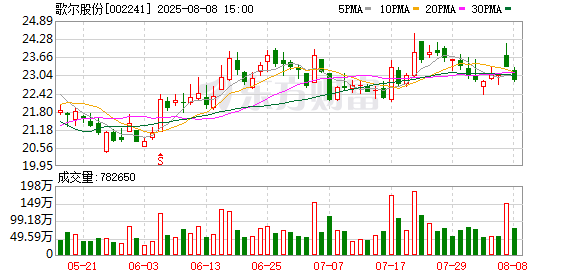
歌尔股份(002241.SZ)子公司拟向Haylo提供不超1亿美元借款 助力其收购Plessey
智通财经网· 2025-08-08 09:58
Core Viewpoint - The company is providing a loan of up to $100 million to Haylo Labs Limited to facilitate the acquisition of Plessey Semiconductors Limited, which is expected to enhance its capabilities in the Micro-LED sector [1][2] Group 1: Investment Details - The loan will be provided using the company's own funds and has a term of five years [1] - Haylo will use the funds to acquire 100% of Plessey's shares and to increase Plessey's capital for purchasing Micro-LED related fixed assets and supplementing working capital [1] - Plessey and its subsidiaries will guarantee the repayment of the principal and interest of the loan [1] Group 2: Strategic Implications - Plessey is recognized as a notable technology company in the global Micro-LED field, possessing significant R&D and technological advantages [1] - The investment is expected to enable Plessey to achieve greater development in the Micro-LED sector, supported by the company's and industry-leading clients [2] - The maturation of related technologies and products is anticipated to positively impact the company's future business expansion in AI smart glasses and AR augmented reality fields [2]
歌尔股份子公司拟向Haylo提供不超1亿美元借款 助力其收购Plessey
Zhi Tong Cai Jing· 2025-08-08 09:49
Core Viewpoint - The company is providing a loan of up to $100 million to Haylo Labs Limited to facilitate the acquisition of Plessey Semiconductors Limited, which is expected to enhance its position in the Micro-LED sector [1][2] Group 1 - The loan will be secured by Plessey and its subsidiaries, and is intended for the acquisition and capital investment in Micro-LED related fixed assets [1] - Plessey is recognized as a notable technology company in the global Micro-LED field, possessing significant R&D and technical advantages [1] - The investment is anticipated to foster the development of Micro-LED technology and products, positively impacting the company's future business expansion in AI smart glasses and AR products [2] Group 2 - The integration of Haylo's investment in Plessey is expected to lead to greater advancements in the Micro-LED sector, supported by the company's leading clients [2] - The leadership of David Hayes and his team is expected to drive Plessey's growth in the Micro-LED domain [2] - The maturation of related technologies and products will have a beneficial effect on the company's future endeavors in the AI smart glasses and AR fields [2]
康耐特光学20250807
2025-08-07 15:04
Summary of 康耐特光学 Conference Call Company Overview - 康耐特光学 is a leading manufacturer of high-refractive index lenses, specifically 1.74 refractive index lenses, with a strong market presence in China and globally, covering regions such as the US, Japan, India, Australia, Thailand, Germany, and Brazil [2][6][17]. Financial Projections - Revenue projections for 康耐特光学 over the next three years are expected to be 2.43 billion, 2.86 billion, and 3.36 billion RMB, with a stable year-on-year growth rate of 17%-18% [2][3]. - Net profit forecasts for the same period are 535 million, 650 million, and 786 million RMB, with year-on-year growth rates of 21%-25% [2][3]. - The company has experienced a compound annual growth rate (CAGR) of 16.8% in revenue and 35% in net profit over the past five years [2][9]. Product and Market Dynamics - 康耐特光学's product offerings include standardized lenses, customized lenses, and functional lenses, with a significant focus on high-margin customized lenses, which have a gross margin of 58% compared to 32% for standardized lenses [11][12]. - The global lens market is projected to reach $67.7 billion by 2028, with a CAGR of 6.2%, driven by increasing myopia rates and demand for functional products [4][15]. - The Chinese lens market is expected to grow to 48.9 billion RMB by 2028, with a CAGR of 7.1% [4][15]. Competitive Positioning - 康耐特光学 has a competitive pricing strategy, with 1.74 refractive index lenses priced between 50-60 RMB, which is competitive against major players like Zeiss and Essilor [12]. - The company has reduced its overall expense ratio from 21.8% in 2020 to 16.2% currently, while increasing R&D expenditure to 4.3% [13]. Strategic Partnerships - 康耐特光学 has deepened its collaboration with 歌尔股份, which holds a 20% stake in the company, to advance their smart glasses business [2][7]. Management and Ownership Structure - The founder, 费振祥, holds a 44% stake, with the management team having extensive industry experience [8]. Industry Trends - The smart glasses market is anticipated to grow significantly, with projections indicating a market size increase from 17.9 billion RMB in 2025 to 178.1 billion RMB by 2030, reflecting a CAGR of 58% [4][20]. - The global penetration rate of AI smart glasses is expected to reach 70% by 2035, indicating a strong future demand for such products [4][18]. Conclusion - 康耐特光学 is well-positioned in the optical lens market with strong financial growth, competitive pricing, and strategic partnerships, particularly in the emerging smart glasses segment. The company's focus on high-margin products and efficient operational models, such as C2M, further enhances its competitive edge and profitability potential [22].