生物制造

Search documents
吉林“十五五”规划建议:抢占人工智能、氢能与新型储能、空天信息、生物制造、原子级制造等未来产业发展新赛道
Zheng Quan Shi Bao Wang· 2025-12-11 02:19
Core Viewpoint - The Jilin Provincial Committee of the Communist Party of China has released recommendations for the 15th Five-Year Plan, emphasizing the strategic development of future industries such as artificial intelligence, hydrogen energy, and biomanufacturing [1] Group 1: Future Industry Development - The plan aims to seize opportunities in future industries, including artificial intelligence, hydrogen energy, new energy storage, aerospace information, biomanufacturing, and atomic-level manufacturing [1] - A focus on building high-performance computing clusters and promoting the "AI+" initiative to develop a comprehensive intelligent and humanoid robotics industry [1] - Accelerating the layout of the hydrogen energy industry and constructing a "hydrogen energy+" industrial ecosystem, including the promotion of hydrogen-powered intercity trains [1] Group 2: Technological Advancements - The plan emphasizes the development of high-efficiency, low-cost new battery products and the research of next-generation satellite products [1] - It aims to create an integrated information infrastructure and service system that combines space, ground, and remote sensing technologies [1] - There is a strong focus on advancing bioproducts and developing new biological health products, alongside tackling key technologies in high-precision equipment, advanced materials, and micro-nano manufacturing processes [1]
吉林“十五五”规划建议:打造全链条具身智能与人形机器人产业
Di Yi Cai Jing· 2025-12-11 02:12
Core Viewpoint - The Jilin Provincial Committee of the Communist Party of China has released recommendations for the 15th Five-Year Plan for the province's economic and social development, focusing on future industries and strategic positioning in emerging sectors [1] Group 1: Future Industry Development - The plan emphasizes the importance of seizing opportunities in future industries such as artificial intelligence, hydrogen energy, new energy storage, aerospace information, biomanufacturing, and atomic-level manufacturing [1] - A high-performance computing cluster will be established to promote the "Artificial Intelligence +" initiative, aiming to develop a comprehensive intelligent and humanoid robotics industry [1] - The hydrogen energy industry will be accelerated, with a focus on creating a "Hydrogen +" industrial ecosystem and promoting applications like hydrogen-powered intercity trains to establish hydrogen transportation corridors [1] Group 2: Technological Advancements - The plan advocates for the development of high-efficiency, low-cost new battery products and the research of next-generation satellite products [1] - It aims to build an integrated information infrastructure and service system that combines space, ground, and remote sensing technologies [1] - There is a strong emphasis on advancing bioproducts and developing new biological health products, alongside tackling key technologies in high-precision equipment, advanced materials, and micro-nano manufacturing processes to accelerate industrialization [1]

双城联展,深圳国际高性能医疗器械展暨创新医药展将开展
Nan Fang Du Shi Bao· 2025-12-11 01:09
Core Viewpoint - The 2025 Shenzhen International High-Performance Medical Device and Innovative Pharmaceutical Exhibition will take place in two phases, with the Hong Kong station starting on December 11 and the main exhibition in Shenzhen from December 18 to 20, showcasing advancements in the medical device and pharmaceutical industries [1][2]. Group 1: Exhibition Overview - The exhibition adopts a "one exhibition, two cities" model, focusing on the latest achievements from innovation to industrial transformation, and aims to create a platform for industry exchange, resource integration, and trade [2][3]. - The Hong Kong station will emphasize international clinical trials, technology and product exports, and new fields such as AI in medical devices and brain science, while the Shenzhen station will cover the entire pharmaceutical and medical device supply chain [2][3]. Group 2: Industry Development - Shenzhen's pharmaceutical and medical device output is projected to grow from 128 billion yuan in 2020 to 157.6 billion yuan by 2024, with an annual growth rate of 5.3%, maintaining its position as the national leader in medical device output [3]. - The city plans to establish a development framework consisting of "one corridor, two zones, and three bases" to enhance its biopharmaceutical and medical device industries [3]. Group 3: Regional Focus - Pingshan District, as a national biopharmaceutical industry base, has established 13 specialized parks covering over 2.79 million square meters, with a compound annual growth rate of 39.8% in enterprise numbers [4]. - The Guangming District has attracted over 900 medical device companies and is focusing on building a comprehensive ecosystem for biomanufacturing and innovative medical devices [5][6]. Group 4: Exhibition Highlights - The exhibition will feature over 300 participating companies, including international giants like Siemens and Medtronic, and will host more than 20 sub-forums covering key topics such as policy interpretation and cutting-edge technologies [7][8]. - This year's exhibition will continue to emphasize the dual focus on pharmaceuticals and medical devices, showcasing a wide range of innovations and establishing a complete industry chain from research to application [7][8].
中央政治局会议解读:培育壮大新动能 充分发挥资本市场枢纽功能
Zheng Quan Ri Bao· 2025-12-10 23:40
Group 1 - The core viewpoint emphasizes the importance of innovation-driven development and the cultivation of new growth drivers in China's economy [1][2] - Key emerging industries identified include artificial intelligence, commercial aerospace, and biomanufacturing, which are becoming internationally competitive due to their unique technological advantages [1] - The integration of technology and industry innovation is crucial for transforming scientific achievements into productive forces, with a focus on breakthroughs in core technologies [2] Group 2 - The new growth drivers also encompass renewable energy, new materials, and high-end equipment manufacturing, which are essential for sustainable development and industrial upgrades [2] - The capital market is highlighted as a vital link between policy, industry, and technology, providing long-term capital for technological innovation and supporting the transition of traditional industries [3] - Recent policy measures have been implemented to enhance the capital market's ability to serve the real economy, including the establishment of the Sci-Tech Innovation Board and reforms in various market segments [3]
中国绿发:将加快新能源、新材料、新型电力系统等领域集群发展
Zheng Quan Shi Bao Wang· 2025-12-10 09:28
Core Viewpoint - China Green Development Investment Group Co., Ltd. aims to accelerate the cluster development in fields such as new energy, new materials, new power systems, new energy storage, artificial intelligence applications, and energy conservation and carbon reduction [1] Group 1 - The company plans to enhance its industrial ecosystem and promote the large-scale application of new technologies, products, and scenarios [1] - There is a focus on forward-looking layout for future industries, exploring typical application scenarios and feasible business models [1] - The company intends to strategically invest in new technologies and materials in hydrogen energy and nuclear fusion, as well as in the health sector, including biomanufacturing and embodied intelligence [1]
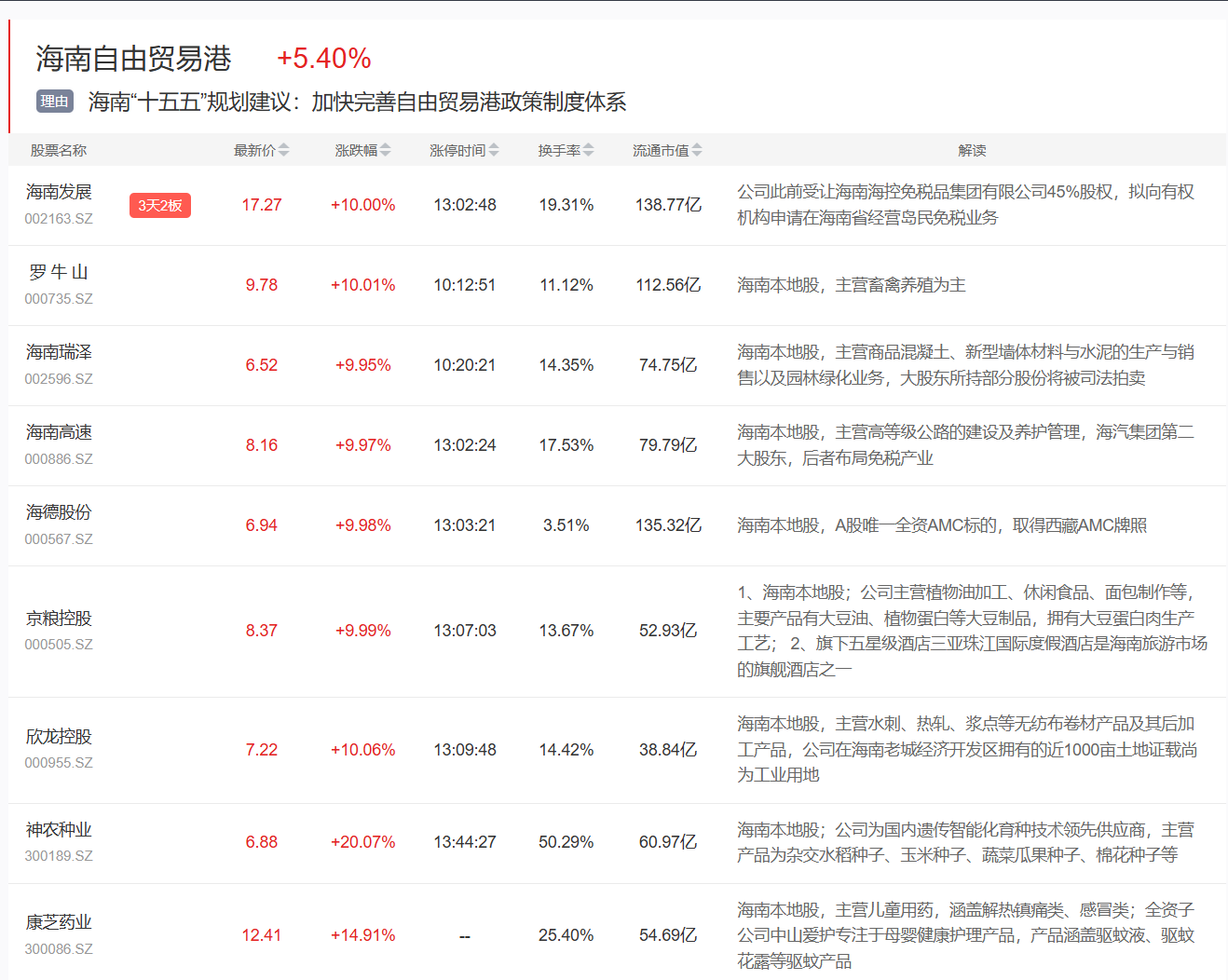
【大涨解读】海南:海南封关在即,还刚刚发布十五五规划建议,将大幅提高贸易自由化便利化,有望形成全球消费需求“虹吸”
Xuan Gu Bao· 2025-12-10 05:54
Group 1 - The Hainan stock market experienced a collective surge on December 10, with multiple companies hitting the daily limit up, including Luoniushan, Hainan Ruize, Hainan Highway, and others [1][2] - The Hainan Free Trade Port index rose by 5.40%, indicating strong investor sentiment and market activity [2] - Key stocks such as Hainan Development and Luoniushan saw significant price increases of 10.00% and 10.01% respectively, reflecting positive market reactions to local economic developments [2] Group 2 - The release of the 15th Five-Year Plan by the Hainan Provincial Committee emphasizes the acceleration of the Free Trade Port policy system and aims to enhance trade liberalization and facilitation [3] - The upcoming full island closure operation on December 18 will implement a policy of "one line open, one line controlled," allowing for greater freedom within the island [3] - The new policies are expected to provide extensive development opportunities for businesses, particularly in tourism, modern services, and high-tech industries, supported by tax incentives and financial openness [4] Group 3 - The Free Trade Port's policies are designed to stimulate economic growth and industrial upgrades, with a focus on optimizing duty-free policies and expanding the consumer base [4] - The implementation of "zero tariffs and low tax rates" is anticipated to attract domestic and international consumer demand, leading to increased foot traffic and consumption scale [4]


海南“十五五”规划建议:聚焦新领域新赛道 推动生物制造、氢能、脑机接口、具身智能等未来产业创新发展
Zheng Quan Shi Bao Wang· 2025-12-10 02:32
人民财讯12月10日电,中共海南省委关于制定国民经济和社会发展第十五个五年规划的建议发布,其中 提出,前瞻布局"四新"未来产业。聚焦新领域新赛道,推动生物制造、氢能、脑机接口、具身智能等未 来产业创新发展。探索多元技术路线、典型应用场景、可行商业模式、市场监管规则,建立投入增长和 风险共担机制。完善生物原料多元供给体系,培育建设高能级创新平台,巩固海洋生物制造、生物育种 领域竞争优势,打造具有海南特色和优势的生物制造产业集群。支持海上风电制氢示范,结合多场景应 用,带动氢能"制储输用"全产业链发展。打造脑机接口省级技术创新中心,攻关脑科学和电极、芯片等 核心技术,加速实现科研成果产业化。推动具身智能在多元场景中广泛应用,打造集生产、学习、研 究、应用为一体的产业生态体系。 ...
邢自强谈“十五五”:“星辰大海”与“柴米油盐”的双向奔赴
2 1 Shi Ji Jing Ji Bao Dao· 2025-12-09 11:03
Core Insights - China is leveraging its unique industrial chain, engineer dividend, and large-scale market advantages to position itself as a global leader in cutting-edge technology [1][4] - The "14th Five-Year Plan" emphasizes technological innovation, consumer upgrades, and social welfare, with a focus on transforming the blueprint into sustained consumer potential through effective implementation of key tasks [1][7] Group 1: Advantages Driving China's Competitive Edge - China's competitive edge is attributed to three main advantages: industrial chain clustering effects, engineer dividends, and a policy framework supported by a vast domestic market [4] - The integration of industrial policy with market mechanisms allows Chinese companies to achieve better pricing and support R&D investments, particularly in sectors like artificial intelligence [4] - Despite the U.S. having approximately ten times the capital expenditure in AI, China demonstrates comparable efficiency in practical application scenarios, showcasing its first-mover advantage in several key sectors [4][5] Group 2: Strategies for Boosting Consumption - To break the weak economic cycle, broader reforms and economic support are necessary beyond just technological innovation, as highlighted in the "15th Five-Year Plan" [7] - Strengthening the social security system is crucial for addressing low-price cycles and increasing consumer spending, with proposals to raise monthly social security subsidies for farmers and migrant workers from approximately 220 yuan to 1,000 yuan by the end of the "15th Five-Year Plan" [8] - If social security reforms are successfully implemented, it is projected that the share of household consumption in GDP could rise from about 40% to 45% within five years, potentially leading to a domestic consumption market exceeding $10 trillion by 2030 [8] Group 3: Real Estate Market Stabilization - To stabilize the real estate market, three policy directions are suggested: inventory reduction through government acquisition of properties for affordable housing, debt restructuring for certain real estate companies to prevent risk spread, and mortgage interest subsidies to encourage home purchases [9][10] - The effectiveness of these measures hinges on addressing concerns about public resource allocation for historical issues, with the mortgage subsidy approach being more operationally feasible [10]
财信证券吴号:医药生物板块分化加剧 三大投资主线机遇凸显
Zhong Guo Zheng Quan Bao· 2025-12-08 23:21
Core Viewpoint - The pharmaceutical and biotechnology sector has demonstrated resilience and growth potential in 2023, driven by policy support and industry transformation, leading to a high-quality development phase characterized by innovation and cost control [1][4]. Industry Performance - As of December 8, 2023, the pharmaceutical and biotechnology sector has shown a weighted average increase of 30.64% in market capitalization, ranking 14th among 31 primary industries, but underperforming the CSI 300 index by 3.82 percentage points [2]. - The sector has exhibited significant internal differentiation, with innovation-driven segments outperforming others; for instance, other biological products, chemical preparations, and medical R&D outsourcing saw increases of 57.07%, 54.68%, and 51.87% respectively, while traditional Chinese medicine, vaccines, and blood products lagged behind with increases of only 3.89%, -0.73%, and -10.85% [2]. Market Dynamics - The strong performance of the innovative drug industry chain is attributed to four key factors: exceeding expectations in earnings from leading companies like BeiGene and WuXi AppTec, ongoing supportive policies for innovative drugs and devices, increased activity in domestic innovative drug business development (BD) transactions, and substantial clinical data disclosures at major global conferences [2][4]. Recent Adjustments - Since September 2023, the sector has experienced a temporary pullback, with a maximum drawdown of 12.72% from September 1 to November 21, primarily due to prior gains, unmet expectations in BD transactions, and geopolitical disturbances [3]. Valuation Insights - As of December 8, 2023, the sector's price-to-earnings (P/E) ratio stands at 51.75, with a premium of 267.54% over the CSI 300 index and 63.87% over all A-shares (excluding banks), indicating a relatively high valuation compared to historical levels [3]. Policy Support - The "14th Five-Year Plan" emphasizes support for innovative drugs and medical devices, transitioning from process optimization to comprehensive empowerment across the industry chain, with a focus on key technological breakthroughs in areas like dual antibodies, ADCs, and mRNA [6]. Investment Opportunities - Three main investment themes are highlighted: 1. The innovative drug sector, which is expected to thrive due to policy support and market expansion [7]. 2. The CXO sector, benefiting from increased demand for innovative drug development [7]. 3. Consumer healthcare, which is anticipated to recover as consumption policies promote growth [7]. Technological Integration - The integration of AI technologies into the biopharmaceutical industry is expected to enhance research efficiency and product development, with significant growth potential in AI-driven medical diagnostics and treatment processes [8].
财信证券吴号: 医药生物板块分化加剧 三大投资主线机遇凸显
Zhong Guo Zheng Quan Bao· 2025-12-08 20:48
Core Viewpoint - The pharmaceutical and biotechnology sector has demonstrated resilience and growth potential in 2023, driven by policy support and industry transformation, leading to a high-quality development phase characterized by innovation and cost control [1][4]. Industry Performance - As of December 8, 2023, the pharmaceutical and biotechnology sector has shown a weighted average increase of 30.64% in market capitalization, ranking 14th among 31 primary industries, but underperforming the CSI 300 index by 3.82 percentage points [2]. - The sector has exhibited significant internal differentiation, with innovation-driven segments outperforming others; for instance, other biological products, chemical preparations, and medical R&D outsourcing saw increases of 57.07%, 54.68%, and 51.87% respectively, while traditional Chinese medicine, vaccines, and blood products lagged with increases of only 3.89%, -0.73%, and -10.85% [2]. Factors Influencing Growth - The strong performance of the innovative drug industry chain is attributed to four key factors: exceeding expectations in earnings from leading companies like BeiGene and WuXi AppTec, ongoing supportive policies for innovative drugs and devices, increased activity in domestic innovative drug business development (BD) transactions, and substantial clinical data disclosures at major global conferences [2]. Recent Adjustments - Since September 2023, the sector has experienced a pullback due to prior significant gains, unmet expectations in some BD transactions, and geopolitical disturbances, with a maximum drawdown of 12.72% from September 1 to November 21 [3]. Valuation Insights - As of December 8, 2023, the sector's price-to-earnings (P/E) ratio stands at 51.75, ranking 10th among primary industries, with a premium of 267.54% over the CSI 300 index and 63.87% over all A-shares (excluding banks), indicating a relatively high valuation level historically [3]. Policy Impact - The policy environment has significantly upgraded support for the pharmaceutical and biotechnology industry, with the "14th Five-Year Plan" emphasizing the development of innovative drugs and medical devices, and the "15th Five-Year Plan" extending support to the entire value chain [6]. - The focus on key technological breakthroughs in areas such as dual antibodies, ADCs, and mRNA is expected to drive further differentiation within the industry [6]. Investment Opportunities - Three main investment themes are highlighted: 1. The innovative drug sector, which is expected to thrive due to policy support and strong performance from leading companies [7]. 2. The CXO sector, benefiting from increased demand for innovative drug development and showing significant performance improvements [7]. 3. Consumer healthcare companies, which are anticipated to recover as consumer demand increases, presenting dual potential for valuation recovery and earnings growth [7]. Technological Integration - The integration of AI technologies into the biopharmaceutical industry is expected to enhance research efficiency and product development, with AI applications improving diagnostic processes and overall healthcare delivery [8].