战略性新兴产业

Search documents
华电科工(601226):8.15亿电制绿色甲醇全链条设备合同落地,打开成长新空间:华电科工
Guoxin Securities· 2025-12-23 05:09
Investment Rating - The investment rating for the company is maintained at "Neutral" [2][15]. Core Insights - The company signed a significant contract worth 815 million yuan with its controlling shareholder, Huadian Group, to supply core equipment for a green methanol project in Liaoning, marking a new growth opportunity [3][7]. - The green methanol production capacity in China is expected to reach 10 million tons by 2030, with an average annual increase of 2 million tons [4][11]. - The market for green methanol equipment is projected to exceed 13 billion yuan annually, with the company positioned to benefit from this growth [4][9]. Summary by Sections Contract Details - The contract includes the supply of electrolyzers, CO2 compression and purification, methanol synthesis and processing, and storage tanks for the integrated demonstration project [3][7]. - The contract structure consists of three main components: hydrogen system equipment (649 million yuan), CO2 treatment and methanol system equipment (124 million yuan), and storage tank equipment (42 million yuan) [8]. Market Potential - The annual investment in green methanol equipment is estimated at 13 billion yuan, with specific allocations for CO2 treatment and methanol synthesis equipment (2.1 billion yuan), hydrogen and CO2 storage tanks (800 million yuan), and hydrogen system investments (10.1 billion yuan) [4][10]. - The company’s full-chain equipment for electro-methanol production is applicable to all green methanol projects, enhancing its market position [9]. Company Performance - In the first three quarters of 2025, the company reported a revenue of 6.534 billion yuan, a year-on-year increase of 32.6%, and a net profit of 120 million yuan, up 11.6% [6][14]. - The gross margin for the same period was 11.0%, reflecting a year-on-year increase of 1.8 percentage points [14]. Profit Forecast - The profit forecast for 2025-2027 has been adjusted downward, with expected net profits of 205 million yuan, 296 million yuan, and 326 million yuan respectively, reflecting growth rates of 78%, 44%, and 10% [15].

广东大动作!500亿战略新兴产业基金来了
Sou Hu Cai Jing· 2025-12-22 23:47
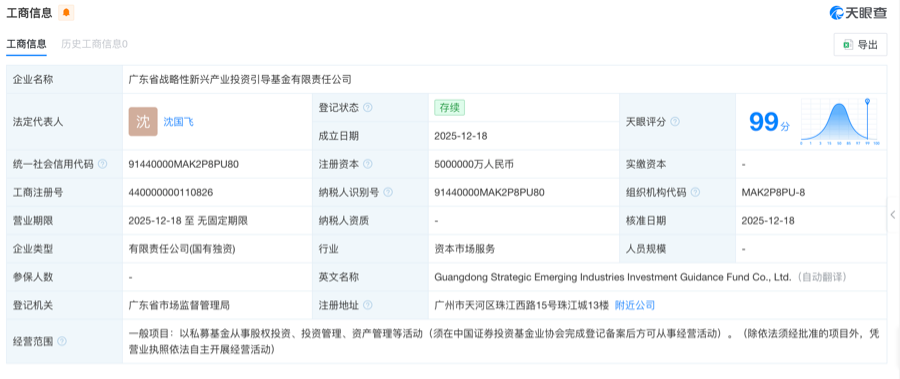
据了解,广东战略新兴产业基金暂由广东粤财基金管理有限公司(简称"粤财基金")负责管理,工商信 息显示,该基金法定代表人同为粤财基金总经理沈国飞。 粤财基金成立于2016年,系广东省属最大的政策性基金投资平台,为广东粤财投资控股有限公司全资子 公司,广东省政府引导基金专业管理人之一。 来源:证券时报 广东,大动作! 记者从天眼查获悉,近日,广东省战略性新兴产业投资引导基金有限责任公司(以下简称"广东战略新 兴产业基金")成立,注册资本500亿元人民币,经营范围包括以私募基金从事股权投资、投资管理、资 产管理等活动。股东信息显示,该公司由广东省财政厅全资持股。 目前,粤财基金管理广东省产业发展基金(一、二期)、广东省半导体及集成电路产业投资基金(一、二 期)等产业母基金,同时管理粤财新兴产业基金、粤财西威汽车产业基金、珠西航天基金、粤和产业投 资基金等市场化基金,管理资产规模超1300亿元。投资聚焦智能制造、半导体/集成电路、数字经济、 新能源/碳中和等产业领域。 近年来,广东省出台了多个政策,支持创投行业高质量发展。今年4月,《广东省进一步促进创业投资 高质量发展行动方案》正式印发,围绕创业投资"募投管退"全链 ...
资本活水润泽产业森林
Su Zhou Ri Bao· 2025-12-22 22:41
Core Insights - The first phase of the Jiangsu Social Security Science and Technology Innovation Fund, with a scale of 50 billion yuan, has officially launched in Suzhou, marking a significant event in the investment landscape [1][6] - Suzhou has seen a vibrant venture capital scene, with 770 new registered funds and a fundraising scale of 280 billion yuan from January 2023 to November 2025 [1][2] Investment Landscape - Over 20 new funds are established in Suzhou each month, attracting nearly 8 billion yuan in venture capital [2] - The Jiangsu Social Security Science and Technology Innovation Fund is expected to stimulate technological innovation and industrial upgrades in Suzhou, reinforcing its position as a national venture capital hub [2][6] Market Performance - Suzhou has achieved significant success in capital markets, with 16 new companies listed domestically and internationally in 2023, including 9 on the A-share market, ranking first in the nation [3] - 91.8% of the newly listed companies in Suzhou from January 2023 to November 2025 have received investments from venture capital or private equity firms [3] Ecosystem Development - The establishment of the Jiangsu Social Security Science and Technology Innovation Fund is a key milestone for the development of Suzhou's venture capital industry, focusing on strategic emerging industries such as advanced manufacturing and artificial intelligence [6][7] - Suzhou has become a core highland for venture capital in China, supported by strong industrial foundations, effective policy support, and significant capital aggregation [4][10] Collaborative Efforts - The collaboration between various financial institutions and venture capital firms aims to provide comprehensive financial services to technology innovation enterprises, fostering a supportive ecosystem for local economic development [7][10] - Suzhou has initiated regular industry salons to facilitate ongoing dialogue between capital and technology, enhancing the integration of capital and industry [9][10] Future Outlook - The AIC fund model in Suzhou, which integrates national, local capital, universities, and industry leaders, is seen as a pioneering approach in the country [10] - The focus on early-stage projects and specific industry chains within the "1030" industrial system is expected to drive further innovation and economic growth in Suzhou [10]
76小时闪电跨界!环保龙头3.1亿双线押注医疗,收款“阵痛”中寻破局
Sou Hu Cai Jing· 2025-12-22 14:38
Core Viewpoint - Company Jindalai is making a significant shift into the health sector by investing over 310 million yuan in two companies, marking its transition from environmental protection to a dual focus on "environment + health" [2] Investment Details - Jindalai announced an investment of 280 million yuan to acquire a 34% stake in Jici Medical, focusing on cell therapy, and an additional 30 million yuan for a 10% stake in Zhongke Hongtai, which specializes in medical robotics [2][6] - The investment in Jici Medical positions Jindalai as the second-largest shareholder, just behind the controlling shareholder [3] Financial Performance of Target Companies - Jici Medical reported revenues of 11.23 million yuan and a net profit of 1.15 million yuan for the first three quarters of 2025, but its equity remains negative at -3.15 million yuan [4] - Zhongke Hongtai's revenue for the same period was only 102,600 yuan, with a net loss of 550,770 yuan, indicating ongoing financial challenges [6] Strategic Alignment with National Policies - Both investments align with national strategic emerging industries, with Jici Medical focusing on cell therapy and Zhongke Hongtai on the trend of intelligent medical devices [6] - The "14th Five-Year Plan" identifies biomanufacturing as a new economic growth point, with stem cell technology included as a key area [6] Challenges in Core Business - Jindalai's core environmental business is under pressure, with a revenue decline of 23.5% year-on-year for the first three quarters of 2025, leading to a search for new growth avenues [8] - The company is facing a "collection battle" with multiple lawsuits, indicating difficulties in cash flow management [9][12] Cash Flow and Investment Risks - Despite current cash flow stability, with over 2.2 billion yuan in liquid assets, future investments in the new sectors may strain resources, especially given the financial status of the target companies [14] - The high-risk nature of clinical trials in cell therapy and the complex registration processes for medical robots pose additional uncertainties for Jindalai's new ventures [14][15] Technical Synergy Concerns - There is limited technical synergy between Jindalai's core wastewater treatment technology and the new health sector investments, which may hinder the company's ability to leverage its existing expertise [15]



广东500亿战略新兴产业基金来了!
证券时报· 2025-12-22 14:08
广东,大动作! 据了解,广东战略新兴产业基金暂由广东粤财基金管理有限公司(简称"粤财基金")负责管 理,工商信息显示,该基金法定代表人同为粤财基金总经理沈国飞。 粤财基金成立于2016年,系广东省属最大的政策性基金投资平台,为广东粤财投资控股有限 公司全资子公司,广东省政府引导基金专业管理人之一。 目前,粤财基金管理广东省产业发展基金(一、二期)、广东省半导体及集成电路产业投资基金 (一、二期)等产业母基金,同时管理粤财新兴产业基金、粤财西威汽车产业基金、珠西航 天基金、粤和产业投资基金等市场化基金,管理资产规模超1300亿元。投资聚焦智能制造、 半导体/集成电路、数字经济、新能源/碳中和等产业领域。 近年来,广东省出台了多个政策,支持创投行业高质量发展。今年4月,《广东省进一步促进 创业投资高质量发展行动方案》正式印发,围绕创业投资"募投管退"全链条,从培育优质创 投机构、拓宽资金来源、健全退出机制、强化政策引导支持、优化市场环境五大维度,推出 19条针对性举措。 方案要求,优化政府出资的创业投资基金运作,切实发挥引导放大功能。政府出资的创业投 资基金通过"母基金+子基金+直投"方式支持战略性新兴产业和未来 ...

中创智领(601717.SH):拟设立中创智领(郑州)产业投资合伙企业 专门从事对外投资业务
Ge Long Hui· 2025-12-22 12:21
Group 1 - The company plans to establish a wholly-owned subsidiary, Zhengzhou Zhongchuangzhiling Future Investment Management Co., Ltd., with a capital investment of RMB 10 million to enhance its capital operation business system [1] - The company will act as a limited partner contributing RMB 29.9 million, while the new subsidiary will contribute RMB 1 million to set up Zhongchuangzhiling (Zhengzhou) Industrial Investment Partnership (Limited Partnership) [1] - The new investment platform aims to promote industrial upgrades and seek to cultivate a "second growth curve" for sustainable high-quality growth over the next 5-10 years [1] Group 2 - The new investment platform will focus on key areas aligned with the national "14th Five-Year Plan" and the company's development strategy, including upstream and downstream enterprises in the existing industry chain [2] - Investments will target strategic emerging industries such as new energy, new materials, semiconductors, aerospace, robotics, and intelligent equipment, resonating with the goal of building new pillar industries [2] - The company aims to deepen internal innovation ecosystem construction by establishing specialized investment platforms to support internal incubation and technological innovation, facilitating the commercialization of scientific achievements [2]

中创智领(00564)拟设立中创智领(郑州)产业投资合伙企业 专门从事对外投资业务
智通财经网· 2025-12-22 12:04
Core Viewpoint - The company is establishing a new investment platform to drive dual development in industry and investment, aiming to enhance its capital operation system and support long-term growth strategies [1][2]. Group 1: Investment Strategy - The company plans to invest CNY 10 million to establish a wholly-owned subsidiary, Zhengzhou Zhongchuang Zhiling Future Investment Management Co., Ltd., and will contribute CNY 299 million as a limited partner to set up Zhongchuang Zhiling (Zhengzhou) Industrial Investment Partnership [1]. - The new investment platform will focus on key areas such as upstream and downstream enterprises in the existing industry chain, strategic emerging industries like new energy, new materials, semiconductors, aerospace, robotics, and smart equipment [2]. - The investment strategy aims to enhance the company's industrial chain layout and reserve new strategic projects, enabling the company to seize merger and acquisition opportunities and achieve industrial synergy [2]. Group 2: Long-term Growth and Innovation - The investment is aligned with the national "14th Five-Year Plan" and aims to deepen internal innovation by supporting the incubation of enterprises and technological talent, facilitating the commercialization of technological innovations [2]. - This initiative is expected to enhance the company's insight into frontier fields and empower new business exploration, laying a foundation for growth in the next 5-10 years [3].
广东500亿战略新兴产业基金来了!
Sou Hu Cai Jing· 2025-12-22 12:03
Group 1 - Guangdong Province has established the Guangdong Strategic Emerging Industries Investment Guidance Fund with a registered capital of 50 billion RMB, focusing on private equity investment, investment management, and asset management [1] - The fund is managed by Guangdong Yuecai Fund Management Co., which is the largest policy-based fund investment platform in Guangdong, managing over 130 billion RMB in assets across various industry funds [1] - The fund aims to invest in sectors such as intelligent manufacturing, semiconductors/integrated circuits, digital economy, and new energy/carbon neutrality [1] Group 2 - Guangdong Province has implemented multiple policies to support the high-quality development of the venture capital industry, including a comprehensive action plan with 19 targeted measures [2] - The action plan emphasizes optimizing the operation of government-funded venture capital funds and enhancing their guiding and leveraging functions [2] - The provincial government aims to establish a total scale of over 1 trillion RMB for industrial investment and venture capital funds, with provincial funds exceeding 100 billion RMB [2] Group 3 - As of the end of 2024, Guangdong Province has 155 government investment funds with a total subscribed scale of 1.77 trillion RMB and has paid in 1.24 trillion RMB [3] - The measures include proactive engagement with overseas sovereign funds and international investment institutions to facilitate over 100 investment cooperation projects annually [3] - The initiative also includes a project roadshow action to introduce over 1,000 high-growth projects each year [3]
500亿,江苏社保科创基金备案完成
FOFWEEKLY· 2025-12-22 10:01
Core Insights - The Jiangsu Social Security Science and Technology Innovation Equity Investment Fund has been officially established, marking a strategic collaboration between the National Social Security Fund Council and the Jiangsu Provincial Government [1] - The initial scale of the fund is set at 50 billion yuan, focusing on key national strategic emerging industries and specific industrial systems within Jiangsu [1] - The fund aims to attract more social capital into core areas of technological innovation, supporting Jiangsu in becoming a nationally influential hub for technological innovation [1] Summary by Sections - **Fund Establishment**: The Jiangsu Social Security Science and Technology Innovation Equity Investment Fund was successfully registered with the Asset Management Association of China, indicating the commencement of its operational phase [1] - **Fund Structure and Focus**: The fund adopts a "dual-layer, joint management" structure, concentrating on advanced manufacturing, artificial intelligence, integrated circuits, new energy, biomedicine, and new materials [1] - **Investment Goals**: The fund is designed to provide strong capital support for the development of new productive forces in Jiangsu, aligning with the province's strategic industrial frameworks [1]

广东再出大手笔 省级战略性新兴产业投资引导基金成立
2 1 Shi Ji Jing Ji Bao Dao· 2025-12-22 04:57
国资入局"耐心资本",广东再出"大手笔"。 12月22日,南方财经记者从工商登记信息获悉,广东省战略性新兴产业投资引导基金有限责任公司于近日在广州成立,由广东 省财政厅100%控股,注册资本500亿人民币,经营范围包括以私募基金从事股权投资、投资管理、资产管理等活动。 南方财经记者从多位业内人士独家获悉,该基金或将暂由广东粤财基金管理有限公司负责管理,工商信息显示该基金法定代表 人同为广东粤财基金管理有限公司总经理沈国飞。 目前,粤财基金管理规模超1300亿元,管理范围既包括广东省产业发展基金(一、二期)、广东省半导体及集成电路产业投资 基金(一、二期)等产业母基金,同时管理粤财新兴产业基金、粤财西威汽车产业基金、分布式能源基金、粤和产业投资基金 等市场化基金。 广东粤财基金管理有限公司官网简介 今年以来,广东密集出台重磅政策支持创投行业高质量发展。4月,《广东省进一步促进创业投资高质量发展行动方案》正式印 发,围绕创业投资"募投管退"全链条,从培育优质创投机构、拓宽资金来源、健全退出机制、强化政策引导支持、优化市场环 境五大维度,推出19条针对性举措。 同月发布的《广东省进一步激发市场主体活力加快建设现代化 ...