生成式AI

Search documents
与郭毅可深聊:AI 逼近“全知”,人类会走向精神荒芜吗?
虎嗅APP· 2026-01-24 14:19
Core Viewpoint - The article discusses the implications of generative AI on knowledge acquisition and human cognition, emphasizing the importance of questioning and communication skills in the AI era [5][6][7]. Group 1: AI and Knowledge Acquisition - The development of large models allows for instant access to knowledge, raising the question of whether the ability to ask questions will become the most critical intellectual asset [8]. - Knowledge is defined as a consensus-based understanding, and the compression process of large models seeks statistical consensus, diminishing the need for personal knowledge systems [8][9]. - The ability to ask meaningful questions is crucial, as superficial questions yield superficial answers, while deeper inquiries can lead to more valuable insights [9][10]. Group 2: Human-Machine Interaction - Communication with machines is highlighted as a vital skill, with the ability to discern and evaluate AI-generated responses being essential for effective interaction [10][11]. - The distinction between asking AI and humans is minimal, but the richness of AI's knowledge necessitates a more critical approach to evaluating its responses [11][12]. - The evolution of thought processes is influenced by the tools used for knowledge acquisition, with AI potentially enhancing cognitive abilities rather than diminishing them [12][13]. Group 3: AI in Creative Processes - Collaboration with AI can lead to profound creative outputs, as demonstrated by individuals who effectively engage with AI to co-create content [13][14]. - The correct use of AI involves treating it as a knowledgeable partner, requiring users to critically analyze and engage with its responses [14][15]. - The potential for AI to develop its own viewpoints and emotions is discussed, suggesting that as AI's reasoning capabilities improve, it may begin to form independent perspectives [15][16]. Group 4: Future of AI and Employment - The emergence of AI tools will elevate the standards for professions like journalism, enhancing the depth and quality of reporting rather than leading to job loss [16][17]. - The article posits that the evolution of skills is necessary in the face of technological advancements, with those who adapt being more likely to thrive [17]. - The ongoing evolution of AI is viewed positively, with an emphasis on the need for humans to evolve alongside technology rather than succumb to pessimism about its impact [17].


苹果进入双寡头时代
虎嗅APP· 2026-01-24 09:43
Core Viewpoint - The article discusses the transition of leadership at Apple as Tim Cook approaches retirement, highlighting the potential successors John Ternus and Craig Federighi, marking the end of the post-Jobs era and the beginning of a new "duopoly" leadership structure at Apple [4][24]. Group 1: Leadership Transition - Tim Cook, aged 65, is facing questions about succession as Apple undergoes significant management restructuring following the departures and retirements of several executives [4]. - John Ternus and Craig Federighi are identified as key figures in Cook's succession plan, with Ternus being positioned as a potential CEO due to his youth and extensive experience in hardware engineering [12][25]. Group 2: Design Department Changes - The design department at Apple has undergone significant changes since the departure of former Chief Design Officer Jony Ive in 2019, leading to a fragmented structure with responsibilities split between Evans Hankey and Alan Dye [6][9]. - Ternus was appointed as the "Executive Sponsor" for design, allowing him to bridge the gap between designers and executives, although he does not directly oversee design [10][11]. Group 3: Federighi's Role in AI - Craig Federighi, now overseeing Apple's AI department, has shifted from being an AI skeptic to actively integrating AI technologies into Apple's products, particularly following the emergence of ChatGPT [17][19]. - Under Federighi's leadership, Apple has faced challenges in AI development, leading to the decision to collaborate with Google for AI capabilities, indicating a pragmatic approach to technology integration [20][26]. Group 4: Philosophical Differences in Management - Ternus represents a shift towards a product-driven, engineering-first approach at Apple, moving away from the design-centric philosophy of the past [13][26]. - Federighi's management style emphasizes cost control and practicality, which may lead to a more stable financial performance for Apple, albeit with less revolutionary innovation [22][26]. Group 5: Future Outlook - The combination of Ternus and Federighi as co-leaders may signify a new era for Apple, focusing on operational efficiency and practical product development rather than groundbreaking design [26][27]. - The transition is seen as a response to the evolving tech landscape, with Apple aiming to maintain relevance without overextending financially [22][26].


守护指尖上的青春
Xin Lang Cai Jing· 2026-01-23 19:56
Group 1 - The article addresses the need to define online information that may negatively impact the physical and mental health of minors [1] - It highlights types of harmful content, including those that may induce minors to imitate bad behavior, such as sexual innuendos, online violence, or irrational spending [1] - The article emphasizes the negative influence on minors' values, including the promotion of materialism, distorted aesthetics, and the notion that education is useless [1] Group 2 - There are specific requirements for content producers and online service providers to manage content presentation effectively [1] - It is mandated that harmful information should not be displayed prominently on homepages, pop-ups, or trending searches [1] - The article calls for significant warning labels to be added before displaying such information, ensuring visibility at the beginning, end, or middle of the content [1] Group 3 - The article stresses the importance of establishing robust technical safeguards, including the management of algorithm recommendations and generative AI services, to prevent the delivery of harmful information to minors [1]
后乔布斯时代结束了,这是库克的接班计划
3 6 Ke· 2026-01-23 11:49
Group 1 - Tim Cook has turned 65, prompting discussions about succession at Apple, with John Ternus and Craig Federighi emerging as potential successors [1] - Apple has undergone significant management restructuring since Steve Jobs' passing, with a clear focus on Ternus and Federighi as key figures in the company's future [1][27] - Ternus has been given a unique title of "Executive Sponsor" for design, allowing him to bridge the gap between designers and executives, while also serving as Senior Vice President of Hardware Engineering [8][11] Group 2 - The design team at Apple has faced fragmentation and talent loss since Jony Ive's departure, leading to a lack of clear leadership and direction [5][6] - Ternus represents a shift towards a product-driven and engineering-focused Apple, moving away from the design-centric approach of the past [10][29] - Federighi, now overseeing AI after taking over from John Giannandrea, has been characterized as a cost-conscious leader, focusing on practical solutions and outsourcing AI capabilities to remain competitive [12][26] Group 3 - The combination of Ternus and Federighi signifies a new "duopoly" at Apple, with Ternus managing hardware and design, while Federighi oversees software and AI [27][29] - Their differing management philosophies reflect a transition from a design-first mentality to a more pragmatic approach, potentially impacting Apple's innovation trajectory [29][31] - The upcoming transition in leadership marks the end of the Cook era and the beginning of a new chapter for Apple as it approaches its 50th anniversary [31]

光线传媒:公司与七维科技合作开发的AI工具集是综合性生成式AI工具集平台
Zheng Quan Ri Bao Wang· 2026-01-23 11:00
Core Viewpoint - The company, Light Media, is collaborating with Seven Dimensions Technology to develop a comprehensive generative AI toolset platform that integrates various AI generation capabilities to enhance workflow processes in content creation [1] Group 1 - The AI toolset aims to address specific workflow issues in the generative process by connecting text, visuals, and sound [1] - The company will select specific tools and applicable scenarios based on practical business operations [1]

仅用半小时!Claude Code“终结”英伟达“最强护城河”?
华尔街见闻· 2026-01-23 09:42
Core Viewpoint - The article highlights the potential of generative AI, specifically the Claude Code platform, in facilitating the migration of code from NVIDIA's CUDA to AMD's ROCm platform, which could challenge NVIDIA's long-standing technological moat built around CUDA [1][2]. Group 1: Migration Capabilities - A user successfully migrated an entire CUDA backend to AMD's ROCm platform using Claude Code without needing an intermediate conversion layer, raising market interest [2]. - The migration process reportedly faced minimal issues, primarily related to "data layout" differences, indicating the tool's effectiveness in handling simpler kernel code [3][4]. Group 2: Limitations and Challenges - Industry experts caution that the success of Claude Code may be limited to simpler kernel codes, as more complex codebases requiring deep hardware optimization still pose significant challenges for AI tools [3][6]. - The real difficulty lies in migrating interconnected complex codebases, which necessitates a comprehensive understanding of contextual information for effective conversion to ROCm [7]. Group 3: Technical Framework - Claude Code operates using an intelligent agent framework that smartly replaces CUDA keywords with their ROCm counterparts while maintaining the underlying logic of specific kernels, rather than merely performing keyword substitutions [4]. - The tool simplifies the migration process, allowing developers to execute the transition via a command-line interface without the need for complex configuration environments like Hipify, thus lowering the barriers for platform migration [4].



Science最新发布:AI Coding正在拉大你的技能、收入差距
3 6 Ke· 2026-01-23 04:15
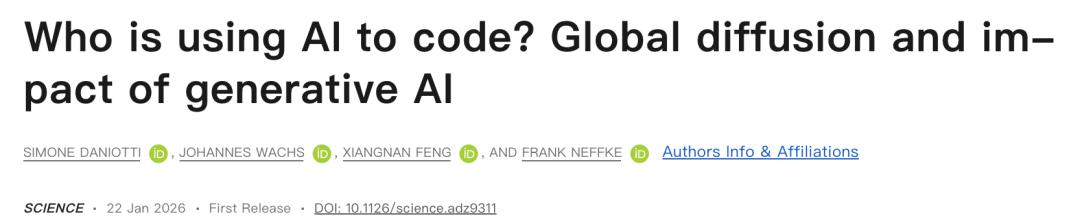
一项发表在 Science上的最新研究表明,当前爆火的氛围编码(Vibe Coding)可能会扩大人与人之间的技能与收入差距。 论文链接:https://www.science.org/doi/10.1126/science.adz9311 来自乌得勒支大学的研究团队通过机器学习方法,系统地分析了 160097 名开发者在 GitHub 上提交的超过 3000 万份 Python 代码,首次大规模地揭示了AI Coding 的渗透实况。 数据显示,截至 2024 年底,美国已有约 29% 的 Python 函数由 AI 辅助或直接生成,且这个比例在 GitHub Copilot、ChatGPT 等 AI 工具发布后呈现爆发 式增长。然而,AI 的普及并不均衡,德国、法国紧随其后,采用率约为 23%-24%,印度快速追赶至 20%,而其他国家的采用率明显滞后。 值得注意的是,尽管 AI 显著提升了资深开发者的生产力与创新能力,却未能让广泛使用 AI 的早期职业开发者获得实质效率提升。这意味着,AI 可能正 在重塑软件开发领域的技能与职业阶梯。 全球AI编程采纳差异明显 过去,理解生成式 AI(genAI)在实际 ...
仅用半小时!Claude Code“终结”英伟达“最强护城河”?
Hua Er Jie Jian Wen· 2026-01-23 03:59
Core Insights - The AI code platform Claude Code has successfully migrated NVIDIA's CUDA code to AMD's ROCm platform within half an hour, showcasing the potential of generative AI in breaking down computational ecosystem barriers [1] - This case has raised market concerns that it may weaken NVIDIA's long-standing technological moat built around CUDA [3] Group 1: Migration Process - A user reported that the only issue encountered during the migration was the "data layout" difference [4] - Claude Code operates using an intelligent agent framework that can smartly replace CUDA keywords with their ROCm counterparts while maintaining the underlying logic of specific kernels [4] - The tool simplifies the migration process, allowing developers to complete the work directly through a command-line interface without needing to configure complex conversion environments like Hipify [4] Group 2: Limitations and Challenges - The user did not specify the exact type of codebase processed, but the design of ROCm mimics several aspects of NVIDIA's CUDA platform, making simple code migration relatively easy for AI tools [5] - Industry experts believe that the real challenge lies in migrating complex, interrelated codebases, which require the intelligent agent system to understand a significant amount of contextual information for effective conversion to ROCm [5] - There are concerns that Claude Code may struggle with deep hardware optimizations, particularly regarding specific cache hierarchies, limiting its practicality in high-performance computing scenarios [6]

日本“特拉斯时刻”算轻量版!城堡投资格里芬最新交流,犀利点评美国债务、移民、美联储、AI等热门话题
聪明投资者· 2026-01-23 03:34
Core Viewpoint - The conversation highlights concerns about the stability of bond markets, particularly in the context of rising debt levels and fiscal discipline, with a focus on the potential risks for the U.S. market as it faces similar pressures as Japan and the UK [3][11][12]. Group 1: Bond Market Concerns - Ken Griffin emphasizes the return of "bond vigilantes," indicating a renewed scrutiny of government fiscal policies as bond yields rise, particularly referencing Japan's recent spike in 40-year bond yields to 4% [3][10]. - The U.S. fiscal deficit is approaching 6% of GDP, raising alarms about the sustainability of its debt levels, which are nearing post-World War II highs [11][12]. - Griffin warns that the current calm in the market may be a dangerous illusion, suggesting that when corrections occur, they could be severe due to accumulated debt [16]. Group 2: Economic Policies and Their Impacts - Griffin critiques Trump's policies on tariffs and immigration, arguing they are more harmful than beneficial, as tariffs disrupt trade relationships and inflate costs, while immigration policies may reduce the labor supply and hinder the U.S.'s ability to attract top talent [4][17][27]. - He notes that the fiscal strategy of relying on economic growth to address debt is risky, especially after pandemic-related spending pushed the U.S. fiscal position into a more precarious state [19][37]. Group 3: AI and Technological Investment - The discussion on AI reveals that while there is significant hype, the real impact of AI on productivity may be more gradual and complex than anticipated, with concerns about the quality of AI-generated content [55][57]. - Griffin suggests that the narrative around AI is partly driven by the need to justify massive investments, with the U.S. and China positioned as the primary beneficiaries of technological advancements [58].

AI:消费品企业能力分水岭
Jing Ji Guan Cha Wang· 2026-01-23 02:24
Group 1 - The core insight from Accenture's report indicates that nearly 80% of surveyed consumers frequently use AI for shopping, with about 60% using it for product comparisons and nearly half for understanding product reviews, highlighting AI's transformative role in consumer behavior [2] - The shift from merely meeting basic needs to pursuing enhanced experiences is driving the consumer goods industry towards high-quality development, with AI becoming a key force in this transformation [2][3] - Companies are facing challenges in growth due to rising costs and demand fluctuations, necessitating a shift from traditional competition methods to leveraging generative AI as a foundational capability for operational transformation [3] Group 2 - AI is evolving from a tool for efficiency to an integral part of business systems, enabling companies to enhance capabilities rather than just reduce labor [4] - Generative AI can help companies achieve revenue increases of approximately 8%-12%, cost optimization of 3%-20%, and improvements in working capital efficiency of 10%-15% by reconstructing business decision-making and operational structures [8] - In finance, generative AI systems can automate complex processes, significantly improving efficiency and transparency, allowing finance teams to focus on oversight and analysis rather than routine tasks [9] Group 3 - In supply chain management, generative AI enables proactive and intelligent collaboration, transforming operations from reactive to autonomous systems that can adapt to uncertainties [11][12] - In brand marketing, generative AI accelerates the creative process, allowing for rapid generation and testing of marketing concepts, thus enhancing agility and responsiveness in campaigns [14] - In sales and channel management, AI-driven insights help prioritize high-value customers and streamline training for new employees, shifting the focus from experience-based to data-driven decision-making [16][17]