
零碳园区

Search documents
“零碳园区”概念火热,如何炼就“真零碳”?服贸会上将揭秘
Nan Fang Du Shi Bao· 2025-08-15 14:34
Group 1: Event Overview - The 2025 Service Trade Fair's Environmental Services Special Exhibition will be held at Shougang Park, featuring an exhibition area of 6,600 square meters with the theme "Green Productivity Empowering the Earth Home" [1] - Over 50 companies will participate in the exhibition, including 16 Fortune 500 and industry-leading enterprises, showcasing advancements in three core areas: new energy and low-carbon services, environmental ecological services and circular economy, and green low-carbon digital technologies and services [1] Group 2: Zero Carbon Park Solutions - The "Zero Carbon Park" solution pavilion will be a highlight, showcasing comprehensive solutions for zero-carbon parks, organized by the International Green Economy Association with nearly 10 participating companies [2] - The pavilion aims to serve as a benchmark demonstration area for cutting-edge solutions, facilitating communication between industry solutions and government entities, and providing a model for local planning [2] Group 3: Innovative Technologies and Solutions - Huamao Group will present the first full-cycle zero-carbon smart business circle in the country, focusing on zero-carbon operations, intelligent management, and low-carbon services [3] - Various companies will provide innovative solutions, including biomass energy integration, photovoltaic building integration, and AI-based diagnostic consulting for zero-carbon park construction [3] Group 4: Water Technology Innovations - The 2025 Beijing Water Technology Innovation Conference will take place on September 11, focusing on "Technology Empowering Water Services" [4] - The conference will feature a core section on smart water management, showcasing technological innovations in water management, including AI and digital twin technologies [4][5] Group 5: Beijing Service Brand Development - The event aims to establish a "Beijing Service" brand, integrating resources in policy innovation, technology research, and international cooperation to showcase nearly 30 representative achievements in environmental services [6] - The focus will be on advanced technologies and solutions, including smart water systems and AI waste incineration systems, contributing to ecological protection and pollution prevention [6] Group 6: AI Smart Incineration System - The AI smart incineration system will be showcased, which integrates cutting-edge technology for efficient waste management, achieving significant improvements in operational efficiency and emissions reduction [7] - The system is expected to enhance steam stability by 36%-48% and increase electricity generation by approximately 4.2% while reducing operational intensity by 80% [7] Group 7: Forums and Conferences - The event will host nine forums, including the Ecological Environmental Industry Service "Dual Carbon" Strategy Forum and the Global Green Economy Development Forum, featuring influential international guests and experts [8] - The Global Green Economy Development Forum will take place on September 12, focusing on sustainable development and green economy innovations, with significant outcomes expected [9]
悦达投资上半年净利润同比增长27.62% 光伏与储能项目推进成效显著
Zheng Quan Ri Bao Wang· 2025-08-15 13:45
Core Viewpoint - Jiangsu Yueda Investment Co., Ltd. reported significant growth in revenue and net profit for the first half of 2025, driven primarily by advancements in solar and energy storage projects [1][2]. Financial Performance - The company achieved an operating income of 1.358 billion yuan and a net profit attributable to shareholders of 14.0247 million yuan, marking a year-on-year increase of 27.62% [1]. Solar Projects - Yueda Investment has made substantial progress in its solar projects, particularly the 150MW and 70MW fish-solar complementary projects in Xiangshui, Yancheng, with the main engineering of the 150MW project completed and successfully connected to the grid in August 2025 [2]. - The Huafeng 378MW fish-solar complementary project, launched at the end of 2024, has generated revenue of 63.06 million yuan and a net profit of 17.23 million yuan from January to June 2025, achieving an annualized capital return rate exceeding 10% [2]. - This project is expected to produce an average annual power generation of 400 million kWh, contributing to both stable electricity sales and significant environmental benefits, including a reduction of 36,650 tons of CO2 emissions and saving 133,400 tons of standard coal annually [2]. Distributed Solar Projects - The company has initiated new distributed solar projects, including the Yueda Smart Center (0.1MW) and the Dianfen project (0.94MW), aiming for operational status by the end of 2025 [3]. - These projects are expected to enhance overall profitability and support the achievement of annual operational goals [3]. Energy Storage Developments - Yueda Investment has rapidly established a 100MW/200MWh shared energy storage power station in Dongtai, which was completed in just 81 days and began operations on June 24, 2025, setting a record in the domestic sector [3]. - The project is projected to generate an average annual revenue of 32 million yuan over its 25-year operational period [3]. - As of June 2025, the company has accumulated a new energy storage capacity of 260MW/520MWh, positioning itself as a key player in the regional energy storage network [3]. Future Initiatives - The company is actively pursuing the development of commercial microgrid projects and has signed strategic cooperation agreements for the construction of a national-level zero-carbon park in collaboration with the Yancheng Economic Development Zone [3].

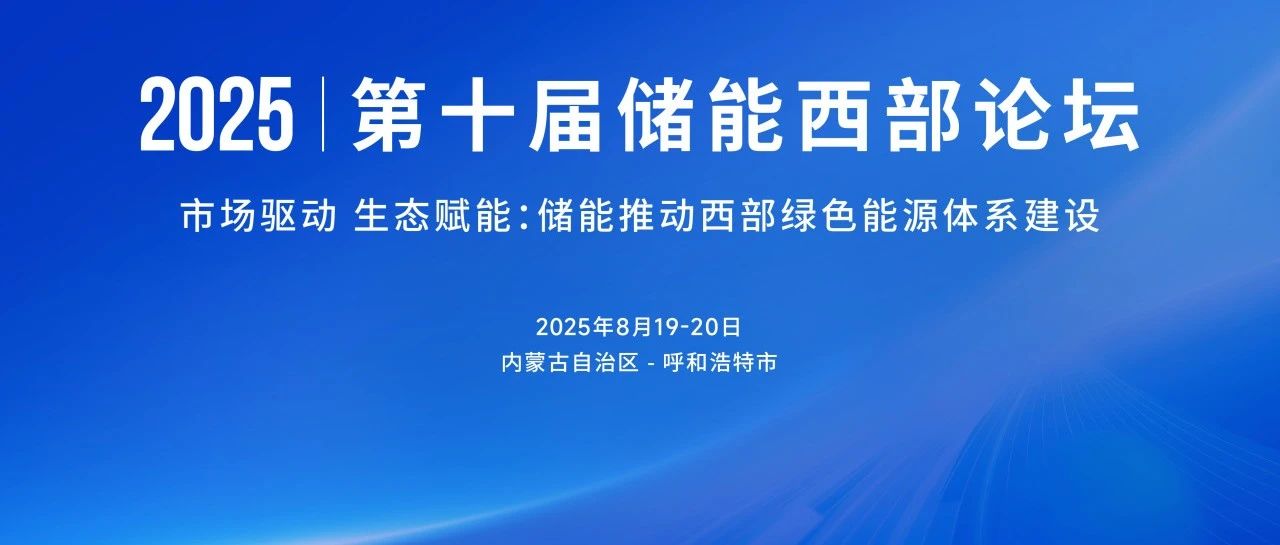
全版日程发布!第十届储能西部论坛倒计时4天
中关村储能产业技术联盟· 2025-08-15 10:59
Core Viewpoint - The 10th Western Energy Storage Forum will be held on August 19-20, 2025, in Hohhot, Inner Mongolia, focusing on the integration of new energy and energy storage in China's western region, contributing to the national dual carbon strategy and the construction of a new power system [2][30]. Event Overview - The forum aims to create an innovative communication platform involving government, industry, academia, research, and application to explore new ideas for the development of new energy and energy storage in western China [2]. - The full agenda for the forum has been officially released, detailing various sessions and discussions [2]. Main Reports and Sessions - Keynote speeches will cover topics such as the new energy revolution and new energy storage technologies, the current status and trends of the new energy storage industry, and innovative practices in energy storage technology by major companies [10][11][12]. - The forum will feature multiple sub-forums focusing on new energy storage and electricity markets, innovative value creation in energy storage, and the exploration of unique energy storage markets in the western region [13][14][16]. Special Topics and Discussions - Discussions will include the integration of energy storage with renewable energy sources, innovative business models for zero-carbon parks, and the application of new energy storage technologies in data centers [19][22]. - A roundtable discussion will address the collaboration between large-scale energy storage and green hydrogen production, emphasizing the importance of stable green electricity supply [19]. Supporting Organizations - The forum is organized by several key institutions, including the China Energy Research Society, the Zhongguancun Energy Storage Industry Technology Alliance, and the Inner Mongolia Energy Storage Industry Promotion Association [24][30].

2025全国生态日广东省活动启幕,共绘生态文明新画卷
Zhong Guo Qi Che Bao Wang· 2025-08-15 08:42
Core Viewpoint - The event held in Shaoguan, Guangdong, on the occasion of the National Ecological Day aims to promote the concept of "Lucid waters and lush mountains are invaluable assets" and accelerate the transition to a green and low-carbon lifestyle and production method [1][4]. Group 1: Event Overview - The event was organized by multiple governmental bodies in Guangdong, showcasing a collaborative effort in ecological civilization construction [1]. - Representatives from various sectors, including government, academia, and industry, participated in the event, highlighting the importance of collective action in ecological initiatives [1]. Group 2: Key Messages from Officials - Guangdong's commitment to ecological civilization is emphasized, with a focus on achieving significant green development outcomes [4]. - Shaoguan's high forest coverage rate of 74.5% is noted as a vital ecological asset, contributing to the region's economic transformation [4]. Group 3: Experience Sharing and Discussions - Representatives shared experiences on green low-carbon development and waste recycling in construction, providing replicable models for ecological progress [5]. - A roundtable discussion focused on the challenges and innovations in building zero-carbon parks, offering new ideas for future developments in this area [5]. Group 4: Call to Action - A collective initiative was launched, urging all sectors of society to adopt green and low-carbon lifestyles, reflecting a strong community response [7]. - The event marked a significant step forward for Guangdong in its ecological civilization journey, with ongoing efforts to explore innovative paths for sustainable development [7].

2025全国生态日广东省活动启幕 共绘生态文明新画卷
Zhong Guo Fa Zhan Wang· 2025-08-15 06:52
中国发展网讯 朱丽莎、记者皮泽红报道 8月15日,在第三个全国生态日之际,广东省紧扣"绿水青山就 是金山银山"主题,在全国生态文明示范县—韶关市始兴县举办了全国生态日广东省活动。活动旨在深 入宣传阐释习近平生态文明思想,充分展示绿水青山就是金山银山理论和实践成果,普及推广绿色低碳 生活方式,加快推动形成绿色低碳的生产方式和生活方式。 本次活动由广东省发展和改革委员会、中共广东省委宣传部、广东省人民代表大会环境与资源保护委员 会、广东省自然资源厅、广东省生态环境厅、广东省水利厅、广东省农业农村厅、广东省林业局、韶关 市人民政府主办,韶关市发展改革局、韶关市始兴县人民政府承办。省相关部门负责同志、各地级以上 市发展改革等部门相关负责同志、专家学者及科研院校代表、企事业单位、有关行业协会代表以及新闻 媒体代表等齐聚一堂,共同参与这场生态文明建设的盛会。 广东省发展改革委党组成员、副主任秦黎明在致辞中指出,今年是习近平总书记提出"两山"理念的20周 年,是我国提出"双碳"目标的5周年,也是"十四五"规划收官之年。广东牢记总书记殷殷嘱托,坚持把 生态文明建设摆在全局工作的突出位置,牢固树立和践行绿水青山就是金山银山理念 ...
内蒙古推动零碳园区培育建设
Ren Min Ri Bao Hai Wai Ban· 2025-08-15 02:20
Core Viewpoint - Inner Mongolia Autonomous Region is launching a plan to cultivate and construct zero-carbon parks, aiming to establish a series of national and regional pilot zero-carbon parks to promote green and low-carbon development [1] Group 1: Zero-Carbon Park Definition and Goals - Zero-carbon parks are defined as areas where carbon dioxide emissions from production and living activities are reduced to "near zero" levels, with the potential to achieve "net zero" conditions [1] - The plan includes high standards and quality construction of zero-carbon parks through pilot promotion, demonstration leadership, and model innovation [1] Group 2: Implementation Phases - The construction of zero-carbon parks will be carried out in three phases: - In 2025, the selection process for zero-carbon park construction will begin, determining the list of parks to be developed [1] - From 2026 to 2028, comprehensive construction of national and regional zero-carbon parks will take place [1] - By 2030, further exploration and practice of zero-carbon park construction will deepen, with more regional parks included in the national pilot program [1]
内蒙古零碳园区培育建设方案印发
Zhong Guo Hua Gong Bao· 2025-08-15 01:49
Core Viewpoint - The Inner Mongolia Autonomous Region has issued a plan to cultivate and construct zero-carbon parks, aiming to promote sustainable development and reduce carbon emissions through a structured three-phase approach [1][2]. Group 1: Phased Development Plan - The first phase will start in 2025, focusing on the selection and approval of zero-carbon park construction [1]. - The second phase, from 2026 to 2028, will involve comprehensive construction of national and regional zero-carbon parks [1]. - By 2030, the third phase aims to deepen the exploration and practice of zero-carbon park construction, with more regional parks included in national pilot programs [1]. Group 2: Key Construction Contents - The plan includes building a zero-carbon park power grid system and enhancing the supply and consumption of green electricity [1]. - It emphasizes energy-saving and carbon-reduction transformations in parks, fostering new green low-carbon industrial dynamics [1]. - The plan promotes carbon capture, utilization, and storage (CCUS) technologies, alongside the development of a green smart energy and carbon management platform [2]. Group 3: Green Low-Carbon Industry Development - The plan identifies zero-carbon parks as crucial for nurturing green low-carbon production capabilities, ensuring resource guarantees for energy, water, and land [1]. - It encourages the transition of emerging and high-energy-consuming industries to zero-carbon parks with sufficient resources [1]. - Traditional industries are urged to integrate green electricity, green hydrogen, and carbon capture technologies to develop low-carbon processes [1].
港华智慧能源(01083) - 2025 H1 - 电话会议演示
2025-08-15 01:30
Financial Performance - Revenue decreased slightly by 1% from HK$10,501 million to HK$10,437 million[9] - Renewable Energy Business Net Profit increased by 5% from HK$164 million to HK$172 million[9] - Capital Expenditure decreased from HK$2 billion to HK$1.4 billion[12] Gas Business - Gas sales volume remained steady at 8.75 billion m³[5] - City Gas Dollar Margin increased by RMB 0.01/m³ to RMB 0.57/m³[5] - Operating expenses decreased by 6% due to optimized personnel structure[20] - Signed a 15 billion m³ pipeline gas LTA with the "Three Majors", amounting to 1.5 billion m³/year[4] - Secured LNG import supply of 1.5 million tonnes/year, equivalent to 2.1 billion m³/year[4] Renewable Energy - PV power generation increased by 44% to 1.18 billion kWh[4, 5] - Accumulated PV Grid-connected capacity increased by 0.3 GW to 2.6 GW[5] - Electricity trading volume increased by 14% to 3.64 billion kWh[5] - Secured 775 MWh in Energy Storage System (ESS) contracts[4] - Two tranches of quasi-REITs raised approximately RMB 1 billion[4, 38]
硅产业链新闻动态
中国有色金属工业协会硅业分会· 2025-08-14 08:06
Group 1 - The U.S. has initiated anti-dumping and countervailing investigations on crystalline silicon photovoltaic cells imported from India, Indonesia, and Laos, following a request from the Alliance for American Solar Manufacturing and Trade [1] - The U.S. International Trade Commission (ITC) is expected to make a preliminary ruling on the material injury caused by these imports by September 2, 2025 [1] - If the ITC finds substantial harm to the U.S. domestic industry, the Department of Commerce will continue its investigation, with preliminary countervailing and anti-dumping rulings expected in October and December 2025, respectively [1] Group 2 - In 2024, the estimated import value of the investigated products from India is approximately $790 million, from Indonesia is about $420 million, and from Laos is around $340 million [2] Group 3 - Shuangliang Group has signed a strategic cooperation agreement with CATL's subsidiary, aiming to integrate resources for the construction of zero-carbon parks [3] - The collaboration will leverage both companies' strengths in energy management and clean energy solutions to explore new models for zero-carbon park development [3] Group 4 - Zhonglai Co., Ltd. announced that its subsidiary won a bid worth 280 million yuan for a 1GW photovoltaic project operation and maintenance contract [4] - The contract includes responsibilities for the operation, maintenance, and safety of the photovoltaic plants during the service period [4] Group 5 - Qidong Hongjun New Energy Co., Ltd. plans to invest 2 billion yuan in a project to build a 4GW heterojunction battery and 2GW module production base [5] - The project will be constructed in phases, with an initial investment of 1 billion yuan for the first phase, which will produce 2GW of bifacial double-glass modules [5]



推动零碳园区培育建设
Ren Min Ri Bao· 2025-08-13 21:50
零碳园区建设内容涵盖多个方面,包括构建零碳园区电网系统、加强绿电高比例供给消纳、强化储能和 柔性负荷管理、大力推进园区节能降碳改造、培育绿色低碳产业新动能、强化园区资源节约集约、完善 升级园区基础设施、推进碳捕集利用与碳汇开发等。园区还将搭建绿色智慧能碳管理平台,增强涉碳综 合服务能力,并参与零碳标准规则制定,提升国际影响力。 《 人民日报 》( 2025年08月14日 04 版) (责编:岳弘彬、牛镛) 本报呼和浩特8月13日电 (记者张枨)日前,内蒙古自治区发展改革委与自治区工信厅、自治区能源局 联合印发方案,计划通过试点推进、示范引领、模式创新等举措,高标准高质量建设零碳园区,培育创 建一批国家级和自治区级零碳园区试点,打造绿色低碳发展高地。 零碳园区是指通过规划、设计、技术、管理等方式,使园区内生产生活活动产生的二氧化碳排放降 至"近零"水平,并具备进一步达到"净零"条件的园区。根据方案,内蒙古将分3个阶段推进零碳园区建 设:2025年启动零碳园区建设申报遴选工作,确定自治区零碳园区培育建设名单;2026至2028年,全面 开展国家级和自治区级零碳园区建设;到2030年,深化零碳园区建设探索实践,更多 ...