
美元指数

Search documents
人民币汇率创15个月新高 双向波动或成常态
Sou Hu Cai Jing· 2025-12-25 17:38
管涛认为,近期人民币升值缘于短期利多因素占据上风,并非意味着升值新周期的开启。综合来看,明 年人民币汇率大概率不会出现单边走势,更可能围绕7反复波动。人民币汇率最终走势将主要取决于三 大因素:中美经济恢复的相对强度、美元利率与汇率的变化趋势、中国对外经贸关系的演进及国内经济 恢复情况。市场不应过度执着于对具体点位的猜测,也不应形成单边升值或贬值的线性预期,双向波动 将成常态。 短期利多因素驱动人民币走强 本轮人民币升值的直接推动力,来自美元环境的转变。 管涛表示,美元指数11月曾升至100以上,随后持续回落并跌破98,"美元走弱为人民币升值提供了外部 支撑"。 汇管信息科技研究院副院长赵庆明也表示,自11月下旬以来,美元指数跌幅约3%,非美货币普遍走 高,人民币涨幅与美元贬值幅度基本对应,充分体现汇率"跷跷板效应"。 12月25日,外汇市场迎来标志性时刻——离岸人民币对美元汇率开盘升破"7"关口,2024年10月以来首 次收复这一重要整数关口,盘中最高触及6.9985,创15个月以来新高。与此同时,在岸人民币对美元汇 率同步走强,逼近"7"关口,报7.0066,创2024年9月以来新高。 2025年以来,伴随 ...
离岸人民币冲破7.0关键水平,三大因素带动后市
Sou Hu Cai Jing· 2025-12-25 15:45
Core Viewpoint - The recent strengthening of the Renminbi (RMB) is attributed to multiple factors, including expectations of interest rate cuts by the Federal Reserve, a weakening US dollar index, and increased demand for currency exchange from domestic enterprises as the year-end approaches [3][5]. Group 1: Factors Driving RMB Appreciation - Federal Reserve Rate Cut Expectations: The Federal Reserve is anticipated to cut rates by 25 basis points in December, with inflation cooling and signs of a slowing labor market, leading investors to bet on two potential rate cuts in 2026. The 10-year US Treasury yield has stabilized between 3.9% and 4.2% since September, reflecting market expectations for a shift towards a more accommodative monetary policy [3]. - Weakening US Dollar Index: The US dollar index has fallen to around 97.80, marking a 9.8% decline for the year, the worst annual performance since 2017, which has contributed to the appreciation of non-US currencies, including the RMB [3]. - Increased Corporate Currency Exchange Demand: As the year-end approaches, domestic foreign trade enterprises are increasing their currency exchange needs for financial settlements and cash flow, leading to a seasonal strengthening of the RMB. Although November's exchange rate did not show significant increases, the overall trade surplus for the year has prompted enterprises to exchange dollars for RMB earlier than usual [5]. Group 2: Implications of RMB Strengthening - Positive Impact on Domestic Capital Markets: The strengthening of the RMB is expected to benefit Chinese assets significantly, enhancing the attractiveness of RMB-denominated assets and potentially allowing for more accommodative monetary policy [5]. - Increased Cross-Border Investment Costs: The appreciation of the RMB may lead to higher currency exchange costs for cross-border investments, which could affect the final returns for investors in instruments like Hong Kong Stock Connect and mutual funds [5]. Group 3: Future Outlook - RMB Exchange Rate Projections: Analysts predict that the RMB will hover around the 7.0 mark against the US dollar through 2026, with potential appreciation towards the 6.7 to 6.8 range if the US dollar index remains weak [6][7]. - Policy Stability and Market Expectations: The central economic work conference emphasizes maintaining the RMB exchange rate's stability, aiming to guide market expectations and prevent one-sided trends in the currency market [6][7]. - Long-Term Trends: Analysts suggest that the RMB may decouple from the US dollar index in the future, with fundamental and policy support for the RMB's strength, while also noting that the underlying economic fundamentals will be crucial for sustained appreciation [7].

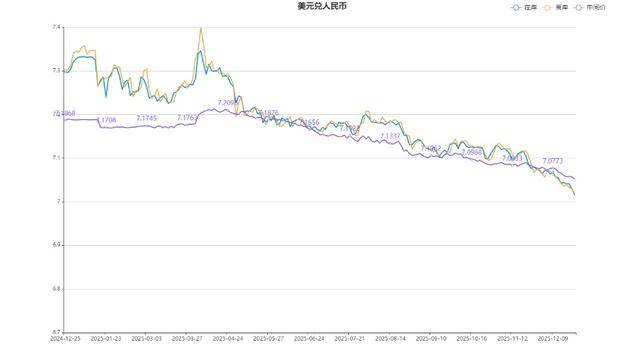
人民币汇率创15个月新高!管涛:双向波动或是常态
Sou Hu Cai Jing· 2025-12-25 15:17
Core Viewpoint - The offshore RMB has broken the "7" threshold against the USD for the first time since October 2024, reaching a high of 6.9985, while the onshore RMB also strengthened, nearing the "7" mark at 7.0066, marking a new high since September 2024 [1] Group 1: Factors Driving RMB Strength - The recent appreciation of the RMB is primarily driven by a weakening USD, with the dollar index dropping from above 100 to below 98 since November [2] - China's robust economic fundamentals, including a trade surplus of $1.0758 trillion for the first 11 months of 2025, have bolstered confidence in the RMB [2] - Increased demand for currency settlement by enterprises at year-end has contributed to the seasonal strengthening of the RMB, although this "settlement wave" is not the main driver of the current appreciation [2][3] Group 2: Outlook on RMB Exchange Rate - Experts caution against expecting a new cycle of sustained RMB appreciation, predicting that the exchange rate will likely exhibit two-way fluctuations rather than a unilateral trend [4] - The future trajectory of the USD is uncertain, with expectations of a potential rebound after a period of decline, which could diminish the RMB's appreciation momentum [4][5] - The complexity of China's foreign trade environment and potential geopolitical tensions may also introduce volatility in the RMB exchange rate [5][6] Group 3: Implications for Enterprises - The appreciation of the RMB presents both opportunities and challenges for businesses, benefiting capital markets and importers while exerting pressure on exporters [9][10] - Exporters are experiencing exchange losses due to the rapid appreciation, affecting their competitiveness and order flow [10][11] - Companies are advised to adopt systematic risk management strategies to mitigate the impacts of exchange rate fluctuations, focusing on maintaining a neutral stance towards currency risk [11][12]
离岸人民币冲破7.0关键水平 三大因素带动后市
Xin Hua Cai Jing· 2025-12-25 14:00
Core Viewpoint - The Chinese yuan has strengthened significantly in December, with the offshore yuan surpassing the 7.0 mark against the US dollar for the first time since September 2024, indicating a trend of appreciation in the currency [1]. Factors Driving Yuan Appreciation - The recent appreciation of the yuan is attributed to three main factors: expectations of interest rate cuts by the Federal Reserve, a weakening US dollar index, and increased demand for currency conversion from domestic enterprises as the year-end approaches [3][6]. - Federal Reserve Rate Cut Expectations: The Fed is anticipated to cut rates by 25 basis points in December, with inflation cooling and signs of a slowing labor market, leading investors to bet on two potential rate cuts in 2026. The 10-year US Treasury yield has stabilized between 3.9% and 4.2% since September, reflecting market expectations for a shift towards a more accommodative monetary policy [3]. - Weakening US Dollar Index: The US dollar index has dropped to around 97.80, marking a 9.8% decline for the year, the worst annual performance since 2017, which has contributed to the appreciation of non-US currencies, including the yuan [3]. - Increased Corporate Currency Conversion Demand: As the year-end approaches, domestic foreign trade enterprises are increasing their demand for currency conversion to meet financial settlement and cash flow needs, leading to a seasonal strengthening of the yuan [6]. Implications for Domestic Capital Markets - The appreciation of the yuan is expected to have a positive impact on domestic capital markets, enhancing the attractiveness of yuan-denominated assets and potentially providing more room for monetary policy easing [6]. - Analysts suggest that the strengthening yuan indicates foreign investors' confidence in yuan assets, which could drive up asset prices [6]. Future Outlook - Looking ahead, the yuan's exchange rate is expected to fluctuate around the 7.0 mark, with predictions suggesting it may rise to the 6.7 to 6.8 range by the end of 2026 if the US dollar index remains weak [7]. - The central economic work conference emphasizes maintaining the yuan's stability at a reasonable level, indicating that rapid appreciation may prompt financial authorities to intervene to stabilize fluctuations [7]. - Analysts predict that the US dollar index may continue to weaken, potentially falling to 96 by the end of 2026, although the pace of decline may be more moderate compared to this year [7][8].
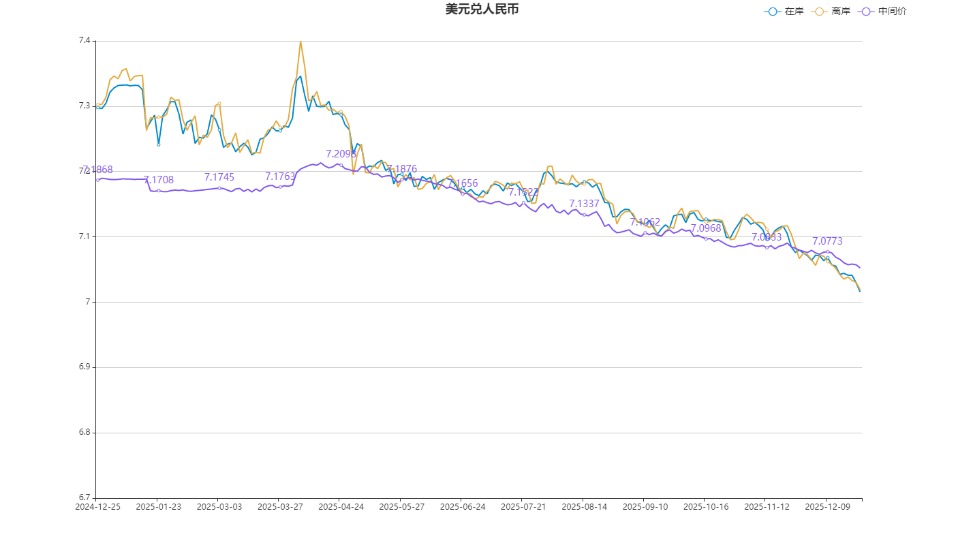
人民币汇率创15个月新高,双向波动或是常态
Di Yi Cai Jing· 2025-12-25 13:31
Core Viewpoint - The offshore RMB has broken the "7" level against the USD for the first time since October 2024, reaching a high of 6.9985, while the onshore RMB also strengthened, nearing the "7" mark at 7.0066, marking a new high since September 2024. The recent appreciation is attributed to a weaker USD and stable economic fundamentals in China, but experts caution against expecting a new cycle of unilateral appreciation [1][2][4]. Group 1: Factors Driving RMB Strength - The recent appreciation of the RMB is primarily driven by the weakening of the USD, which has seen a decline of about 3% since late November, providing external support for the RMB [2][4]. - China's economic fundamentals remain robust, with a trade surplus of $1.0758 trillion for the first 11 months of 2025, bolstering confidence in the RMB [2][4]. - Increased demand for currency settlement by enterprises at year-end has contributed to the seasonal strengthening of the RMB, although this "settlement tide" is not the main driver of the current appreciation [2][3]. Group 2: Outlook on RMB Exchange Rate - Experts generally believe that a sustained unilateral appreciation of the RMB is unlikely, with expectations for continued two-way fluctuations around the "7" level [4][8]. - The future trajectory of the USD is uncertain, with predictions of a potential rebound after a period of decline, which could diminish the RMB's appreciation momentum [4][5]. - The complex external economic environment, including trade relations and potential retaliatory measures from other countries due to China's trade surplus, adds uncertainty to the RMB's future [5][6]. Group 3: Implications for Enterprises - The appreciation of the RMB presents both opportunities and challenges for enterprises, benefiting capital markets and importers while posing risks for exporters [9][10]. - Exporters are experiencing exchange rate losses due to the rapid appreciation, which affects their international price competitiveness and order flow [10][11]. - Companies are advised to adopt systematic risk management strategies to mitigate the impacts of exchange rate fluctuations, focusing on maintaining a neutral stance towards currency risk [11].
人民币汇率创新高 升破7.0整数关口
Sou Hu Cai Jing· 2025-12-25 10:18
新华网北京12月25日电(刘睿祎 梁栋飞)近期,人民币兑美元汇率不断走强。12月25日,离岸人民币 对美元升破7.0整数关口,截至发稿时,达6.9978;在岸人民币对美元也探至7.0133。另外,中国外汇交 易中心12月25日受权公布人民币对美元的市场汇价,即人民币对美元市场中间价为7.0392,上调79个基 点。 他表示,美联储降息将继续主导美元指数走势。尽管明年美联储降息节奏需视美国经济后续走势而定, 但在新任美联储主席有可能态度偏"鸽"、更偏向用货币政策来保增长的情况下,降息幅度或超过今年9 月的点阵图预测。 "从2019年和2024年经验来看,美元指数在降息兑现后,均有所反弹,但在数月后转向下行。若以此类 推,特别是再考虑到美联储的降息空间或明显大于其他非美央行,美元指数的下行趋势或大致于明年一 季度或二季度正式开启。同时,美国经济仍领跑主要发达经济体,对于美元有支撑。"温彬说。 申万宏源证券首席经济学家赵伟认为,10月中旬以来,人民币经历了一波快速升值,但结汇率并没有显 著走高。其团队研报分析称,10月至11月,在"三价合一"的背景下,央行重启逆周期因子、不断调升的 中间价对升值有一定引导。而12月 ...
钟亿金:黄金多头居高不下 空军节节败退如何自处
Xin Lang Cai Jing· 2025-12-25 08:33
Group 1 - The core viewpoint of the articles indicates that international gold prices are experiencing a rebound, supported by a weakening US dollar index and ongoing bullish sentiment following a breakout of resistance levels [1][4] - The US dollar index is expected to continue its downward trend, which will further support gold prices in the short term [1][4] - The market is anticipating the release of initial jobless claims data for the week ending December 20, with expectations that it will remain unchanged, although a potential decrease could negatively impact gold prices [1][4] Group 2 - The price behavior of gold is characterized by a "high pullback and stabilization" pattern due to reduced liquidity ahead of the holiday season, with a peak at $4,525.70 before retreating to around $4,485, indicating some profit-taking at high levels [2][5] - Weekly data shows that spot gold has accumulated a gain of over 3.0% this week, suggesting that short-term selling pressure is more about price digestion rather than a fundamental shift [2][5] - Technical analysis indicates that gold prices are advancing along an upward channel, with the previous high of $4,381.29 effectively broken and now serving as a support level, while the critical central level of $4,300 represents a structural bottom for the trend [2][5] - Momentum indicators such as MACD remain above the zero line and are expanding, indicating that medium-term upward momentum is still dominant, while RSI at 80.86 suggests a high level of market congestion, making it more susceptible to fluctuations or corrections [2][5]
刚刚,人民币大消息!
中国能源报· 2025-12-25 06:57
离岸人民币兑美元升破7 . 0大关,最高触及6.9985,为2024年以来首次。 此外, 在岸人民币兑美元升破7.01关口,创2024年9月27日以来新高。 "近期人民币升值行情,是外部压力趋缓、内部韧性增强、政策精准调控与市场预期转向 等多种因素共同作用的结果。"国家金融与发展实验室特聘高级研究员庞溟表示。 庞溟分析,本轮人民币升值的直接推动力,来自美元环境的转变。市场预期,伴随美联储 继续开展降息,将进一步压制美元长期走势,为人民币提供外部升值空间。 欢迎分享给你的朋友! 出品 | 中国能源报(c n e n e rg y) 对于人民币汇率升破7元关口,庞溟表示,预计汇率中枢将围绕7元关口双向波动、稳中 偏强运行,单边快速行情的概率不高。 国泰研究报告分析,未来人民币汇率与美元指数的脱钩将成为常态,人民币汇率破7具有 基本面和政策端的双重基础。不过也需要关注基本面边际变化,中长期看,基本面才是支 撑汇率走强的核心变量。 多位专家表示,展望2026年,人民币汇率有望保持温和升值。 中信证券首席经济学家明明 表示,2026年美元指数偏弱运行趋势或延续,央行稳汇率政 策张弛有度,增强人民币汇率韧性,人民币汇率有 ...

人民币破7,年末结汇潮下,跨境电商人的“忧”与“机”
Sou Hu Cai Jing· 2025-12-25 06:33
跨境电商卖家,大概是对汇率波动最敏感的人群之一,毕竟人民币升值贬值,直接意味着利润增长货值缩水。 与此同时,大洋彼岸,美元指数跌破100,美联储降息预期升温是主要推动力。今年美联储已经降息3次,而且美国的通胀数据也比预期好些,这就进一步推 动了降息预期。 最后,年底季节性结汇需求增加,进一步加速人民币升值,成为支撑人民币升值的核心因素,进一步推动人民币走强。 关注汇率政策,把握结汇时机,减少汇率损失,仍是2026年跨境电商卖家们应关注的重要课题。 汇率的剧烈变动,牵动着每一位跨境电商卖家的神经。 2025年最后一个月底,人民币汇率升破7.0大关,有人看到利润缩水,有人发现新机遇,这场汇率变局中,跨境电商是被动承压还是主动破局? 12月25日,离岸人民币对美元汇率升破7.0整数关口,为2024年9月以来首次。截至当日,离岸人民币今年累计升值已达4.6%,在岸人民币也逼近7.0关口, 年内累计升值4%。 人民币升值意味着出口企业结汇时同等美元收入能兑换的人民币减少,直接挤压利润空间。有跨境电商卖家测算过,人民币每升值1%,企业利润就减少相 应比例,对今年关税战下本就微利的行业更是雪上加霜。 ...

离岸人民币升破7关口,在岸汇率创9月底新高
Sou Hu Cai Jing· 2025-12-25 06:30
Group 1 - The offshore RMB against the US dollar has surpassed the "7" mark for the first time since October 2024, indicating a significant strengthening of the currency [1] - On the same day, the onshore RMB also rose above 7.01, reaching a new high since late September 2024 [1] - The People's Bank of China reported that the central parity rate for the RMB against the US dollar was set at 7.0392, an increase of 79 basis points from the previous trading day, marking a new high since October 2024 [1] Group 2 - Factors contributing to the recent strengthening of the RMB include reduced external pressures, enhanced internal resilience, precise policy adjustments, and a shift in market expectations [1] - The weakening of the US dollar index, driven by the Federal Reserve entering a rate-cutting phase, has led to a passive appreciation of major non-USD currencies, including the RMB [1] - The resilience of China's economic fundamentals, particularly the unexpected performance of exports and the attractiveness of the capital market, has provided internal support for the exchange rate [1] Group 3 - Seasonal increases in corporate demand for currency settlement towards the end of the year are also contributing to the strengthening of the RMB [1] - Analysts advise foreign trade enterprises to avoid betting on unilateral exchange rate trends and to utilize foreign exchange derivatives such as options and futures to manage exchange rate risks [1]