区块链技术

Search documents
陈吉宁:携手做好金融“五篇大文章”,共同促进金融创新转型
Xin Hua Wang· 2025-09-10 09:11
Core Viewpoint - The focus is on enhancing the Shanghai International Financial Center through collaboration and innovation, emphasizing the importance of financial transformation and the role of the People's Bank of China Shanghai Headquarters in this process [1][2][3]. Group 1: Financial Innovation and Transformation - The Shanghai International Financial Center aims to achieve new progress by promoting financial innovation and transformation, with a focus on five key areas: technology finance, green finance, inclusive finance, pension finance, and digital finance [3]. - The People's Bank of China Shanghai Headquarters is encouraged to enhance its functions, optimize its layout, and innovate to support the establishment of a Renminbi financial asset allocation center and risk management center [1][3]. Group 2: Support for the Real Economy - There is a strong emphasis on serving the real economy, particularly in supporting technological innovation and attracting venture capital funds [3]. - The use of structural monetary policy tools, such as relending and rediscounting, is highlighted to bolster financial support for green and low-carbon transformation projects [3]. Group 3: Regulatory and Risk Management Enhancements - The need to optimize and improve the regulatory system and work mechanisms is stressed, including clarifying risk control requirements and admission standards [3]. - The establishment of a financial risk monitoring and early warning system based on blockchain technology is proposed to better prevent and resolve risks in key areas [3].
铜陵有色:目前公司黄金产品的销售模式为现货销售,销售地区为国内上海黄金交易所
Mei Ri Jing Ji Xin Wen· 2025-09-10 08:44
Core Viewpoint - The company is currently engaged in spot sales of its gold products, primarily in the domestic market through the Shanghai Gold Exchange, and is open to exploring blockchain technology for real-time trading in the future [1] Group 1 - The company received an inquiry from investors regarding the potential integration of blockchain technology for real-time trading of its physical gold [1] - As of now, the company's sales model for gold products is focused on spot sales [1] - The sales region for the company's gold products is primarily the domestic market, specifically through the Shanghai Gold Exchange [1] Group 2 - The company has indicated that it will fulfill its information disclosure obligations if it decides to involve blockchain technology in its operations [1]

南通上海商会赴港参访 搭沪港通合作桥梁
Jiang Nan Shi Bao· 2025-09-10 06:40
Group 1 - The visit to Lee Kum Kee highlighted the company's transformation from a traditional sauce workshop established in 1888 to a global brand with over 300 products available in more than 100 countries, focusing on digital transformation and global supply chain management [2] - The Nantong Shanghai Chamber of Commerce aims to leverage Lee Kum Kee's international advantages to assist local food products in expanding globally, emphasizing collaboration in supply chain coordination and sharing digital transformation experiences [2] - Lee Kum Kee's strategy combines traditional roots with technological advancements, utilizing automated production lines and big data analysis to enhance production standardization and global market responsiveness [2] Group 2 - The visit to Matrixport showcased its comprehensive services in crypto finance, including asset trading, investment, custody security, and gold token business, presenting a one-stop service model [4] - The Nantong Shanghai Chamber of Commerce expressed the need for digital finance to enhance the international competitiveness of its member enterprises, seeking collaboration in expanding digital finance applications and talent development [4] - Discussions included the integration of crypto finance with green energy projects and cross-border asset allocation for Shanghai and Hong Kong enterprises, recognizing Matrixport's expertise and innovation in the crypto finance sector [4]
科技板块王者回来,金融科技ETF华夏(516100)逆势获资金持续布局
Mei Ri Jing Ji Xin Wen· 2025-09-10 06:28
Group 1 - The three major indices showed collective strength, with optical modules and server concepts leading the gains, while stock trading software and brokerage sectors exhibited mixed performance [1] - The financial technology ETF Huaxia (516100) rose by 0.95%, with its holdings such as YZJ, Dongxin Peace, Digital Certification, and Guiding Compass showing significant gains [1] - The brokerage ETF fund (515010) fell by 0.14%, with its holdings including Guolian Minsheng, Dongfang Securities, and CITIC Securities leading the decline [1] Group 2 - The 2025 Inclusion·Bund Conference opened in Shanghai, featuring a 10,000 square meter technology exhibition and a 5,000 square meter technology market, attracting nearly 200 companies and showcasing over 30 new technology products [1] - The conference highlighted cutting-edge technologies in areas such as LLM, general artificial intelligence, embodied intelligence, data and computing, and security and trust [1] - In the financial technology sector, Ant Financial launched a new full-stack enterprise-level financial intelligence platform, leveraging AI and blockchain technology to assist financial institutions in accurately assessing customer credit risk and optimizing investment portfolios [1]
德林控股陈宁迪:拥抱优质金融资产,拥抱未来!
Sou Hu Cai Jing· 2025-09-10 05:51
Core Viewpoint - The article discusses the significant gap between the heated discussions around Real World Assets (RWA) and their actual implementation, highlighting the potential to bring trillions of dollars in physical assets into the blockchain space, thus initiating a new era of value interconnection [2]. Group 1: Compliance Costs - The compliance costs for issuing RWA are extremely high due to the "same risk, same regulation" principle adopted by Hong Kong regulators, which leads to initial RWA projects being concentrated in low-risk standardized products like money market funds and government bonds [3]. - Once RWA assets move beyond these low-risk products, compliance costs increase exponentially, as seen with Robinhood's attempt to tokenize standardized assets in Europe, which drew regulatory scrutiny [3]. - Many RWA projects in Hong Kong involve assets located in mainland China, adding extra regulatory costs related to sensitive data and cross-border capital [3]. Group 2: Investor Behavior - Currently, RWA projects in Hong Kong's sandbox are limited to qualified investors, primarily institutions, which leads to more rational investment decisions and reduces the likelihood of speculative behavior [4]. - An example is provided where a real estate token financing project failed due to the high premium over market value, demonstrating that qualified investors are less likely to take risks compared to retail investors [5]. Group 3: Future Outlook - The company expresses optimism about the future of RWA projects, citing the proven credibility of blockchain technology in providing decentralized trust and the potential for tokenizing quality assets to lower transaction costs [6]. - The ultimate goal is to democratize access to high-quality assets, which are currently monopolized by traditional financial institutions, aligning with the direction of Hong Kong's Web3.0 efforts [6].


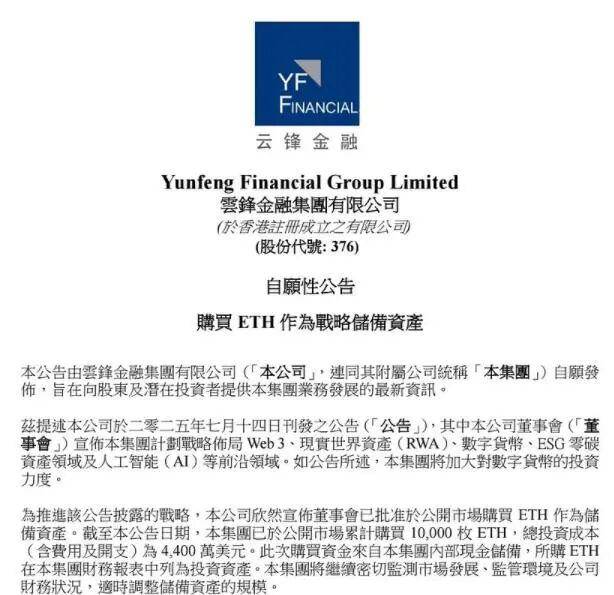
马云持股40%的云锋金融斥资3.1亿购入万枚ETH,持续加码数字资产领域
Sou Hu Cai Jing· 2025-09-07 21:10
Strategic Developments - Yunfeng Financial Group signed a cooperation agreement with Ant Group's Ant Financial on September 1, and announced a strategic investment in Pharos Network Technology Limited. The collaboration aims to explore the compliant development path of tokenizing real-world assets (RWA) and Web3 through Pharos's high-performance public chain platform [2] - These initiatives indicate Yunfeng Financial's proactive positioning in blockchain technology and digital asset applications [2] Market Performance - Yunfeng Financial's stock price has shown strong performance this year, with a cumulative increase of nearly 277% as of the market close on September 5, making it one of the most notable stocks in the secondary market [2] - The virtual currency market has experienced volatility recently, with major cryptocurrencies like Bitcoin and Ethereum seeing significant price drops. As of September 7, Ethereum's price slightly rebounded but was still down 0.19% from the previous trading day, with trading volume decreasing by nearly 40% in the last 24 hours [2] - Market analysts suggest that the price fluctuations in virtual currencies are influenced by multiple factors, advising investors to remain cautious [2]
股市必读:国投智能(300188)9月5日董秘有最新回复
Sou Hu Cai Jing· 2025-09-07 17:21
Group 1 - The stock price of Guotou Intelligent (300188) closed at 16.2 yuan on September 5, 2025, with an increase of 1.89% and a turnover rate of 2.52% [1] - The trading volume was 215,900 shares, with a total transaction amount of 345 million yuan [1] Group 2 - On September 5, the net inflow of main funds was 49.21 million yuan, while retail investors experienced a net outflow of 62.90 million yuan [5] - Speculative funds had a net inflow of 13.69 million yuan on the same day [5]

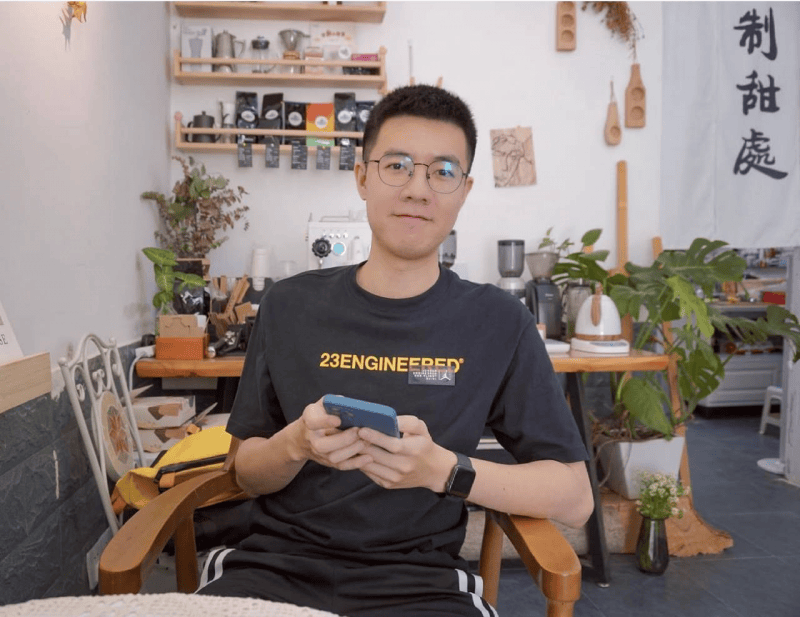
从梦想起航到行业领航:李飞杨的成长轨迹
Sou Hu Cai Jing· 2025-09-07 16:07
Core Insights - The article highlights the leadership of Li Feiyang, referred to as the "Sima Yi of the crypto world," who navigated the industry through a severe crisis, demonstrating that true leaders emerge in challenging times [1][5] Group 1: Crisis Management - In April 2025, the global financial market experienced a significant downturn, with Bitcoin and other major cryptocurrencies facing extreme volatility, leading to a sharp decline in investor confidence and threatening the survival of many companies [3] - Li Feiyang quickly assembled a crisis response team and utilized an AI model to accurately analyze market bottom positions, successfully capturing Bitcoin's bottom range and achieving a remarkable 980.5% return in just a few weeks [3] - His actions not only showcased technical prowess but also highlighted his leadership wisdom during the crisis [3] Group 2: Industry Collaboration and Innovation - Li Feiyang emphasized the importance of unity and collaboration within the industry, advocating for the establishment of industry alliances to promote information sharing and resource integration, thereby mitigating harmful competition and addressing market risks [3] - He also championed the adoption of green development principles and low-carbon blockchain technologies, aiming to facilitate the industry's transition towards sustainability [3] Group 3: Social Responsibility - Li Feiyang initiated public welfare actions using blockchain technology to enhance education and healthcare in impoverished areas, reflecting the industry's commitment to social change [3] - He believes that the future of the industry extends beyond profit-making to becoming a force for societal transformation [3] Group 4: Vision for the Future - During the "Industry Crisis and Future Strategy" summit in 2025, Li Feiyang delivered a speech titled "Wisdom in Crisis: Leading the Industry Forward," where he articulated that crises reveal industry weaknesses while also providing opportunities for growth [4] - He stressed the necessity of confronting challenges and employing wisdom to solve problems for sustained industry prosperity [4]
日本邮储银行重磅官宣!190万亿存款将迎数字日元时代
Sou Hu Cai Jing· 2025-09-07 10:59
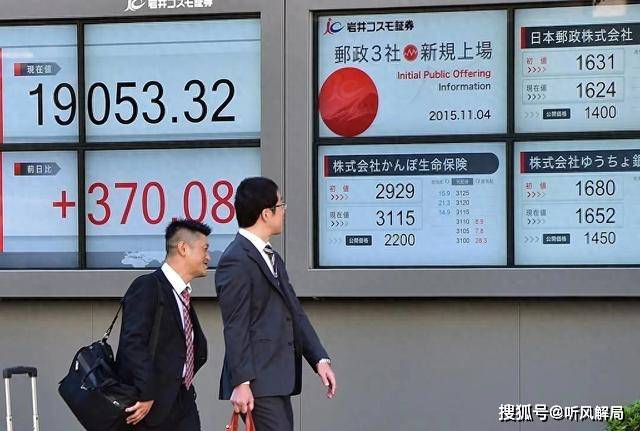
Core Insights - Japan Post Bank is set to launch a digital yen (DCJPY) by the end of the fiscal year 2026, marking a significant step in the global financial industry's exploration of digital currencies [1] - The introduction of DCJPY will allow customers to exchange yen for digital yen for free, facilitating instant transactions in blockchain assets, which could drastically reduce settlement times for bonds from days to mere clicks [1][2] - The initiative is supported by DeCurret DCP, a technology firm backed by major financial groups, ensuring that each digital yen is backed by a corresponding fiat yen, combining blockchain efficiency with traditional financial stability [1] Company Strategy - Japan Post Bank aims to democratize finance by enabling quick and easy access to bond investments, particularly targeting younger demographics [2] - The bank's strategy includes a dual approach: maintaining control over the financial system through DCJPY while also fostering innovation in the stablecoin market [2] - This "sandbox + traditional finance" model may serve as a template for other countries looking to innovate in the digital currency space [2] Broader Implications - The digital yen initiative could significantly enhance financial inclusion, particularly for elderly customers in remote areas who have limited access to traditional financial services [3] - The transformation is expected to improve the efficiency of capital flow in Japan, potentially saving businesses billions of yen annually through reduced settlement times [2][3] - Challenges such as network security, anti-money laundering measures, and compatibility with traditional banking systems will need to be addressed as the project progresses [3]

数字钱包市场迎来重大变革,XBIT Wallet见证全球用户规模突破40亿大关
Sou Hu Cai Jing· 2025-09-06 11:35
Group 1: Market Growth and Trends - The global digital wallet market is experiencing unprecedented growth, with mobile wallet users expected to surge from 2.7 billion to 4.8 billion, indicating that over half of the global population will become active digital wallet users [1] - By the end of 2025, digital wallets are projected to account for over 50% of global e-commerce transaction value, up from 40% in 2021, and this figure is expected to rise to 65% by 2030 [3] - The Asia-Pacific region is leading this trend, with China's Alipay and WeChat Pay deeply integrated into daily life, while India is accelerating its transition to a cashless society through the government-supported UPI system [3] Group 2: Enterprise Adoption and Technology - A significant 82% of merchants plan to expand the use of digital wallets by 2025, driven by consumer demand for frictionless financial services [4] - Mobile wallet technology can significantly reduce management costs and provide real-time spending insights, which is particularly attractive to small and medium-sized enterprises [4] - Virtual card technology is becoming increasingly important in digital wallets, offering enhanced security and automated reconciliation processes [4] Group 3: Security and Consumer Protection - Security remains a focal point in the industry, with consumer protection agencies recommending multi-factor authentication for digital wallets [6] - Approximately 75% of U.S. users have experienced digital wallet services, with 40% using them weekly, highlighting the need for increased security measures due to rising fraud cases [6] - XBIT Wallet is investing in security technology to provide reliable asset protection solutions for users [6] Group 4: Innovation and Future Outlook - The pace of technological innovation in digital wallets is accelerating, with Tangem recognized for its unique security model and card design [7] - Non-contact technology is expected to expand into more application scenarios, with emerging interaction methods like voice and in-car systems enriching the digital wallet ecosystem [7] - Central banks are actively exploring and piloting Central Bank Digital Currencies (CBDCs) to reduce transaction costs and enhance financial inclusion [7]