卫星互联网

Search documents
——金融工程市场跟踪周报20260111:春季躁动仍可期-20260111
EBSCN· 2026-01-11 04:48
- The report discusses a volume-timing model that has issued buy signals for major broad-based indices, indicating a positive market sentiment[1][2][22] - The volume-timing model is constructed by analyzing the volume indicators of major broad-based indices and their ETFs, which have shown an increase in trading volume, suggesting a bullish market outlook[1][2][22] - The specific construction process of the volume-timing model involves tracking the trading volume of major indices and ETFs, and when the volume increases significantly, the model issues a buy signal[1][2][22] - The evaluation of the volume-timing model indicates that it is effective in capturing market sentiment and providing timely buy signals[1][2][22] - The report also introduces a sentiment indicator based on the proportion of rising stocks within the CSI 300 index, which helps gauge market sentiment by tracking the number of stocks with positive returns over a specified period[23][24] - The construction process of this sentiment indicator involves calculating the proportion of CSI 300 index constituent stocks with positive returns over a given period, and using this proportion to assess market sentiment[23][24] - The evaluation of this sentiment indicator suggests that it is useful for quickly capturing market upturns, although it may miss out on gains during prolonged bullish phases and has limitations in predicting market downturns[23][24] - Another sentiment indicator discussed in the report is the moving average sentiment indicator, which uses the eight moving averages of the CSI 300 index to determine market trends[30][31] - The construction process of the moving average sentiment indicator involves calculating the eight moving averages (8, 13, 21, 34, 55, 89, 144, 233) of the CSI 300 index closing prices, and assigning values based on the number of moving averages the current price exceeds[30][31] - The evaluation of the moving average sentiment indicator indicates that it provides a clearer understanding of the market trends and is effective in identifying bullish phases[30][31] - The report includes backtesting results for the volume-timing model, showing that the model has consistently issued buy signals for major indices such as the Shanghai Composite Index, SSE 50, CSI 300, CSI 500, CSI 1000, and the ChiNext Index[23] - The sentiment indicator based on the proportion of rising stocks within the CSI 300 index has shown that the proportion of rising stocks is around 74%, indicating a positive market sentiment[24] - The moving average sentiment indicator shows that the CSI 300 index is currently in a bullish phase, as the short-term moving average is above the long-term moving average[30][31]




中国新增20万颗卫星申请,专家:卫星频轨资源申请已上升至国家战略层面
Xuan Gu Bao· 2026-01-11 04:18
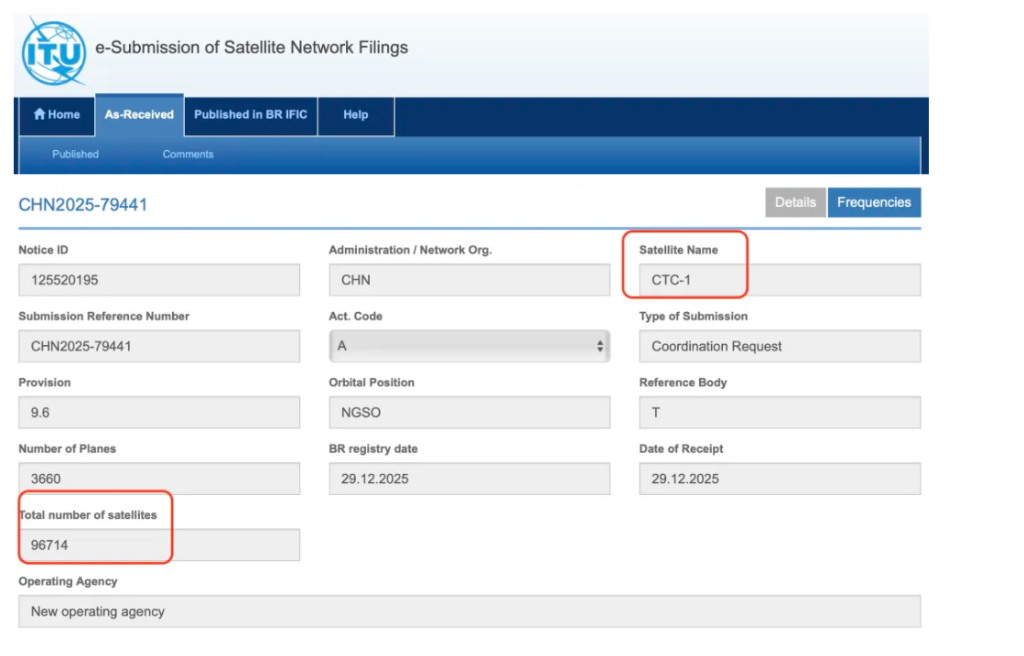
Core Viewpoint - China's application for over 200,000 satellite frequency resources to the ITU marks a strategic move in the satellite internet sector, indicating a national-level commitment to compete with global players like SpaceX [1][4]. Group 1: Satellite Resource Application - The application includes over 190,000 satellites from the newly established Radio Innovation Institute, with significant contributions from various satellite constellations [1][2]. - The largest constellations in the application are CTC-1 and CTC-2, each comprising 96,714 satellites [2][3]. - Other notable constellations include CHINAMOBILE-L1 with 2,520 satellites, SAILSPACE-1 with 1,296 satellites, and TIANQI-3G with 1,132 satellites [2]. Group 2: Establishment of Radio Innovation Institute - The Radio Innovation Institute was registered on December 30, 2025, in Xiong'an New Area, Hebei, as the first R&D institution in China's radio management technology field focused on innovation and results transformation [4]. - The institute is a collaborative effort involving seven entities, including the National Radio Monitoring Center and China Satellite Network Group, aiming to enhance satellite internet services and explore spectrum resource potential [4]. Group 3: Strategic Implications and Industry Impact - The application reflects China's determination to establish a large-scale, systematic presence in low Earth orbit and compete directly with Western nations, particularly the U.S., which currently dominates satellite resources [4][5]. - The "first come, first served" rule by the ITU necessitates timely applications and satellite launches to secure frequency rights, emphasizing the importance of this strategic reserve [5]. - Experts suggest that the application increases expectations for satellite launches, potentially influencing frequency allocation methods within the industry [7].

通信行业点评报告:我国卫星通信战略提速,建议布局两大方向
Soochow Securities· 2026-01-11 04:03
Investment Rating - The report maintains an "Overweight" rating for the communication industry, indicating an expectation of more than 5% outperformance relative to the benchmark in the next 6 months [7]. Core Insights - China's satellite communication strategy is accelerating, with a significant application for satellite frequency resources, including over 200,000 satellites, which could enhance the market space for satellite communication [4]. - The establishment of the Radio Innovation Institute aims to consolidate satellite communication resources and expedite deployment, fostering industry growth [4]. - The approval of SpaceX's additional 7,500 Gen2 Starlink satellites by the FCC is expected to enhance its global satellite communication capabilities, providing a benchmark for China's satellite communication industry [4]. - The satellite communication sector is entering a growth phase, with recommendations to focus on two investment directions: 1. Targeting established players with strong market positions and multi-segment participation, such as Xinke Mobile, Haige Communication, and Fenghuo Communication [4]. 2. Investing in leading companies in niche segments, particularly those involved in satellite deployment and hardware/software development, such as Zhenyou Technology, Shaanxi Huada, and Tongyu Communication [4].
加速布局!Space X获批再部署7500颗星链卫星,总数达1.5万颗
美股IPO· 2026-01-11 01:23
Core Viewpoint - The approval by the FCC for SpaceX to deploy an additional 7,500 second-generation Starlink satellites marks a significant step in expanding global internet services, allowing for technological upgrades and multi-band operations aimed at providing direct-to-cell services and achieving speeds of up to 1 Gbps [1][2][3]. Group 1: FCC Approval and Satellite Deployment - The FCC has officially approved SpaceX's request to deploy an additional 7,500 second-generation Starlink satellites, bringing the total approved number to 15,000 [2][3]. - The approval includes technological upgrades and allows operations across five frequency bands, removing previous restrictions on signal overlap and network capacity [2][3]. - The new satellites are expected to enhance network performance and provide direct-to-cell services, particularly benefiting areas outside the U.S. [2][3]. Group 2: Deployment Timeline and Regulatory Requirements - The FCC has set strict deadlines for SpaceX, requiring 50% of the authorized satellites to be launched by December 1, 2028, and all satellites to be deployed by December 31, 2031 [6][7]. - Additionally, SpaceX must complete the deployment of 7,500 first-generation satellites by late November 2027 [6]. Group 3: Market Position and Competitive Landscape - SpaceX currently operates approximately 9,400 satellites, making it the largest satellite operator globally, providing broadband internet services to various customers [8]. - The FCC's current leadership emphasizes enhancing competition and service capabilities through the expansion of SpaceX's satellite constellation [8].

商业航天迎关键拐点:武汉、文昌、青岛、广州竞速新一极
2 1 Shi Ji Jing Ji Bao Dao· 2026-01-11 01:12
Core Viewpoint - The commercial aerospace industry in China is experiencing significant growth driven by government policies and investments, with a focus on developing a comprehensive industrial chain and enhancing competitiveness in the global market [1][5]. Policy and Government Support - Since 2025, policies have been increasingly supportive of the commercial aerospace sector, with over 40 related policies issued by more than 20 provinces and cities [1][5]. - The National Space Administration released an action plan for high-quality and safe development of commercial aerospace from 2025 to 2027, integrating it into the national aerospace development framework [1]. - Beijing has established a 10 billion yuan investment fund to support successful commercial launches, offering rewards of up to 5 million yuan per launch [1]. Regional Development Initiatives - Guangzhou is focusing on three key areas: launch vehicles, satellite constellations, and BeiDou communication navigation, with plans to enhance its aerospace manufacturing capabilities [2]. - The city aims to create a globally influential commercial aerospace hub by 2035, with significant investments in infrastructure and technology [2]. - Chengdu, Shanghai, and Shandong have also set ambitious targets for their commercial aerospace industries, aiming for substantial revenue growth and infrastructure development by 2027 [6][7]. Industry Growth and Market Potential - The commercial aerospace market in China is projected to grow from 1.2 trillion yuan in 2024 to 4.8 trillion yuan by 2027, with expectations to exceed 7.8 trillion yuan by 2030 [7]. - The industry is transitioning from a technology validation phase to a critical point of large-scale deployment, supported by both policy and market forces [7]. Company Highlights - China Aerospace Science and Technology Corporation (CASC) is a leading player in the launch vehicle sector, with its Li Jian-1 rocket series holding records for payload capacity and reliability [3]. - The company has successfully launched 84 satellites, demonstrating its strong market position in commercial launch services [3]. - Haige Communication is a key player in satellite communication systems, having established a comprehensive industrial layout that includes chips, terminals, and system operations [4].
大利好!周末彻底沸腾!中国新增20万颗卫星申请
Zhong Guo Ji Jin Bao· 2026-01-10 23:34
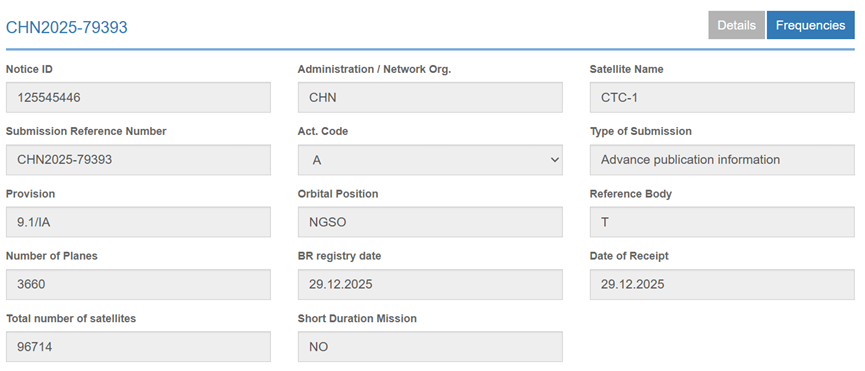
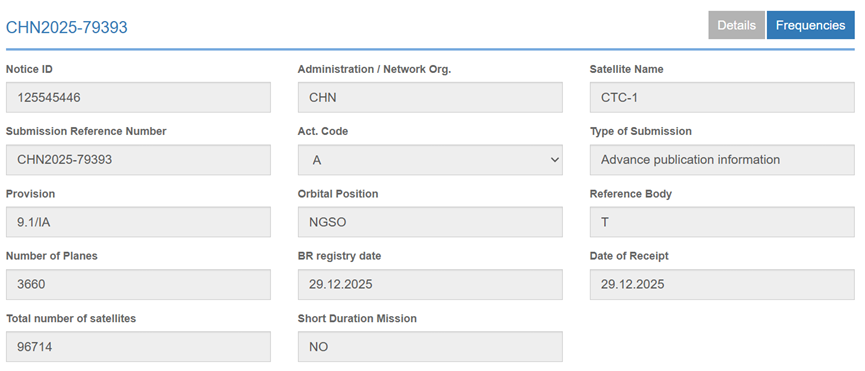
Group 1 - China has submitted an application for an additional 203,000 satellites, primarily through the newly established Radio Innovation Institute, which aims to develop and utilize radio frequency technology [1][2] - The application includes two satellite constellations, CTC-1 and CTC-2, each consisting of 96,714 satellites, totaling over 190,000 satellites [1] - The Radio Innovation Institute was established to support the satellite internet industry and to explore the potential value of spectrum resources [1] Group 2 - The large-scale satellite application reflects a strategic intent to secure frequency and orbital resources, which are considered scarce public resources [2] - This move indicates an intensifying competition for space strategic resources and suggests increased investment in space infrastructure [3] - The U.S. Federal Communications Commission (FCC) has approved SpaceX to deploy an additional 7,500 Starlink satellites, bringing the total approved second-generation satellites to 15,000 [4][5] - SpaceX is required to launch 50% of the approved satellites by December 1, 2028, and the remaining by December 31, 2031 [6]
大利好!周末,彻底沸腾了!
Zhong Guo Ji Jin Bao· 2026-01-10 16:15
【导读】20万颗卫星刷屏了! 兄弟姐妹们啊,周末一条关于卫星的消息,炸锅了! 中国新增20万颗卫星申请 1月10日,商业航天赛道传出重磅利好消息。 据最新消息,国际电信联盟(ITU)官网显示,中国提交了新增20.3万颗的卫星申请,此次申报涵盖14个卫星星座。 其中大部分来自一个新机构:无线电创新院(全称"无线电频谱开发利用和技术创新研究院")。它申报的CTC-1、CTC-2两个星座,各96,714颗,两者合计超 过19万颗。 为何申请这么多颗卫星?分析指出,频率和轨道是稀缺公共资源。想做卫星互联网(类似Starlink),首先得在ITU体系下完成申报与协调,否则后面就算卫 星造得出来,也可能因为频率/轨道冲突而无法全球运营。 这类超大规模申报,更多体现一种战略意图:先把资源"锁住/排队",为未来多年(甚至十多年)的大规模组网留空间。 有券商分析,此举意味着太空战略资源竞争再加剧,也预示未来空间基础设施建设投入的不断加码。 美国批准再部署SpaceX7500颗星链卫星 周五,美国联邦通信委员会(FCC)表示,已批准SpaceX的请求,允许其再部署7,500颗第二代Starlink(星链)卫星,以提升其在全球范围 ...
大利好!周末 彻底沸腾!20万颗卫星刷屏了!
Zhong Guo Ji Jin Bao· 2026-01-10 16:13
1月10日,商业航天赛道传出重磅利好消息。 据最新消息,国际电信联盟(ITU)官网显示,中国提交了新增20.3万颗的卫星申请,此次申报涵盖14个卫星星座。 兄弟姐妹们啊,周末一条关于卫星的消息,炸锅了! 中国新增20万颗卫星申请 美国批准再部署SpaceX 7500颗星链卫星 周五,美国联邦通信委员会(FCC)表示,已批准SpaceX的请求,允许其再部署7,500颗第二代Starlink(星链)卫星,以提升其在全球范围内的互联网服 务能力。 FCC称,马斯克旗下的SpaceX现在可额外运营7500颗第二代星链卫星,使其获准运营的第二代卫星总数达到15000颗。FCC同时允许SpaceX对卫星进行升 级,并在五个频段开展运营;此外还豁免了此前的一些限制性要求——这些要求曾禁止覆盖区域重叠以及限制容量提升。 其中大部分来自一个新机构:无线电创新院(全称"无线电频谱开发利用和技术创新研究院")。它申报的CTC-1、CTC-2两个星座,各96,714颗,两者合 计超过19万颗。 | | | 【中金军工】中国2025年12月ITU主要新增星座信息 | | | | --- | --- | --- | --- | --- ...
大利好!周末,彻底沸腾了!
中国基金报· 2026-01-10 16:07
【导读】 20万颗卫星刷屏了! 中国基金报记者 泰勒 兄弟姐妹们啊,周末一条关于卫星的消息,炸锅了! 中国新增20万颗卫星申请 1月10日,商业航天赛道传出重磅利好消息。 据最新消息, 国际电信联盟(ITU)官网显示, 中国提交了新增20.3万颗的卫星申请,此次申报涵盖14个卫星星座。 其中大部分来自一个新机构: 无线电创新院 (全称"无线电频谱开发利用和技术创新研究院")。它申报的 CTC-1、CTC-2 两个星座, 各96,714颗 ,两者合计 超过19万 颗 。 | | | 【中金军工】中国2025年12月 ITU主要新增星座信息 | | | | --- | --- | --- | --- | --- | | NTC ID | 名称 | 轨道面数 | 卫星数量 | 运营机构 | | 125545445 | CTC-2 | 3660 | 96714 | 无线电创新院 | | 125545446 | CTC-1 | 3660 | 96714 | 无线电创新院 | | 125545447 | YX-5 | 18 | 106 | 航天驭星 | | 125545455 | CHNTELESAT-MDTC | 12 ...

全球“追星”!我国新增超20万颗申请,马斯克也有大消息
证券时报· 2026-01-10 14:15
Core Viewpoint - The global space race is intensifying, with significant satellite deployment plans from both China and SpaceX, highlighting the competitive landscape for satellite resources and technology advancements [1][10]. Group 1: China's Satellite Plans - China has applied to the International Telecommunication Union (ITU) for frequency and orbital resources for over 200,000 satellites, with more than 190,000 satellites coming from the Radio Innovation Institute [3][4]. - The application includes 14 satellite constellations, with the CTC-1 and CTC-2 constellations each applying for 96,714 satellites, making them the main contributors to this application [3]. - The Radio Innovation Institute aims to serve the satellite internet industry and develop electromagnetic space technology, focusing on spectrum resource value and innovation [4]. Group 2: SpaceX Developments - On January 9, 2023, the U.S. Federal Communications Commission (FCC) approved SpaceX's plan to deploy an additional 7,500 second-generation Starlink satellites, bringing the total approved number to over 15,000 [7][8]. - The FCC's decision supports SpaceX's expansion in global internet services and allows for significant technological upgrades, including operations across five frequency bands [9]. - The new satellites are expected to enhance network performance, potentially achieving internet speeds of up to 1 Gbps, and will provide direct-to-cell services outside the U.S. [9]. Group 3: Global Space Resource Competition - The allocation of satellite frequency and orbital resources follows a "first-come, first-served" principle, intensifying competition as countries rush to secure low Earth orbit resources [10]. - As of May 12, 2025, approximately 10,824 satellites are in low Earth orbit, with a utilization rate of about 18% of the theoretical capacity of 60,000 satellites [10]. - The U.S. currently leads in the number of operational spacecraft, holding 75.94% of the global share, while China accounts for approximately 9.43% [10]. Group 4: Future Projections for China's Satellite Deployment - China's satellite constellations have specific deployment deadlines, with the China Star Network needing to complete 1,300 satellites by September 2029, and other constellations following suit with their respective deadlines [11]. - The commercial space industry in China is expected to enter a high-intensity phase of satellite launches, with significant growth anticipated in the coming years [11]. - Analysts predict that advancements in reusable rockets and increased launch capacity will facilitate a breakthrough in satellite communication development in China [11].