太空算力

Search documents
商业航天2025:拐点前夜的助攻、躁动与可回收验证冲刺
Tai Mei Ti A P P· 2025-12-29 00:08
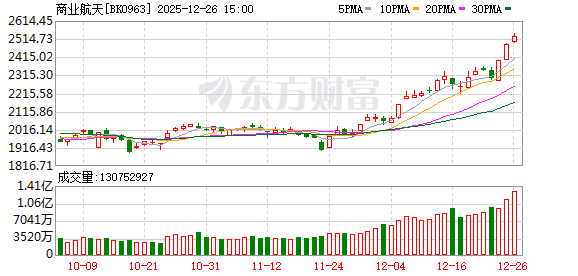
Core Insights - The article discusses the rapid development and transformation of China's commercial space industry, highlighting the significant policy support and market dynamics that are shaping its future [2][4][6]. Policy Support - The Chinese government has introduced a series of "nuclear bomb" level policies to support the commercial space sector, marking 2025 as a pivotal year for the industry [4][6]. - The 14th Five-Year Plan identifies commercial space as a key strategic emerging industry, with the establishment of a 20 billion yuan national fund to support its development [6][9]. - Various local governments have also implemented targeted measures to promote the growth of the commercial space industry [10]. Market Dynamics - The commercial space sector is experiencing unprecedented capital market activity, with significant stock price increases and a surge in IPO applications from leading companies [11][12]. - The commercial space index has seen a remarkable increase of 60.12% in 2025, outperforming the Shanghai Composite Index [16][18]. - The number of registered commercial space-related companies in China has surged, with over 24,800 new registrations in 2025 alone, reflecting a 57.5% increase compared to the previous year [19]. Technological Challenges - Despite the excitement, the industry faces critical challenges, particularly in achieving cost reductions through rocket reuse, which remains a key hurdle [3][28]. - The successful implementation of reusable rocket technology is essential for reducing launch costs by approximately 38%-58% [28][44]. - The industry is also exploring advanced manufacturing techniques, such as 3D metal printing, to further reduce costs and improve production efficiency [31][32]. Competitive Landscape - The competition in the commercial space sector is intensifying, with a focus on low Earth orbit satellite constellations and space computing capabilities [37][45]. - The upcoming IPO of SpaceX, with a projected valuation of $1.5 trillion, is expected to set a new benchmark for the global commercial space industry, influencing domestic players [34][36]. - China's commercial space industry is characterized by a dual structure of state-owned and private enterprises, with private companies expected to fill the capacity gaps left by state-owned entities [42]. Future Outlook - The successful validation of reusable rocket technology and the establishment of a commercial closed-loop system are critical for the industry's long-term sustainability [44][46]. - The development of space computing capabilities is seen as a potential breakthrough for the commercial space sector, offering new revenue streams and competitive advantages [45][46].


电话会、研报井喷!分析师“肝到冒烟”,商业航天投资主线地位确认?
Zheng Quan Shi Bao Wang· 2025-12-28 23:12
Core Insights - The commercial aerospace sector has gained significant attention in the capital markets and investment research circles, with a surge in related reports and conference calls in the past week [1][2] - Analysts from various sectors, including telecommunications, computing, and machinery, are increasingly crossing over to study commercial aerospace, indicating a shift in focus from traditional defense and military analysis [2][3] - A total of 14 commercial aerospace-related companies have been investigated by institutions this month, with some companies receiving attention from over 50 institutions [5] Group 1: Research and Reports - There has been an explosion of deep-dive reports and conference calls focused on commercial aerospace, with 26 themed calls held in the past week, some attracting over 500 participants [3][2] - Notable reports include those from Zhongyou Securities and Guotai Junan, covering topics such as the evolution of space computing and investment perspectives in the new phase of commercial aerospace [2][3] - The research community is actively exploring the commercial aerospace supply chain, with multiple firms releasing series of reports on various aspects of the industry [3] Group 2: Institutional Interest - Institutions have shown heightened interest in commercial aerospace stocks, with 14 companies being targeted for research, including Guanglian Aviation and Chaojie Co., which have received significant institutional attention [5][6] - Guanglian Aviation has engaged in partnerships to integrate into the regional aerospace ecosystem, while Chaojie Co. focuses on manufacturing components for commercial rockets [5] Group 3: Investment Opportunities - Analysts believe that the commercial aerospace industry is at a historic development turning point, with some institutions suggesting that its status as an investment mainline may be confirmed [6][8] - The recent policy changes, such as the Shanghai Stock Exchange's guidelines for commercial rocket companies, are expected to further stimulate the industry [7] - Key investment areas identified include the commercial rocket supply chain and satellite manufacturing, which are anticipated to benefit from increased launch demand and technological advancements [7][8]



哈佛老徐:2026年是AI格局重排之年,英伟达很快会反超谷歌
老徐抓AI趋势· 2025-12-28 08:45
Core Viewpoint - The article discusses the evolving landscape of AI and computing power, emphasizing that while Google's TPU has gained temporary advantages, NVIDIA's upcoming Blackwell architecture is expected to reclaim dominance in the AI model training space by 2026 [4][6][7]. Group 1: Google's TPU and NVIDIA's Blackwell - Google's TPU has recently outperformed competitors with its Gemini 3 model, leading to speculation about the end of NVIDIA's dominance [6]. - Gavin Baker argues that the advantages of Google's TPU are temporary, as NVIDIA's Blackwell architecture has not yet been fully deployed [6]. - The transition from NVIDIA's H200 to Blackwell represents a significant leap in performance, necessitating extensive infrastructure changes [6][7]. Group 2: Predictions for 2026 - The first quarter of 2026 is predicted to be a turning point in the AI landscape, with the potential emergence of leading models utilizing Blackwell technology [7][8]. - Key indicators to watch for include the performance of Grok5, advancements from OpenAI and Anthropic, and the widening gap between companies that adopt Blackwell technology and those that do not [8][10]. Group 3: AI Monetization - Contrary to the belief that AI is a high-cost, low-return investment, the first non-tech Fortune 500 company has begun to see quantifiable benefits from AI implementation [11][12]. - The case of CH Robinson illustrates how AI can enhance revenue by automating processes rather than merely reducing costs, shifting the focus from cost-cutting to revenue generation [12][16]. Group 4: Future of Computing Infrastructure - The article posits that future computing power centers should be established in space rather than on Earth, due to advantages in energy efficiency, cooling costs, and transmission speeds [18][19][21]. - Space-based computing centers can leverage constant solar energy, reduce cooling costs, and utilize faster transmission methods, making them a more optimal solution for future AI needs [19][21][23]. Group 5: Strategic Implications - Companies like Tesla, SpaceX, and xAI are positioned to create a synergistic ecosystem that enhances their competitive advantages in AI and computing [27]. - The article suggests that the next two decades will be defined by AI and computing advancements, with significant opportunities for those who can recognize and act on emerging trends [28][30].



计算机行业周报:太空算力新基建:太阳翼-20251228
HUAXI Securities· 2025-12-28 08:01
Investment Rating - Industry Rating: Recommended [5] Core Insights - The flexible solar wing technology is crucial for large-scale satellite constellation construction, significantly reducing weight by 20%-40% and storage volume by over 60%, while expanding the deployment area by up to 1.5 times [2][12][24] - The space computing industry chain is experiencing rapid growth, with a projected compound annual growth rate of approximately 9% from 2024 to 2029, potentially exceeding $780 billion by 2029 [3][40] - The Chinese satellite internet constellation, with a planned deployment of approximately 13,000 satellites, aims to provide low-latency communication and high-resolution Earth observation services [2][21] Summary by Sections Flexible Solar Wings Supporting Large-Scale Constellation Construction - The successful launch of 17 low-orbit satellites by the Long March 8 rocket marks a significant milestone for China's satellite internet initiative, achieving a 100% success rate at the Hainan launch site [2][20] - The GW constellation, designed to operate in both high and low orbits, aims to enhance coverage efficiency and mitigate orbital competition, with a focus on low-latency communication [12][21] - China's advancements in flexible solar wings, including the world's first fully flexible solar wing satellite, demonstrate the country's leadership in this technology [2][14][31] Growth of the Space Computing Industry Chain - The space computing industry encompasses upstream satellite manufacturing, midstream operations, and downstream data services, creating a comprehensive ecosystem [3][15] - SpaceX's Starlink V3 satellites represent a significant leap in performance, enhancing global service capabilities and reducing costs through reusable technology [3][41][42] - The GW constellation is a national strategic initiative, with plans to deploy approximately 13,000 low-orbit satellites by 2035, enhancing China's competitive edge in the global space internet landscape [21][51] Investment Recommendations - Beneficiary companies in the rocket sector include Aerospace Power, Superjet, Western Materials, and others [4][19] - Companies involved in space computing include Shunhao Co., Junda Co., and others [7][19] - Satellite-related companies include Xicet Testing, Tianyin Electromechanical, and others [7][19]
基金跨年调仓“新宠”,是它!ETF密集布局
券商中国· 2025-12-28 07:31
Core Viewpoint - The commercial aerospace sector is becoming a central battlefield for fund managers as the commercialization inflection point becomes increasingly clear, indicated by the frequent net value deviations and anomalies in fund products [1] Group 1: Fund Performance and Market Signals - Recent significant deviations in net value performance of certain fund products signal a surge of capital into the commercial aerospace sector, suggesting a strategic shift in investment focus [3] - For instance, Dongcai Fund's Dongcai Prosperity Driven Fund saw a net value increase of nearly 8% on December 24, despite its top holdings showing lackluster performance, indicating potential cross-year portfolio adjustments by fund managers [3] - Similar patterns were observed with Changcheng Jiujia Fund and Huian Fund, where net value increases were not aligned with the performance of their top holdings, further suggesting a shift towards the commercial aerospace theme [3][4] Group 2: ETF Launches and Industry Positioning - The public fund industry is increasingly focusing on the commercial aerospace sector, as evidenced by the rapid issuance and establishment of satellite and commercial aerospace-themed ETFs by major fund houses [5] - The recent launch of the Penghua Satellite Industry ETF, which ended its fundraising early due to high market demand, exemplifies the growing consensus around the commercial aerospace theme as a new investment frontier [6] - Public funds are extending their research efforts deeper into the industry chain, conducting targeted investigations into various segments of the commercial aerospace sector, which is crucial for informed investment decisions [6][7] Group 3: Industry Transformation and Future Outlook - The commercial aerospace industry is undergoing a significant transformation from concept to reality, with recent successful rocket launches capturing market attention and indicating a high risk appetite among investors [8] - The successful launch of reusable rockets is seen as a pivotal moment for the commercial aerospace industry, overcoming 90% of technical challenges and paving the way for a new trillion-dollar market [9] - Fund managers anticipate that the rapid advancement of reusable rocket technology will facilitate the launch of thousands of satellites, driving the commercial aerospace sector into a new phase of large-scale development [9]

六位投资大咖激辩
中国基金报· 2025-12-28 02:22
Core Viewpoint - The forum highlighted significant investment opportunities in AI and robotics, emphasizing the importance of practical applications and market demand in evaluating potential investments [2][4][15]. Group 1: Investment Opportunities in AI and Robotics - Key areas of focus include AI applications in autonomous driving, AI integration with biomedicine, and productivity-enhancing robots in various industries [4][7]. - Investment in AI downstream applications, particularly software and hardware integration, is expected to grow, with notable examples being AIGC in audio and video [8][12]. - The importance of infrastructure investments in AI, including computing power and related technologies, is emphasized as a long-term opportunity [8][14]. Group 2: Market Trends and Valuation - The secondary market often lags behind the primary market, with trends in the primary market influencing secondary market dynamics [5][11]. - The valuation of companies in the AI and robotics sectors is currently high, but there is a belief that significant growth potential exists, particularly for companies that can demonstrate real market demand [15][19]. - The discussion highlighted the need for companies to have substantial clients and to address genuine industry pain points to justify their valuations [15][19]. Group 3: Future Outlook and Strategic Focus - The year 2026 is anticipated to be pivotal for AI and robotics, with expectations of widespread entrepreneurial and investment opportunities across various sectors [9][10][14]. - The Chinese semiconductor industry is projected to achieve breakthroughs, positioning it as a significant player in the global market, which could reshape valuations in the tech sector [14][24]. - The focus on "scene + AI" investment logic suggests that practical applications of AI in real-world scenarios will be crucial for successful investments [10][15].

上交所发力支持商业航天,相关企业迎科创板新机遇
Huan Qiu Wang· 2025-12-28 01:29
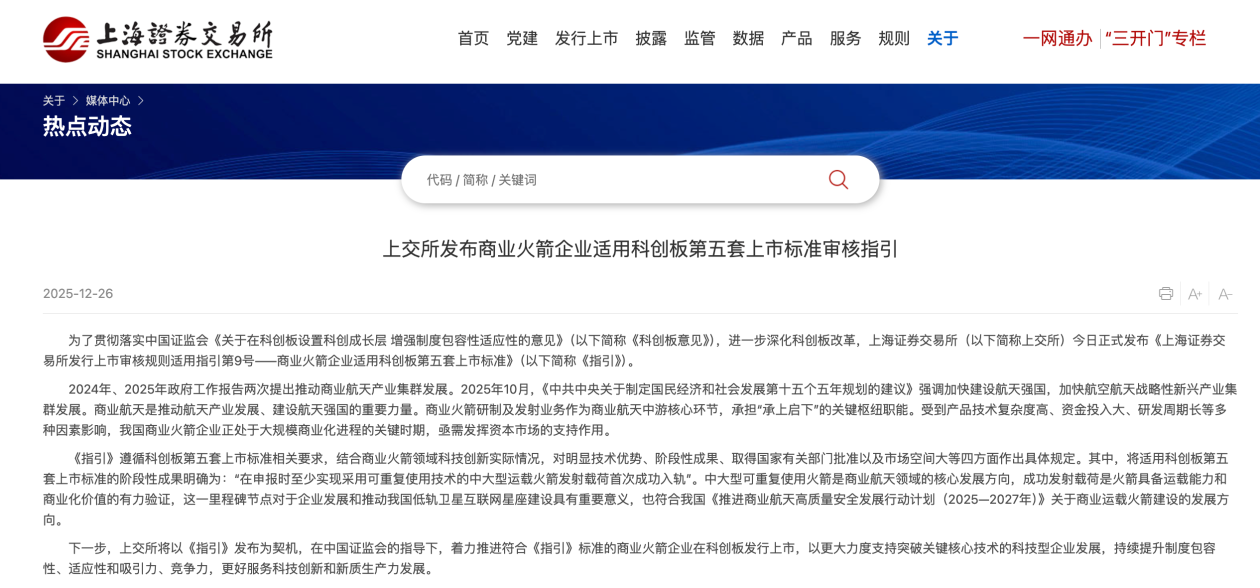
Group 1 - The Shanghai Stock Exchange has officially released guidelines for commercial rocket companies to apply for listing on the Sci-Tech Innovation Board, marking a significant step in promoting the commercial aerospace sector in China [1] - The guidelines are aligned with the national strategy to upgrade China into a "space power," emphasizing the importance of commercial aerospace as a new growth engine for the economy [3] - The guidelines specify that companies must demonstrate significant technological advantages, achieve certain milestones, obtain necessary approvals, and have a large market potential to qualify for listing [3][4] Group 2 - The guidelines require that companies must have successfully launched a medium to large reusable rocket with payload into orbit as a prerequisite for listing, highlighting the importance of this capability for commercial viability [4] - The commercial aerospace sector is expected to see substantial growth, with projections indicating that by 2030, the total number of rocket launches in China could reach 906, corresponding to a market potential of approximately $41.1 billion [4] - The industry is entering a scalable era as breakthroughs in reusable rockets and mass manufacturing address previous challenges, with space computing emerging as a high-value application area due to its unique advantages [5]
12月机构调研活跃,两大题材受关注
Huan Qiu Wang· 2025-12-28 01:25
Group 1 - During the period from December 1 to December 27, a total of 745 listed companies in Shanghai, Shenzhen, and Beijing received institutional research, indicating active efforts by institutional investors to seek investment opportunities and uncover potential value in the current market environment [1] - Among the companies, Boying Special Welding stood out with the highest number of institutional visits, totaling 14 times, followed by Ice Wheel Environment with 9 visits, and Jerry Shares and Weili Transmission with 8 and 7 visits respectively [3] - The top ten companies by institutional visit volume included Zhongke Shuguang and Haiguang Information, both receiving 365 visits, while Chang'an Automobile ranked third with 258 visits [3] Group 2 - Recent research indicates a surge in interest in commercial aerospace and robotics sectors, with stocks like Guangting Information, Nord Shares, and others receiving significant attention from institutions [3] - The net inflow of funds on December 26 showed that the top ten stocks with institutional net inflow included Aerospace Development, Demingli, and others, highlighting the growing interest in these sectors [3] - Guosheng Securities suggests that "space computing power" has commercial value potential, with related projects already underway, emphasizing the importance of early positioning in the industry [4] - According to Zhongtai Securities, "space computing power" is transitioning from concept to commercial reality, driving growth in the commercial aerospace industry, particularly as it integrates with artificial intelligence [4]





一周26场会!商业航天赛道大火 相关公司被调研
Xin Lang Cai Jing· 2025-12-27 23:51
Core Insights - The commercial aerospace sector has gained significant attention in the capital markets and investment research circles, with a surge in related reports and conference calls in the past week [2][4] - Analysts from various sectors, including telecommunications, computer science, and mechanical engineering, are increasingly engaging in cross-disciplinary research on commercial aerospace, indicating a shift in focus from traditional defense and military analysis [4][5] - A total of 14 commercial aerospace-related companies have been investigated by institutions this month, with some companies receiving attention from over 50 institutions [7] Group 1: Research and Reports - There has been an explosion of deep-dive reports and conference calls focused on commercial aerospace, with 26 themed calls held in the past week, some attracting over 500 participants [5][4] - Notable reports include those from Zhongyou Securities and Guotai Junan, covering topics such as the evolution of space computing and investment perspectives in the new phase of commercial aerospace [4][5] - The research community is actively exploring the commercial aerospace supply chain, with multiple firms releasing series of reports on upcoming events and opportunities in the sector [5] Group 2: Institutional Interest - Institutions have shown heightened interest in commercial aerospace stocks, with companies like Guanglian Aviation and Chaojie Co. receiving significant attention from over 50 institutions [7][8] - Guanglian Aviation is collaborating with Wenchang International Aerospace City to integrate into the regional aerospace ecosystem, while Chaojie Co. focuses on manufacturing components for commercial rockets [7] - The data indicates that several companies have experienced substantial stock price increases, with Chaojie Co. rising by 106.39% in December [8] Group 3: Policy and Market Trends - The Shanghai Stock Exchange has introduced guidelines for commercial rocket companies to list on the Sci-Tech Innovation Board, facilitating market entry for these firms [9] - Analysts believe that the commercial aerospace industry is at a historic turning point, driven by national strategies and policies that position it as a new growth engine [10] - The focus is on two core areas: the commercial rocket supply chain and satellite manufacturing and application, which are expected to benefit from increased launch demand and technological advancements [10] Group 4: Future Outlook - The industry is anticipated to enter a rapid development phase as launch costs decrease, enabling commercial aerospace to transition from technology validation to market expansion [11] - Analysts are optimistic about the potential of space computing and the scalability of manufacturing, with significant infrastructure developments underway [11][10] - The investment focus is shifting towards space computing and reusable rockets, with low Earth orbit communication satellite chains emerging as a promising segment supported by fundamental logic and orders [11]
一周26场会!这个赛道大火,相关公司被调研
券商中国· 2025-12-27 23:25
Core Viewpoint - The commercial aerospace sector is experiencing a surge in interest from the capital market and research circles, with numerous reports and conferences emerging in a short period [1][2]. Group 1: Market Activity - In the past week, there has been a significant increase in research reports and conference calls focused on commercial aerospace, with 26 themed calls attracting over 500 participants in some cases [2][3]. - Analysts from various sectors, including telecommunications, computing, and mechanical engineering, are increasingly engaging in cross-sector research on commercial aerospace, indicating a shift in focus from traditional defense and military analysis [2][3]. Group 2: Company Research and Interest - A total of 14 commercial aerospace-related companies have been investigated by institutions this month, with companies like Guanglian Aviation and Chaojie Co. receiving attention from over 50 institutions [5][6]. - Guanglian Aviation has been actively collaborating with Wenchang International Aerospace City and is in the process of acquiring Tianjin Yuefeng, a company specializing in aerospace equipment manufacturing [5][6]. - Chaojie Co. has reported significant interest, with 80 institutions conducting research, focusing on the manufacturing of commercial rocket components [5][6]. Group 3: Policy and Strategic Developments - The Shanghai Stock Exchange has released guidelines for commercial rocket companies to list on the Sci-Tech Innovation Board, marking a significant step for the industry [7]. - The national strategy to elevate China as a "space power" has positioned commercial aerospace as a new growth engine, prompting analysts to recommend investments in the commercial rocket and satellite manufacturing sectors [8]. Group 4: Future Outlook - Analysts predict that the commercial aerospace industry is on the verge of a historic development turning point, with investment opportunities becoming more apparent [6][9]. - The cost of launching satellites is expected to decline significantly, facilitating market expansion and the transition from technology validation to rapid growth [9].