零碳园区

Search documents
国家发展改革委:将确定首批国家级零碳园区建设名单 在政策先行先试等方面给予积极支持
Xin Hua Cai Jing· 2025-08-01 07:04
新华财经北京8月1日电 在8月1日举行的国家发展改革委新闻发布会上,国家发展改革委政研室主任蒋 毅表示,零碳园区建设不是戴帽子、挂牌子,是一项创新性强、挑战性高的系统性工程、长期性工作; 不是要打造"政策洼地",而是要建设"绿色转型高地"。 "每一项指标都有明确、严格的要求,不是随随便便就能达到的。"蒋毅表示,"地方、园区、企业要坚 持从自身实际出发,根据自身资源禀赋、产业特点、发展阶段,科学确定零碳园区建设的路径和方式, 确保技术方案可操作、工程项目能落地、创新举措能实施、要素资金有保障,一定要避免盲目决策、贪 大求全、大干快上的误区。" 在蒋毅看来,零碳园区建设具有五方面意义:一是加快能源绿色转型。综合采用绿电直连直供、需求侧 管理、科学配置储能等调节性资源、利用清洁低碳热能资源等方式,为提高新能源消纳比例探索新路 径。二是引导产业深度脱碳。探索以绿色能源制造绿色产品的"以绿制绿"模式,支持节能降碳改造和用 能设备更新,鼓励企业建设极致能效工厂、零碳工厂。三是促进区域协调发展。引导高载能产业有序向 资源可支撑、能源有保障、环境有容量的园区转移集聚,推动区域间形成合理分工和良性循环。四是适 应绿色贸易规则。 ...
国家发改委:将确定首批国家级零碳园区建设名单 在政策先行先试等方面给予积极支持
Zheng Quan Shi Bao Wang· 2025-08-01 03:04
人民财讯8月1日电,国家发改委政策研究室主任蒋毅8月1日在新闻发布会上表示,下一步,将根据地方 推荐情况,统筹考虑产业代表性、综合示范性、碳减排潜力等因素,确定首批国家级零碳园区建设名 单,在政策先行先试、体制机制创新、重大项目建设等方面给予积极支持。这里想强调一点,零碳园区 建设不是戴帽子、挂牌子,是一项创新性强、挑战性高的系统性工程、长期性工作;不是要打造"政策 洼地",而是要建设"绿色转型高地"。 ...
国家发改委:将确定首批国家级零碳园区建设名单
news flash· 2025-08-01 02:43
国家发展改革委政研室主任蒋毅表示,下一步将根据地方推荐的情况,统筹考虑产业代表性,综合示范 性,减排的潜力因素,确定首批国家级零碳园区建设名单。(新华财经) ...
江宁开发区国家碳达峰试点一年多,“试验田”长出一批“首个首创”
Nan Jing Ri Bao· 2025-07-31 23:52
2023年11月28日,江宁开发区入选国家首批碳达峰试点园区,试点推进一年多,"试验田"里长势如何? 7月31日,江宁开发区国家碳达峰试点建设发展大会举行,发布一批全市乃至全国的"首个首创",为全 国开发区低碳绿色转型提供可复制的经验。 没有厂房、没有烟囱,在江宁开发区上空,一座看不见的"云端"电厂悄然架起,改变园区能源格局—— 这就是当天正式上线的"江宁开发区能碳虚拟电厂",也是全国首座园区级能碳虚拟电厂。 探路,用"吃螃蟹"精神落地一批"首个首创" 江宁开发区国家碳达峰试点一年多,"试验田"长出一批"首个首创" "碳"路先锋,这样先行 □ 南京日报/紫金山新闻记者 张希 从国家试点启动伊始,江宁开发区的思路就是"开放",广发"邀请函"邀请社会各界参与。昨天,江宁开 发区又对外发布第二批零碳园区建设应用场景开放招商清单。 响应国家关于开展零碳园区建设的政策要求,下一步,江宁开发区将全面推进空港片区、紫金山科技城 等重点区域零碳园区建设。此次发布的清单,涵盖新型电力、交通建筑、生态环保等五大领域15个重点 项目,鼓励各界资金、项目和人才等要素积极加入。一个个绿色应用场景就像散落在园区的"珍珠",而 国家碳达峰 ...
全国首个100%绿电直连离网型零碳产业园区开建
Zhong Guo Chan Ye Jing Ji Xin Xi Wang· 2025-07-30 22:39
7月26日,东营时代零碳产业园现场推进会议在山东东营市垦利区举行。据了解,东营时代零碳产业园 是全国首个100%绿电直连离网型零碳产业园区。项目一期投资80亿元开工建设的40GWh锂电池绿色智 造基地是整个零碳产业园的核心项目,2026年建成投产,年产值可达260亿元,税收12亿元。 据介绍,绿电直连就是风电、光伏发的电不进公共电网,直接通过专线"点对点"送进工厂,发电、布 网、用能、储能,一个园区内自己解决。这种模式不仅能促进更多新能源的消纳,而且经由这种模式下 生产出来的新能源电池,从发电端到用电端的全链条绿电追踪认证,给产品配上从发电到用电全流程 的"绿电身份证"。 "东营时代零碳产业园建设不仅响应国家号召,减少碳排放,对扩大海外市场也有助推作用。"宁德时代 零碳能源事业部山东区域负责人郭孟超介绍。 东营因石油而兴,近年来,东营市聚焦绿色低碳转型,持续推动可再生能源高质量跃升发展,能源结构 不断优化。国华1000MW海上光伏项目累计并网500MW,河口区军马场500MW光储一体化项目并网投 运,东营津辉795MW/1600MWh集中式储能项目全容量并网投运,全市可再生能源装机达到998.24万千 瓦、同 ...

中山公用(000685) - 中山公用事业集团股份有限公司投资者关系活动记录表(2025年7月30日)
2025-07-30 10:48
Group 1: New Energy Development - The company is focusing on green development in the new energy sector, promoting projects like regional energy carbon management platforms and virtual power plants [3] - As of mid-2025, the company has expanded its operations to over 20 cities, with more than 80 distributed photovoltaic projects and a grid-connected installed capacity of 300 MW [3] Group 2: Water Supply Business - In 2024, the local water sales volume reached 450 million tons, marking a 7.5% year-on-year growth, driven by strategic layout benefits and an increase in market share to 94% [3] - The company has integrated coverage across 22 towns and two major functional areas, serving over 1.46 million households [3] Group 3: Waste Management Projects - The acquisition of the Central Group's waste treatment base is strategically valuable, benefiting from a favorable industry outlook and providing long-term stable revenue [4] - The design capacity of the acquired projects includes 1,050 tons/day for Changqing Energy and 1,200 tons/day for Changqing Thermal [3] Group 4: Business Integration and Collaboration - The company integrates its three main businesses: environmental water services, waste management, and new energy, creating a resource-sharing ecosystem [4] - In 2025, the company aims to optimize its financing structure, having established long-term partnerships with financial institutions, issuing a 500 million yuan short-term financing bond at a record low interest rate of 1.66% [4] Group 5: Strategic Partnerships - The company maintains a strong partnership with GF Securities, exploring deeper strategic collaborations in green finance and innovative business areas [5] - Future cooperation will focus on leveraging GF Securities' expertise in green finance and capital support for the company's main business development [5]

财经观察:我国能源绿色低碳转型加快推进
Ren Min Wang· 2025-07-30 05:21
Group 1 - The world's largest single-phase "concentrated solar power" integrated project in Hami, Xinjiang has completed the turbine foundation pouring, laying the groundwork for subsequent grid-connected power generation. The project has a total installed capacity of 1500 megawatts and is expected to provide nearly 2.9 billion kilowatt-hours of green electricity annually upon completion [1] - In the first half of this year, the world's largest clean energy corridor, consisting of six power stations including Wudongde, Baihetan, Xiluodu, Xiangjiaba, Three Gorges, and Gezhouba, generated a total of 126.66 billion kilowatt-hours, an increase of 6 billion kilowatt-hours year-on-year, setting a historical record for the same period [1] - Clean energy generation in China continues to grow rapidly, with hydropower, nuclear power, wind power, and solar power accounting for 35.2% of the total power generation from large-scale industrial sources in the first half of the year, an increase of 2.1 percentage points compared to the same period last year [1] Group 2 - The construction of zero-carbon parks has become a key focus for local governments in response to national policies. Shandong Province aims to establish around 15 provincial-level zero-carbon parks by 2027, while Guangdong Province has initiated a new energy circular economy zero-carbon smart industrial park [2] - Green certificates, as the only proof of the environmental attributes of renewable energy electricity in China, play a significant role in fostering a green consumption environment and accelerating the formation of green production and lifestyle [2] - China has established the largest and most complete new energy industrial chain globally, providing over 80% of the world's photovoltaic components and 70% of wind power equipment, thus acting as a stabilizer for the global clean energy supply chain [2]
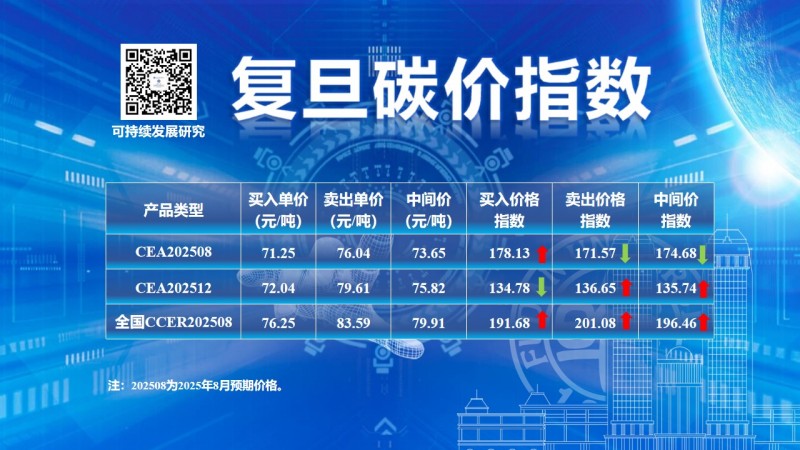
复旦碳价指数:2025年8月GEC价格指数走势分化
Cai Fu Zai Xian· 2025-07-29 03:28
Core Insights - The Fudan University Sustainable Development Research Center released the carbon price index for August 2025, including national carbon emission allowance (CEA) prices, CCER prices, and GEC prices [1][2]. Carbon Emission Allowance (CEA) Prices - The expected buy price for the CEA in August 2025 is 71.25 CNY/ton, with a sell price of 76.04 CNY/ton, resulting in a midpoint price of 73.65 CNY/ton. The buy price index increased by 0.83% to 178.13, while the sell price index decreased by 0.82% to 171.57 [2][3]. - For December 2025, the expected buy price is 72.04 CNY/ton, sell price is 79.61 CNY/ton, and midpoint price is 75.82 CNY/ton. The buy price index is 134.78, and the sell price index is 136.65 [2][3]. Certified Emission Reduction (CCER) Prices - The expected buy price for CCER in August 2025 is 76.25 CNY/ton, with a sell price of 83.59 CNY/ton, leading to a midpoint price of 79.91 CNY/ton. The buy price index rose by 2.49% to 191.68, and the sell price index increased by 3.45% to 201.08 [2][3]. Green Electricity Certificate (GEC) Prices - The expected prices for GECs in August 2025 show a divergence in trends. For 2024 production, centralized project GECs are priced at 3.50 CNY/unit, distributed project GECs at 3.36 CNY/unit, and biomass power generation GECs at 3.66 CNY/unit. For 2025 production, prices are 7.82 CNY/unit for centralized projects, 6.94 CNY/unit for distributed projects, and 6.77 CNY/unit for biomass [4][5]. Market Trends - In July, the average closing price for CEA was 73.64 CNY/ton, up approximately 3% from June's average of 71.51 CNY/ton. However, the trading volume decreased by 35.75% to an average of 51.03 million tons compared to June [6]. - The global carbon market showed mixed trends, with the EU carbon market's average price rising slightly, while the UK market saw a significant drop in trading volume [9].

清洁技术热泵减排潜力超15亿吨,多元工业应用场景有待激发
2 1 Shi Ji Jing Ji Bao Dao· 2025-07-23 09:31
Core Insights - The core viewpoint of the articles emphasizes the significant potential of heat pump technology in China, particularly in reducing carbon emissions in industrial applications, with a reduction potential exceeding 1.5 billion tons [1][2]. Group 1: Heat Pump Technology Potential - Heat pump technology is recognized as a key player in achieving deep decarbonization in the industrial sector, moving beyond its traditional role in household energy savings [1][2]. - The International Energy Agency lists heat pump technology among the six major clean energy technologies, alongside solar, wind, and electric vehicles [1]. - The estimated carbon reduction potential of heat pump technology in China ranges from 1.5 billion to 2 billion tons, accounting for approximately 15% to 20% of the country's total carbon emissions [2]. Group 2: Industrial Applications and Development - Industrial heat pump technology is rapidly advancing, with breakthroughs in core technologies such as high-power high-temperature heat pumps and efficient compressors [2]. - The application of industrial heat pumps spans multiple sectors, including petrochemicals, textiles, food processing, papermaking, pharmaceuticals, and building materials, showcasing adaptability and efficiency improvements [2]. - The unique feature of industrial heat pumps is their ability to recover and reuse waste heat, significantly enhancing the quality of this heat for further use [3]. Group 3: Policy and Market Dynamics - The Chinese government has launched initiatives to promote high-quality development in the heat pump industry, aiming for a 20% increase in energy efficiency of key heat pump products by 2030 [2]. - There is a cautious attitude among enterprises regarding large-scale investments in technology upgrades, although awareness of industrial heat pumps is increasing [4]. - The industry is projected to achieve a compound annual growth rate of 20% to 30% over the next five years, necessitating the establishment of benchmark cases and more supportive policies [4]. Group 4: Challenges and Opportunities - The promotion of industrial heat pumps faces challenges due to varying temperature requirements across industries and the need for tailored energy conversion technologies [5]. - Successful case studies in industries such as textiles demonstrate the feasibility and economic viability of heat pump applications, with projects already implemented in regions like Shanghai [6][7]. - The transition to heat pump technology requires a collaborative effort from government, customers, and industry stakeholders to address knowledge gaps and external constraints [8].
从“卖气郎”到“能源管家”,城燃行业新一轮跑马圈地大幕拉开
第一财经· 2025-07-21 10:00
Core Viewpoint - The urban gas industry is undergoing a transformation towards comprehensive energy services, embracing smart technologies and exploring international expansion opportunities, driven by the dual carbon goals and market reforms in China [1][5][9]. Industry Overview - The urban gas industry in China has evolved significantly since the "West-East Gas Pipeline" project in 2004, transitioning from a phase of rapid expansion to a period of deep adjustment due to market reforms and increased competition [1][7]. - The industry is now characterized by a fragmented structure with major players and numerous small enterprises, facing challenges such as aging infrastructure and intensified competition from electrification [1][7]. Transition to Comprehensive Energy Services - Urban gas companies are shifting from traditional gas sales to becoming comprehensive energy service providers, integrating electricity, gas, heat, and renewable energy sources [4][5]. - New opportunities are emerging under the dual carbon goals, prompting companies to innovate and adapt their business models to include energy efficiency and carbon reduction strategies [3][9]. Case Study: Dunhuang Textile - Dunhuang Textile has successfully reduced energy costs by 14% through energy efficiency upgrades and the implementation of a comprehensive energy management system, showcasing the potential benefits of transitioning to a comprehensive energy model [3][12]. - The company’s experience reflects a broader trend in the industry where traditional high-energy-consuming sectors are seeking to lower costs and improve competitiveness through integrated energy solutions [3][12]. Market Dynamics and Challenges - The demand for natural gas is declining, with a reported 1.3% year-on-year decrease in consumption from January to May, leading to financial pressures on urban gas companies [7][8]. - Companies are facing challenges from price fluctuations and regulatory constraints, which complicate their ability to maintain profitability in the face of rising operational costs [7][8]. Policy and Technological Support - Government policies are increasingly focused on establishing zero-carbon parks and promoting renewable energy integration, which is expected to drive the growth of comprehensive energy services [9][10]. - Technological advancements in renewable energy and energy management systems are reducing costs and enhancing the economic viability of comprehensive energy solutions [10][16]. Business Model Innovation - Urban gas companies are exploring different business models, including fixed-price and sharing models, to enhance profitability and align interests with customers [15][16]. - The shift towards a service-oriented approach requires companies to rethink their operational strategies, focusing on customer needs and collaborative value creation [15][16]. Future Outlook - The comprehensive energy market presents significant growth potential, particularly in energy efficiency retrofits and carbon reduction investments, estimated to be in the range of $0.7 trillion to $2.7 trillion for industrial sectors [14]. - As the market evolves, urban gas companies will need to enhance their operational and trading capabilities to remain competitive in the integrated energy landscape [16].