
净息差

Search documents
宁波银行(002142):基本面呈现改善的
Xin Lang Cai Jing· 2025-08-29 02:47
Core Viewpoint - Ningbo Bank's mid-year report for 2025 shows a recovery in performance, with revenue growth of 7.91% year-on-year, pre-provision profit growth of 11.82%, and net profit attributable to shareholders increasing by 8.23% [1] Group 1: Financial Performance - In Q2 2025, Ningbo Bank's performance growth was driven by scale expansion, slower cost expenditure, and tax benefits, while increased provisioning and a continued narrowing of net interest margin negatively impacted net profit growth [1] - The average daily balance of interest-earning assets grew by 18.98% year-on-year in Q2, marking a 1.19 percentage point increase from Q1, indicating a recovery in growth rate over three consecutive quarters [1] - Non-interest income saw a year-on-year increase of 9.4% in Q2, with a significant contribution from wealth management and bond investment returns [6][8] Group 2: Loan and Deposit Trends - In Q2, net new loans amounted to 31.6 billion yuan, with a notable decline in personal loans, particularly in consumer and operational loans, while housing mortgage loans showed some growth due to a recovering real estate market [2] - New general corporate loans reached 35.1 billion yuan in Q2, with a total of 175.6 billion yuan added in the first half of the year, primarily directed towards broad infrastructure sectors [3] - Deposit growth slowed, with a decrease of 106.2 billion yuan in Q2, leading to a year-on-year growth rate of 12.7%, down 7.22 percentage points from Q1 [4] Group 3: Interest Margin and Cost Management - The net interest margin for Q2 was 1.72%, down 13 basis points year-on-year and 8 basis points from the previous quarter, influenced by a decrease in asset yield [4][5] - The cost-to-income ratio improved to 31.64%, a decrease of 2.41 percentage points year-on-year, reflecting effective cost management and operational efficiency [6] Group 4: Asset Quality and Risk Management - The non-performing loan generation rate for the first half of the year was 0.94%, a decrease of 27 basis points year-on-year, indicating stable asset quality [6] - Credit impairment losses increased by 35.5% year-on-year in Q2, impacting profit growth, while the provision coverage ratio slightly improved to 374% [7] Group 5: Future Outlook - The company is expected to see a revenue growth rate of 6.50% and a net profit growth rate of 5.48% for 2025, with a target price of 35.11 yuan, reflecting a 1.0X price-to-book ratio [8]

宁波银行(002142):2025年中报点评:基本面呈现改善的迹象
Guotou Securities· 2025-08-29 01:32
Investment Rating - The investment rating for the company is "Buy-A" with a target price of 35.11 CNY, compared to the current stock price of 28.29 CNY as of August 28, 2025 [4]. Core Views - The company's performance shows signs of improvement, with revenue growth of 7.91% year-on-year and a net profit increase of 8.23% [1]. - The growth in the second quarter was primarily driven by asset expansion, reduced cost expenditures, and tax incentives, although increased provisioning and a narrowing net interest margin negatively impacted net profit growth [1][15]. - The company is expected to achieve a revenue growth rate of 6.50% and a net profit growth rate of 5.48% for 2025 [15]. Financial Performance Summary - Revenue for 2025 is projected at 70.96 billion CNY, with a revenue growth rate of 6.50% [16]. - The net profit attributable to the parent company is expected to reach 28.61 billion CNY, reflecting a growth rate of 5.48% [16]. - The bank's non-interest income grew by 9.4% year-on-year, indicating a recovery in wealth management and investment income [11]. - The cost-to-income ratio improved to 31.64%, down 2.41 percentage points year-on-year, due to effective cost management [11]. Asset Quality and Risk Management - The non-performing loan generation rate decreased to 0.94% annualized, down 27 basis points year-on-year, indicating improved asset quality [12]. - The bank's provisioning coverage ratio increased slightly to 374%, reflecting a stable credit risk environment [14]. - The overdue rate was reported at 0.89%, showing a slight improvement in credit quality [14]. Loan and Deposit Trends - New loans in the second quarter amounted to 316 billion CNY, with a notable decrease in personal loans due to weak consumer demand [2][3]. - The bank's deposit balance decreased by 1,062 billion CNY in the second quarter, indicating signs of disintermediation [3][10]. - The bank's total loans are projected to reach approximately 1.25 trillion CNY by 2025, with a focus on broad infrastructure sectors [16][44].
Banco Macro S.A.(BMA) - 2025 Q2 - Earnings Call Transcript
2025-08-28 16:00
Financial Data and Key Metrics Changes - Banco Macro's net income for Q2 2025 totaled ARS 101.1 billion, representing a 209% increase compared to the previous quarter, primarily driven by higher net interest income and net fee income [4][5] - Total comprehensive income for the quarter reached ARS 157.1 billion, a 241% increase from the previous quarter [5] - The annualized ROE and ROA were reported at 123.5% [5] - Provision for loan losses increased by 47% quarter-on-quarter and 349% year-on-year, totaling ARS 103 billion [6] - Net interest income for Q2 2025 was ARS 696.9 billion, a 14% increase from the previous quarter and a 163% increase year-on-year [6][7] Business Line Data and Key Metrics Changes - Income from interest on loans increased by 19% quarter-on-quarter and 30% year-on-year, totaling ARS 746.1 billion [7] - Income from government and private securities rose by 18% quarter-on-quarter and 54% year-on-year [7][8] - Net fee income for Q2 2025 was ARS 108.4 billion, a 16% increase from the previous quarter and a 34% increase year-on-year [11] - Other operating income decreased by 37% quarter-on-quarter and 24% year-on-year, totaling ARS 45.8 billion [12] Market Data and Key Metrics Changes - Banco Macro's market share in private sector loans reached 9.2% as of June 2025 [16] - Total deposits increased by 4% quarter-on-quarter and 13% year-on-year, totaling ARS 62 trillion [17] - Nonperforming loans to total financial ratio was reported at 2.06% [18] - The current ratio of total allowances under expected credit losses over nonperforming loans was 137% [18] Company Strategy and Development Direction - The company aims to maintain a loan growth guidance of 60% for 2025 and a deposit growth guidance of 30% [40][41] - Banco Macro is focused on optimizing its deposit base and improving efficiency standards while managing asset quality [19][20] - The bank is open to M&A opportunities but currently has no specific targets [53] Management's Comments on Operating Environment and Future Outlook - Management noted an increase in funding costs and anticipated a slight reduction in net interest margins for Q3 2025 due to market volatility [24][26] - The bank expects some deterioration in asset quality, projecting nonperforming loans to rise to between 2.5% to 3% of total loans by year-end [28][35] - The effective income tax rate was reported at 39%, lower than the previous year [14] Other Important Information - Banco Macro's capital adequacy ratio was reported at 30.5%, with an excess capital of ARS 3.13 trillion [19] - The liquidity ratio of liquid assets to total deposits was 67% [19] Q&A Session Summary Question: Impact on NIMs and asset quality from interest rate volatility - Management acknowledged higher volatility and increased funding costs but noted that net interest margins had widened in Q2 2025. They expect a slight reduction in NIMs for Q3 due to these factors [24][26] Question: ROE expectations for the second half of 2025 - Management maintained the ROE guidance range of 8% to 10% for 2025, despite macroeconomic challenges [28] Question: Quality of the retail loan portfolio - Management indicated a general deterioration in asset quality across the system, with expectations of continued increases in delinquency rates [35] Question: Funding strategy and loan growth guidance - Management emphasized the importance of maintaining growth in both peso and dollar deposits, with a loan growth guidance of 60% for 2025 [40][41] Question: Inflation adjustment item in the P&L - Management confirmed that the inflation adjustment item is due to inflation accounting [55] Question: Expected loan growth for 2025 and 2026 - Management projected a 60% loan growth for 2025 and a 45% growth for 2026 [56]

金融投资拉动业绩!渤海银行上半年营收和净利润“双增”
Nan Fang Du Shi Bao· 2025-08-28 13:44
Core Viewpoint - Bohai Bank reported a growth in both revenue and net profit for the first half of 2025, driven primarily by financial investment income, despite facing challenges in asset quality and scale [1][2]. Financial Performance - For the first half of 2025, Bohai Bank's operating income reached 14.215 billion yuan, an increase of 8.14% year-on-year; net profit was 3.830 billion yuan, up 3.61% year-on-year [1][2]. - The growth in net profit was attributed to increased operating income and ongoing cost reduction efforts [2]. Asset Quality and Scale - As of the end of June, the total assets of Bohai Bank amounted to 1.8238 trillion yuan, a decrease of 1.09% from the end of the previous year [2]. - The non-performing loan (NPL) ratio rose to 1.81%, an increase of 0.05 percentage points from the end of the previous year [2]. Revenue Composition - Interest income for the first half was 8.046 billion yuan, a slight decline of 0.43% year-on-year; the net interest margin was 1.20%, up 0.04 percentage points [3]. - Non-interest income reached 6.169 billion yuan, a significant increase of 21.81% year-on-year, primarily driven by a 61.16% rise in financial investment income [3]. Loan Quality - As of June, the non-performing loan balance for corporate loans increased by 468 million yuan, with a non-performing rate of 1.12% [5]. - Personal loan non-performing balance rose by 319 million yuan, with the non-performing rate increasing from 4.15% to 4.43% [5]. Regional and Sectoral Performance - The highest non-performing loan rates were observed in Central and Southern China at 3.10%, with increases noted in the real estate and construction sectors [5]. - The bank disposed of 3.742 billion yuan of non-performing assets through various methods by the end of June [6].
兴业银行上半年归母净利润微增0.21% 营收延续下降态势
Shang Hai Zheng Quan Bao· 2025-08-28 13:26
Core Viewpoint - The financial performance of Industrial Bank in the first half of 2025 shows a decline in operating income but a slight increase in net profit, indicating a stabilization in profitability despite challenges in revenue generation [1][2]. Financial Performance - Operating income for the first half of 2025 was 110.46 billion yuan, a year-on-year decrease of 2.29%, with the decline rate narrowing by 1.29 percentage points compared to the first quarter [1]. - Net profit attributable to shareholders was 43.14 billion yuan, reflecting a year-on-year growth of 0.21%, with the growth rate turning positive from a negative in the first quarter [1]. Revenue Structure - Net interest income amounted to 73.76 billion yuan, down 1.52% year-on-year, primarily due to a narrowing interest margin, which was managed effectively by balancing liabilities and assets [1]. - The net interest margin stood at 1.75%, a decrease of 7 basis points compared to the previous year [1]. - Non-interest income totaled 36.70 billion yuan, a decline of 3.80% year-on-year, influenced by market interest rate fluctuations [1]. - Fee and commission income was 13.08 billion yuan, showing a year-on-year increase of 2.59%, driven by enhanced customer financial service capabilities [1]. - Other non-interest income reached 23.63 billion yuan, down 7.00% year-on-year, although it saw a 11.7% increase in the second quarter compared to the previous year [1]. Asset and Loan Growth - Total assets reached 10,614.38 billion yuan, reflecting a growth of 1.01% from the end of the previous year [2]. - The balance of loans in domestic and foreign currencies was 5,903.43 billion yuan, an increase of 2.91% from the end of the previous year [2]. - The balance of deposits in domestic and foreign currencies was 5,869.83 billion yuan, up 6.10% from the end of the previous year [2]. Asset Quality - The overall asset quality remained stable, with a non-performing loan ratio of 1.08%, unchanged from the first quarter but up 0.01 percentage points from the end of the previous year [2]. - The provision coverage ratio was 228.54%, a decrease of 9.24 percentage points from the end of the previous year [2].

稳息差控风险,定调下半年发展!直击中信银行中期业绩会
券商中国· 2025-08-28 12:49
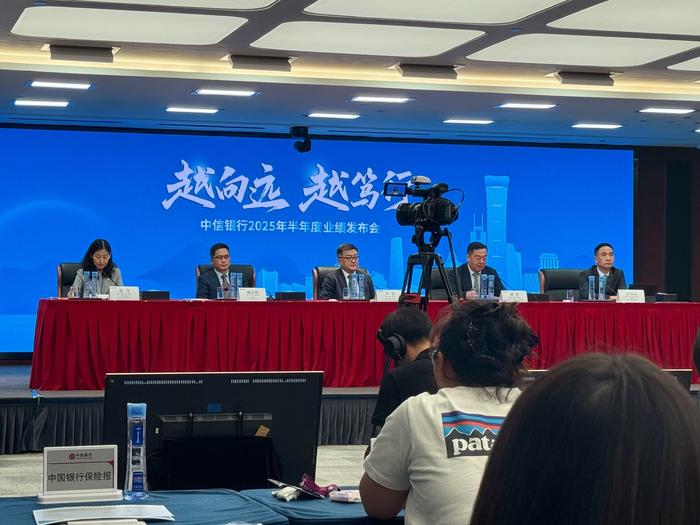
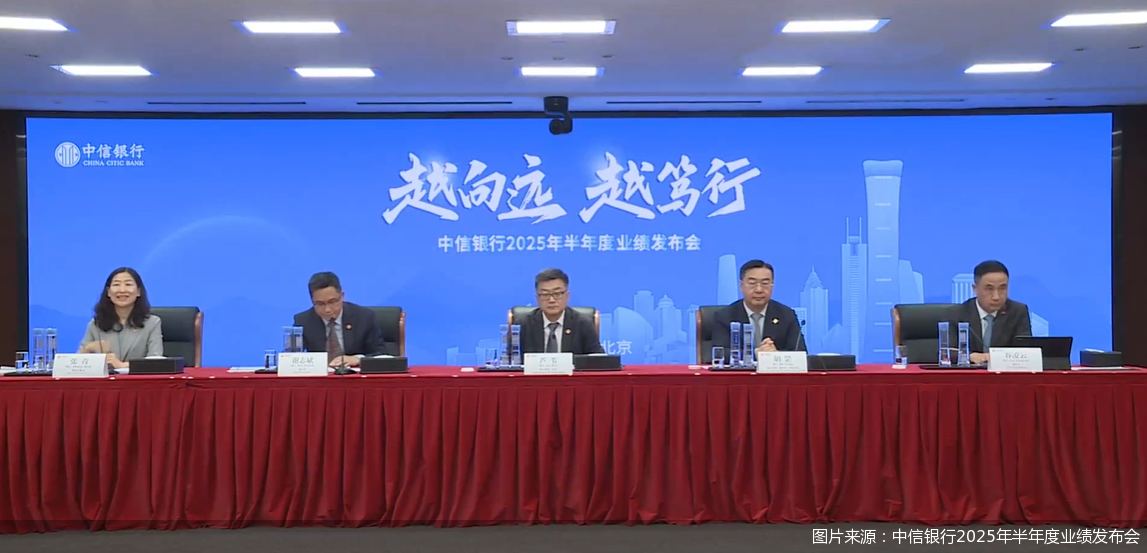
8月28日,中信银行2025年半年度业绩发布会在北京举行。 中信银行行长芦苇、董事会秘书张青、副行长谢志斌、谷凌云、胡罡出席。会议现场,该行管理层就净息差、资产质 量、分红等热点问题进行了回应。 谈业绩:难中求成、坚持"量价平衡"稳息差 半年报显示,2025年上半年,中信银行实现归母净利润364.78亿元,同比增长2.78%;营业收入1057.62亿元,同比下降 2.99%。对于营业收入小幅下降,该行解释称,是受利率下行和市场走势的影响,二季度营收同比下降2.28%,降幅较一 季度收窄1.44个百分点。 上半年,该行利息收入同比下降7.53%至1451.22亿元,半年报显示,主要是生息资产收益率下降所致;非利息净收入 345.61亿元,同比下降5.08%;手续费及佣金净收入169.06亿元,同比增加3.38%。 截至6月末,中信银行净息差1.63%,同比下降14个百分点;比一季度下降2个百分点,降幅趋缓。 在净息差整体下行背景下,该行多次强调"净息差变动跑赢大市、优于同业"的目标。"一个故事讲一年不难,但持续讲且 要讲好可不容易。"芦苇总结中信银行上半年的经营亮点时表示,中信银行在营收端积极开源,并持续调整资 ...



记者直击中信银行中期业绩会:“有信心实现全年业绩,跑赢大势!”
Zheng Quan Ri Bao Zhi Sheng· 2025-08-28 12:36
2025年上半年,中信银行开源节流双管齐下,经营效益保持稳健。报告期内,实现归属于该行股东的净 利润364.78亿元,同比增长2.78%。此外,中信银行拟将2025年度中期现金分红比例提升至30.7%,进一 步提升投资者回报预期。 "一个故事讲一年不难,但要持续讲,而且要讲好可不容易。"芦苇表示,今年上半年,中信银行经营最 大的亮点在于,一如既往地在稳健、均衡、可持续的道路上坚定不移地走下去。 对于下半年经营发展、居民资产配置新变化、财富管理发力方向以及银行业净息差走势等话题,中信银 行管理层在现场进行了回应。 本报记者 杨洁 8月28日,中信银行召开2025年半年度业绩发布会。中信银行行长芦苇,中信银行副行长胡罡,中信银 行副行长谢志斌,中信银行副行长谷凌云等出席发布会。 谈下半年规划: 资产、息差、非息三方面持续发力 对于下半年的规划,芦苇表示,中信银行将进一步强化"大抓营收"的导向,从资产、息差、非息三个方 面持续发力,有信心实现全年业绩跑赢大势。 一是,进一步抓好大类资产配置,稳住营收的基本盘。对公端,重点加大金融"五篇大文章"领域的贷款 投放力度,通过构建优质项目储备库做优增量储备,完善提前还款的应 ...
不以风险下沉换取短期利润!中信银行行长业绩会上“反内卷”
Bei Jing Shang Bao· 2025-08-28 11:34
Core Viewpoint - The bank emphasizes maintaining risk resilience over short-term profit growth, adhering to a "反内卷" (anti-involution) policy to uphold operational standards [1][3]. Financial Performance - In the first half of 2025, the bank reported a net profit of 36.478 billion yuan, a year-on-year increase of 2.78%, while operating revenue decreased by 2.99% to 105.762 billion yuan [3]. - Net interest income was 71.201 billion yuan, down 1.94%, and non-interest income was 34.561 billion yuan, down 5.08% [3]. - The net interest margin was 1.63%, a decrease of 0.14 percentage points year-on-year, and the net profit margin was 1.60%, down 0.11 percentage points [3][4]. Market Environment - The bank's performance is influenced by a low-interest-rate environment and the gradual expiration of high-yield assets, which may exert downward pressure on asset yields and interest margins [4]. - The "反内卷" policy and neutral monetary policy are expected to stabilize the banking sector's net interest margin [4]. Retail Banking Strategy - The bank's retail management assets reached 4.99 trillion yuan, a growth of 6.52% year-on-year, but retail banking net income fell by 8.43% to 38.107 billion yuan [5][6]. - Changes in consumer asset allocation include a shift from deposits to wealth management and insurance products, with a focus on low-risk investments [5]. - The bank aims to enhance its asset organization capabilities and diversify its product offerings, including a transition to "固收+" strategies in wealth management [5][6]. Industry Competition - The bank acknowledges the challenges posed by intense competition in the retail sector, including price wars and changing consumer preferences [5][7]. - The government has signaled a need for supply-side reforms to regulate market order and promote sustainable development in the banking sector [8]. Support for Industry Transformation - The bank is committed to supporting industries undergoing transformation while avoiding excessive support for overcapacity sectors [8][9]. - The bank plans to focus on high-end manufacturing enterprises with independent R&D capabilities while gradually withdrawing from low-end manufacturing sectors lacking core competitiveness [9].
杭州银行(600926):25H1财报点评:利润保持高增,净息差收窄有限
Orient Securities· 2025-08-28 11:23
Investment Rating - The report maintains a "Buy" rating for Hangzhou Bank with a target price of 16.64 CNY per share, reflecting a 20% premium over the comparable company's PB of 0.79x for 2025 [3][6]. Core Insights - The company's net profit for 2025 is projected to grow by 16.2%, with BVPS expected to be 17.52 CNY. The current stock price corresponds to PB ratios of 0.91x, 0.78x, and 0.68x for 2025, 2026, and 2027 respectively [3][6]. - As of H1 2025, Hangzhou Bank's revenue, PPOP, and net profit growth rates are 3.9%, 4.7%, and 16.7% respectively, showing a slight recovery compared to Q1 2025 [10]. - The bank's total assets and loan amounts grew by 12.6% and 12.2% year-on-year, indicating a cautious approach to credit risk management [10]. - The bank's asset quality remains strong, with a non-performing loan ratio stable at 0.76% and a provision coverage ratio of 521% as of H1 2025 [10]. Financial Performance Summary - Revenue for 2023 is reported at 35,016 million CNY, with projected growth rates of 6.3% for 2024, 3.9% for 2025, and 6.6% for 2026 [5][13]. - The net profit attributable to the parent company is expected to reach 19,727 million CNY in 2025, reflecting a year-on-year growth of 16.2% [5][13]. - The bank's net interest margin has narrowed by 6 basis points compared to 2024, but remains better than the industry average [10].

浦发银行行长谢伟:息差优化一个基点就可以给营收多带来8亿元
Bei Jing Shang Bao· 2025-08-28 11:11
北京商报讯(记者宋亦桐)8月28日,浦发银行(600000)召开2025年半年度业绩说明会,浦发银行行长 谢伟指出,"改善净息差是一个系统性的工程,浦发银行非常重视强调资产负债管理的主动性,通过主 动、前瞻科学的进行顶层设计,明确短中长期资产负债管理目标,来综合运用预算考核、定价、财务、 资本、组织等机制形成合力,一体化推动净息差的改善。" "如果在息差上面能够优化一个bp(基点),就可以给营收多带来8亿元",谢伟指出,当前国内整个银行 业还处于降息周期,贷款利率仍将会持续下滑,但是各方面的决策也会非常重视银行息差的影响,预计 未来一两年银行业净息差可能会逐步达到一个触底反弹的过程,降幅会进一步的收敛。" ...
