
贸易逆差

Search documents
美媒:美今年前5个月贸易逆差或破纪录,“关税暂缓期”临近引发亚洲出口狂飙
Huan Qiu Shi Bao· 2025-06-24 22:42
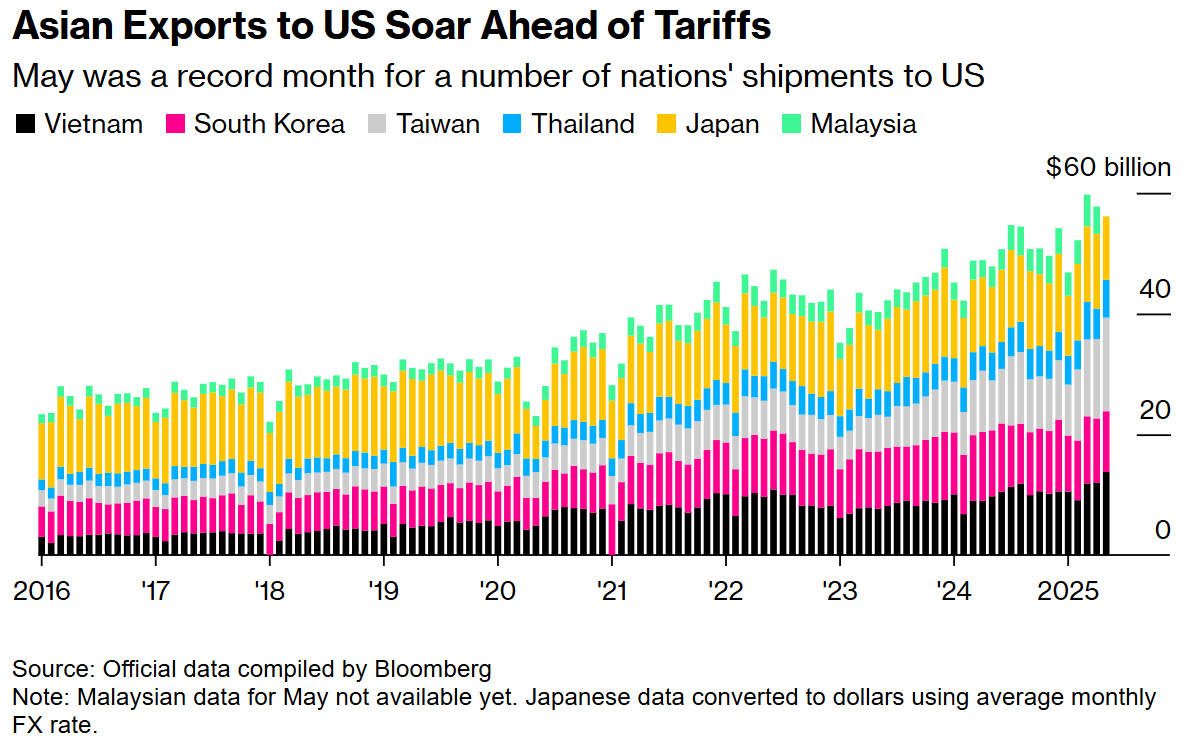
【环球时报综合报道】"今年前5个月美国的贸易逆差或将创下历史同期最高纪录。"彭博社23日报道 称,随着美国"对等关税"暂停期限的临近,囤货效应推升美国与亚洲国家的贸易逆差持续扩大。但进展 缓慢的关税谈判,也为这些亚洲国家对美出口的前景带来了不确定性。 日美之间也尚未达成任何协议。据雅虎财经24日报道,两名日本政府消息人士周二透露,日本首席贸易 谈判代表赤泽亮正正筹备最早于6月26日启程的第7次美国之行,旨在终结当前损害日本经济的关税措 施。 彭博社说,对美出口历史性的增长将体现在本周美国发布的5月份对外贸易数据中,并可能使美国政府 与亚洲各经济体就美国所谓"对等关税"的谈判复杂化。 公开信息显示,目前,美国与亚洲主要贸易伙伴间的关税谈判依然进展缓慢,甚至陷入僵局。《印度时 报》23日报道称,担心对农民造成不利影响以及出于对美国转基因食品相关的担忧,印度政府拒绝了美 国玉米和大豆等农产品以低关税进入印度市场的要求。消息人士表示,谈判已陷入僵局。 据报道,越南、泰国5月出口均创下历史同期最高纪录。其中,越南和泰国对美出口同比均激增35%。 另据《韩国先驱报》23日报道,韩国6月前20天出口额同比增长8.3%,其中 ...
关税截止日逼近,亚洲对美出口飙升,多个经济体创纪录
Hua Er Jie Jian Wen· 2025-06-24 00:21
亚洲主要经济体出口创纪录增长 报道称,据过去几周发布的数据显示,越南、中国台湾和泰国5月对美出口均创历史新高。其中,越南 和泰国对美出口同比激增35%,中国台湾对美出口更是飙升近90%。 值得注意的是,韩国5月对美出口也接近纪录水平,此外周一公布的海关数据显示,韩国6月前20天出口 额同比增长8.3%,其中对美国出口增长4.3%。 亚洲经济体对美国出口的大幅增长模式颠覆了历史规律。 在特朗普暂停所谓"对等关税"截止日期临近之际,亚洲多个经济体对美国出口飙升,进而是的美国与亚 洲地区的贸易逆差持续扩大。 6月23日,据报道,越南、中国台湾和泰国均在5月份创下对美出口新纪录,显示企业正争分夺秒将货物 运抵美国,以规避可能的高额关税。 这轮出口激增预计将在本周美国5月贸易数据中显现,市场预测美国5月贸易逆差将达910亿美元,推动 2025年迄今逆差总额接近6430亿美元,远超历史同期纪录。 有分析指出,如果特朗普在7月初对亚洲各经济体征收历史性高关税,目前的出口激增态势可能迅速逆 转,从而冲击整个地区的经济增长。亚太经合组织已因贸易紧张局势将今年GDP增长预期从3月的3.3% 下调至2.6%。 目前,市场预测显示, ...
美国对亚洲贸易逆差激增,企业再次抢跑特朗普关税大限
智通财经网· 2025-06-23 23:19
智通财经APP获悉,随着进口商赶在美国总统特朗普设定的"对等"关税最后期限之前囤货,美国对亚洲的贸易逆差正在扩大。过去几周发布的数据显示,越 南、中国台湾省和泰国5月份对美出口均创下纪录。 周一公布的数据显示,韩国上月对美出口接近创纪录水平,且6月初似乎再次增长。 这些创纪录数字打破了正常的历史模式,即贸易往往在下半年更为强劲,因为亚洲供应商赶在圣诞节假期之前向美国发货。美国从7月初开始征收新关税的 威胁正迫使企业尽快将货物装上船、运往美国。 美国贸易逆差今年创下新高 如果特朗普像他所威胁的那样,在7月初对亚洲各国征收历史性的高关税,出口激增的局面可能很快就会逆转,破坏整个地区的经济增长。 上个月,亚太经济合作组织(APEC)因贸易紧张而大幅下调了对今年GDP增长的预测,预计21个成员的经济体将增长2.6%,低于3月份预测的3.3%。 亚洲对美国的出口在关税之前飙升 5月份,越南和泰国对美出口均同比增长35%,而台湾对美出口飙升近90%。这些创纪录的增长可能在本周美国公布5月份数据时开始显现出来,并可能使特 朗普与亚洲各经济体之间围绕美国将设定的关税水平的谈判复杂化。 由于企业试图应对华盛顿方面关税和贸易政策 ...

公开:日本出口罕见下滑!对美国出口15140亿,对中国出口多少?
Sou Hu Cai Jing· 2025-06-22 00:46
Group 1 - Japan's economy is facing significant challenges, with exports dropping by 1.7% year-on-year to 81,350 billion yen, marking an eight-month low [1] - The trade deficit has widened to 637.6 billion yen, indicating a potential technical recession as it has recorded deficits for two consecutive months [2] - The first quarter GDP decreased by 0.2% quarter-on-quarter, translating to an annualized decline of 0.7%, raising concerns about economic confidence [2] Group 2 - The decline in exports is heavily influenced by the U.S. tariff policies, which have imposed a 25% tariff on imported cars and parts, and a 10% tariff on other Japanese goods [4] - Exports to the U.S. fell by 11.1%, while exports to China decreased by 8.8%, highlighting the adverse effects of these tariffs on Japan's export market [4] - The Japanese government attempted to negotiate a new trade agreement with the U.S. in June 2025, but these talks ended without success, leading to a restoration of the 10% tariff to 24% on July 9, 2025 [5] Group 3 - Japan's economic issues are compounded by structural weaknesses, including high inflation that erodes purchasing power and insufficient domestic demand [5] - The over-reliance on exports has left Japan vulnerable to international market fluctuations, exacerbated by global economic downturns such as U.S.-China trade tensions and a sluggish European economy [5] - The current economic situation reflects deeper contradictions in Japan's trade strategy and domestic economic structure, necessitating significant reforms to navigate future challenges [7]
韩对美经常账户盈余创新高 李在明面临特朗普关税谈判大考
news flash· 2025-06-20 04:22
Core Insights - South Korea's current account surplus with the United States reached a record high of $118.2 billion in 2024, highlighting the challenges faced by Lee Jae-myung in negotiating a trade agreement with Trump [1] - The surplus has been increasing annually since 2019, indicating a growing trade relationship between South Korea and Washington, while also suggesting potential friction [1] - South Korea has been identified as one of the top ten countries contributing to the U.S. trade deficit, as noted by Trump [1] Trade Negotiation Context - The planned meeting between the two leaders at the G7 summit in Canada was canceled due to escalating tensions in the Middle East, which adds complexity to the trade discussions [1] - Lee Jae-myung's nominated Prime Minister candidate expressed the President's desire to reach an agreement before the end of July to avoid potential increases in baseline tariffs [1]
“要么提好协议,要么付钱”!特朗普再批欧盟
第一财经· 2025-06-19 11:16
Core Viewpoint - The article discusses the ongoing trade negotiations between the United States and the European Union, highlighting President Trump's demands for a fair trade agreement and the potential for increased tariffs if an agreement is not reached by the July 9 deadline [2][6][10]. Summary by Sections Trade Negotiations - President Trump criticized the EU for not presenting a fair trade agreement and emphasized the need for the EU to either propose a good deal or face higher tariffs [2][3]. - The EU aims to reach an agreement before the expiration of the 90-day tariff suspension period on July 9, with ongoing discussions about tariffs and trade barriers in key sectors such as steel, aluminum, and automobiles [6][7]. Tariff Implications - The Trump administration has threatened to impose a 20% tariff on EU imports, while currently maintaining a 10% baseline tariff on EU goods entering the U.S. [6]. - The EU has denied reports of accepting a 10% baseline tariff, asserting that such claims do not reflect the current negotiation status [6][7]. EU's Response and Strategy - The EU is preparing countermeasures, including potential actions beyond tariffs, and is reviewing strategic areas where the U.S. relies on the EU [10][11]. - The EU has already approved tariffs on $21 billion worth of U.S. goods in response to U.S. steel and aluminum tariffs, with additional tariffs on $95 billion worth of U.S. products being considered [11]. Economic Impact - The Oxford Economics report indicates that higher tariffs could negatively impact trade, with the extent of the impact being debated due to uncertainties surrounding future tariff paths and their effects on trade [12]. - Increased tariffs are viewed as a supply shock for the U.S., potentially lowering growth and increasing inflation, while for the Eurozone and the UK, they represent a demand shock [12].
特朗普再批欧盟“要么提好协议,要么付钱”,有何谋划?|全球贸易观察
Di Yi Cai Jing· 2025-06-19 10:54
Core Viewpoint - The ongoing trade negotiations between the US and EU are marked by tensions, with President Trump insisting on a fair trade agreement or else higher tariffs will be imposed on the EU [3][4][12]. Group 1: Trade Negotiations - Trump criticized the EU for not presenting a fair trade agreement, emphasizing that the EU must either propose a good deal or face financial consequences [3][4]. - The US and EU are under pressure to reach an agreement before the July 9 deadline for tariff suspension, with negotiations accelerating recently [5][7]. - The EU aims to finalize an agreement before the expiration of the 90-day suspension period to avoid higher reciprocal tariffs [7]. Group 2: Tariff Implications - Trump has threatened to impose a 20% tariff on the EU due to the significant trade surplus the EU has with the US, which is currently on hold [7][13]. - The EU has already approved tariffs on $21 billion worth of US goods in response to US steel and aluminum tariffs, with additional tariffs on $95 billion of US products being prepared [14]. - The EU's exports to the US are significantly affected by Trump's tariffs, covering €380 billion worth of products, which accounts for about 70% of total EU exports to the US [13]. Group 3: Economic Impact - The negotiations are complicated by the need for the EU to address the trade deficit issue, which requires a combination of market access, purchasing US products, and investment in the US [5][10]. - The Oxford Economics report indicates that higher tariffs could negatively impact trade, with the US facing supply shocks that may lower growth and increase inflation, while the EU may experience demand shocks [14].
突然崩了!日本,传出重大利空!
券商中国· 2025-06-18 12:40
Core Viewpoint - The article highlights the negative impact of U.S. tariffs on Japan's economy, indicating a potential technical recession due to declining exports and increasing trade deficits [1][3][5]. Group 1: Trade Data and Economic Impact - Japan's exports fell by 1.7% year-on-year in May, marking the first decline in eight months, primarily due to decreases in automotive, steel, and mineral fuel exports [1][3]. - Exports to the U.S. decreased by 11.1% in May, while exports to China dropped by 8.8% [3]. - Japan recorded a trade deficit of 637.6 billion yen in May, continuing a trend of trade deficits for the second consecutive month [2][3]. Group 2: Government and Central Bank Responses - Japanese Prime Minister Shinzo Abe has been seeking to negotiate the removal of automotive tariffs but has not yet succeeded [4]. - The Bank of Japan maintained its target interest rate at 0.5%, indicating a cautious approach amid economic uncertainties caused by U.S. tariffs [5][6]. - The Bank of Japan's economic outlook remains cautious, with a noted contraction in GDP of 0.2% in the first quarter of 2025 [5]. Group 3: Future Outlook and Negotiations - There is uncertainty regarding future interest rate hikes by the Bank of Japan, with some analysts suggesting a delay until the first quarter of next year due to the lack of strong inflationary pressures [6]. - The ongoing trade negotiations between Japan and the U.S. remain unresolved, with both sides agreeing to continue discussions without reaching a consensus [7][8].

关税大消息!重要数据公布!
Zhong Guo Ji Jin Bao· 2025-06-18 01:54
Group 1 - Japanese and South Korean stock markets opened lower but experienced a subsequent rally, with the Nikkei 225 index rising by 0.2% to its highest point since February 21 [3][5] - Notable individual stocks that performed well include Prince Holdings, Taisei Corporation, and Nintendo [4] - The KOSPI index in South Korea increased by 0.45%, reaching 2963.63 points [5] Group 2 - Japan's exports fell for the first time in eight months, with a year-on-year decline of 1.7% in May, impacted by tariffs and weak demand for automobiles, steel, and mineral fuels [7] - Imports also decreased by 7.7% year-on-year, with significant reductions in crude oil and coal imports [7] - Japan's trade balance showed a deficit for the second consecutive month, with the deficit amounting to 637.6 billion yen [7] - Exports to the U.S. dropped by 11.1% year-on-year, marking a 4.7% decline in Japan's trade surplus with the U.S. for the first time in five months [7] - Concerns are rising about a potential technical recession in Japan if the economy continues to contract in the second quarter, amid weak domestic consumption and inflation outpacing wage growth [7] Group 3 - Ongoing tariff negotiations between Japan and the U.S. have not reached a consensus, with both sides agreeing to further discussions [7] - The Bank of Japan is expected to maintain its policy interest rate at 0.5% and plans to slow down the pace of bond purchase reductions in the next fiscal year [7] - Ben Powell, Chief Investment Strategist for BlackRock in the Middle East and Asia-Pacific, indicated that the Bank of Japan is likely to keep interest rates unchanged due to global economic uncertainties [8] - The current economic environment is complicated by rising food prices, global trade tensions, and oil price fluctuations, although there is a positive cycle forming between wage increases and stable prices domestically [8]
日本5月贸易逆差6376亿日元
news flash· 2025-06-18 00:45
日本财务省6月18日公布的5月贸易统计初值显示,出口减去进口的贸易收支为逆差6376亿日元(约合人 民币315亿元)。这是连续两个月呈现逆差。 ...