中华文化

Search documents
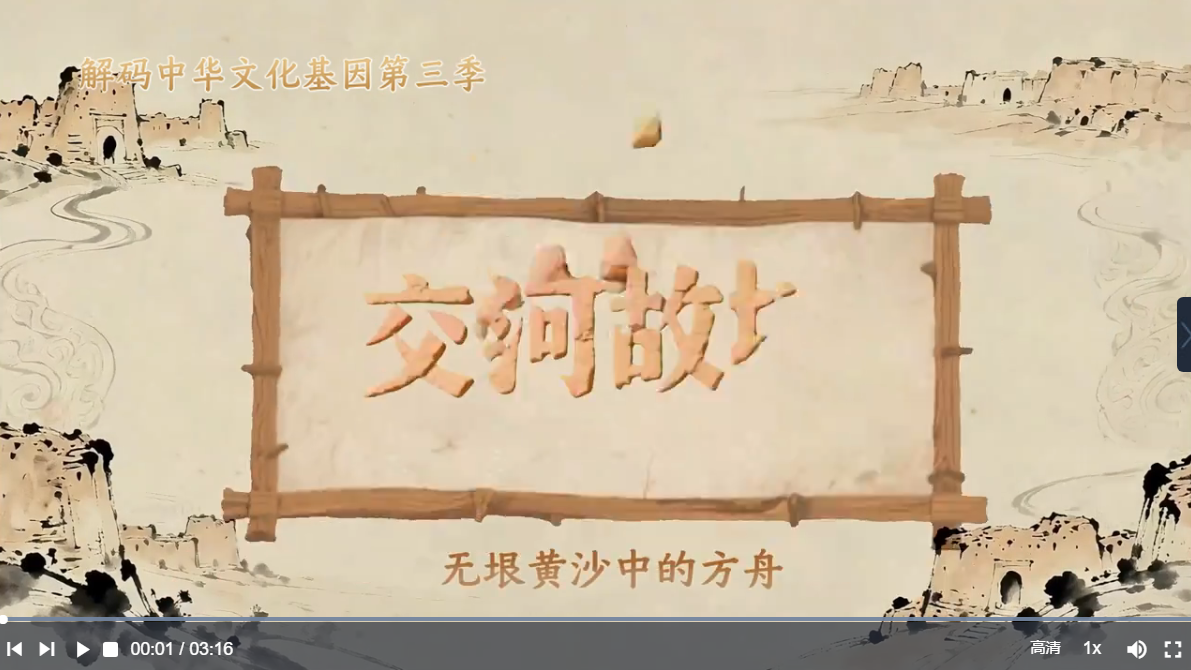
解码中华文化基因:交河故城,丝绸之路的交通要道
Zhong Guo Xin Wen Wang· 2025-11-17 10:41
Core Viewpoint - The article emphasizes the importance of cultural heritage protection and the international influence of Chinese culture, particularly through the example of the ancient city of Jiaohe, which is a significant historical site along the Silk Road [2]. Group 1: Cultural Heritage Significance - Jiaohe Ancient City is recognized as the most well-preserved, longest-lasting, and largest earthen structure ancient city in the world, directly carved from the earth [2]. - The site serves as a crucial witness to over 5,000 years of Chinese civilization and holds significant historical value [2]. Group 2: UNESCO World Heritage Status - In 2014, Jiaohe was included in the UNESCO World Heritage List as part of the "Silk Roads: the Routes Network of Chang'an-Tianshan Corridor" [2]. Group 3: National Pride and Cultural Confidence - The article highlights the need to enhance national pride and cultural confidence through the protection and utilization of cultural heritage [2].

东西问|短评:为何说汉学源自中国、属于世界?
Zhong Guo Xin Wen Wang· 2025-11-14 07:03
Core Viewpoint - The article emphasizes that Sinology originates from China and belongs to the world, highlighting its significance in bridging Chinese civilization with global understanding [1][3][5]. Group 1: Origin of Sinology - Sinology is rooted in China, encompassing a vast array of cultural achievements from oracle bone inscriptions to classical literature and art forms, all of which have emerged, accumulated, and been passed down within Chinese soil [3]. - The methodologies derived from traditional Chinese scholarship, such as textual interpretation and historical criticism, have significantly influenced the development of Sinology, establishing a foundational approach for the field [3]. Group 2: Global Nature of Sinology - Sinology is a global endeavor, with researchers from around the world contributing to its exploration, providing insights that transcend cultural boundaries and offer universal values [5]. - The philosophical concepts inherent in Chinese civilization, such as harmony and moral integrity, serve as a source of wisdom that benefits humanity as a whole, reinforcing the idea of a shared human destiny [5]. Group 3: Development and Future of Sinology - The evolution of Sinology reflects a dialectical unity between the particular and the universal, indicating that deeper engagement with Chinese culture enhances its global appeal and vitality [6]. - The transition from a Western-centric view of Sinology to a collaborative global effort signifies a maturation of the field, where mutual learning and exchange are increasingly emphasized [6].

与汉学结伴 和中国同行(和音)
Ren Min Ri Bao· 2025-11-13 22:10
Core Insights - The article emphasizes the importance of international scholars collaborating with Chinese counterparts to promote mutual understanding and respect among nations, contributing to the advancement of human civilization [1][4] - The growing interest in Sinology reflects a broader trend of cultural exchange and appreciation for Chinese culture globally, with over 80 countries incorporating Chinese into their national education systems and more than 200 million international learners of the language [2][3] Group 1 - The revival of Sinology is seen as a symbol of the flourishing of Chinese culture, with various initiatives and cultural exchanges gaining traction worldwide [2] - The number of foreign visitors to China has significantly increased, with a 30.2% year-on-year growth in entry and exit numbers, and a 53.9% increase in visa-free entries, indicating a rising global interest in experiencing Chinese culture firsthand [3] - Platforms such as the World Chinese Conference and the World Sinology Conference are becoming increasingly influential in fostering dialogue and understanding between different civilizations [3] Group 2 - The article highlights the role of cultural exchange in addressing global challenges and achieving common development, advocating for equal dialogue and mutual learning among civilizations [3][4] - The commitment of China to openness and inclusivity is underscored, as it continues to share development opportunities with the world, fostering a reciprocal relationship with foreign friends [3]
文博公开课丨孔子研究院:以儒学智慧讲述中国故事
Zhong Guo Xin Wen Wang· 2025-11-13 08:20
Core Viewpoint - The Confucius Research Institute, established in 1996, emphasizes the importance of cultural prosperity for national strength and the revival of the Chinese nation, advocating for the learning, inheritance, and innovation of Confucian culture to better narrate China's story to the world [1] Group 1 - The Confucius Research Institute is a specialized institution for Confucian and Chinese studies approved by the State Council in 1996 [1] - Xi Jinping visited the Confucius Research Institute on November 26, 2013, highlighting the connection between a nation's strength and cultural prosperity [1] - Key Confucian concepts such as "harmony in diversity," "benevolence and propriety," "unity of heaven and humanity," and "balancing righteousness and profit" provide moral and governance insights for the world [1] Group 2 - The promotion of Confucian culture is seen as essential for the development and prosperity of Chinese culture, which is a prerequisite for the great rejuvenation of the Chinese nation [1] - The study and innovation of Confucian culture are positioned as vital for effectively communicating China's narrative globally [1]
感知可爱可亲的中国(侨界关注)
Ren Min Ri Bao Hai Wai Ban· 2025-11-12 23:10
Core Viewpoint - The article highlights the experiences of a Chinese-American youth, He Jianing, who actively engages with Chinese culture through travel, food, language learning, and cultural exchange, showcasing a modern perspective on cultural identity and heritage [2][10]. Group 1: Cultural Engagement - He Jianing utilizes AR technology to enhance her understanding of traditional Chinese culture at the National Museum of China [2]. - She expresses a deep appreciation for Chinese cuisine, emphasizing the emotional and cultural connections it fosters [3][5]. - The youth's travels across China, from Chongqing to Beijing and Shenzhen, reflect a strong desire to explore and connect with her roots [5]. Group 2: Language Learning - He Jianing's fluency in spoken Chinese is complemented by her efforts to improve her reading and writing skills through music and family support [6]. - The family environment plays a crucial role in her language acquisition, with a focus on Chinese pop songs as a learning tool [6][7]. - She actively participates in Chinese language courses in the U.S., engaging with classmates from diverse backgrounds, which enriches her learning experience [8][9]. Group 3: Cultural Sharing - He Jianing aims to present a multifaceted view of China to her peers abroad, countering stereotypes with a blend of traditional and modern cultural elements [9][10]. - She shares Chinese cultural artifacts and experiences with her American friends, fostering interest in traditional practices like calligraphy and Hanfu [9]. - The youth's enthusiasm for Chinese animation, particularly the "Nezha" series, illustrates her commitment to promoting contemporary Chinese culture [10].
大国五年丨中华文化,蓬勃气象万千!
Xin Hua She· 2025-11-10 04:18
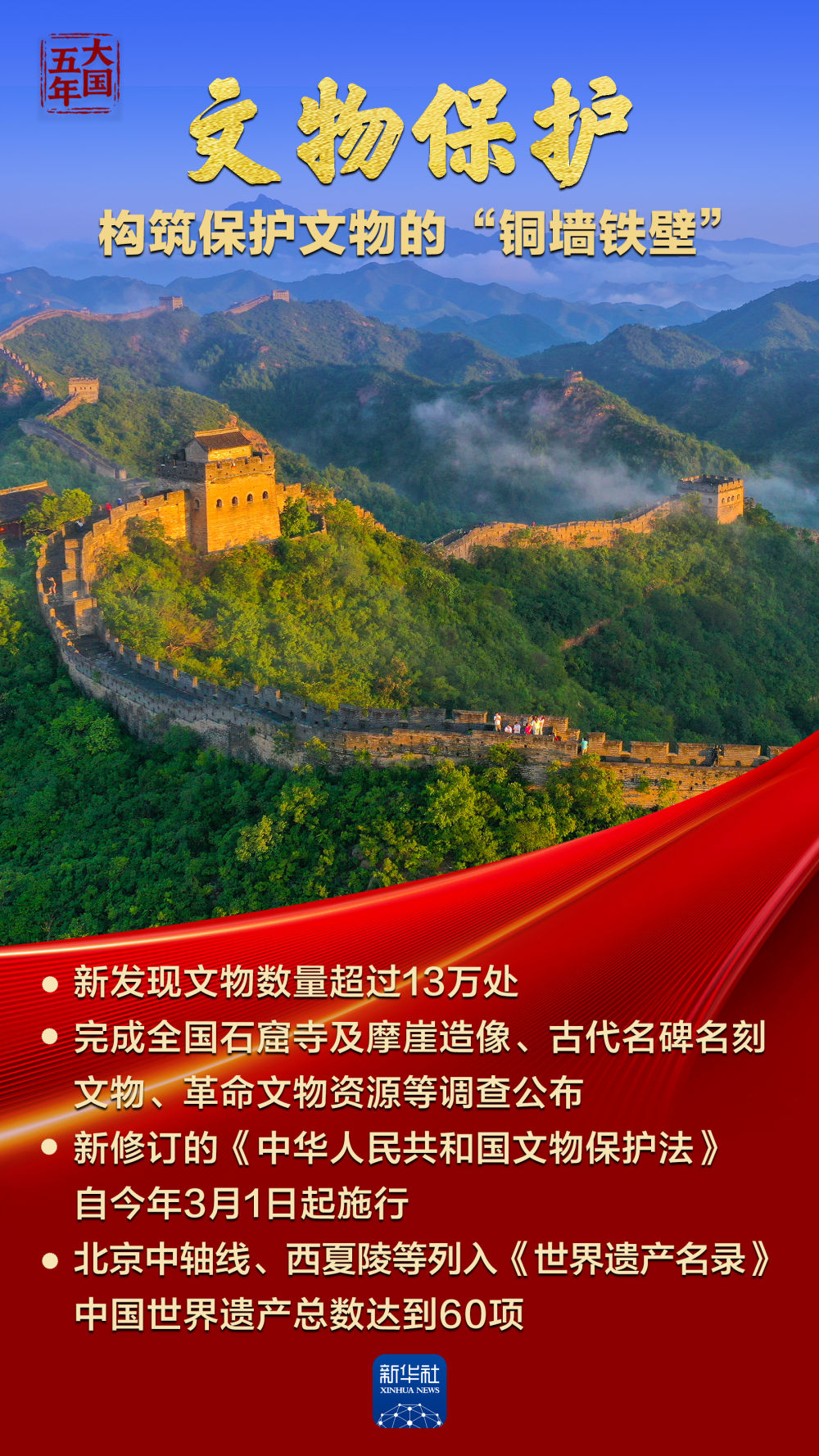
Group 1 - The core idea emphasizes the importance of culture as the root and soul of the nation, highlighting various cultural initiatives and achievements during the "14th Five-Year Plan" period [1] - The new revision of the "Cultural Relics Protection Law" took effect on March 1, 2023, and China's total number of World Heritage sites has reached 60, including the Beijing Central Axis and the Western Xia Tombs [3] - The number of registered museums in the country has reached 7,046, with an average of one museum for every 200,000 people [10] Group 2 - Significant progress has been made in major archaeological projects, with over 7,700 proactive archaeological excavations and basic construction projects approved [7] - The cultural industry is projected to reach a total asset value of 34.4 trillion yuan, with operating income exceeding 19 trillion yuan in 2024 [18] - The number of public libraries in the country stands at 3,248, and there are nearly 44,000 community cultural institutions [13] Group 3 - The number of national archaeological heritage parks has increased to 65, and there are over 3,000 revolutionary memorial museums nationwide [10] - The country has launched 36 smart tourism solutions and 42 immersive experience spaces, incorporating AI technology in various aspects of content production [20] - The number of self-organized cultural groups by the public has exceeded 470,000, with 81,700 "village evenings" planned for 2024, attracting 262 million participants [15]
澳门中华文化演出季将启动
Ren Min Ri Bao Hai Wai Ban· 2025-11-05 22:11
Core Points - The Macao Special Administrative Region's Cultural Bureau held a presentation for the Chinese Cultural Performance Season, which will run from November to March next year [1][2] - The season will feature four premium performances, starting with the National Peking Opera performing classic plays [1] - The event aims to promote Chinese culture globally and provide a platform for cultural exchange [2] Group 1 - The Chinese Cultural Performance Season will showcase four premium productions, including "The Heroes of the Three Kingdoms" and "The Legend of the White Snake" [1] - The Beijing People's Art Theatre will present an immersive drama "Farewell My Concubine" from January 29 to February 1, with a new adaptation by director Lin Cong [1] - The closing performance will be the dance drama "Mulan" by the Ningbo Performing Arts Group on March 27 and 28 [2] Group 2 - In addition to the main performances, the season will include community outreach, campus activities, and workshops to engage the public with Chinese culture [2] - The Cultural Bureau aims to leverage Macao's position as a cultural exchange hub to enhance global understanding of Chinese culture [2]
华裔Z视界丨从“听”到“看” 马来西亚华裔姐弟的中华文化探索记
Zhong Guo Xin Wen Wang· 2025-11-03 10:58
Core Points - The article highlights the experiences of two Malaysian Chinese siblings, Lin Qianyin and Lin Youqi, who have developed a deep appreciation for Chinese culture through their studies in China [2]. Group 1 - The siblings have been influenced by their parents to learn Chinese and dialects from a young age, fostering a natural curiosity about Chinese culture [2]. - In 2022, both siblings moved to China for their studies, which allowed them to gain a deeper understanding of China's development and culture [2]. - Lin Qianyin describes her experience in China as an exploration of Chinese culture, indicating a desire to continue learning and connecting with both China and Malaysia [2].
丰富藏品展现璀璨中华文化
Ren Min Ri Bao Hai Wai Ban· 2025-10-17 00:55
Group 1 - The Taipei National Palace Museum is celebrating its 100th anniversary with a series of special exhibitions, including the "Jiazi Wannian" exhibition featuring over a hundred selected artifacts, including paintings, documents, and digital works [2] - The highlight of the exhibition is the "Dwelling in the Fuchun Mountains" by the Yuan dynasty painter Huang Gongwang, which has drawn significant attention from visitors [2] - The exhibition is divided into four sections: "Opening the Door to the Mountains," "Encountering the Universe," "Interwoven Phenomena," and "Facing the Future," showcasing a diverse range of cultural artifacts [2] Group 2 - The "Bi Song - Palace Museum Song Edition Books" exhibition features 98 Song dynasty books, with 19 being unique copies, highlighting the historical and cultural significance of these works [3] - The "Thousand-Year Divine Encounter - The Legend of the Northern Song Dynasty Xiyuan Gathering" focuses on one of the most famous gatherings of literati in Chinese history, displaying notable works such as Su Shi's "Preface to the Red Cliffs" and Li Gonglin's "Five Horses" [3] - Visitors express a strong interest in the exhibitions, indicating a desire to experience and appreciate the rich cultural heritage of both Taiwan and mainland China [3]
怒其不争,张亚中的呐喊或成绝响
经济观察报· 2025-10-15 10:11
Core Viewpoint - The article discusses the differing political stances of the Kuomintang (KMT) leadership in relation to various elections, highlighting the emphasis on the concept of "China" during the party chair election, while downplaying it in the context of the Taiwan election, focusing instead on opposing "Taiwan independence" [5][8]. Group 1: Party Chair Election - The KMT will hold its party chair election on October 18, with candidates emphasizing the concept of "China" [5][9]. - Candidate Zhang Yazhong expressed a sense of despair during the debate, indicating that the KMT has not truly governed Taiwan since Chiang Ching-kuo, and criticized previous leaders for their roles in promoting "Taiwan independence" [6][7]. - Zhang also lamented the loss of the party's spirit and the abandonment of Sun Yat-sen's ideology, criticizing the educational curriculum changes that have marginalized Chinese history [8]. Group 2: Candidate Dynamics - The current KMT membership demographics show that over 65% are aged 60 and above, which influences candidates to emphasize Chinese identity [9]. - If candidate Hao Longbin wins, there may be a shift of the KMT towards the Democratic Progressive Party (DPP), as indicated by his more conciliatory language towards the DPP [10]. - Conversely, if candidate Zheng Liwen wins, collaboration with the People's Party may become smoother, potentially leading to joint candidates in future elections [11]. Group 3: Policy and Strategy - Hao Longbin's recent crisis management efforts included announcing five major policies regarding cross-strait relations, aiming to gain the support of older KMT members [12]. - Zhang Yazhong criticized Hao's policies, suggesting a significant gap in their understanding of cross-strait issues [12][13]. - The contrasting styles of Zhang and Zhao Shaokang highlight the differences between a scholar's approach and a politician's pragmatism [14].