合规管理

Search documents
过渡期临近 险企首席合规官加速上岗
Bei Jing Shang Bao· 2026-01-08 02:48
Core Viewpoint - The recent appointment of chief compliance officers (CCOs) in various insurance companies, including China Insurance, reflects a significant shift in the industry towards proactive governance and compliance management in response to regulatory requirements [1][2]. Group 1: Regulatory Changes - The Financial Regulatory Bureau issued the "Compliance Management Measures for Financial Institutions," which will take effect on March 1, 2025, mandating the establishment of CCOs at the headquarters of financial institutions [2][4]. - The CCO is considered a senior management position, directly reporting to the chairman and CEO, and is responsible to the board of directors [2][4]. Group 2: Industry Trends - Multiple insurance companies have recently appointed CCOs, indicating a trend where compliance roles are becoming a focal point in corporate governance [1][2]. - The qualifications for CCOs are stringent, requiring extensive experience in both financial and legal fields, ensuring that appointees possess the necessary expertise [2][5]. Group 3: Implementation Challenges - The establishment of CCOs is not only a response to regulatory demands but also a restructuring of internal governance and risk management systems within insurance companies [4][5]. - Challenges in implementing the CCO role include potential resistance from business departments, the need for clear authority and resource allocation, and the complexity of compliance risks across various operational areas [4][5]. Group 4: Talent Development - There is a notable shortage of qualified professionals who can fulfill the multifaceted requirements of the CCO role, particularly in smaller insurance companies [5][6]. - Recommendations for overcoming these challenges include establishing direct communication between the board and CCOs, integrating compliance performance into executive assessments, and fostering a culture of compliance throughout the organization [5][6].

过渡期临近,险企首席合规官加速“上岗”
Bei Jing Shang Bao· 2026-01-07 12:24
Core Viewpoint - The recent appointment of compliance officers in various insurance companies, including Bai Feipeng at China Insurance, reflects a response to regulatory requirements and signifies a shift from "passive compliance" to "active governance" in the insurance industry, aiming to strengthen risk management for high-quality development [1][3]. Group 1: Regulatory Changes - The Financial Regulatory Bureau issued the "Compliance Management Measures" which will take effect on March 1, 2025, mandating financial institutions to establish a Chief Compliance Officer (CCO) at their headquarters [3][5]. - The CCO is a senior management position directly reporting to the board and is responsible for compliance management, with a one-year transition period provided for implementation [3][5]. Group 2: Appointment Trends - Several insurance companies have recently appointed CCOs, including Bai Feipeng at China Insurance, Wang Zhu at Guobao Life, and Miao Lianguang at Guohua Xingyi Insurance Asset Management [1][4]. - Some companies have chosen to appoint existing senior management as CCOs, while others have recruited new executives for the role [4]. Group 3: Compliance Management Evolution - The establishment of CCO positions is seen as a restructuring of internal governance and risk management systems within insurance companies [5]. - The CCO role is expected to enhance compliance management by creating a vertical compliance management system, clarifying compliance responsibilities, and embedding compliance throughout business processes [5][6]. Group 4: Challenges in Implementation - Despite the potential benefits, the implementation of the CCO role faces challenges, including resistance from business departments and the need for clear authority and resource allocation [5][6]. - The insurance sector's diverse operations create numerous compliance risk points, complicating the effective coverage of compliance management [5][6]. Group 5: Talent and Development Needs - There is a shortage of qualified professionals who possess the necessary expertise in finance, law, and risk management, particularly in smaller insurance companies [6]. - To address these challenges, insurance companies need to develop a comprehensive approach involving institutional support, talent cultivation, technological empowerment, and cultural integration to ensure the effective implementation of the CCO role [6].


首席合规官 为非银机构稳健发展注入新力量
Jin Rong Shi Bao· 2026-01-07 02:32
Core Viewpoint - The importance of compliance for the stable development of financial institutions has become increasingly prominent under the backdrop of stringent regulation and risk prevention. The "Compliance Management Measures for Financial Institutions" will take effect on March 1, 2025, emphasizing the establishment of a compliance culture starting from the top management and involving all employees [1] Group 1: Compliance Officer Appointment - A one-year transition period has been set for financial institutions to comply with the new regulations, with many non-bank institutions already appointing Chief Compliance Officers (CCOs) [1] - As of now, various financial institutions such as trust companies, financial leasing firms, and consumer finance companies have initiated the appointment of CCOs, with regulatory approvals accelerating [1] - The first CCO in the financial leasing industry post-regulation is Ma Chi from Kunlun Financial Leasing, approved by the Financial Regulatory Bureau at the end of December 2024 [2] Group 2: Trust Companies and Financial Companies - Several trust companies have successfully appointed CCOs, including Lujiazui Trust and Shanxi Trust, with approvals from local regulatory authorities [3] - The trend of appointing CCOs is also evident in corporate financial companies, with multiple firms like Anhui Jiaokong Financial Company and others across key sectors such as energy and transportation establishing CCO positions [4] Group 3: Compliance Management Framework - In 2025, financial regulatory authorities have issued various management measures and guidelines aimed at clarifying business boundaries and reinforcing accountability, thereby establishing a structured compliance management framework [5] - The regulatory environment for non-bank institutions in 2025 is characterized by a dual focus on "system improvement and enforcement enhancement," shifting compliance management from mere formal compliance to substantive compliance [6] Group 4: Industry-Specific Compliance Practices - Different non-bank institutions are exploring compliance practices tailored to their specific regulatory requirements, such as trust companies enhancing management in areas like related transactions and fund flows [7] - Consumer finance companies are focusing on consumer rights protection through mechanisms like a "white list" of partner institutions and AI-driven fraud prevention systems [7] - Financial leasing companies are strengthening their compliance measures in project due diligence and asset management to prevent issues like false leasing [7]
体育彩票守好合规“生命线”
Xin Lang Cai Jing· 2026-01-05 16:39
Group 1 - The core theme of the training organized by Jiangxi Provincial Sports Lottery Center is "risk prevention and compliance," focusing on enhancing risk control capabilities [1] - The training emphasizes the importance of a comprehensive risk management mindset, including prevention, handling, and review of risk events [1] - The training aims to improve the normative management processes and professional capabilities of grassroots managers in handling risk events [1] Group 2 - The training incorporates case studies to strengthen awareness of legal and regulatory compliance among grassroots management personnel [2] - It highlights the serious consequences of illegal sales practices and aims to reinforce the responsibilities and risk awareness of the staff [2] - A specialized lecture by lawyer Chen Tianyi provided insights into legal risks and compliance management, enhancing the understanding of the importance of compliance for the healthy development of the sports lottery industry [2]
华夏银行杨书剑上任首年即拿罚款第一!2025年度被罚超亿元,位居全国性股份银行之首,深陷合规泥潭
Xin Lang Cai Jing· 2026-01-05 10:44
Core Insights - Huaxia Bank received the highest fines among national joint-stock commercial banks in 2025, totaling 120 million yuan, significantly surpassing other banks [1][21] - The bank's compliance issues are systemic, affecting various operational areas, including credit management, data governance, and anti-money laundering [8][30][38] Major Penalties Overview - In 2025, Huaxia Bank faced three major penalties totaling over 113 million yuan, accounting for the majority of its annual fines [3][25] - The largest single penalty of 87.25 million yuan was issued by the National Financial Regulatory Administration on September 5, 2025, for imprudent management of loans, bills, and interbank business, as well as data reporting issues [6][27] - The second penalty of 13.81 million yuan was imposed by the People's Bank of China on November 26, 2025, for violations across ten operational areas, including account management and anti-money laundering [6][27] - Huaxia Wealth, a subsidiary, received a penalty of 12 million yuan, marking its first administrative punishment since its establishment in 2020, which accounted for 38% of the total penalties in the wealth management sector for 2024 [6][35] Branch Penalty Analysis - In 2025, Huaxia Bank's branches collectively received penalties amounting to approximately 17.99 million yuan, primarily related to credit management issues [3][25] - The Shenzhen branch was fined 5.6 million yuan for multiple violations, including improper asset transfer and inadequate internal controls [28] - Other branches, such as Wenzhou and Ningbo, faced fines for various compliance failures, including inadequate loan management and internal controls [28][29] Systemic Issues Identified - The bank's credit management violations are characterized by their prevalence, severity, and recurrence, indicating a systemic issue rather than isolated incidents [10][31] - Data governance problems were highlighted, with 18 specific violations related to the EAST system, reflecting a significant deficiency in data management capabilities [12][34] - Anti-money laundering compliance was found to be severely lacking, with multiple violations noted, including failure to identify customers and report suspicious transactions [14][37] Governance and Compliance Failures - The penalties reveal deep-rooted governance issues within Huaxia Bank, including failures at the board and executive levels in risk management [38] - Institutional and procedural weaknesses were evident, with inadequate execution of critical policies such as the "three checks" in credit management and anti-money laundering protocols [38] - The lack of effective internal oversight mechanisms contributed to the failure to detect and rectify compliance issues in a timely manner [38][39] Market Impact and Future Outlook - Following the imposition of substantial fines, market reactions included negative impacts on Huaxia Bank's credit ratings and stock performance, potentially leading to a reevaluation of the entire joint-stock banking sector [40] - To meet regulatory requirements, the bank may need to increase compliance investments, tighten credit standards, and slow business expansion, which could sacrifice short-term profits [21][40]

更名3个月后7人违规被罚,金融街证券的“恒泰”旧疾未了
Xin Lang Cai Jing· 2026-01-05 09:37
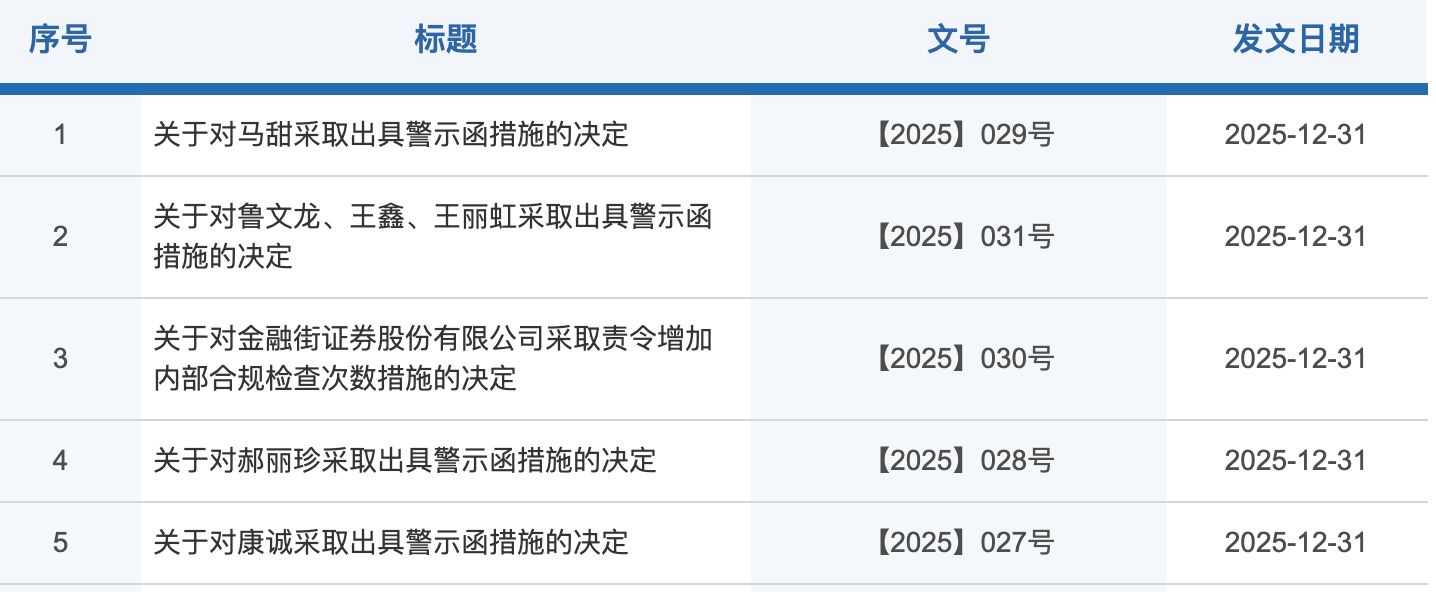
Core Viewpoint - Financial Street Securities (1476.HK) faces regulatory penalties shortly after rebranding from Heng Tai Securities, highlighting compliance issues related to private fund sales and "flying orders" [3][26]. Group 1: Regulatory Penalties - The Inner Mongolia and Guangdong Securities Regulatory Bureaus issued a total of 7 regulatory penalties against Financial Street Securities for four types of violations, including improper private fund sales and "flying orders" [4][26]. - Seven employees were held accountable for their actions, which included violations such as unauthorized fund sales and promises of guaranteed returns [4][27]. Group 2: Violations Overview - The violations primarily involved improper sales of private funds, "flying orders," unauthorized holding of funds, and promises of capital protection and returns, affecting multiple branches in Inner Mongolia and Guangdong [4][26]. - Specific cases included employees offering improper benefits to clients and failing to use standardized promotional materials, leading to potential misrepresentation of risks [7][29]. Group 3: Internal Compliance Issues - The company was ordered to increase the frequency of internal compliance checks due to inadequate internal controls and management failures that allowed these violations to occur [11][33]. - Financial Street Securities must complete corrective actions within three months and submit compliance reports quarterly throughout 2026 [11][33]. Group 4: Financial Performance - In the first half of 2025, Financial Street Securities reported a significant rebound in performance, with total revenue reaching 1.398 billion yuan, a 43.38% increase year-on-year, and net profit of 241 million yuan, up 346.86% [22][44]. - The growth was driven by brokerage and wealth management services, which generated 951 million yuan in revenue, a 36.19% increase, attributed to an expanding client base and improved advisory capabilities [22][44]. Group 5: Historical Context and Legacy Issues - The compliance failures are seen as a continuation of issues from the company's previous identity as Heng Tai Securities, with a history of regulatory penalties for similar violations [18][41]. - The company has faced nearly 200 legal notices in 2025, with over 180 related to entrusted wealth management contract disputes, indicating ongoing legacy compliance challenges [40][41].


密集落地!6家银行,敲定首席合规官!
券商中国· 2026-01-05 04:43
Core Viewpoint - The establishment of Chief Compliance Officer (CCO) positions in Chinese banks has intensified in 2025, driven by regulatory requirements aimed at enhancing compliance management within financial institutions [2][4]. Group 1: Regulatory Background - In March 2025, the Financial Regulatory Administration implemented the "Compliance Management Measures for Financial Institutions," mandating that financial institutions appoint a CCO at their headquarters, who must be a senior management member [2][4]. - The year 2025 serves as a critical transitional period for compliance management, with many banks already appointing CCOs and obtaining regulatory approval for their qualifications [8]. Group 2: Appointment Trends - Several banks, including Jiangyin Bank, Ping An Bank, and Minsheng Bank, have recently appointed CCOs, with many of these positions filled by existing senior executives such as presidents or vice presidents [4][5][6]. - The trend shows that many banks are opting for current executives to take on the CCO role, which may help mitigate internal communication costs associated with having too many specialized positions [4][7]. Group 3: Compliance Management Practices - The unique nature of financial institutions necessitates a higher standard of compliance management compared to general enterprises, emphasizing the need for a robust compliance culture [4]. - The "Compliance Management Measures" also allow for the CCO to concurrently hold other executive roles, which is particularly beneficial for smaller banks [4][8]. Group 4: Recruitment Initiatives - Some regional banks, such as Jiangxi Bank and Shangrao Bank, have actively sought to recruit CCOs, indicating a proactive approach to compliance management [9]. - Recruitment criteria for these positions often prioritize candidates with judicial experience or previous roles in compliance departments of major banks [9].

更名后首次被监管“点名”,金融街证券7名员工集中被曝违规
Mei Ri Jing Ji Xin Wen· 2026-01-04 08:12
Core Viewpoint - Financial Street Securities has come under regulatory scrutiny due to compliance risks involving multiple employees, overshadowing its impressive financial performance since its rebranding in September 2025 [1][4]. Group 1: Regulatory Actions - The Inner Mongolia and Guangdong Securities Regulatory Bureaus have taken regulatory measures against Financial Street Securities and seven of its employees for internal control failures, unauthorized promotion of non-commissioned products, and improper benefits to clients [1][2]. - The regulatory actions include issuing warning letters to six employees in Inner Mongolia and a supervisory conversation with one employee in Guangdong, indicating a widespread issue of employee misconduct [1][3]. Group 2: Financial Performance - In the first half of 2025, Financial Street Securities reported a net profit of 2.41 billion, a staggering increase of 346.86% year-on-year, with its brokerage and wealth management business contributing significantly with a revenue growth of over 36% [1][5]. - The company achieved total operating revenue of 16.66 billion, reflecting a year-on-year growth of 42.45%, indicating a recovery in performance since the change in control to Beijing Financial Street Investment Group [4][5]. Group 3: Business Operations and Compliance Issues - The brokerage and wealth management segment generated 9.51 billion in revenue, up 36.19% year-on-year, driven by increased market activity and an expanded client base, with 143,900 new accounts opened [5]. - The compliance issues highlighted include employees engaging in unauthorized sales of non-commissioned products and failing to use standardized promotional materials, which raises concerns about the company's internal control and compliance management [3][4][5].
银行业去年被罚26亿元,同比增四成多!这项违规行为暴增
Nan Fang Du Shi Bao· 2026-01-04 07:29
2025年我国银行业被罚没金额同比猛增四成多。南都湾财社记者根据企业预警通数据统计发现,以披露 日期为准,去年,央行、金融监管总局、外管局及派出机构对我国千余家银行及其分支机构开出罚单, 累计罚没26.41亿元(含个人罚金),较2024年大幅增长44.95%。罚金猛增背后是巨额罚单的频现,去 年我国银行业共收到千万元级别的罚单31张,是2024年的5倍有余。 从银行类型来看,城商行去年罚单最多,股份行被罚没金额则居首。从违规领域看,主要集中在信贷业 务、反洗钱业务、内控制度等方面。其中,反洗钱业务违规相关罚单数量较2024年增长了185.92%。 千万元巨额罚单数量猛增 根据企业预警通数据,以披露日期为准,2025年,央行、金融监管总局、外管局及派出机构针对银行机 构及从业人员开出罚单6521张,较上年减少0.81%;罚没金额达26.41亿元,较上年增加44.95%;共计 1094家银行及分支机构被罚。 近年我国银行业处罚趋势。数据来源:企业预警通 从处罚趋势来看,罚单数量最高的月份是1月份、7月份和12月份,分别为799张、874张和916张。而要 论总罚没金额,则9月份、12月份和10月份位列前三甲,分别 ...

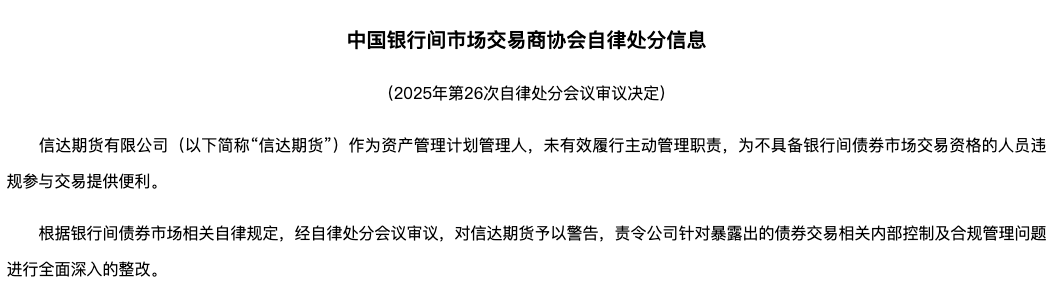
信达期货,因合规问题又被“点名”!
Shen Zhen Shang Bao· 2026-01-03 03:26
Group 1 - The China Interbank Market Dealers Association announced that Cinda Futures Co., Ltd. failed to effectively fulfill its active management responsibilities, facilitating unauthorized trading by individuals not qualified for interbank bond market transactions [1] - Cinda Futures has been named for compliance issues for the second time in 2025, with a previous incident in September regarding its app's privacy policy violations, which did not adequately disclose the purposes, methods, and scope of personal information collection [3] - Cinda Futures was established in October 1995 and is wholly owned by Cinda Securities Co., Ltd., with a registered capital of 600 million RMB, and is recognized as a large, reputable futures company in China [3] Group 2 - Cinda Futures is a member of several major exchanges, including the China Financial Futures Exchange and the Shanghai Futures Exchange, and holds various memberships in industry associations [3] - In June 2025, the China Securities Regulatory Commission officially approved Central Huijin Investment Ltd. as the actual controller of Cinda Securities, changing the controlling shareholder from the Ministry of Finance to Central Huijin [3]