
新兴支柱产业

Search documents
为什么要着力打造新兴支柱产业
Xin Hua She· 2025-11-25 04:55
新华社北京11月25日电 支柱产业是国民经济的基本盘,在现代化产业体系建设中居于牵一发而动全身 的重要地位。《中共中央关于制定国民经济和社会发展第十五个五年规划的建议》提出:"着力打造新 兴支柱产业。"这是时代所需、发展所需,意义重大、影响深远。 ...
学习规划建议每日问答|为什么要着力打造新兴支柱产业
Sou Hu Cai Jing· 2025-11-25 04:10
第三,着力打造新兴支柱产业对推进产业体系现代化举足轻重。历史证明,每一次科技革命都会催生出 一批新兴支柱产业,推动产业体系"新陈代谢"。抓住机遇的国家成功实现产业体系现代化,有的保住强 国地位,有的新进入发达国家行列;没有抓住机遇的国家失去国际竞争力,有的退出强国行列,有的掉 入"中等收入陷阱"。当今世界,新一轮科技革命和产业变革加速突破,辐射范围之广、影响程度之深前 所未有,涌现出一大批新技术、新产业、新业态、新模式,引发全球产业结构和布局趋势性调整甚至重 塑。"十五五"时期,我国产业发展面临机遇与挑战并存、竞争加剧的严峻复杂形势,必须把握住新一轮 科技革命和产业变革机遇,将新能源、新材料、航空航天、低空经济等打造成为新兴支柱产业,加快建 设现代化产业体系。(完) 新华社北京11月25日电 支柱产业是国民经济的基本盘,在现代化产业体系建设中居于牵一发而动全身 的重要地位。《中共中央关于制定国民经济和社会发展第十五个五年规划的建议》提出:"着力打造新 兴支柱产业。"这是时代所需、发展所需,意义重大、影响深远。 第二,着力打造新兴支柱产业对保持经济量的合理增长尤为迫切。近年来,在国际贸易环境恶化、国内 市场需求 ...
欧派家居再度获人民日报点赞!
Zhong Jin Zai Xian· 2025-11-25 03:05
11月23日,人民目报重磅发布《为中国式现代化提供坚强物质支撑》专题报道,系统阐述建设现代化产 业体系的核心路径,并聚焦"智能化、绿色化"产业升级三大方向。其中,欧派家居作为"融合 化"发展的标杆企业被重点报道,其从"产品制造商"向"生态服务商"的战略转型,展现了企业在产业融 合与模式创新上的实践成果。 (上接第一版) 观察一个行业,可以领略"绿色化"的澎湃 活力。 对比一组数据。2010年,我国新能源汽车年 产量不足1万辆;2024年,我国新能源汽车产销量 均超 1200万辆,渗透率为 40.9%。 10余年发展,我国抓住绿色化转型机遇,率外 转换赛道,形成国际竞争新优势。如今,我国新能 源汽车产销量连续10年位居全球首位,一跃成为 全球第一大汽车出口国。 置身一个场景,可以体会"融合化"的协同 魅力。 对着毛坯房拍张照,选择喜爱的装修风格,小 程序自动生成精美效果图;一键切换样式,各类吊 顶、墙面、地板、沙发随意搭配 …… "我们即将上线 人工智能设计助手,为客户提供所感即所要、设计 即制造、制造即服务的一站式家居解决方案。"欧 派家居集团副总裁朱耀军说。 "制造业+现代服务业",眼下,越来越多企业 正从 ...


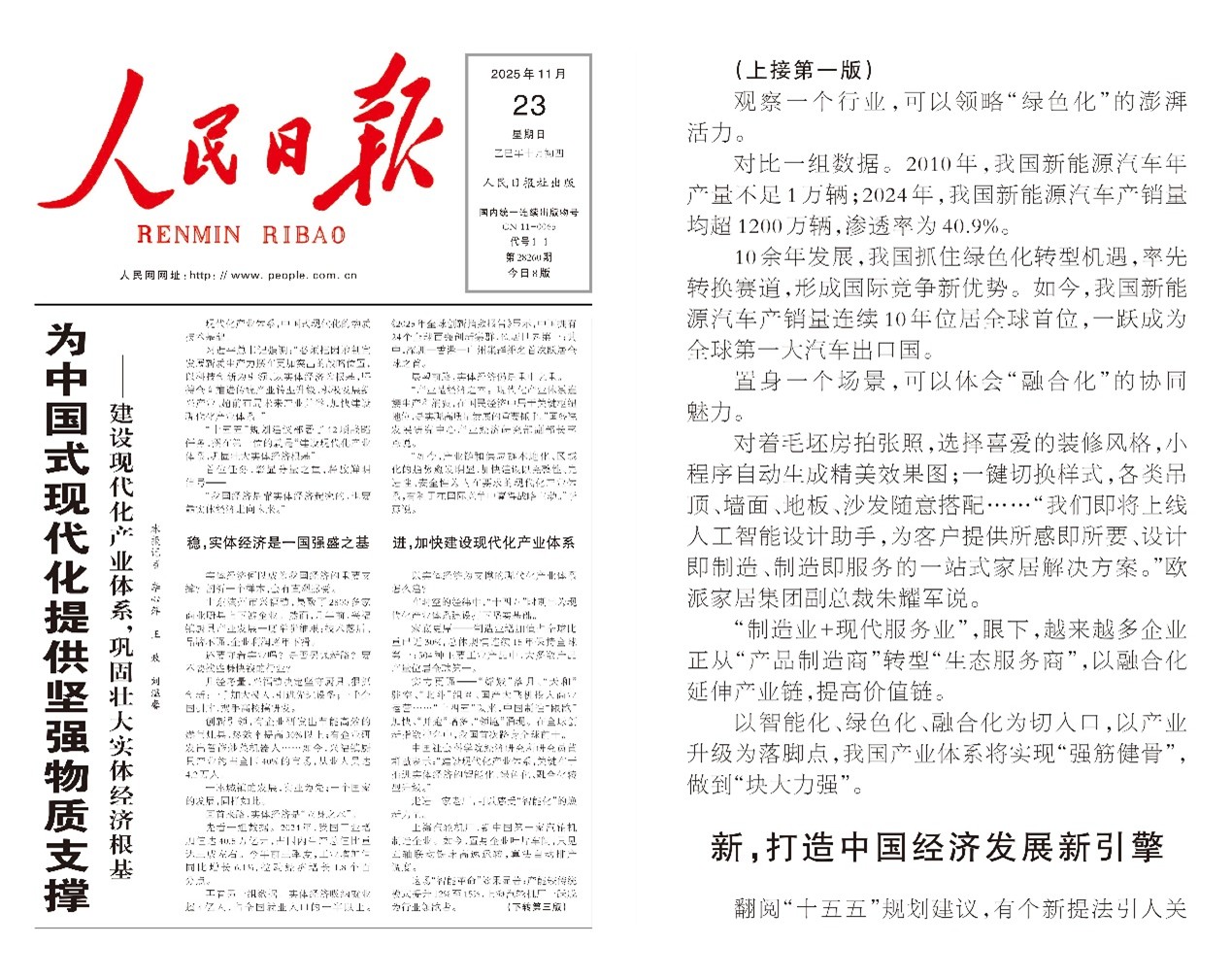
为中国式现代化提供坚强物质支撑——建设现代化产业体系,巩固壮大实体经济根基
Ren Min Ri Bao· 2025-11-23 02:45
Core Viewpoint - The article emphasizes the importance of building a modern industrial system as the material and technological foundation for Chinese-style modernization, highlighting the need for innovation and the strengthening of the real economy [1][5]. Group 1: Importance of the Real Economy - The real economy is identified as the cornerstone of national strength, with a focus on its role in supporting economic growth and employment [3][4]. - In 2024, China's industrial added value reached 40.5 trillion yuan, accounting for about 30% of GDP, with a year-on-year growth of 6.1% in the first three quarters [4]. - The real economy employs over 400 million people, representing more than half of the national employment population [4]. Group 2: Modern Industrial System Construction - The construction of a modern industrial system is crucial for connecting production and consumption, serving as a key pivot in the national economy for achieving high-quality development [5][6]. - The manufacturing sector's added value accounts for nearly 30% of the global total, maintaining the world's largest scale for 15 consecutive years [7]. - The shift towards intelligent, green, and integrated transformations in the real economy is essential for building a modern industrial system [7][10]. Group 3: Emerging Pillar Industries - The article introduces the concept of emerging pillar industries, which combine characteristics of both emerging and pillar industries, playing a significant role in economic growth [12][16]. - By 2025, the added value of strategic emerging industries is expected to exceed 17% of GDP, an increase of approximately 5.3 percentage points from the end of the 13th Five-Year Plan [16]. - The development of new industries such as low-altitude economy is highlighted, with a projected market size of 1.5 trillion yuan in 2023, potentially reaching 3.5 trillion yuan by 2035 [18]. Group 4: Future Outlook - The article stresses the need to optimize traditional industries while proactively planning for future industries, which are seen as potential strategic emerging industries [19]. - The traditional industries currently account for about 80% of the added value in manufacturing, with an estimated market space of 10 trillion yuan to be added in the next five years [19]. - Strengthening the foundation of the real economy and accelerating the construction of a modern industrial system will lay a solid material foundation for Chinese-style modernization [19].
为中国式现代化提供坚强物质支撑——建设现代化产业体系 巩固壮大实体经济根基
Ren Min Ri Bao· 2025-11-22 22:04
Core Viewpoint - The construction of a modern industrial system is essential for China's economic development, emphasizing the importance of the real economy and technological innovation as foundational elements for future growth [1][5]. Group 1: Importance of the Real Economy - The real economy is highlighted as the cornerstone of national strength, with a focus on its role in supporting economic stability and growth [1][3]. - In Shandong's Bingzhou, the local kitchenware industry, which includes over 2,800 enterprises, has transformed through innovation and investment, now accounting for 40% of the national market [2][4]. Group 2: Current Economic Data - In 2024, China's industrial added value is projected to reach 40.5 trillion yuan, constituting about 30% of the GDP, with a year-on-year growth of 6.1% in the first three quarters of the current year [4]. - The real economy employs over 400 million people, representing more than half of the national employment population [4]. Group 3: Future Directions and Strategies - The modern industrial system is crucial for achieving high-quality development, with a focus on localizing and regionalizing industrial and supply chains [5][6]. - The "14th Five-Year Plan" has laid a solid foundation for building a modern industrial system, with China's manufacturing value added accounting for nearly 30% of the global total [6][7]. Group 4: Technological Advancements - The shift towards intelligent, green, and integrated transformations in the real economy is essential for enhancing competitiveness [7][10]. - The "smart revolution" in manufacturing has led to a 12% to 15% increase in productivity, exemplified by Shanghai's turbine manufacturing plant [8]. Group 5: Emerging Pillar Industries - The concept of "emerging pillar industries" combines characteristics of both emerging and traditional industries, playing a significant role in economic growth and technological advancement [12][17]. - By 2025, the added value of strategic emerging industries is expected to exceed 17% of GDP, indicating a substantial increase from previous years [18]. Group 6: Market Opportunities - The low-altitude economy is projected to reach a market size of 1.5 trillion yuan this year, with expectations of growing to 3.5 trillion yuan by 2035 [20]. - The traditional industries, which currently account for about 80% of manufacturing value added, are also expected to see significant market expansion, potentially adding around 10 trillion yuan in the next five years [21].
为中国式现代化提供坚强物质支撑
Ren Min Ri Bao· 2025-11-22 22:00
Core Viewpoint - The construction of a modern industrial system is essential for China's economic development, emphasizing the importance of the real economy and technological innovation as foundational elements for future growth [1][5][21]. Group 1: Importance of the Real Economy - The real economy is highlighted as the cornerstone of national strength, with a focus on its role in supporting economic stability and growth [1][3]. - In Shandong's Bingzhou, the local kitchenware industry, which includes over 2,800 enterprises, has successfully transformed through innovation and investment, now accounting for 40% of the national market [2][4]. - The industrial added value in China is projected to reach 40.5 trillion yuan in 2024, contributing approximately 30% to the GDP, with a year-on-year growth of 6.1% in the first three quarters of the current year [4]. Group 2: Modern Industrial System Construction - The modern industrial system is described as a key link between production and consumption, crucial for achieving high-quality development [5][21]. - The "14th Five-Year Plan" has laid a solid foundation for building this system, with China's manufacturing value added accounting for nearly 30% of the global total [6][7]. - The shift towards intelligent, green, and integrated transformations in the real economy is emphasized as vital for enhancing competitiveness [7][10]. Group 3: Emerging Pillar Industries - The concept of "emerging pillar industries" is introduced, which combines characteristics of both emerging and pillar industries, playing a significant role in economic growth and technological advancement [11][12][17]. - Predictions indicate that by 2025, the added value of strategic emerging industries will exceed 17% of GDP, marking a significant increase from previous years [18]. - The low-altitude economy is cited as a promising sector, with a market size expected to reach 1.5 trillion yuan this year and potentially 3.5 trillion yuan by 2035 [20]. Group 4: Future Outlook - The need to optimize traditional industries while strategically developing future industries is stressed, with traditional sectors currently accounting for about 80% of manufacturing value added [21]. - The potential for new industries to emerge as significant contributors to the economy over the next decade is highlighted, suggesting a transformative impact on China's high-tech sector [21].
【权威访谈·擘画新蓝图】推动经济持续健康发展
Yang Guang Wang· 2025-11-16 02:22
Group 1 - The core focus of the news is the strategic design and planning for high-quality economic development as outlined in the "Suggestions for Formulating the 15th Five-Year Plan for National Economic and Social Development" [1] - The first strategic task emphasizes the construction of a modern industrial system and the strengthening of the real economy, with a focus on optimizing and upgrading traditional industries and developing emerging pillar industries [1] - The National Development and Reform Commission highlights the importance of emerging pillar industries as new support and engines for economic development, emphasizing coordinated efforts from both supply and demand sides [1] Group 2 - The establishment of a unified national market is a significant decision made by the central government, aiming to eliminate barriers to market construction and enhance the internal dynamics of the domestic economy [2] - The Ministry of Market Regulation plans to improve fair competition review capabilities and strengthen enforcement against anti-competitive practices to ensure a fair market environment [2] - The suggestions also call for the enhancement of the socialist market economy system to support high-quality development [2] Group 3 - The Ministry of Finance emphasizes the importance of optimizing resource allocation and maintaining a reasonable macro tax burden to promote high-quality development and social equity [3] - There is a focus on improving the fiscal relationship between central and local governments, increasing local financial autonomy, and establishing a sustainable government debt management mechanism [3] - The approach aims to balance debt reduction with development to enhance fiscal sustainability [3]
如何把握“十五五”时期经济高质量发展着力点?权威解读
Yang Shi Wang· 2025-11-14 13:54
Core Viewpoint - The core focus of the article is on the "15th Five-Year Plan" which emphasizes high-quality development as the central theme for China's economic and social development in the upcoming five years, building on the previous "14th Five-Year Plan" [1][2]. Economic Development Strategy - The "15th Five-Year Plan" outlines seven strategic tasks aimed at promoting sustained and healthy economic development, which include building a modern industrial system, enhancing technological self-reliance, and optimizing regional economic layouts [2][3]. - The plan stresses the importance of economic construction as a priority, reflecting the party's long-standing commitment to economic development [3]. Technological Innovation - The plan prioritizes the establishment of a modern industrial system and emphasizes the need for innovation in key technologies to overcome reliance on external sources [4][5]. - It aims to foster new pillar industries, particularly in sectors like renewable energy, aerospace, and advanced materials, to drive economic growth [3][4]. Financial Support and Policy - Financial systems are urged to enhance support for major strategic areas and weak links, with a focus on providing comprehensive financial services for technological innovation [2]. - The government plans to optimize fiscal resource allocation to ensure effective use of funds in high-quality development areas [2][7]. Market and Economic Structure - The plan emphasizes the construction of a strong domestic market and the need to break down barriers to create a unified national market [6][8]. - It calls for the enhancement of the socialist market economy to ensure sustainable high-quality development [6]. Agricultural and Rural Development - The plan highlights the importance of modernizing agriculture and rural areas, ensuring that rural populations benefit from modernization efforts [9]. - It aims to establish mechanisms to prevent poverty and ensure sustainable development in rural regions [9]. Regional Coordination - The plan includes measures to promote regional coordinated development, emphasizing infrastructure connectivity and collaboration across administrative boundaries [10]. - It aims to create a framework for sustainable cooperation among different regions to leverage their respective advantages [10].
国富氢能齐鲁液氢项目正式量产 蓄势发力再造中国高技术产业
Zhi Tong Cai Jing· 2025-11-13 01:30
Core Insights - Jiangsu Guofu Hydrogen Energy Technology Equipment Co., Ltd. has achieved a significant breakthrough with the successful debugging and mass production of a 10 tons/day liquid hydrogen project, marking the first domestically produced liquid hydrogen plant of this scale with complete independent intellectual property rights [1][2] - The project is expected to lay a solid foundation for the large-scale industrialization of liquid hydrogen in China and support the high-quality development of the hydrogen energy industry [1][3] Project Development - The project has progressed steadily, with key equipment successfully offline in May 2023 and the completion of core equipment installation and full-process debugging in May 2024 [1] - The project has passed verification by authoritative experts in the domestic liquid hydrogen field, confirming its readiness for mass production [1] Technical Highlights - The liquid hydrogen production exhibits significant performance advantages, with comprehensive energy consumption below 12 kW.h/kg-LH2 and hydrogen purity exceeding 98.5% [2] - The equipment utilizes Guofu Hydrogen Energy's independently developed multi-stage pre-cooling hydrogen expansion refrigeration technology, ensuring compact structure, high heat exchange efficiency, and stable operation [2] Industry Impact - The liquid hydrogen project is expected to significantly reduce production costs as the scale of liquefaction increases, aligning with experiences from the U.S. liquid hydrogen industry [2] - The project supports the "West Hydrogen East Transport" strategy, facilitating large-scale and market-oriented long-distance transportation of liquid hydrogen and providing efficient solutions for peak-shaving energy storage in hydrogen pipelines [2] Future Outlook - Over the next decade, China is set to enter a phase of nurturing and expanding emerging industries, with liquid hydrogen playing a crucial role in the development of strategic emerging industry clusters [3] - Guofu Hydrogen Energy aims to optimize technology and control costs to promote the commercialization of green hydrogen liquefaction, thereby enhancing its contribution to high-tech industries and creating greater societal value [3]
市场午后反弹,创业板ETF(159915)和A500ETF易方达等产品受资金关注
Mei Ri Jing Ji Xin Wen· 2025-11-03 07:46
Core Viewpoint - The market is experiencing a rebound, with sectors such as media, gaming, oil and gas extraction, airport shipping, and photovoltaic equipment showing strength. The A-share market is expected to enter a performance vacuum period after the third quarter reports, shifting focus towards next year's performance expectations and industry trends [1]. Group 1: Market Performance - As of 14:00, the ChiNext Index rose by 0.2%, the CSI A500 Index increased by 0.1%, while the STAR Market 50 Index fell by 1.1%, having previously dropped over 3% in the morning [1]. - The ChiNext ETF (159915) saw a net subscription of over 20 million units, and the A500 ETF by E Fund (159361) had a net subscription of 200 million units [1]. Group 2: Investment Outlook - After the third quarter reports, the A-share market will focus on performance expectations for the coming year and industry trends, supported by ample micro liquidity from recent trading volumes, financing balances, and positions in private equity and public equity funds [1]. - The CSI A500 Index consists of 500 stocks with large market capitalization and good liquidity, balancing core assets and emerging industry leaders. The ChiNext Index includes 100 stocks from the ChiNext board with high representation from strategic emerging industries like new-generation information technology and new energy [1]. - The STAR Market 50 Index is composed of 50 stocks from the STAR Market, with over 65% representation from the semiconductor industry [1]. Group 3: ETF Management Fees - The A500 ETF by E Fund (159361), ChiNext ETF (159915), and STAR Market 50 ETF (588080) track the respective indices and all implement the lowest management fee rate of 0.15% per year, providing diverse options for investors to build a balanced investment portfolio [2].
