
时空智能

Search documents
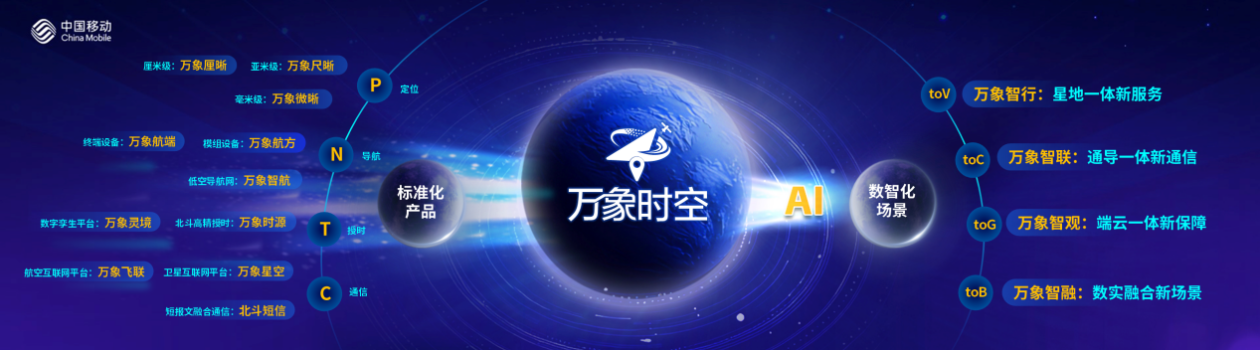
2025 MWC上海丨中国移动发布“万象时空”系列产品体系
Huan Qiu Wang· 2025-06-20 06:25
Core Viewpoint - China Mobile is leveraging the "AI+" era to enhance its position as a leading information service technology innovation company, focusing on the integration of 5G and Beidou satellite navigation systems to develop a new type of spatial intelligence service [1][9]. Group 1: Product System and Features - The "Wandering Space" product system was officially launched, integrating 5G, AI, and Beidou to create four major intelligent scenarios: "Wandering Intelligent Travel," "Wandering Intelligent Connection," "Wandering Intelligent Observation," and "Wandering Intelligent Integration" [2][3]. - "Wandering Intelligent Travel" focuses on providing seamless connectivity for smart vehicles, achieving over 94% fixed rate in complex scenarios through centimeter-level RTK coverage and AI-enhanced technologies [3]. - "Wandering Intelligent Connection" integrates emergency communication capabilities with satellite connectivity, ensuring coverage in extreme environments and providing communication support for over 100 million users annually [3]. - "Wandering Intelligent Observation" offers a comprehensive self-developed terminal module that ensures safety through high-precision positioning and short message communication, supporting government governance with continuous data analysis [3]. - "Wandering Intelligent Integration" aims to merge indoor and outdoor spatial data, high-fidelity business process simulations, and consistent simulation algorithms, utilizing AI for rapid modeling and simulation [3]. Group 2: Collaborations and Future Plans - China Mobile is actively promoting industry-academia-research cooperation, establishing joint laboratories with Shanghai Jiao Tong University and Wuhan University to advance spatial information technology [5][6][7]. - The company plans to collaborate with various partners across government, industry, academia, and research to enhance its 5G and Beidou infrastructure, targeting sectors such as smart transportation, low-altitude economy, and new industrialization [9].


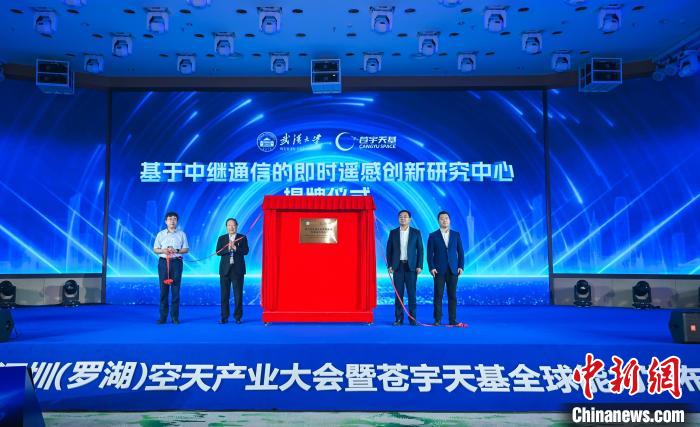
全球首颗高轨商业中继卫星项目在深圳罗湖启动
Zhong Guo Xin Wen Wang· 2025-06-19 21:04
Group 1 - The "2025 Shenzhen (Luohu) Aerospace Industry Conference and Cangyu Space-Based Global Capability Release" was held, marking the official launch of the world's first high-orbit commercial relay satellite project [1] - A total of 203 domestic and international aerospace organizations, research institutes, leading enterprises, and investment institutions participated in discussions on commercial aerospace technology innovation, industrial collaboration, and international cooperation [1][3] Group 2 - Luohu has chosen the aerospace industry as a breakthrough for industrial transformation and upgrading, establishing an aerospace industry innovation service platform that integrates resources from universities, research institutes, and enterprises [3] - The region has also set up a low-altitude economy demonstration base to provide testing and validation space for enterprises, gathering over 50 companies in satellite communication, remote sensing applications, and aircraft manufacturing [3] Group 3 - Li Deren, a recipient of the National Highest Science and Technology Award, emphasized the deep integration of spatiotemporal information with new technologies such as artificial intelligence, big data, and the Internet of Things, which will give rise to new productive forces in low-altitude economy and commercial remote sensing [5] - Christian Feichtinger, Executive Director of the International Astronautical Federation, highlighted the need for international cooperation in the peaceful use of space technology to address global challenges like climate change and disaster response [5] Group 4 - Cangyu Space, the first commercial aerospace company in mainland China focusing on high and medium orbit space-based information system construction and operation, announced the establishment of a research center for instant remote sensing based on relay communication in collaboration with Wuhan University [5] - The company plans to launch the Cangyu-1 high-orbit satellite by 2026, achieving 60% low-orbit coverage and 40% surface coverage, with a goal of completing a constellation of 13 satellites by 2030 for all-weather and all-time coverage [7]
一场50年的科技攀峰——珠峰高程测量见证中国测绘技术跃迁
Zhong Guo Zi Ran Zi Yuan Bao· 2025-05-28 01:56
Core Points - The article highlights the advancements in China's surveying technology over the past 50 years, particularly in measuring the height of Mount Everest, showcasing a significant evolution from traditional methods to modern techniques [1][3][12] - It emphasizes the importance of technological innovation in achieving more accurate measurements, with the precision improving from ±0.35 meters in 1975 to ±0.05 meters in 2020 [8][10][12] Group 1: Historical Milestones - In 1975, China conducted its first independent measurement of Mount Everest, achieving a height of 8848.13 meters, which was recognized internationally [3][4][22] - The 2005 measurement utilized modern techniques such as GPS and snow depth radar, marking a significant historical breakthrough by providing the first accurate measurement of the Everest rock surface [5][23] - The 2020 measurement incorporated advanced technologies, including aerial gravity measurement and the Beidou satellite system, significantly enhancing the accuracy of the height measurement [6][24] Group 2: Technological Advancements - The transition from traditional optical measurement methods to satellite-based positioning systems in the 1990s marked a pivotal shift in surveying technology [4][23] - The 2020 measurement collected over 1.44 billion data points, far exceeding the data collected in previous measurements, showcasing advancements in data processing and technology [6][24] - The integration of artificial intelligence, big data, and cloud computing into surveying practices is expected to revolutionize the field, leading to smarter and more efficient measurement techniques [16][19] Group 3: Future Directions - The article discusses the ongoing transformation towards intelligent surveying technologies, with a goal to complete the transition from digital to intelligent surveying by 2035 [19] - Emphasis is placed on the need for continuous innovation to address key technological challenges and enhance the capabilities of surveying equipment [18][19] - The future of surveying in China is projected to focus on building a comprehensive spatial-temporal system that integrates various technologies for improved data acquisition and processing [19][20]
时空智能是小脑 千寻位置CEO陈金培:机器人比智能汽车复杂
Bei Ke Cai Jing· 2025-05-22 06:09
Core Insights - The development of AI and equipment upgrades have significantly enhanced the interaction capabilities of devices with the real world, positioning AI as the "brain" and spatiotemporal intelligence as the "small brain" for robots [1] - The overall output value of China's satellite navigation and positioning service industry is projected to reach 575.8 billion yuan in 2024, reflecting a year-on-year growth of 7.39% [1] - In the field of intelligent driving, spatiotemporal intelligence is transitioning from being an "optional feature" to a "standard feature," with over 100 models equipped with spatiotemporal intelligence services and a penetration rate exceeding 75% among new energy vehicle manufacturers [1] Industry Developments - The low-altitude economy is evolving, necessitating advancements in collision avoidance capabilities for aircraft, which includes both self-avoidance technologies and pre-planned airspace routes [2] - The robotics industry is facing challenges similar to those in the smart automotive sector, where traditional companies may struggle as electrification and intelligence become prevalent [2] - While AI is rapidly advancing and may not fully replace humans, robots are expected to take over specific tasks in areas such as intelligent driving and basic programming [2]

科技自立自强之院士说|推进时空智能 创造万亿级产业——访中国科学院院士、中国工程院院士李德仁
Xin Hua She· 2025-05-22 02:31
Core Viewpoint - The article emphasizes the development of "spatiotemporal intelligence" through the integration of AI, big data, and remote sensing technologies, aiming to create a trillion-level industry that supports sustainable development goals [1][4]. Group 1: Technological Advancements - The integration of high-throughput communication satellites, optical remote sensing satellites, radar satellites, and BeiDou positioning satellites is creating a comprehensive spatiotemporal intelligence system [1][4]. - The "Oriental Eye" intelligent remote sensing constellation aims to launch 252 satellites by 2030, including 100 radar satellites and 144 high-resolution optical satellites, to achieve comprehensive and real-time monitoring of the Earth's ecological environment [5][6]. Group 2: Applications in Various Fields - Remote sensing satellites are increasingly utilized in agriculture, environmental protection, smart cities, and emergency response, enhancing monitoring capabilities and operational efficiency [6]. - AI-driven systems are being developed to automate tasks such as irrigation, fertilization, and pest control in agriculture, significantly improving productivity [6]. Group 3: Future Prospects - The article highlights the potential for spatiotemporal intelligence to facilitate the sustainable development of human and natural resource relationships, creating significant economic opportunities [4][6]. - The development of a real-time service system for spatiotemporal information is expected to enhance the efficiency and effectiveness of various industries, contributing to societal progress [6].

WGDC25全球时空智能大会在京开幕 促产业与技术深度融合
Zhong Guo Xin Wen Wang· 2025-05-21 14:23
Group 1 - The WGDC25 Global Spatiotemporal Intelligence Conference aims to promote the integration of spatiotemporal information, commercial aerospace, low-altitude economy, and technologies such as artificial intelligence, big data, cloud computing, and the Internet of Things [1] - The conference attracted scientists, industry professionals, investors, and technology developers to explore the evolution and leap of AI and spatiotemporal technology [1] - Li De Ren, an academician, emphasized the need for intelligent processing of spatiotemporal data across various domains, including deep space and socioeconomic studies, indicating a trend towards using intelligent sensing networks for global spatiotemporal intelligence [1] Group 2 - Wu Senseng from Zhejiang University highlighted challenges in earth space intelligence analysis, such as sparse geological data and complex computational processes, while generative AI is reshaping the technology and industry ecosystem [2] - Andrei Iordache from HERE Technologies discussed the intersection of artificial intelligence and location intelligence in the automotive sector, suggesting that this fusion will shape the future of software-defined vehicles and enhance user experience through immersive digital environments [2]
未来产业潮涌浙江湖州 691亿项目锚定长三角增长极
Zhong Guo Xin Wen Wang· 2025-05-11 01:50
Group 1 - The future of cities is envisioned as green and full of possibilities, with a focus on long-term development strategies as demonstrated by Huzhou's Future Conference [1] - A total investment of 69.12 billion yuan was signed for 106 projects, covering sectors such as new energy vehicles, semiconductors, biomedicine, and high-end equipment manufacturing [1] - Huzhou's city-level capabilities are expected to accelerate, becoming a significant growth pole in the Yangtze River Delta urban agglomeration [1] Group 2 - In the first quarter of this year, Huzhou attracted 212 projects with over 100 million yuan investment, marking a year-on-year increase of 55 projects [1] - The city is experiencing a surge in high-precision spatiotemporal data, with over 10 billion data points generated daily, connecting digital and real-world applications [2] - Huzhou has established a dual narrative of being a high-quality living city and a low-cost entrepreneurial city, with over 3,200 youth innovation projects launched in the past three years [2] Group 3 - Huzhou is rapidly developing its innovation landscape, with the establishment of the Xisai Science Valley and the introduction of 25 research teams in two years [3] - The city has achieved a significant breakthrough in medical device development, marking a historic transition from "0" to "1" in large-scale medical equipment [3] - Huzhou's R&D investment intensity reached 3.4%, ranking third in Zhejiang Province, with a sustainable development index ranked first nationally for two consecutive years [3] Group 4 - Huzhou has established 15 talent innovation "flyovers" in major cities, attracting 203 enterprises and nurturing 37 companies for local industrialization [4][5] - The city is actively supporting businesses, as seen in the case of Zhejiang Xinzi Precision Machinery Co., which is building a dock to reduce logistics costs [6] - Huzhou is fostering a welcoming environment for entrepreneurs, with initiatives like the establishment of a private enterprise festival and regular government-enterprise dialogue sessions [6]
59.95亿元资金流向:人工智能与医疗器械融资活跃,千寻位置完成超10亿元B轮融资|21私募投融资周报
2 1 Shi Ji Jing Ji Bao Dao· 2025-04-30 06:15
Group 1 - The core focus of recent financing activities is on artificial intelligence and medical devices, with significant investments in technology and manufacturing sectors [1] - Core Medical completed over $100 million in Series D financing, marking the largest investment in China's innovative medical device sector since 2025 [1][17] - Qianxun Positioning Network Co., Ltd. secured over 1 billion RMB in Series B financing, indicating strong investor interest in spatial intelligence technology [1][22] Group 2 - A total of 48 financing events occurred in the domestic primary market from April 21 to April 27, with disclosed amounts exceeding 59.95 billion RMB [2] - The majority of financing cases were in the technology and manufacturing sectors, particularly in artificial intelligence, robotics, and medical devices [4][5] - Guangdong, Zhejiang, and Shanghai were the leading regions for financing activities, with 11, 9, and 8 cases respectively [6][7] Group 3 - Active investment institutions included Bohua Capital, which invested in three companies, and Junlian Capital, which participated in two financing rounds [8][9] - Notable financing cases included: - Core Medical's Series D financing of over $100 million [17] - A+ round financing of over 100 million RMB for Changde Medical [16] - Series C financing of nearly 100 million RMB for Aopeng Medical [13] Group 4 - The financing landscape shows a diverse range of applications in robotics, with companies focusing on smart care, industrial, and general service sectors [1] - The medical health sector also demonstrated robust activity, with multiple financing rounds for medical devices and biopharmaceuticals [1][4] - The trend indicates a growing interest in AI-driven solutions for healthcare and manufacturing, reflecting broader technological advancements [1][22]

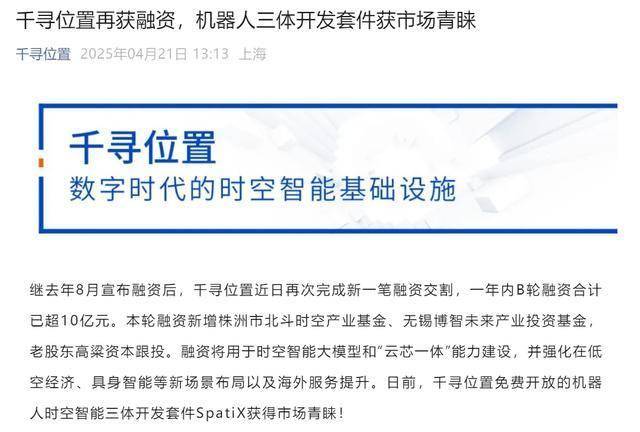
阿里系160亿元独角兽再获融资,千寻位置一年内B轮融资合计超10亿
Sou Hu Cai Jing· 2025-04-22 02:38
Group 1 - The core point of the article is that Qianxun Position Network Co., Ltd. has completed a new round of financing, raising over 1 billion yuan in total B-round financing within a year, which will be used for the development of spatial intelligence models and cloud-core integration capabilities [2] - The recent financing round included new investors such as Zhuzhou Beidou Space-Time Industry Fund and Wuxi Bozhi Future Industry Investment Fund, with existing shareholder Gaoliang Capital also participating [2] - After the previous financing round in August last year, Qianxun Position's overall valuation rose to 16 billion yuan, marking it as a new unicorn in the Beijing venture capital market [2] Group 2 - Qianxun Position was established in August 2015 with a registered capital of 2.47 billion yuan, focusing on spatial intelligence infrastructure based on the Beidou satellite system [2] - The company utilizes over 5,000 GNSS ground and space-based enhancement stations globally, along with self-developed positioning algorithms and a large-scale internet service platform to provide centimeter-level positioning and millisecond-level timing services [2] - Alibaba's subsidiary, Hangzhou Alibaba Weiteng Information Technology Co., Ltd., is the largest shareholder of Qianxun Position, holding 40.5% of the shares, while China National Beidou is the second-largest shareholder with 33.07% [2] Group 3 - The CEO of Qianxun Position, Chen Jinpei, has a strong background with Alibaba, having joined the company in 2004 and held various management positions [3] - Chen has extensive experience in cloud computing, having served as the general manager of Alibaba Cloud Computing before becoming the CEO of Qianxun Position in 2015 [3] - Chen graduated from Zhejiang University with a degree in management science and engineering, and also studied computer and electronic courses [3]
北京龙软科技股份有限公司2024年年度报告摘要
Shang Hai Zheng Quan Bao· 2025-04-18 09:41
Core Viewpoint - The company has proposed a profit distribution plan for 2024, which includes a cash dividend of 1.36 yuan per 10 shares, amounting to a total of approximately 9.91 million yuan, representing 30.01% of the net profit attributable to shareholders for the year [1][2]. Company Overview - The company specializes in developing industrial software and intelligent solutions based on its proprietary LongRuan GIS platform, integrating technologies such as cloud computing, big data, artificial intelligence, and digital twins [3][4]. - The main business areas include smart mining, safety monitoring, smart parks, and "zero-carbon" airports, providing comprehensive digital solutions tailored to the needs of various sectors [3][4]. Main Products - LongRuan GIS platform: A fully autonomous GIS product that supports various applications, including desktop, web, and mobile, with capabilities for spatial data management and analysis [3][4]. - LongRuan 4D-GIS platform: A four-dimensional management platform that integrates real-time data for dynamic modeling and high-precision digital twin mining applications [5][6]. - LongRuan mobile GIS platform: A mobile-native GIS product that facilitates data sharing and application in mining safety management [7]. Intelligent Mining Solutions - The company offers a series of intelligent mining software and solutions, including: - Transparent geological assurance systems that utilize advanced technologies for high-precision geological detection and data integration [8]. - Intelligent control platforms that provide dynamic processing and visualization of geological measurement data [9][10]. - Disaster prevention systems that monitor various hazards in real-time and provide predictive analytics [12]. Industrial Internet of Things Applications - The company has developed a comprehensive automation system that integrates various subsystems for efficient data management and operational control across mining processes [29]. - The intelligent mobile management platform app supports real-time monitoring and decision-making for mining safety and operations [21]. AI and Data Analytics - The AI video intelligent analysis system utilizes deep learning for real-time monitoring and hazard detection in mining operations [30]. - The company has implemented a data middle platform that addresses data management challenges and enhances the efficiency of data utilization across mining operations [20]. Training and Education - The company has established virtual simulation laboratories for training personnel in mining operations, enhancing their skills through immersive experiences [44][46]. - A comprehensive training and examination system is in place to ensure continuous education and skill development for mining employees [48].
