
自由现金流

Search documents
百胜中国(09987.HK):2025年第四季度同店销售表现优异 股东回报源远流长
Ge Long Hui· 2026-02-11 06:54
Core Viewpoint - The company reported a solid performance in Q4 2025, with revenue and net profit growth, alongside a strategic expansion plan targeting over 30,000 stores by 2030 [1][2]. Financial Performance - In Q4 2025, the company achieved revenue of $2.82 billion, a year-on-year increase of 9% - The net profit attributable to shareholders was $140 million, reflecting a 24% year-on-year growth - The operating profit margin and net profit margin for Q4 were 6.6% and 5.0%, respectively, with increases of 0.8 percentage points and 0.5 percentage points year-on-year [1]. Same-store Sales - The company experienced positive same-store sales growth for three consecutive quarters, with a 3% increase in Q4 2025 - KFC's same-store sales grew by 3%, with transaction volume also increasing by 3%, while average ticket size remained flat compared to the same period in 2024 - Pizza Hut's same-store sales rose by 1%, with a 13% increase in transaction volume, although the average ticket size decreased by 11%, aligning with the company's mass-market strategy [1]. Store Expansion Strategy - The company aims to exceed 30,000 stores by 2030, having reached 18,101 stores by the end of 2025, with a net addition of 1,706 stores for the year - In Q4 2025, 587 new stores were opened, with an accelerated opening pace in the second half of the year - The "shoulder-to-shoulder" model and the Gemini store format are key to rapid expansion, with plans to open 2,200 KFC coffee locations and pilot Gemini stores in low-tier cities [2]. Shareholder Returns - The company plans to complete $1.5 billion in share buybacks and dividends in 2026, with average annual shareholder returns of approximately $900 million to over $1 billion from 2027 to 2028 - From 2027, the company intends to return about 100% of free cash flow to shareholders, excluding dividends paid to minority shareholders [3]. Profit Forecast - The projected net profits for 2026, 2027, and 2028 are $1.071 billion, $1.156 billion, and $1.242 billion, respectively, with year-on-year growth rates of 15%, 8%, and 8% - The current price-to-earnings ratios are expected to be 19, 17, and 16 for the years 2026, 2027, and 2028 [3].
小摩:友邦保险及保诚自由现金流改善前景强劲 重申“增持”评级
Zhi Tong Cai Jing· 2026-02-11 06:53
Group 1 - The core viewpoint of the reports is that strong improvements in free surplus and free cash flow generation are expected to rebuild market confidence in the intrinsic value of AIA Group (01299) and Prudential (02378) [1] - Morgan Stanley maintains an "overweight" rating on both AIA and Prudential, citing attractive capital returns and free cash flow yield as potential drivers for stock price revaluation against intrinsic value multiples [1] - The stock prices of Prudential and AIA surged approximately 70% to 80% last year, attributed to the recovery of Asian stock markets and improved cash generation capabilities [1] Group 2 - Morgan Stanley forecasts significant growth in new business sales for Hong Kong life insurance in 2025, but expects normalization this year based on baseline predictions for AIA and Prudential [2] - The firm believes there is upside risk to its assumptions, as the sales and product environment remains attractive, particularly for mainland visitors to Hong Kong [2] - Scenario analysis indicates that if Hong Kong sales maintain strong momentum (doubling the baseline growth rate), AIA and Prudential could see net earnings yield potential of 2.5% to 3.5% by 2028, along with an IFRS operating profit upside of 2.5% to 3% [2]

大行评级丨小摩:重申友邦和保诚“增持”评级,自由现金流强劲改善
Ge Long Hui· 2026-02-11 05:31
Core Viewpoint - Morgan Stanley's report indicates that the strong improvement in free surplus and free cash flow generation is expected to rebuild market confidence in the embedded value of AIA and Prudential [1] Group 1: Financial Performance - The report highlights that the free cash flow yield and attractive capital returns may drive a revaluation of the stock prices against embedded value multiples, with strong growth momentum in Hong Kong presenting upside risks [1] - Prudential and AIA's stock prices surged approximately 70% to 80% last year, attributed to the recovery of Asian stock markets and improved cash generation capabilities [1] Group 2: Business Strategy - Both companies are focusing on optimizing their product portfolios to shorten the payback period for new business, such as increasing the proportion of health and protection products [1] - The P/EV multiples have rebounded from previous lows, with AIA at approximately 1.3 times the forecasted embedded value for 2026 and Prudential at about 0.9 times [1] Group 3: Future Outlook - New business profits drive free cash flow, which is utilized for capital returns and further growth, suggesting potential for P/EV revaluation for both stocks [1]
自由现金流指数半日涨近1%,关注自由现金流ETF易方达(159222)等产品布局机会
Sou Hu Cai Jing· 2026-02-11 05:00
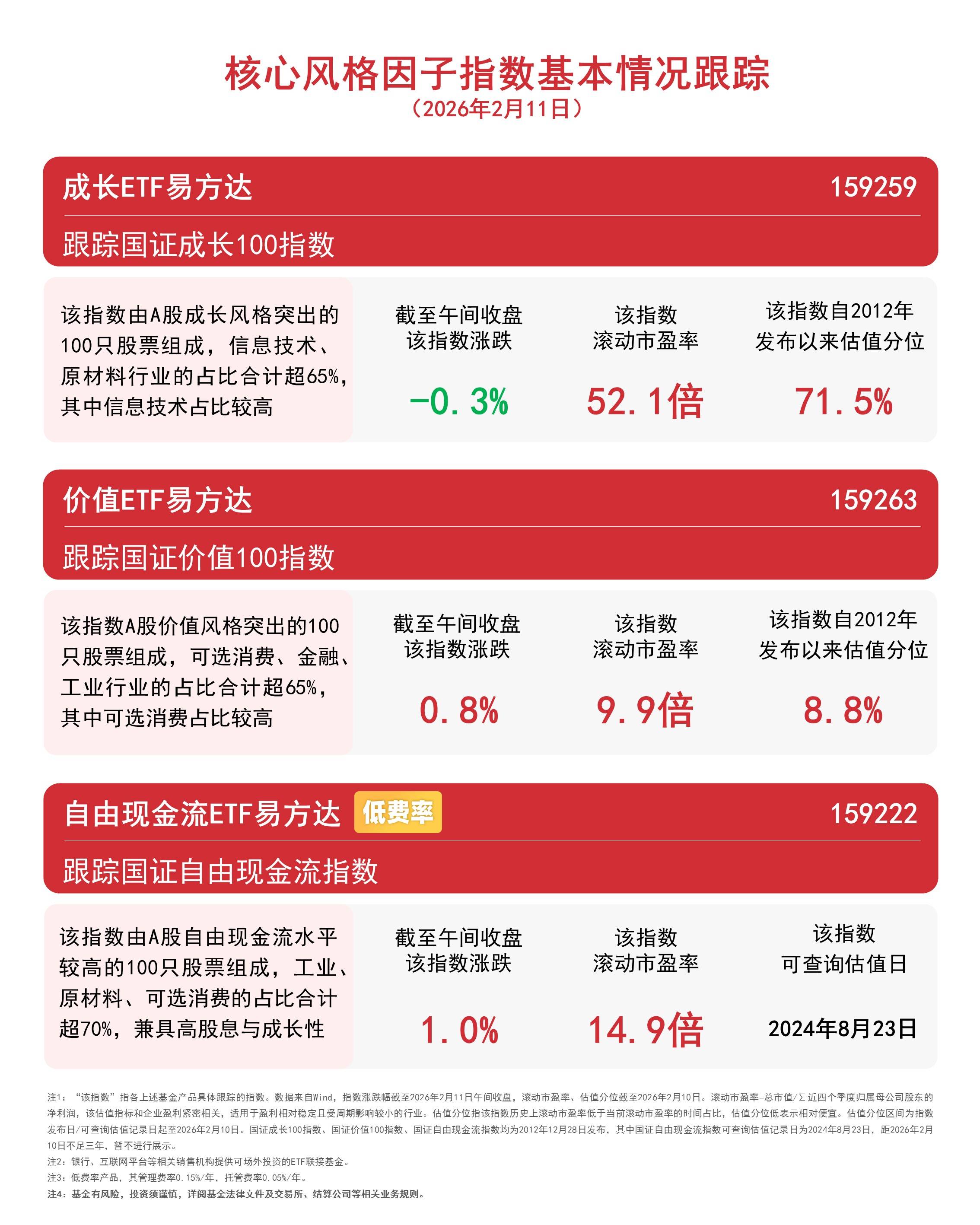
截至午间收盘,国证自由现金流指数上涨1.0%,国证价值100指数上涨0.8%,国证成长100指数下跌0.3%。 自由现金流ETF易方达(159222)跟踪的国证自由现金流指数以自由现金流率为核心选股逻辑,成份股行业分布均衡,涵盖汽车、家电等制造业与资源板 块,前者依托出口优势与政策托底迎内需改善,后者受益全球供应刚性与再通胀预期,与成长主线有效互补,中长期景气度受关注。 每日经济新闻 ...

停牌!低费率800现金流ETF(159119)分红首秀!今日10:30起复牌交易
Sou Hu Cai Jing· 2026-02-11 02:38
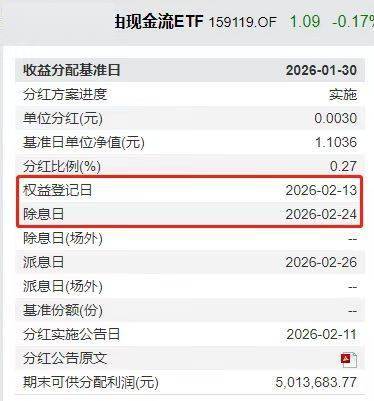
Group 1 - The 800 Cash Flow ETF (159119) will distribute a cash dividend of 0.003 yuan per fund share for the first time in 2026 [1][2] - The fund will suspend trading on February 11, 2026, and will resume trading at 10:30 AM [1] - The dividend distribution benchmark date is set for January 30, 2026, with the record date on February 13, 2026, and the payment date on February 24, 2026 [2] Group 2 - The 800 Cash Flow ETF (159119) is noted for its low fee rate of 0.2% per year, selecting companies with strong cash generation capabilities [3] - Major industries represented in the fund include automotive, petrochemicals, and home appliances, indicating a focus on "cash cows" [3] - The investment strategy reflects a shift from short-term trading expectations to a return to fundamental value, emphasizing the scarcity of companies that can consistently generate stable free cash flow [3]
自由现金流ETF(159201)连续5日合计“吸金”9.89亿元,最新规模达132.06亿元
Xin Lang Cai Jing· 2026-02-10 02:33
Group 1 - The core index, the National Certificate Free Cash Flow Index (980092), experienced a decline of 0.12% as of February 10, 2026, with mixed performance among constituent stocks [1] - Leading stocks included Fenghuo Communication, Qianjin Pharmaceutical, and Anfu Technology, while stocks such as Silver Nonferrous, ShouLü Hotel, and Jiashitang lagged [1] - The Free Cash Flow ETF (159201) also saw a decrease of 0.15%, with the latest price at 1.31 yuan [1] Group 2 - The Free Cash Flow ETF recorded a net inflow of 9.89 billion yuan over the past five days, reaching a total share count of 10.063 billion and a total scale of 13.206 billion yuan, both marking new highs since inception [1] - The ETF's financing net purchase on the previous trading day was 4.6439 million yuan, with the latest financing balance at 172 million yuan [1] - The ETF has shown strong performance, with a maximum monthly return of 9.25% since inception and a historical holding period profit probability of 100% over six months [1] Group 3 - The National Certificate Free Cash Flow Index reflects the price changes of listed companies with high and stable free cash flow levels in the Shanghai and Shenzhen stock exchanges [2] - The top ten weighted stocks in the index as of January 30, 2026, include China National Offshore Oil Corporation, Gree Electric Appliances, and SAIC Motor, collectively accounting for 50.3% of the index [2] - The management fee for the Free Cash Flow ETF is 0.15%, and the custody fee is 0.05%, which are among the lowest in comparable funds [2]
机构称当前位置具备较强配置价值,自由现金流ETF(159201)连续4天合计“吸金”9.31亿元
Mei Ri Jing Ji Xin Wen· 2026-02-09 05:31
Core Viewpoint - The A-share market is experiencing an upward trend, with the National Index of Free Cash Flow rising over 1% and significant inflows into related ETFs, indicating a potential recovery and investment opportunity in the near term [1] Group 1: Market Performance - On February 9, the A-share market saw a rise, with stocks like Anfu Technology and Yaxiang Integration hitting the daily limit [1] - The largest free cash flow ETF (159201) has seen a net inflow of 931 million yuan over the past four days, reaching a new high in both shares at 10.019 billion and total scale at 12.958 billion yuan [1] Group 2: Analyst Insights - Guangfa Securities suggests that recent market corrections have caused investor concerns, but the Shanghai Composite Index returning to around 4000 points presents a chance for renewed confidence and preparation for the first round of gains in the Year of the Rabbit [1] - The outflow from broad-based ETFs that previously affected the market has largely ended, and the A-share market is expected to benefit from favorable conditions in the next 1-2 months [1] Group 3: Investment Strategy - The free cash flow ETF (159201) and its linked funds are closely tracking the National Index of Free Cash Flow, selecting stocks with positive and high free cash flow after liquidity, industry, and ROE stability screening [1] - The index is characterized by high quality and strong risk resistance, making it suitable for core portfolio allocation and long-term investment needs [1]
自由现金流ETF(159201)连续4天合计“吸金”9.31亿元,最新规模达129.58亿元,创成立以来新高
Xin Lang Cai Jing· 2026-02-09 02:11
Group 1 - The core index, the National Certificate Free Cash Flow Index (980092), has seen a strong increase of 1.2% as of February 9, 2026, with notable stock performances including Zhejiang Longsheng up 9.7%, Anfu Technology up 5.5%, and Weichai Power up 5.13% [1] - The Free Cash Flow ETF (159201) has also risen by 1%, with the latest price reported at 1.31 yuan, and has achieved a record high in both share count at 10.019 billion and total scale at 12.958 billion yuan [1] - Over the past four days, the Free Cash Flow ETF has experienced continuous net inflows totaling 931 million yuan, indicating strong investor interest [1] Group 2 - The top ten weighted stocks in the National Certificate Free Cash Flow Index as of January 30, 2026, include China National Offshore Oil Corporation, Gree Electric Appliances, SAIC Motor, and others, collectively accounting for 50.3% of the index [2] - The management fee for the Free Cash Flow ETF is 0.15%, and the custody fee is 0.05%, which are among the lowest in comparable funds [2] - The Free Cash Flow ETF has demonstrated strong performance metrics, with a maximum monthly return of 9.25% since inception and a historical holding period profitability rate of 100% over six months [1]
CNO Financial Group(CNO) - 2025 Q4 - Earnings Call Transcript
2026-02-06 17:00
Financial Data and Key Metrics Changes - CNO Financial Group achieved an operating return on equity of 11.4% for 2025, up from 10% in 2024, reflecting strong operational momentum [12][21] - Operating earnings per diluted share increased by 11% to $4.40, with full-year operating earnings per share exceeding guidance at $4.02 [5][12] - The company returned $386 million to shareholders, marking an 11% increase over 2024, and raised its quarterly common stock dividend for the 13th consecutive year [6][12] Business Line Data and Key Metrics Changes - The consumer division reported a record total new annualized premium (NAP) growth of 15%, with life NAP up 10% and Medicare supplement NAP up 49% for the year [7][8] - The worksite division also saw record insurance sales, with a 15% increase for the full year and 13% for the fourth quarter, driven by life insurance sales up 36% and hospital indemnity insurance up 41% [10][11] Market Data and Key Metrics Changes - Total health NAP increased by 22%, marking 14 consecutive quarters of growth, while Medicare Advantage policies sold decreased by 3% for the year [8][9] - The company expects overall demand for Medicare products to grow, with approximately 11,000 Americans turning 65 each day, indicating a stable market opportunity [9][29] Company Strategy and Development Direction - CNO Financial Group focuses on the underserved middle-income market, leveraging a last-mile captive agent distribution model as a competitive advantage [5][6] - The company is investing in technology modernization with a planned investment of approximately $170 million over three years, with $20 million deployed in 2025 and $75 million expected in 2026 [19][20] Management's Comments on Operating Environment and Future Outlook - Management expressed concerns about economic visibility due to layoffs and job market challenges, which could impact discretionary purchases but noted the ongoing opportunity from the aging population [28][29] - The company anticipates continued growth in producing agent count and productivity, emphasizing that agent productivity is a primary focus for 2026 [26][27] Other Important Information - CNO Financial Group's consolidated risk-based capital ratio was 380%, within the target range of 360%-390%, indicating a strong capital position [16][17] - The company issued $400 million of fixed-rate bonds in the fourth quarter, contributing to disciplined portfolio management and strong earnings fundamentals [15][16] Q&A Session Summary Question: Earnings emergence and target returns - Management indicated that the time to hit target returns varies by product, but confidence remains in meeting ROE targets due to strong sales momentum [23][24] Question: Environment impact on recruiting and agent count growth - Management expects to grow producing agent count in 2026, emphasizing productivity over sheer numbers, while acknowledging economic pressures on consumer spending [25][26] Question: Sustainability of growth levels - Management believes growth is sustainable, with Medicare supplement sales expected to rise while Medicare Advantage sales may decline due to market conditions [37][38] Question: Impact of Medicare Advantage distribution fees - Management has reflected expected pressures in Medicare Advantage in their projections, focusing more on Medicare supplement products [40][41] Question: Capital deployment strategy - Management plans to return excess capital to shareholders through share repurchases while being measured in capital deployment [44][46] Question: Investment portfolio exposure to software - The company has limited exposure to software in its investment portfolio, focusing on mission-critical software and maintaining a cautious approach to risk [72][73]

CEMEX(CX) - 2025 Q4 - Earnings Call Transcript
2026-02-05 16:02
Financial Data and Key Metrics Changes - The company achieved a free cash flow from operations of $1.4 billion in 2025, with a conversion rate of 46% after adjusting for one-off items [5][9] - Net income increased by 2% for the full year, with a significant impact from goodwill impairment and asset write-downs [29] - EBITDA for the fourth quarter increased by 20% year-over-year, with a margin expansion of 5 percentage points [15] Business Line Data and Key Metrics Changes - Consolidated cement and aggregates volumes in the fourth quarter grew by 1% and 2%, respectively, with notable growth in EMEA cement volumes [10] - The aggregates business contributed 39% to U.S. EBITDA, nearly equal to that of cement, reflecting strong performance driven by Project Cutting Edge [20] - The Urbanization Solutions portfolio saw higher EBITDA in the admixtures business in EMEA, partially offsetting soft performance in Mexico and the U.S. [12] Market Data and Key Metrics Changes - In Mexico, average daily cement sales increased by 8% sequentially, indicating improved demand conditions [15] - U.S. operations posted record fourth quarter EBITDA, with margins near record highs, driven by higher operating efficiency and the consolidation of Couch Aggregates [17] - EMEA region achieved record EBITDA and EBITDA margin in 2025, supported by higher volumes and prices [22] Company Strategy and Development Direction - The company is focused on enhancing shareholder returns through improved free cash flow conversion and disciplined capital allocation, prioritizing aggregates and adjacent businesses [6][31] - Project Cutting Edge aims for recurring savings of $400 million by 2027, with $125 million expected in 2026 [13][34] - The company plans to continue seeking divestments in non-core markets to expand its presence in the U.S. [5][6] Management's Comments on Operating Environment and Future Outlook - Management expects a more favorable demand environment in 2026, particularly from Mexico and EMEA, with guidance for high single-digit EBITDA growth [34] - The company anticipates incremental savings of $165 million under Project Cutting Edge, contributing to improved free cash flow [34] - Management remains focused on operational excellence and shareholder return, emphasizing the importance of self-help measures for growth [36] Other Important Information - The board of directors will propose an annual cash dividend of $180 million, representing a nearly 40% increase compared to the previous year [31] - The company recognized a goodwill impairment of $538 million in 2025, which significantly impacted net income [10][29] - Energy costs per ton of cement declined by 12% for the full year, driven by lower fuel and power prices [29] Q&A Session Summary Question: Impact of potential EU ETS target changes on pricing and profitability - Management indicated that potential changes to EU ETS targets would not alter the pricing strategy in Europe, maintaining mid-single digit price increase targets for the coming years [38][39] Question: Clarification on high single-digit EBITDA growth guidance - Management expressed confidence in the guidance, highlighting more upside than downside risks, particularly from currency fluctuations and ongoing operational efficiencies [45][46] Question: Future capital allocation and divestments - Management confirmed plans for divestments, with proceeds aimed at reinvestment in the U.S. aggregates market, emphasizing a disciplined approach to acquisitions [81][83]
