
门罗主义

Search documents
“21世纪社会主义”理论创始人迪特里希接受《环球时报》专访:全球治理倡议是对人类更美好世界的严肃贡献
Huan Qiu Shi Bao· 2026-01-14 22:51
在迪特里希看来,所有全球治理解决方案在当下国际关系的现实环境中都无法一蹴而就,需要通过持续 的对话与务实合作加以推进。不过,他对记者说:"一件事情是明确的:各国人民普遍期望一个新的全 球共同家园——一个能够保障和平、尊严与自主发展的国际体系。在这一背景下,中国提出的一系列全 球倡议为国际社会提供了新的可能性,为探索更加公平、可持续的全球治理模式注入了重要动力。" 迪特里希认为,中国提出的四大全球倡议共同构成了一个面向21世纪国际体系的整体性构想。它们是中 国为世界提供的典型的"公共产品",也体现出中国在参与全球治理过程中一贯强调的稳健性、连续性与 规划能力。 "联合国是目前最广泛、最具代表性、最包容的全球平台,适合作为现有国际秩序改革的起点。以联合 国为基础开展开放式谈判具有现实意义,也能最大程度地推动多边主义。"迪特里希表示。不过,他也 提到,在当前国际体系中,部分国家和集团仍倾向于小圈子或阵营化的合作模式,它们的政府和决策精 英更倾向于根据自身利益、国家间力量平衡或国内权力关系来推动自身议程,并把全球通行的原则排在 次要位置。这会给推动多边合作和克服全球治理障碍的进程带来复杂性和挑战。 迪特里希举例说:" ...
拉美如何面对“新门罗主义”?(环球热点)
Ren Min Ri Bao· 2026-01-14 20:35
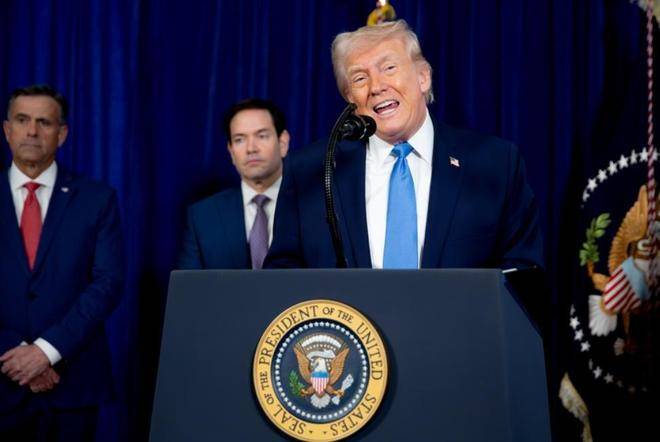
近日,美国对委内瑞拉采取军事行动。多国媒体指出,这是美国自1989年入侵巴拿马以来在拉美地区开 展的规模最大的军事行动。事后,美国总统特朗普召开记者会,宣称此举"远超'门罗主义'",目的是确 保"美国在西半球的主导地位永远不再受到质疑"。美国去年底发布的国家安全战略报告加入了"门罗主 义的特朗普推论"。从19世纪"门罗主义"提出,到现在"新门罗主义"出现,拉美的自主发展举步维艰。 本报邀请中国国际问题研究院拉美和加勒比研究所所长宋均营与广东外语外贸大学拉丁美洲研究中心主 任袁东振予以析评。 立场分化,折射复杂政治生态 拉美国家在委内瑞拉事件上态度不同,表明各国在涉及本地区的重大问题上存在分歧,折射出拉美地区 极其复杂的政治生态 【观察】 在美国对委内瑞拉发动袭击并强行控制委总统及其夫人后,包括巴西总统卢拉、墨西哥总统辛鲍姆、智 利总统博里奇、古巴国家主席迪亚斯—卡内尔在内的多位拉美国家领导人都对美国的行为予以强烈谴 责。与此同时,拉美部分国家的中间派政府和相对"亲美"的拉美国家政府则态度谨慎。多名拉美专家学 者表示,拉美社会与政治精英已明显感受到"寒蝉效应"。" "委内瑞拉之后,美国的目标可能是哪些国家?"据 ...
全球化红利与保守转向:门罗主义背后的价格与数量博弈
付鹏的财经世界· 2026-01-14 12:51
Group 1 - The article discusses the benefits of multilateralism and globalization, emphasizing the multiplication effect of price and quantity, where a leading entity can set favorable prices while expanding market size through cooperation [3][4][5] - It highlights the ideal scenario where multilateralism enhances economies of scale, allowing dominant countries to maintain high marginal profits and achieve absolute gains while fostering relative prosperity for followers [5][6] - The article also addresses the challenges posed by technological spillovers and productivity diffusion, which can erode the core advantages of leading countries, leading to increased competition and potential internal conflicts [6][10] Group 2 - The concept of Monroe Doctrine-like strategies is introduced, suggesting that protectionism can be a rational response to maintain price stability by sacrificing some market quantity [9][10] - The article reflects on the shift towards a conservative path in the U.S., characterized by economic protectionism and a focus on core strengths, while still benefiting from technological advancements that drive productivity [14][15] - It concludes that the future of globalization lies in finding a dynamic balance between price and quantity, openness and protection, as well as sharing and monopolization [15]

特朗普在策划三场战争,美国成为世界恐怖阴影
Sou Hu Cai Jing· 2026-01-14 10:37
Group 1 - The article highlights Trump's aggressive foreign policy, particularly his military actions in various countries, including Venezuela, Yemen, Syria, Iran, Iraq, Somalia, and Nigeria, with over 620 airstrikes ordered during his presidency [1][3][5] - Trump's announcement of Venezuela's oil delivery to the U.S. and his rebranding of the Monroe Doctrine as "Trump Doctrine" reflect his imperialistic ambitions in Latin America [3][5] - The U.S. government's discussions on acquiring Greenland, including potential military options, indicate a strategic focus on maintaining dominance in the Arctic and North Atlantic regions [5][7] Group 2 - The threats against Mexico, Iran, and Greenland demonstrate a broader strategy to reassert U.S. hegemony globally, as outlined in the new National Security Strategy emphasizing the Monroe Doctrine [7][9] - Trump's disregard for international law and the potential for increased isolation of the U.S. on the global stage are underscored by international reactions, including statements from European leaders regarding Greenland [9][11] - The article suggests that Trump's policies may lead to a united global response against U.S. aggression, as seen in joint military exercises by China, Russia, Iran, and South Africa [11][12]
认清“新门罗主义”的美式霸权逻辑(深度聚焦)
Ren Min Ri Bao· 2026-01-14 08:16
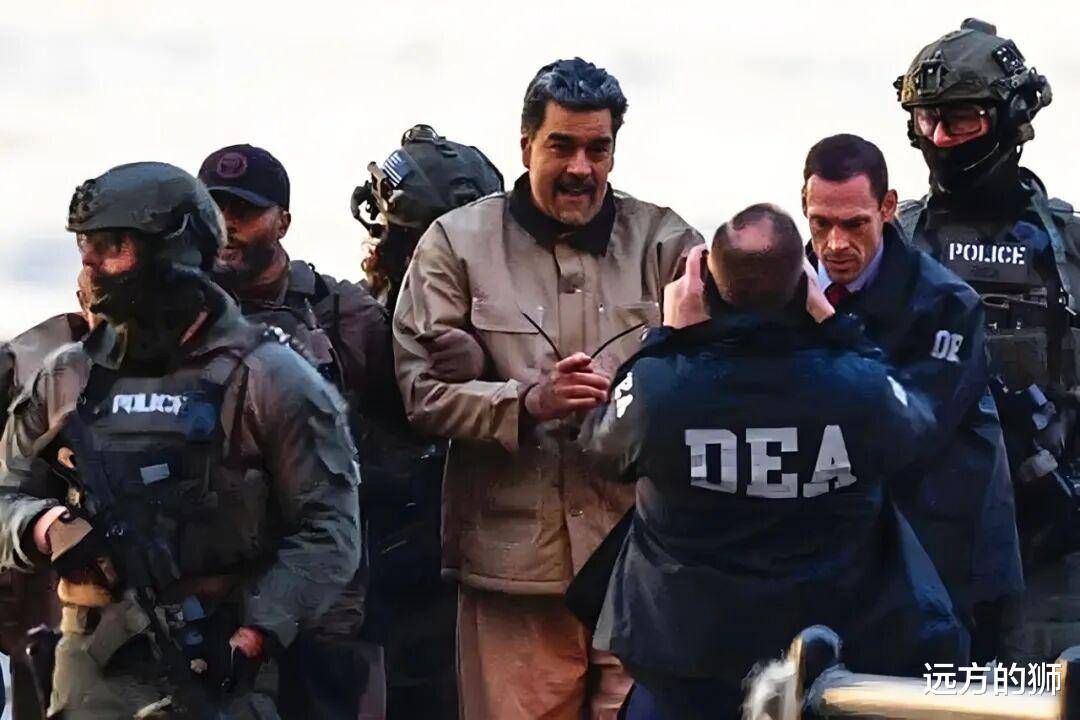
"经多年忽视,美国将重申并推行'门罗主义',重塑西半球主导地位",美国2025年12月发布的国家安全 战略报告如是写道。对同处西半球的拉美国家而言,他们从美国"新门罗主义"中感受到的不是和平和善 意,而是霸权和破坏。 1月3日,在长达4个多月的军事威胁之后,美国悍然对委内瑞拉使用武力,强行控制委内瑞拉总统马杜 罗夫妇,震惊国际社会。这一公然践踏《联合国宪章》的行径,是美国对外战略大调整背景下重拾"门 罗主义"的冒险尝试,严重违反国际法和国际关系基本准则,成为西半球地缘政治的"分水岭"。 单边制裁封锁经济命脉,干涉内政破坏和平稳定,霸权话术扭曲公平正义……近年来,美国对委内瑞拉 的极限施压从未停止。这一系列操作的背后,是"门罗主义"阴影在拉美的蔓延。强推"门罗主义"的美国 视西半球为其"势力范围",对拉美地区的霸权逻辑不但从未改变,而且不断升级。 战略野心与野蛮行径 2025年1月美国新一届政府上台伊始,"门罗主义"便高调回归美国外交政策核心,一系列霸权扩张行径 在拉美接连上演。美国新版国家安全战略报告强调美国必须在西半球占据主导地位,"这种优势使我们 能在该地区需要的任何时间、任何地点自信地展现实力"。此次美 ...
不许中俄购买,美国要独占委石油!特朗普摊牌后,中企如何自救?
Sou Hu Cai Jing· 2026-01-14 05:13
Group 1 - The article discusses Trump's aggressive strategy to control Venezuelan oil resources, demanding Venezuela to send 30 to 50 million barrels of oil to the U.S. and have the proceeds managed by the U.S. [1] - Trump's actions are seen as a blatant disregard for China's interests and a direct challenge to Russia, as evidenced by the U.S. seizing a Russian tanker that transported Venezuelan oil [1] - The article highlights a shift in U.S. foreign policy under Trump, openly embracing a Monroe Doctrine approach, asserting dominance over the Americas and disregarding previous diplomatic subtleties [3] Group 2 - Chinese companies face unprecedented geopolitical challenges in the Americas, with potential risks of sacrificing their interests to appease U.S. demands [3] - Three strategies are proposed for Chinese companies to mitigate risks: reducing heavy asset exposure in the Americas, relocating investments to more stable countries like Brazil, and pursuing legal avenues to challenge U.S. sanctions [5] - Brazil is identified as a strategic location for Chinese investments due to its distance from U.S. influence and the current administration's independent stance, although upcoming elections may introduce uncertainties [5][6] Group 3 - The article suggests that while risks for Chinese investments in the Americas are evident, there is no immediate cause for alarm, as the backing of a strong home country provides support [6] - Examples of successful interventions by Chinese regulatory bodies, such as the case of Cheung Kong Group, illustrate the potential for effective responses to U.S. pressures [6]
日韩警惕“唐罗主义”,携手巩固对美关系
日经中文网· 2026-01-14 03:28
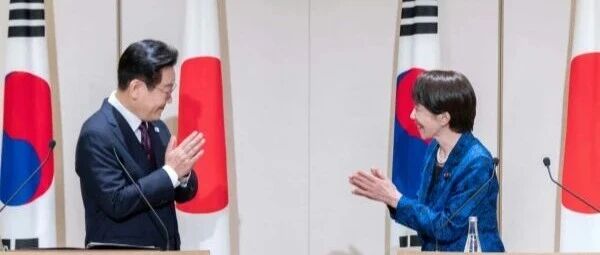
Group 1 - The core viewpoint of the articles emphasizes the strategic importance of Japan-South Korea relations in the context of changing international dynamics and the need to maintain strong alliances, particularly with the United States [2][4][6] - Japan's Prime Minister, Fumio Kishida, and South Korea's President, Lee Jae-myung, reached a consensus on the strategic significance of their bilateral relationship, highlighting the necessity for continued diplomatic engagement [4][5] - The discussions included cooperation on economic security, scientific technology, and supply chain collaboration, as well as addressing common social issues such as aging populations [5][6] Group 2 - The articles indicate a growing concern regarding the security environment surrounding Japan and South Korea, particularly due to North Korea's ongoing nuclear development and military cooperation with Russia, as well as China's increasing military activities in the Pacific [6][7] - Both countries have avoided explicitly criticizing the United States' actions, such as its military engagement in Venezuela, instead emphasizing the importance of returning to democratic principles while prioritizing their alliance with the U.S. [6][7] - There is a noted lack of significant disagreement between Japan and South Korea regarding China, despite rising tensions, suggesting a unified front in their diplomatic approach [7]
晨枫:特朗普是为了MAGA“赢学”,但美国石油公司不赚辛苦钱
Sou Hu Cai Jing· 2026-01-14 02:10
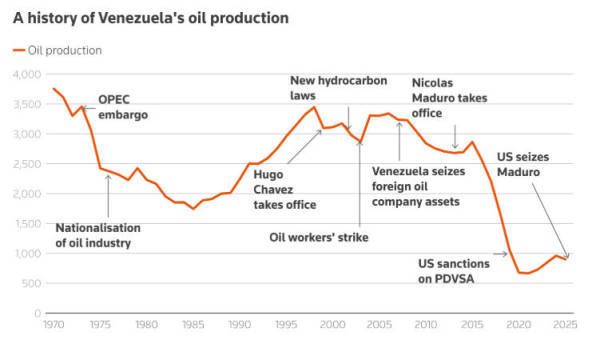
Core Viewpoint - The article discusses Trump's strategy to increase oil production in Venezuela to lower oil prices and combat inflation in the U.S., but U.S. oil companies are hesitant to invest due to concerns over stability and potential losses from past nationalizations [1][4][9]. Group 1: U.S. Oil Production and Market Dynamics - U.S. oil production is currently the highest in the world, reaching 13-15 million barrels per day, while Venezuela's production is only 1 million barrels per day, down from a peak of 3.5 million barrels in the 1970s [1][4]. - Trump aims to reduce oil prices to below $50 per barrel, which is critical for the profitability of U.S. shale oil production [4][10]. - The global oil market is complex, with OPEC controlling about 40% of production, and OPEC+ controlling around 60%, which influences pricing strategies [13][14]. Group 2: Investment Hesitations and Risks - U.S. oil companies are reluctant to invest in Venezuela due to concerns over legal and financial security, fearing a repeat of past nationalizations [9][15]. - The current global oil supply is in a state of oversupply, making it less attractive for companies to invest heavily in increasing Venezuelan oil production [10][15]. - The potential for U.S. domestic oil production to be negatively impacted by increased Venezuelan exports raises further concerns for investors [15][17]. Group 3: Political and Economic Implications - The article highlights the geopolitical implications of U.S. involvement in Venezuela, including the desire to reduce Chinese and Russian influence in the region [6][18]. - Trump's strategy includes a three-phase plan for Venezuela: stabilizing the situation, reviving the oil industry, and achieving political transition [6][18]. - The return of Venezuelan refugees could create significant social and economic pressures on the country, complicating recovery efforts [19][21].
美国加速变为“规则破坏者”(回声)
Ren Min Ri Bao· 2026-01-14 01:57
Core Viewpoint - The article discusses the U.S. military intervention in Venezuela, highlighting it as a manifestation of the resurgence of the Monroe Doctrine and a strategy to maintain hegemony in the Western Hemisphere through force [1][2]. Group 1: U.S. Military Actions - The U.S. military actions in Venezuela signify a shift towards openly using military force to reshape power structures in Latin America, moving away from covert operations and electoral manipulation [1][6]. - The intervention is characterized as a systematic deprivation of sovereignty, with the U.S. aiming to establish a long-term control framework under the guise of "managing" Venezuela [1][6]. Group 2: International Law and Reactions - The military actions violate a fundamental principle of international law, which prohibits the use of force to undermine a nation's territorial integrity or political independence [3][4]. - There is a call for all nations to unite in defending the United Nations Charter and international law against such acts of aggression [3][4]. Group 3: Implications of U.S. Actions - The U.S. intervention is seen as a reflection of its declining control in a multipolar world, with military dominance viewed as a last resort to delay the decline of hegemony [1][6]. - The actions are described as reckless and driven by a desire to plunder resources, which could ultimately backfire on the U.S. itself [5][6].
世界不需要“新门罗主义”(寰宇平)
Ren Min Ri Bao· 2026-01-13 23:28
Core Viewpoint - The article argues that the "New Monroe Doctrine" represents a dangerous escalation of traditional U.S. hegemonic policies, showcasing a blatant disregard for international law and the principles of sovereign equality among nations [1][2][3]. Group 1: Historical Context and Implications - The "New Monroe Doctrine" is not a new concept but a continuation of U.S. interventionist policies that have historically caused suffering in Latin America, as evidenced by past military interventions and territorial acquisitions [4][5]. - The U.S. aims to ensure that the Western Hemisphere remains under its influence, using military force and economic coercion to control the internal and external affairs of regional countries [3][5]. Group 2: Regional and Global Impact - The U.S. military actions against Venezuela and threats to other Latin American countries are seen as a significant threat to regional stability and the autonomy of these nations, potentially leading to increased political fragmentation and economic hardship [5][6]. - The "New Monroe Doctrine" poses risks not only to Latin America but also to global stability, as it undermines established international laws and norms, leading to a potential normalization of aggressive hegemonic behavior [6][7]. Group 3: International Response and Future Outlook - There is a growing consensus in the international community to defend the principles of international law and the UN Charter against U.S. actions, emphasizing the need for respect for sovereign equality and non-interference [7][8]. - The article concludes that history will ultimately reject the "New Monroe Doctrine," as the principles of justice and fairness will prevail over hegemonic power [7].