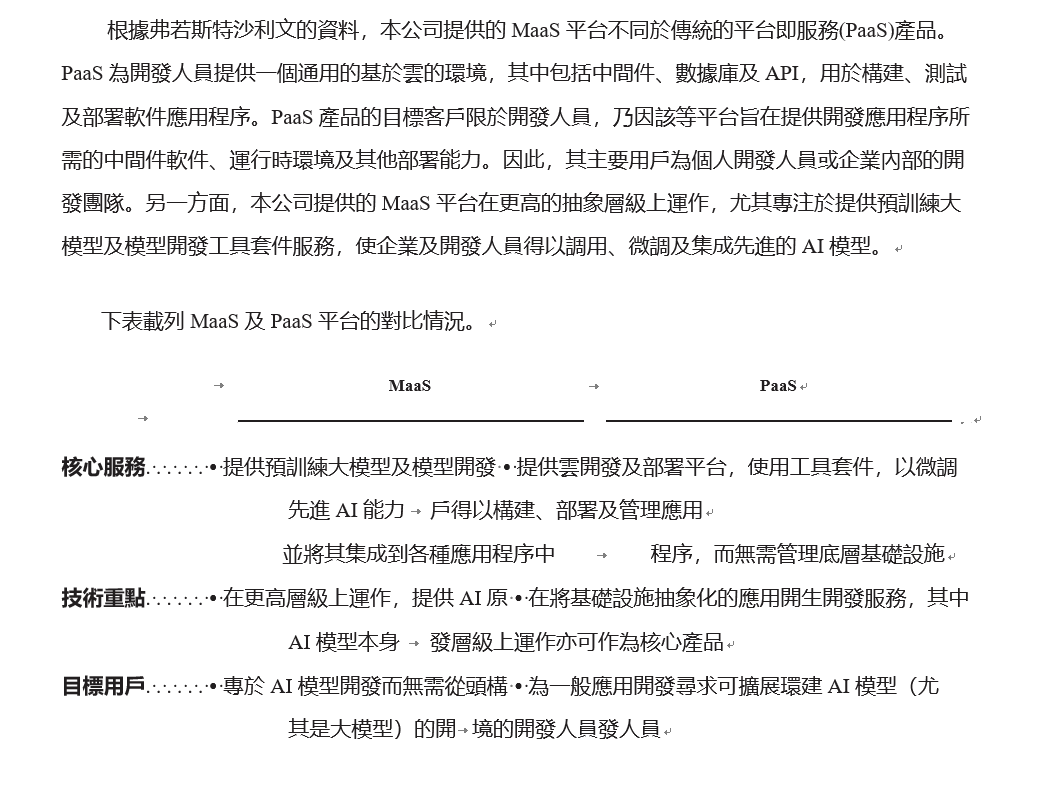
MaaS

Search documents
大模型第一股来了
财联社· 2025-12-20 07:38
Core Viewpoint - The article discusses the significance of Zhipu's IPO as it aims to become the first global large model stock, providing a valuation benchmark for the underrepresented large model industry in the public market, and marking a shift from a "technical race" to "capital validation" for China's AI sector [3]. Financial Performance - Zhipu's revenue is projected to grow rapidly from 57.4 million yuan in 2022 to 312.4 million yuan in 2024, with a compound annual growth rate (CAGR) of 130% [4]. - The gross margin for Zhipu is expected to be 54.6% in 2022, 64.6% in 2023, and 56.3% in 2024, with a gross margin of 50% in the first half of 2025 [4]. - Despite significant revenue growth, Zhipu has recorded losses of 144 million yuan in 2022, 788 million yuan in 2023, and 2.958 billion yuan in 2024, with a loss of 2.358 billion yuan in the first half of 2025 [5]. Research and Development - Zhipu has invested heavily in R&D, with expenditures increasing from 84.4 million yuan in 2022 to 2.195 billion yuan in 2024, totaling over 4.4 billion yuan [5]. - The company has achieved a breakthrough in domestic GLM architecture, compatible with over 40 domestic chips, and has developed a comprehensive product matrix covering various AI applications [5]. Market Position and Competition - Zhipu ranks first among independent general-purpose large model developers in China and second among all general-purpose large model developers, with a market share of 6.6% as of 2024 [4]. - The company has raised over 8.3 billion yuan in funding since its establishment in 2019, with notable investors including Meituan, Tencent, and Xiaomi [6]. Business Model and Revenue Streams - Zhipu's revenue primarily comes from localized deployment of large models, contributing 84.5% of total revenue by 2024, while cloud revenue accounts for 15.5% [7]. - The company is shifting its focus towards cloud deployment and MaaS (Model as a Service) to enhance scalability and profitability [8][9]. - The annual recurring revenue (ARR) from its model services for global developers has surpassed 100 million yuan, indicating a strategic shift towards increasing the revenue share from API services [11]. Strategic Direction - Zhipu aims to strengthen its core business of localized deployment while increasing the revenue share from its MaaS platform, which has shown exponential growth [10]. - The company is also focusing on expanding its cloud services and reducing reliance on private deployments, as evidenced by the increasing share of cloud business revenue [12]. - Zhipu's daily token consumption has surged from 500 million in 2022 to 4.6 trillion in the first half of 2025, highlighting its ambition to become a scalable cloud-based model platform [13].


“全球大模型第一股”来了?智谱“家底”曝光 营收3.12亿估值243 亿
Xin Lang Cai Jing· 2025-12-20 06:52
Core Viewpoint - Zhiyu is on the verge of entering the capital market, aiming to become the world's first publicly listed large model company, which will provide a reference for valuation in the long-lacking public market of the large model industry [2] Company Overview - Zhiyu has accumulated over 4.4 billion yuan in R&D investment and is experiencing rapid revenue growth, with projected revenues of 57.4 million yuan, 124.5 million yuan, and 312.4 million yuan from 2022 to 2024, reflecting a compound annual growth rate of 130% [3] - The company has not yet achieved profitability, recording losses of 144 million yuan, 788 million yuan, and 2.958 billion yuan from 2022 to 2024, with a loss of 2.358 billion yuan in the first half of 2025 [3] Market Position - According to a report by Frost & Sullivan, Zhiyu ranks first among independent general large model developers in China and second among all general large model developers, with a market share of 6.6% as of 2024 [3] - As of September 30, 2025, Zhiyu's models have reached 12,000 enterprise clients, over 80 million terminal user devices, and more than 45 million developers [8] Business Model - The core revenue source for Zhiyu comes from localized deployment of large models, contributing 84.5% of revenue as of 2024, while cloud revenue accounts for 15.5% [8] - The company is shifting its focus towards cloud deployment and the MaaS (Model as a Service) model to enhance its scalability and demonstrate its business model's profitability and long-term growth potential [8][9] Strategic Direction - Zhiyu's MaaS platform is experiencing exponential growth, with annual recurring revenue (ARR) from its global developer model service exceeding 100 million yuan (approximately 14 million USD) [9] - The company aims to increase the revenue share from API services to 50% and is actively working on enhancing its cloud-based offerings [9] Competitive Landscape - The company has established a strong presence in the technology internet and enterprise service markets, with nine of the top ten internet companies in China utilizing Zhiyu's GLM large models [11] - The average daily token consumption has surged from 500 million in 2022 to 4.6 trillion in the first half of 2025, indicating a shift towards a scalable cloud-based model [12] International Expansion - Zhiyu's localized deployment services have begun generating revenue from overseas clients, particularly in Southeast Asia, with the revenue share from this region increasing from 0.5% in 2024 to 11.1% in the first half of 2025 [12]
全球大模型第一股,会是智谱吗?
虎嗅APP· 2025-12-19 14:37
Core Viewpoint - The article discusses the upcoming IPO of Zhiyu AI, a leading Chinese large model company, and its potential to become the world's first publicly listed large model company, highlighting its rapid revenue growth and strategic shifts in business model [3][10][32]. Revenue Growth - Zhiyu AI has shown a steep growth trajectory, with revenues increasing from 57.4 million RMB in 2022 to 124.5 million RMB in 2023, and projected to reach 312.4 million RMB in 2024, resulting in a compound annual growth rate of 130% over three years [4]. - The company's revenue structure is primarily B2B, with significant reliance on private deployments, which accounted for 95.5% of revenue in 2022, decreasing to 84.8% by mid-2025, while cloud-based services contributed 15.2% [4][5]. Profitability and R&D Investment - Despite the shift in revenue structure, Zhiyu AI has maintained a stable gross margin above 50% since 2022, indicating efficient delivery of model capabilities without heavy delivery costs [7]. - R&D expenditures have surged from 84.4 million RMB in 2022 to 5.289 billion RMB in 2023, and further to 21.954 billion RMB in 2024, with a significant portion of the workforce (74%) dedicated to R&D [8][9]. Market Position and Strategy - Zhiyu AI aims to balance its revenue sources between private deployments and cloud-based services, with plans to equalize their contributions [5][19]. - The company has strategically shifted focus towards API services and cloud-based deployments, with annual recurring revenue from its model business exceeding 100 million RMB, indicating a trend towards scaling its cloud offerings [23][24]. Industry Context - The large model industry is still in a phase of conceptual pricing, with no widely accepted business model established, making Zhiyu AI's IPO significant for setting industry benchmarks [30][32]. - The article emphasizes that the first publicly listed large model company will influence how the market values similar companies, shaping future investment narratives and industry evolution [32][34].

智谱通过港交所聆讯:中国OpenAI将成「全球大模型第一股」,收入连续三年翻倍
IPO早知道· 2025-12-19 14:09
Core Viewpoint - Beijing Zhiyu Huazhang Technology Co., Ltd. (referred to as "Zhiyu") is poised to become the "global first stock of large models" after passing the Hong Kong Stock Exchange hearing, positioning itself as a significant competitor to OpenAI in the AGI space [2][4]. Group 1: Company Overview - Zhiyu, established in 2019, is recognized as China's largest independent large model vendor, achieving revenue growth from 0.57 million yuan in 2022 to 3.12 million yuan in 2024, with a compound annual growth rate (CAGR) of 130% [4]. - The company has completed eight rounds of financing, raising over 8.3 billion yuan from various investors, including major tech firms and venture capital [4][10]. - Zhiyu's models are utilized by nine out of the top ten internet companies in China, indicating strong market penetration [11]. Group 2: Product Development and Innovation - Zhiyu has pioneered several significant advancements in large model technology, including the first hundred billion model and the first open-source thousand billion model, establishing a comprehensive model portfolio [6][8]. - The flagship model GLM-4.5 was released in July 2025, achieving top rankings in various industry benchmarks, including being the third globally and first in China [6][7]. - The upgraded model GLM-4.6 was released in September 2025, achieving a historic milestone by ranking first in global coding competitions alongside models from OpenAI and Anthropic [7]. Group 3: Business Model and Revenue Growth - Zhiyu has established a robust business model with a focus on Model as a Service (MaaS), which has led to a doubling of revenue for three consecutive years while maintaining a gross margin above 50% [9][10]. - The MaaS platform has over 2.7 million enterprise and application developers, making it one of the most active large model API platforms in China [10][11]. - The company has seen significant adoption of its models in international markets, with notable clients in North America and Europe, further enhancing its revenue streams [11]. Group 4: Market Potential and Future Outlook - The Chinese large language model market is projected to grow from 5.3 billion yuan in 2024 to 101.1 billion yuan by 2030, with institutional clients being the primary growth driver [14]. - Following its anticipated IPO, Zhiyu is expected to leverage its leading position in revenue and paid traffic to further expand its influence in the global AGI industry [14].

MaaS做到第一后,火山下一步怎么走?
雷峰网· 2025-12-19 04:55
Core Viewpoint - The article discusses the competitive landscape of cloud service providers, emphasizing the emergence of AI-driven models and the introduction of the AgentKit platform by Volcano Engine as a strategic move to capitalize on the AI market and enhance developer engagement [2][3][4]. Group 1: Market Dynamics - The cloud market is currently facing intense competition characterized by price wars and challenges in standardization, making it difficult for companies to scale effectively [2]. - The introduction of large models has created new opportunities for cloud providers, with Volcano Engine leading the market in model-as-a-service (MaaS) by capturing a significant share of the public cloud model invocation market [5][6]. - Volcano Engine's market share reached 49.2% in the first half of 2023, indicating its dominance in the AI infrastructure space [5]. Group 2: Strategic Developments - Volcano Engine has transitioned from traditional cloud services to an AI-native model, focusing on selling tokens instead of computing power, which allows for a more sustainable business model [6][7]. - The company has significantly reduced the pricing of its models, with a price drop of 99.3%, to encourage widespread adoption and increase invocation rates, thereby enhancing model evolution through user feedback [7][8]. - The launch of the AgentKit platform aims to provide developers with the necessary tools to create and manage AI agents effectively, addressing the challenges faced in deploying AI solutions [9][18]. Group 3: AgentKit Features - AgentKit is designed to cover the entire lifecycle of agent application deployment, providing a comprehensive solution that addresses the real challenges enterprises face in implementing AI agents [18][19]. - The platform includes modules for identity management, security, and operational efficiency, ensuring that agents can operate safely and effectively within enterprise environments [22][23][24]. - AgentKit also features observation and evaluation capabilities, allowing for transparent decision-making processes and performance assessments of agents, which are crucial for enterprise adoption [30][31]. Group 4: Future Outlook - The article suggests that the future of cloud service providers lies in their ability to adapt to AI-driven models and infrastructure, with a focus on building robust AI-native architectures [33]. - Volcano Engine's AgentKit is positioned as a key player in the agent development space, aiming to attract professional developers and enhance user engagement, ultimately driving growth in the AI cloud market [36][37].

对话火山引擎谭待:多数人低估了火山拿下 AI 云的决心
晚点LatePost· 2025-12-18 11:58
Core Viewpoint - The company has adjusted its revenue target for 2021, increasing it by several hundred billion yuan while maintaining the original timeline of 2029-2031, reflecting a strong commitment to AI cloud services and a belief in the growth potential of its products [2][29]. Group 1: Revenue and Growth - The daily token processing volume of the Doubao model has exceeded 50 trillion, with a growth rate of over 200% in six months, driven by both internal applications and external clients [2][22]. - The company has observed a significant increase in demand for image and video generation capabilities, particularly with the maturation of models like Seedream and Seedance [3][22]. - The overall revenue from MaaS (Model as a Service) has surpassed expectations, contributing to the company's confidence in maintaining market share despite increasing competition [4][32]. Group 2: Product Development and Innovation - The company has upgraded several large models, including Doubao 1.8, which enhances multi-turn instruction adherence and OS Agent capabilities, allowing for the processing of longer videos [3][6]. - A new pricing strategy called the "saving plan" has been introduced, which encourages deeper usage of various models by offering discounts based on overall consumption rather than individual model pricing [4][10]. - The introduction of the Doubao Assistant API simplifies the integration of advanced capabilities into client applications, significantly lowering the barrier for innovation [12][17]. Group 3: Market Position and Strategy - The company views the increasing competition in the AI cloud sector as a positive development that can expand the overall market size, allowing for mutual growth among competitors [30][32]. - The company emphasizes the importance of accelerating growth and innovation, focusing on the speed of development rather than just the current market position [8][32]. - The company has established a comprehensive product ecosystem that integrates various AI capabilities, positioning itself as a leader in the MaaS market [21][29].

谁将定义中国智算未来?从系统可用的算力基建,到产业认可的价值闭环丨GAIR 2025
雷峰网· 2025-12-15 07:44
Core Viewpoint - The future of intelligent computing will be defined by those who can establish standards, models, and foundational systems, leading to true dominance in the next generation of intelligent competition [2][3]. Group 1: Conference Overview - The GAIR 2025 conference, focusing on "AI Computing in the New Decade," was held in Shenzhen, aiming to connect technological advancements with industrial practices [2]. - The afternoon forum centered on the theme "Who Will Define the Future of Intelligent Computing," shifting focus from breakthrough innovations to systematic construction and value closure [2][3]. Group 2: Key Presentations - Wang Zhi from Tsinghua University discussed the challenges of industrial large models, emphasizing the need for a new paradigm of "training and inference collaboration" to drive intelligent manufacturing [4][6]. - Liu Xiangyang, an IEEE Fellow, highlighted that a company's AI capabilities are fundamentally determined by its digital foundation, stressing the importance of a robust digital infrastructure [9][11]. - Zhao Hongbing from Beijing Parallel Technology emphasized the need for computing services to transform from mere resources to productive forces, advocating for a user-centric approach in computing service operations [14][16]. - Shi Tianhui from Qingcheng Jizhi pointed out the importance of software in unlocking the value of computing power, advocating for the growth of the MaaS (Model as a Service) market [19][20]. - Lü Haifeng from Dingxi Zhichuang proposed a "wet and dry combined" approach to tackle data bottlenecks in AI and new materials, emphasizing the integration of AI in material design and development [22][24]. Group 3: Industry Insights - The current computing market faces challenges such as low utilization rates of computing resources, with many intelligent computing centers averaging below 40% [28]. - The transition from "building first, using later" to a more efficient model prioritizing cost-effectiveness and user scenarios is underway in the computing industry [28][29]. - The MaaS model is seen as a key to achieving a value closure in computing, allowing users to access computing power at lower costs while suppliers optimize their technology to reduce expenses [29][30]. - The future of AI in China is expected to shift from training to inference by 2025, with a growing emphasis on the MaaS market and the integration of domestic chips and cooling technologies by 2026 [30].


字节彻底爆发了?
虎嗅APP· 2025-12-02 00:01
Core Viewpoint - ByteDance has officially entered the operating system market with the launch of the Doubao mobile assistant, which redefines the AI mobile era by enabling proactive task management across multiple applications [5][8]. Group 1: Product Launch and Market Reaction - The Doubao mobile assistant can perform various tasks such as ticket booking, file downloads, and service comparisons, showcasing a significant advancement in AI capabilities from passive responses to active task management [5]. - Following the announcement, ZTE's stock surged to its limit in A-shares, and Hong Kong stocks rose over 13%, indicating strong market anticipation for AI agent applications [7]. Group 2: Industry Trends and Competitive Landscape - The AI industry has seen rapid iteration over the past six months, with a shift towards multi-modal capabilities becoming a core trend, contrasting with the previous year's focus on single-modal models [8]. - The demand for AI agents has surged, as evidenced by the explosive growth in "Function Call" requests, highlighting a critical market need for these capabilities [8]. - The recent Gartner report ranked Volcano Engine as the top Chinese AI application development platform, surpassing Alibaba Cloud and Tencent Cloud in execution ability, and placing it fourth globally in multi-modal capabilities [9][12]. Group 3: Competitive Strategies and Market Position - The competition among major cloud service providers has intensified, with Volcano Engine leveraging its model capabilities to gain market share in the MaaS (Model as a Service) era, while traditional players like Alibaba Cloud and Tencent Cloud are adapting their strategies [15][25]. - Volcano Engine's aggressive pricing strategy has significantly increased its platform usage, with daily token processing reaching 30 trillion, a 25,300% increase since its launch [27]. - Despite the rapid growth, concerns remain about the sustainability of Volcano Engine's business model, as it relies heavily on API calls and may struggle to scale profitably compared to established players [30][32]. Group 4: Future Outlook and Industry Dynamics - The AI cloud market is expected to consolidate, with only a few leading players remaining by 2026, emphasizing the need for continuous innovation and cost-effective solutions [35]. - The shift from IaaS to MaaS signifies a fundamental change in cloud service dynamics, with a focus on intelligence rather than just resource provision [36]. - The competitive landscape is characterized by a race for technological advancement and market share, with companies needing to balance model capabilities and engineering efficiency to remain relevant [38][40].

小度AI眼镜将开启预售;高通推出人工智能芯片|数智早参
Mei Ri Jing Ji Xin Wen· 2025-10-28 23:17
Group 1 - Baidu's "XiaoDu AI Glasses" will start pre-sale on November 1, with official release on November 10, featuring functions like AI translation, AI object recognition, AI reminders, and AI recording [1] - The initial release will include the Boston sunglasses model, with other styles to follow [1] - The product aims to meet the growing consumer expectations for smart wearable devices, necessitating continuous updates and upgrades [1] Group 2 - Qualcomm has launched AI chips, the AI200 and AI250, expected to be commercially available in 2026 and 2027, respectively [2] - This move represents Qualcomm's strategic shift from mobile to data center markets, intensifying competition in the AI chip sector [2] - Nvidia currently holds about 70% of the AI inference market, and Qualcomm's entry may challenge Nvidia's dominance [2] Group 3 - IDC reported that China's MaaS market experienced explosive growth in the first half of 2025, reaching 1.29 billion RMB, a year-on-year increase of 421.2% [3] - The AI large model solutions market also saw significant growth, with a market size of 3.07 billion RMB, up 122.1% year-on-year [3] - The rapid growth is attributed to continuous breakthroughs in AI technology, making it easier for businesses to adopt AI solutions [3]


字节跳动最新披露:豆包大模型日均tokens使用量超30万亿
Di Yi Cai Jing· 2025-10-16 08:00
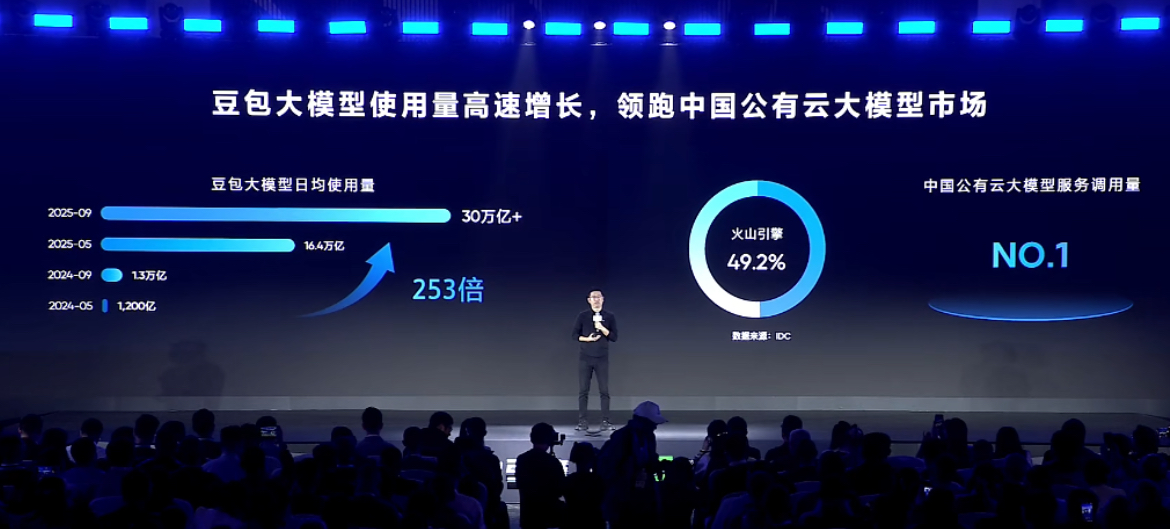
Core Insights - ByteDance's Volcano Engine has seen a dramatic increase in the usage of its Doubao large model, with token usage growing from 120 billion tokens in May 2024 to over 30 trillion tokens by September 2024, marking a 253-fold increase [2] - According to IDC's September report, the public cloud large model token usage in China is expected to reach 536.7 trillion tokens in the first half of 2025, with Volcano Engine holding a 49.2% market share, leading the market ahead of Alibaba Cloud and Baidu Smart Cloud [2] - The emergence of large models has revitalized the cloud industry, transitioning it from a mature phase to a new growth cycle, as evidenced by significant revenue growth in AI services from major cloud providers like Microsoft [2][3] Industry Trends - The AI cloud market is evolving with the introduction of Model as a Service (MaaS), which is contributing to a 60% revenue growth for Volcano Engine in 2024, alongside an increase in token usage [3] - The key differentiator in the current AI cloud market compared to traditional cloud computing is the service of large models, with token usage being a critical metric for measuring market scale [6] - The global AI large model landscape is advancing in three main directions: integration of deep thinking models with multimodal understanding, production-level capabilities in video, image, and voice models, and the maturation of complex enterprise agents [7] Future Outlook - The large model service market is projected to have over a hundredfold growth potential, driven by continuous technological breakthroughs and the expansion of model systems and tools [7] - The AI coding sector is identified as a significant future trend, with current limitations in model capabilities hindering its full potential in the domestic market [7] - The transition of user demographics from the general internet to traditional enterprises presents challenges that need to be addressed for further growth in the AI cloud sector [7]