长期投资

Search documents
深度起底 “股神” 巴菲特的传奇人生:表面亏50%,实则大赚60%!
Sou Hu Cai Jing· 2025-08-11 07:36
Group 1 - Warren Buffett's Berkshire Hathaway reported a significant asset write-down of $3.8 billion on its investment in Kraft Heinz, reducing its book value to $8.4 billion from over $17 billion at the end of 2017 [4] - Despite the apparent loss, an analysis revealed that Buffett had secured nearly 60% profit due to favorable terms negotiated during the transaction, showcasing his ability to turn a perceived failure into a profitable outcome [4][5] - Buffett's investment philosophy emphasizes long-term value and strategic positioning, which has allowed him to navigate market fluctuations effectively [5] Group 2 - Buffett's cautious outlook on the current U.S. stock market is evident, as he believes the S&P 500's price-to-earnings ratio exceeding 30 indicates inflated growth expectations, suggesting potential historical investment opportunities in the next five years [16] - Berkshire Hathaway's cash reserves reached a record high of $344 billion, providing a robust buffer against market volatility as Buffett prepares to pass the reins to his successor, Greg Abel [21] - The company holds a diversified portfolio, with significant investments in Apple, American Express, and Coca-Cola, which together account for over 50% of its stock investment portfolio [18][19] Group 3 - Buffett's investment strategy includes a focus on companies with strong fundamentals, as evidenced by his long-term holdings in Coca-Cola and Apple, which have shown resilience and growth despite market challenges [27][29] - The investment approach is characterized by a preference for businesses with a competitive edge and sustainable cash flow, avoiding speculative trends such as AI investments that do not align with his expertise [20][32] - Buffett's principles emphasize the importance of understanding the intrinsic value of investments, advocating for a long-term perspective rather than short-term speculation [28][30] Group 4 - Buffett's philanthropic efforts include significant donations to charitable causes, particularly the Gates Foundation, reflecting his belief in responsible wealth distribution and opposition to hereditary wealth [36] - His lifestyle remains modest despite immense wealth, highlighting a commitment to simplicity and frugality, which has become a notable aspect of his public persona [36]


巨头官宣大手笔自购:2.3亿元
3 6 Ke· 2025-08-11 00:25
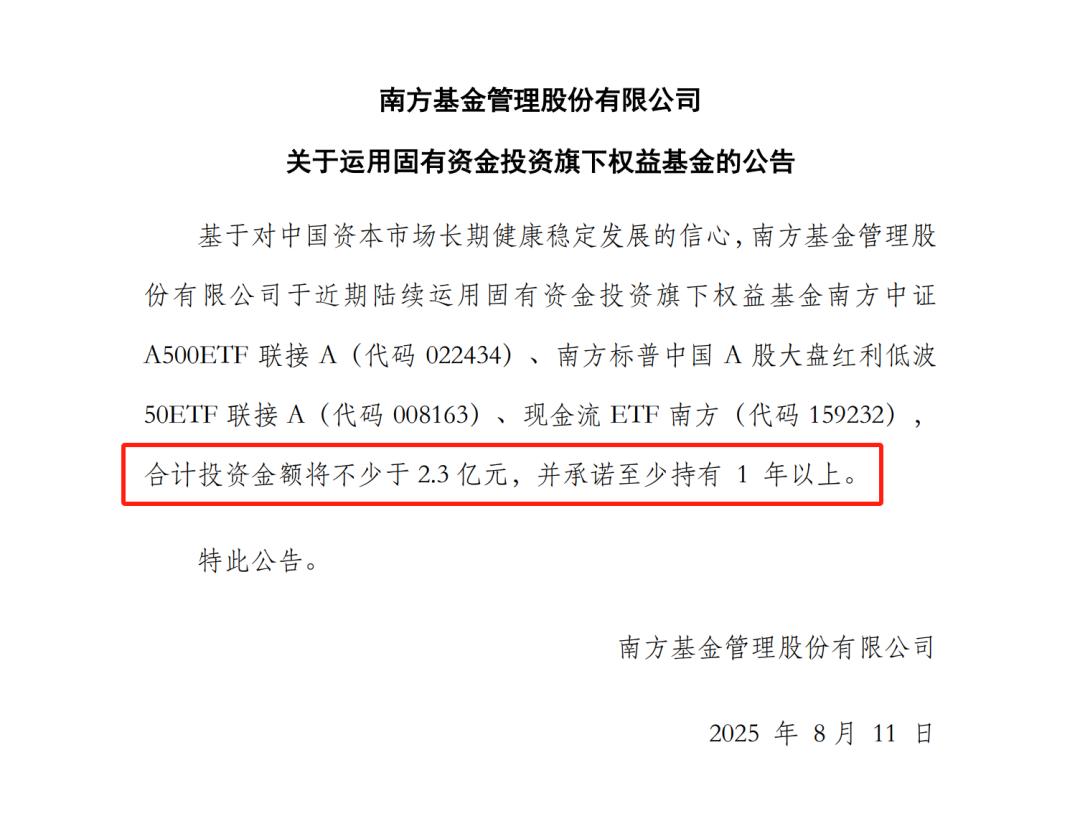
Core Viewpoint - Southern Fund demonstrates confidence in the Chinese capital market by announcing a self-purchase of its equity funds amounting to no less than 230 million yuan, reflecting a strong belief in the long-term health and stability of the market [1][2]. Group 1: Fund Self-Purchase Actions - Southern Fund has committed to investing at least 230 million yuan in its equity funds, including specific funds like the Southern CSI A500 ETF and Southern S&P China A-Share Large Cap Dividend Low Volatility ETF, with a holding period of at least one year [2]. - Other fund companies, such as ICBC Credit Suisse, Founder Fubon, and Da Cheng, have also engaged in self-purchases, indicating a broader trend among asset management institutions to invest their own capital [1][5]. - The total net subscription amount for public funds' self-purchases in equity funds (stock and mixed types) has reached 2.464 billion yuan this year, highlighting a sustained trend of self-purchase actions among fund companies [15]. Group 2: Market Confidence and Economic Outlook - The recent market recovery has led many institutions to recognize the medium to long-term investment value of the A-share market, with Southern Fund citing the strong vitality and resilience of the Chinese economy as a foundation for the capital market's long-term growth [16]. - Despite external complexities, China's GDP achieved a steady growth of 5.3% in the first half of the year, indicating a positive macroeconomic trend [16]. - The current valuation of the Chinese stock market is seen as particularly attractive, with the CSI 300 Index and Hang Seng Index trading at price-to-earnings ratios of 13.93 and 11.83, respectively, which are lower than those of major mature markets [16]. Group 3: Future Market Expectations - A fund company expressed a cautiously optimistic view on the A-share market for the second half of 2025, anticipating a three-phase upward cycle driven by policy support, technological advancements, and globalization [17]. - The market may enter a phase of adjustment after a rapid rise, but the long-term outlook remains positive, particularly in sectors such as technology, domestic demand stimulation, and financial reform [17].
刚刚!巨头官宣大手笔自购:2.3亿元!
中国基金报· 2025-08-10 15:24
Core Viewpoint - The article emphasizes the confidence in the Chinese capital market, highlighted by Southern Fund's announcement of a self-purchase of its equity funds amounting to at least 230 million yuan, reflecting a strong belief in the long-term health and stability of the market [2][5]. Group 1: Fund Company Actions - Southern Fund has committed to investing at least 230 million yuan in its equity funds, including specific ETFs, and will hold these investments for a minimum of one year [5]. - Other fund companies, such as ICBC Credit Suisse, Founder Fubon, and Great Wall, have also engaged in self-purchases, indicating a broader trend among asset management institutions to invest their own funds [3][10][12]. - The total net subscription amount for equity funds (stock and mixed types) by public institutions has reached 2.464 billion yuan this year, showcasing a significant commitment to the market [17]. Group 2: Market Confidence and Economic Outlook - The article notes that the recent recovery in the market has led many institutions to recognize the medium to long-term investment value of A-shares, supported by China's strong economic vitality and resilience [19]. - Despite external complexities, China's GDP achieved a steady growth of 5.3% in the first half of the year, indicating a positive macroeconomic trend [19]. - The current valuation of the Chinese stock market is considered attractive, with the price-to-earnings ratios of major indices being lower than those of developed markets, presenting a good opportunity for long-term investors [19]. Group 3: Future Market Expectations - A cautious optimism is expressed regarding the A-share market for the second half of 2025, with expectations of a fluctuating upward trend driven by policy support, technological advancements, and financial reforms [20][21]. - The article outlines a three-phase upward cycle for A-shares, suggesting a positive outlook for sectors such as technology and domestic demand stimulation [21].

上交所围绕普惠型ETF开展“三个走进”普及性活动
Zhong Guo Xin Wen Wang· 2025-08-08 21:49
Group 1 - The Shanghai Stock Exchange (SSE) conducted 143 "investor-centric" themed activities in July, focusing on "Inclusive Finance" and engaging over 4.1 million participants across 51 cities in 19 provinces [1][2] - As of the end of July, the number of ETFs listed on the SSE reached 719, with a total market size exceeding 3.3 trillion yuan, including over 140 billion yuan in dividend ETFs and 370 billion yuan in bond ETFs [1] - Year-to-date, net inflows into SSE ETFs have surpassed 400 billion yuan, indicating strong investor interest and market recognition [1] Group 2 - The SSE is promoting inclusive ETF products such as dividend, low-volatility, and bond ETFs to a broader investor base, aiming to cultivate rational, value, and long-term investment philosophies [2] - The SSE has organized 36 outreach activities in county-level cities to educate local investors about the economic functions and long-term value of ETFs as asset allocation tools [2] - Additional initiatives include financial summer camps in universities to educate future market participants and community outreach events to enhance the depth and breadth of ETF market promotion [2]
今年以来沪市ETF资金净流入已超4000亿元
Di Yi Cai Jing· 2025-08-08 10:41
Core Insights - The Shanghai Stock Exchange (SSE) is promoting inclusive ETF products such as dividend, low volatility, and bond ETFs to reach a broader investor base and foster rational, value, and long-term investment concepts [1] Group 1: ETF Market Overview - As of the end of July, the number of ETFs listed on the SSE reached 719, with a total scale exceeding 3.3 trillion yuan [1] - The scale of dividend ETFs and bond ETFs surpassed 140 billion yuan and 370 billion yuan respectively [1] - Year-to-date net inflow into ETFs in the Shanghai market has exceeded 400 billion yuan [1] Group 2: Investor Engagement Initiatives - In July, the SSE conducted 143 events themed "Investor-Centric, Return-Driven Development" focusing on ETF promotion [1] - The SSE's initiatives aim to enhance the understanding and accessibility of ETF products among a wider range of investors [1]
“耐心资本”效应正在逐步显现
Jin Rong Shi Bao· 2025-08-08 07:27
扩大长期投资改革试点范围、开展投资黄金业务试点、支持参与金融资产投资公司(AIC)股权投 资……在我国经济迈向高质量发展的新征程中,保险资金迎来一系列政策加持,正以更加积极多元的姿 态,展现出更大作为,成为推动实体经济发展与助力资本市场稳定的重要力量,充分彰显出其作为耐心 资本的独特担当。 截至2024年年末,我国保险公司资金运用余额达33.26万亿元,较2023年年末增长15.08%。这一增速不 仅超越了2023年的11.1%,更是连续两年维持在两位数的高位,彰显出保险资金强大的发展活力与巨大 的发展潜力。 越来越多的保险"长钱"积极响应资金入市号召。自2024年下半年以来,我国多部门合力推动长期资金进 一步入市,金融监管总局全力推进保险资金长期投资改革试点工作。由中国人寿和新华保险联合设立的 鸿鹄基金,首期500亿元已全部投资落地。今年年初,金融监管总局批复第二批试点,规模达520亿元, 太保寿险、泰康人寿及阳光人寿纷纷入围;2025年3月,又新增了第三批试点,规模达600亿元,人保寿 险、太平人寿、平安人寿等5家头部险企加入。截至目前,已有8家保险公司获批开展试点,累计获批总 金额达 1620亿元,为资 ...
中国太保:坚定看好中国资本市场 当好长期耐心资本
Xin Hua She· 2025-08-08 07:26
Core Viewpoint - China Pacific Insurance (Group) Co., Ltd. expresses confidence in the long-term positive fundamentals of the Chinese economy and the development prospects of the Chinese capital market [1] Group 1 - The company emphasizes its commitment to long-term, value, and prudent investments, leveraging the advantages of insurance funds for long-term investment [1] - China Pacific Insurance plans to increase investment in strategic emerging industries, advanced manufacturing, and new infrastructure [1] - The company aims to contribute to the stability of the market and support the development of new productive forces [1]

国有险企长周期考核机制落地 更好发挥险资长期资本耐心资本作用
Jin Rong Shi Bao· 2025-08-08 07:24
Core Viewpoint - The Ministry of Finance's recent notification aims to guide insurance funds towards long-term stable investments and enhance the long-cycle assessment of state-owned commercial insurance companies, addressing the issue of short-term investment tendencies in the industry [1][2]. Group 1: Changes in Assessment Mechanism - The assessment method for "return on net assets" has been adjusted from a combination of "3-year cycle indicator + annual indicator" to "annual indicator + 3-year cycle indicator + 5-year cycle indicator," with respective weights of 30%, 50%, and 20% [2][3]. - The adjustment is expected to alleviate the pressure on investment managers from short-term performance fluctuations, encouraging a focus on stable long-term returns [3][4]. Group 2: Impact on Investment Behavior - The notification is seen as a key measure to promote investment behavior that transcends cyclical fluctuations, emphasizing the importance of long-term capital and enhancing asset allocation capabilities [4][8]. - Insurance companies are encouraged to increase their equity market investments, particularly in light of new accounting standards that have increased the volatility of investment returns [3][8]. Group 3: Addressing Investment Barriers - The insurance sector faces three main barriers to market entry: the mismatch between long-cycle investments and short-cycle assessments, solvency pressures limiting equity investment enthusiasm, and the volatility of profits and net assets due to stock investments [6][7]. - Recent policy initiatives aim to alleviate these barriers, including a comprehensive implementation of long-cycle assessments for state-owned insurance companies and adjustments to risk factors for stock investments [6][7]. Group 4: Strategic Investment Directions - The notification emphasizes the need for state-owned insurance companies to enhance asset-liability management and align investment strategies with long-term stability and risk control [8][9]. - Companies are expected to focus on high-quality investment opportunities, including infrastructure REITs, green bonds, and sectors like artificial intelligence and biomedicine, to support the real economy [8][9].


深度绑定投资者利益 公募新品已在路上
Shang Hai Zheng Quan Bao· 2025-08-08 07:19
Core Viewpoint - The "Action Plan for Promoting High-Quality Development of Public Funds" emphasizes a core value of "investor-centric" principles, aiming to enhance long-term returns for investors and bind their interests with fund management [1][2]. Group 1: Key Aspects of the Action Plan - The Action Plan is viewed as one of the most systematic and forward-looking regulatory innovations in China's capital market in recent years [2]. - It focuses on optimizing the evaluation system for fund management, emphasizing investor satisfaction as a key metric [2]. - The plan encourages innovation in equity products and improves mechanisms for aligning interests between fund managers and investors [2]. Group 2: Floating Management Fee Funds - A new batch of floating management fee funds will be launched, which will deeply bind investor interests at the product establishment level [3]. - These funds will adopt a performance-based fee structure, where management fees are determined based on the fund's performance relative to a benchmark during the holding period [3]. - For example, if a fund performs significantly better than the benchmark, it may charge a fee above 1.2%, while underperformance could lead to a reduced fee of 0.6% [3]. Group 3: Market Trends and Historical Context - Since their inception in 1999, floating management fee funds have undergone several market evaluations, with 20 funds set to pilot the new fee structure in 2023 [4]. - By the end of 2024, there will be 75 products using the floating management fee model, with a total management scale of 783.29 billion, of which 63 products are performance-linked [4]. - The differentiation in management fees among floating fee products has been significant, particularly influenced by market performance from 2021 to 2024 [4]. Group 4: Future Investment Strategies - The future of public funds is expected to focus on long-term and value investing, addressing previous misalignments among stakeholders' interests [5]. - The binding of interests between fund companies and investors is seen as beneficial for product management and investor returns [5].
权益基金哪家强?最新榜单出炉
Shang Hai Zheng Quan Bao· 2025-08-08 07:16
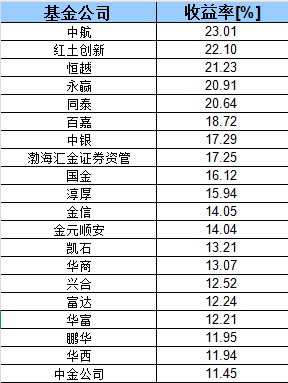
Group 1 - The average return rate of equity funds from 170 public fund institutions reached 6.08% in the first half of 2025, with notable performers like Zhonghang Fund achieving a return of 23.01% [1][2] - Several public fund institutions, including Hongtu Innovation, Hengyue, Yongying, and Tongtai, reported annual returns exceeding 20%, while over 20 institutions, including Guojin, Huashang, and Penghua, had returns above 10% [1][2] Group 2 - Over the past decade, the performance of equity investments among public fund institutions has varied significantly, with institutions like Wanjia, Dacheng, and Hongta Hongtu doubling their investment returns [3] - The top-performing equity funds from July 1, 2015, to June 30, 2025, include Wanjia Fund with a return of 151.15%, followed by Dacheng and Hongta Hongtu with returns of 120.64% and 117.93% respectively [4][5] Group 3 - In the last three years, only 23 out of 156 public fund institutions achieved positive returns, with Huarun Yuanda leading at 34.65% [7][8] - A significant number of public fund institutions experienced losses, with 103 institutions reporting losses exceeding 10% over the past three years, including major firms like GF Fund and China Europe Fund [9] Group 4 - In contrast to equity funds, fixed income funds showed more stable performance, with only two out of 70 public fund institutions reporting losses over the past decade [10][11] - The highest return for fixed income funds in the last ten years was achieved by Everbright Baodexin at 74.80%, with several other institutions exceeding 50% returns [12]