碳中和

Search documents
德创环保涨2.04%,成交额1833.17万元,主力资金净流入8.46万元
Xin Lang Cai Jing· 2026-01-14 02:39
Core Viewpoint - Dechuan Environmental Protection has shown a positive stock performance with a year-to-date increase of 7.82% and a recent rise of 4.99% over the last five trading days, indicating strong market interest in the company [2]. Group 1: Stock Performance - As of January 14, the stock price of Dechuan Environmental Protection rose by 2.04% to 12.00 CNY per share, with a trading volume of 18.33 million CNY and a turnover rate of 0.76% [1]. - The company has experienced a stock price increase of 4.35% over the past 20 days and 0.84% over the past 60 days [2]. Group 2: Financial Performance - For the period from January to September 2025, Dechuan Environmental Protection reported a revenue of 793 million CNY, representing a year-on-year growth of 17.48%. However, the net profit attributable to shareholders decreased by 45.88% to 13.11 million CNY [2]. - The company has distributed a total of 48.65 million CNY in dividends since its A-share listing, with 8.25 million CNY distributed over the last three years [3]. Group 3: Shareholder Information - As of September 30, 2025, the number of shareholders for Dechuan Environmental Protection increased to 24,100, marking a 98.74% rise compared to the previous period. The average number of circulating shares per shareholder decreased by 49.68% to 8,470 shares [2]. - Notably, two funds, CITIC Prudential Multi-Strategy Mixed (LOF) A and Nuoan Multi-Strategy Mixed A, have exited the list of the top ten circulating shareholders [3]. Group 4: Business Overview - Dechuan Environmental Protection, established on September 6, 2005, and listed on February 7, 2017, specializes in flue gas treatment products and services. Its revenue composition includes flue gas treatment projects (44.16%), denitrification catalysts (30.20%), desulfurization equipment (15.97%), dust removal equipment (4.00%), waste salt resource utilization (3.36%), hazardous waste treatment (2.00%), and others (0.32%) [2]. - The company operates within the environmental protection industry, specifically focusing on air pollution control, and is associated with concepts such as sodium batteries, micro-cap stocks, carbon neutrality, and solid waste treatment [2].

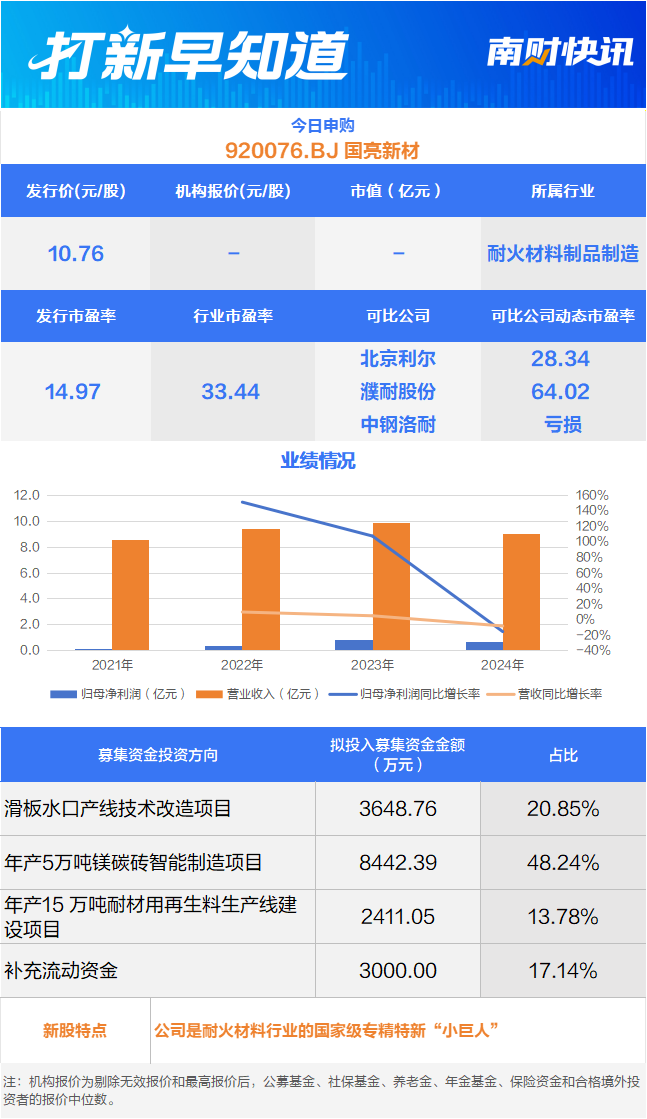
耐火材料行业龙头 国家级专精特新“小巨人”今日申购丨打新早知道
2 1 Shi Ji Jing Ji Bao Dao· 2026-01-13 23:12
Core Viewpoint - Guoliang New Materials (920076.BJ) is set to be available for subscription on the Beijing Stock Exchange, specializing in high-temperature industrial refractory materials and providing comprehensive solutions in this sector [1][2]. Group 1: Company Overview - Established in 2002, Guoliang New Materials is located in Tangshan, Hebei Province, a significant steel production base in China [1]. - The company has accumulated 5 provincial scientific and technological achievement certificates, 33 invention patents, and 52 utility model patents [3]. - Guoliang New Materials has been recognized as a national-level "specialized, refined, distinctive, and innovative" small giant enterprise [3]. Group 2: Financial Information - The offering price is set at 10.76 yuan per share, with an issuance price-to-earnings ratio of 14.97, compared to the industry average of 33.44 [2]. - The company plans to invest raised funds in several projects, including a technical transformation project for the sliding water nozzle production line (36.49 million yuan), an intelligent manufacturing project for 50,000 tons of magnesia-carbon bricks (84.42 million yuan), and a production line for 150,000 tons of recycled materials (24.11 million yuan) [2]. Group 3: Market Position and Clientele - Guoliang New Materials has established long-term partnerships with notable steel companies such as Delong Steel, Donghai Special Steel, and Shougang Group, leveraging its technological and regional advantages [3]. - The company is expanding its market presence internationally, targeting regions like Russia and Vietnam [3]. Group 4: Industry Context - The refractory materials industry is characterized by cyclical fluctuations, heavily influenced by the steel industry, which is subject to macroeconomic cycles and various policies [4]. - The steel industry accounted for approximately 15% of China's total carbon emissions in 2020, and ongoing policies for carbon neutrality will necessitate a shift towards greener practices [4]. - There is a risk of overcapacity in the refractory materials sector, as the industry currently has a low concentration of firms, leading to potential competition and challenges in maintaining profitability [4].

国亮新材(920076):高温工业耐火材料方案商,优质客户与钢铁行业需求升级驱动
Hua Yuan Zheng Quan· 2026-01-13 12:32
Investment Rating - The report suggests to pay attention to Guoliang New Materials as a leading provider of overall solutions for high-temperature industrial refractory materials [55]. Core Viewpoints - Guoliang New Materials focuses on high-temperature industrial refractory materials, providing comprehensive contracting services and direct sales to the steel industry, with stable relationships with major clients like Donghai Special Steel [55]. - The company is expected to benefit from the "dual carbon" policy and technological upgrades in the steel industry, leading to increased demand for high-performance and long-lasting refractory materials [55]. - The company plans to invest in capacity upgrades and smart manufacturing, which is anticipated to enhance product competitiveness and market coverage after the completion of fundraising projects [55]. Summary by Sections 1. Issuance Information - The issuance price is set at 10.76 CNY per share with a P/E ratio of 12.68X, and the subscription date is January 14, 2026 [5][6]. - A total of 18.04 million shares will be issued, accounting for 21.58% of the total share capital post-issuance [5][6]. 2. Company Overview - Guoliang New Materials specializes in high-temperature industrial refractory materials, with a net profit of 83.8 million CNY in 2023, representing a year-on-year increase of 107.59% [10]. - The company has a strong R&D team and has received multiple awards for its technological innovations [10]. - The company’s revenue for Q1-Q3 2025 was 787 million CNY, with a year-on-year growth of 21.18% [33]. 3. Industry Overview - The refractory materials industry is closely tied to the steel industry, which accounts for approximately 65% of refractory material usage [44]. - The national production of refractory materials is projected to be 22.07 million tons in 2024, reflecting a year-on-year decrease of 3.94% [40]. - The industry is expected to see increased demand for high-end refractory materials due to the implementation of carbon neutrality policies and advancements in steelmaking technology [38]. 4. Financial Performance - From 2022 to 2024, the compound annual growth rate (CAGR) of the company's net profit is 32.6% [33]. - The company’s gross margin has improved significantly, rising from 16.50% in 2021 to 20.39% in Q1-Q3 2025 [33]. - The revenue for 2024 is expected to be 905 million CNY, with a net profit of approximately 70.96 million CNY [6][33].
甬金股份全资子公司拟出资参设公司,投建“年产200万吨短流程绿色精品不锈钢项目”
Zheng Quan Shi Bao Wang· 2026-01-13 08:49
甬金股份介绍,在中国钢铁工业去产能化的大背景下,热轧不锈钢板卷产品国内市场产能过剩。中国鼓 励钢铁企业"走出去",以资本输出转移过剩的生产能力,调整钢铁产业结构,实现钢铁产能的全球化布 局。随着"一带一路"共建国家开始落实"进口替代"政策,国内制造业(如电子、家电、汽车产业等)加速 向东南亚国家转移,不锈钢海外需求将大增。 随着全球碳中和的推进,绿色低碳产品将带来更大的市场空间和竞争优势,短流程炼钢工艺可大幅降低 吨钢碳排放量,符合全球绿色冶金趋势,降低碳排放关税支出,提升产品市场竞争力。根据估算,"年 产200万吨短流程绿色精品不锈钢项目"具有很强的盈利能力和抗风险能力。公司目前已针对该项目进行 人员、技术储备,后续不排除通过与国内上游相关企业合作的方式提升产品竞争力。 该项目定位于满足公司海外不锈钢冷轧业务的上游原料供应,提前布局越南未来增量市场,打破境外市 场针对原产于中国及印尼不锈钢产品的反倾销、反规避贸易壁垒,为公司产品全球化布局开辟新的合法 通道,有利于提升公司产品的整体竞争力,增强公司品牌在国内和国际市场的知名度和影响力。 甬金股份(603995)1月13日晚公告,公司全资子公司新越资产管理(新 ...

新中港跌0.49%,成交额3.45亿元,近5日主力净流入3531.55万
Xin Lang Cai Jing· 2026-01-13 08:05
Core Viewpoint - The company aims to become a regional comprehensive energy supply center and carbon neutrality center, focusing on carbon reduction through efficiency improvements and coupling carbon reduction measures [2] Group 1: Company Development Goals - The company targets to develop a regional public utility cogeneration enterprise with scale advantages and environmental performance comparable to natural gas units [2] - Specific carbon reduction measures include efficiency improvements through new unit expansions and technological upgrades, as well as coupling carbon reduction by increasing the proportion of solid waste and biomass fuel [2] Group 2: Carbon Emission Management - In 2019 and 2020, the company had a total carbon emission quota of 2.6483 million tons, with actual emissions of 2.1483 million tons, resulting in a surplus of 500,100 tons, which is 18.88% of the quota [2] - The company sold 500,000 tons of carbon credits in December 2021 [2] Group 3: Technological Innovations - The company plans to construct a "three-dimensional virtual power plant" system to enhance operational efficiency and reliability through real-time data collection and analysis [2][3] - This internal information system differs from a dispatchable virtual power plant, but its completion will facilitate the development of a dispatchable system in the future [2] Group 4: Financial Performance - As of September 30, the company had 22,900 shareholders, an increase of 12.16% from the previous period, with an average of 17,497 circulating shares per person, a decrease of 10.83% [8] - For the period from January to September 2025, the company reported revenue of 529 million yuan, a year-on-year decrease of 18.48%, while net profit attributable to shareholders was 91.8345 million yuan, an increase of 2.51% [8] Group 5: Dividend Distribution - Since its A-share listing, the company has distributed a total of 344 million yuan in dividends, with 204 million yuan distributed over the past three years [9]

成都深化“碳普惠”改革 打造公众参与碳减排的制度化平台
Zhong Guo Xin Wen Wang· 2026-01-13 08:02
Core Viewpoint - Chengdu is advancing its "carbon benefit" reform to create a systematic platform for public participation in carbon reduction, leveraging the national pilot for market-oriented resource allocation [1][2]. Group 1: Carbon Benefit Mechanism - The "Carbon Benefit Tianfu" mechanism, initiated in 2020, incentivizes public participation in low-carbon actions through carbon points and project carbon reduction development [2]. - This mechanism has been included in the national pilot implementation plan, distinguishing it as the only carbon benefit reform task among the ten pilot projects [2]. Group 2: User Engagement and Project Development - The "Carbon Benefit Tianfu" platform has over 4 million users and has developed 222 local carbon reduction projects, achieving over 700,000 tons of carbon reduction value conversion [2]. - The platform has supported major events like the Chengdu Universiade and World Games in achieving carbon neutrality [2]. Group 3: Future Reforms and Expansion - Future reforms will focus on improving the regulatory framework, revising management methods, and optimizing the carbon points quantification and redemption mechanisms [2]. - Chengdu plans to expand the carbon points system by enhancing six low-carbon behavior scenarios, targeting communities, schools, and businesses to increase accessibility to carbon points [2]. Group 4: Innovative Integration and Development - Chengdu will innovate the linkage between carbon points, carbon reduction, green procurement, and credit disclosure, establishing a carbon sink alternative restoration mechanism [3]. - The city aims to empower its development as a world-class event city and international exhibition hub by creating local "carbon neutral" products and demonstrating carbon neutrality in various sectors [3].
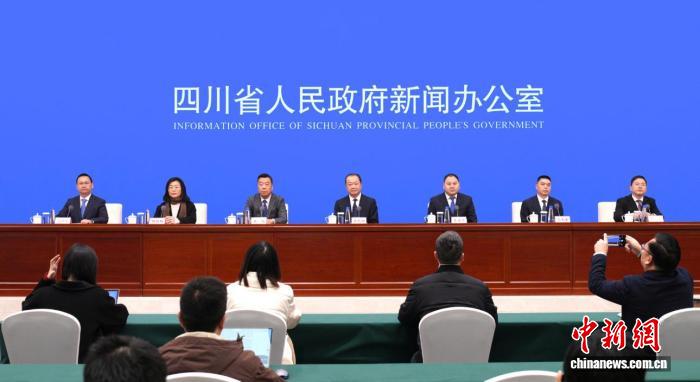
3月19-20日 常州 2026锂电关键材料及应用市场高峰论坛
鑫椤锂电· 2026-01-13 07:38
Core Viewpoint - The lithium battery industry is poised for a significant growth cycle in 2026, characterized by strong demand recovery, accelerated global expansion, and disruptive technological advancements, leading to a "spiral rise" in both volume and price [3]. Group 1: Conference Overview - The 2026 Lithium Battery Key Materials and Applications Market Summit will be held on March 19-20, 2026, in Changzhou, Jiangsu, organized by Xinluo Information [4]. - The summit aims to address the supply-demand dynamics in the lithium battery sector, focusing on the critical materials needed for battery production and the expected supply shortages [5]. Group 2: Key Topics of Discussion - The conference will feature three main topics: 1. In-depth discussions on cutting-edge technologies and market supply-demand [5]. 2. Announcement of the "Top Ten Lithium Battery Material Brands of 2025," evaluated based on shipment volume, market share, and customer reputation [6]. 3. B2B procurement matchmaking to connect top battery manufacturers and material suppliers, enhancing resource matching and reducing procurement costs [7]. Group 3: Proposed Discussion Topics - Proposed topics for the main forum include: - Outlook on lithium ore resource supply for 2026 [9]. - Market environment discussions on lithium carbonate operations [9]. - Research and application of high-energy density power battery technology [9]. - Additional topics will cover trends in the global new energy vehicle market and the impact of policies on the lithium market [10][11]. Group 4: Participation and Costs - The participation fee for the conference is set at 2800 yuan per person, with a limited-time free attendance option available for the first 200 registrants [17].






对日二氯二氢硅反倾销调查启动,中石化与中航油实施重组
Huaan Securities· 2026-01-13 07:10
Investment Rating - The industry investment rating is "Overweight" [3] Core Insights - The chemical industry is expected to continue its differentiated trend in 2026, with recommendations to focus on synthetic biology, pesticides, chromatography media, sweeteners, vitamins, light hydrocarbon chemicals, COC polymers, and MDI [6][7] - The arrival of a pivotal moment in synthetic biology is anticipated, driven by the adjustment of energy structures, which may disrupt fossil-based materials and favor low-energy products [7] - The implementation of quota policies for third-generation refrigerants is expected to lead to a high prosperity cycle, with demand remaining stable due to market expansion in Southeast Asia [8] - The electronic specialty gases market is characterized by high technical barriers and value, presenting significant opportunities for domestic substitution [10] - The trend of light hydrocarbon chemicals is becoming global, with a shift towards lighter raw materials in the olefin industry, which is expected to lead to a revaluation of leading companies in this sector [10] - The industrialization process of COC polymers is accelerating, with domestic companies likely to break through supply bottlenecks and expand market space [11] - Potash fertilizer prices are expected to rebound as the industry enters a destocking cycle, with supply pressures easing due to production cuts by major companies [12] - The MDI market is characterized by oligopoly, with a favorable supply structure expected to develop as demand gradually recovers [13] Industry Performance - The chemical sector's overall performance ranked 12th with a weekly change of 5.03%, outperforming the Shanghai Composite Index by 1.21 percentage points [5][22] - The top three performing sub-sectors were inorganic salts (10.92%), modified plastics (9.94%), and oil and gas refining engineering (8.67%) [25] Company Performance - The top three performing companies in the chemical sector for the week were Pulit (42.59%), Dawi Technology (35.34%), and Sanfu Co., Ltd. (32.29%) [29][30] - The companies with the largest declines included Hangzhou High-tech (-11.24%), Yahua Group (-6.59%), and Wind God Co., Ltd. (-5.48%) [31][32] Industry Dynamics - A recent anti-dumping investigation has been initiated against imports of dichlorodihydrosilane from Japan, which is expected to impact the domestic industry [38] - The restructuring of Sinopec and China Aviation Oil is a significant event in the state-owned enterprise reform landscape, aiming to enhance competitiveness in a complex international environment [38]

国亮新材(920076):北交所新股申购报告:耐火材料产业龙头,受益行业绿色升级与集中度提升间
KAIYUAN SECURITIES· 2026-01-13 06:52
Investment Rating - The report assigns a positive investment rating to Guoliang New Materials, highlighting its leadership in the refractory materials industry and potential benefits from industry upgrades and increased concentration [1]. Core Insights - Guoliang New Materials has consistently focused on the refractory materials sector, emphasizing technological innovation and green development. The company has been recognized as a national-level "Little Giant" and is included in the key "Little Giant" list as of August 2025 [1][11]. - The company has a strong R&D team led by PhDs and has received multiple awards for its technological advancements. Its main revenue source is the overall contracting of refractory materials, which has seen a steady increase in revenue contribution from 85.64% in 2022 to 93.75% in 2025H1 [1][31]. - The company forecasts a revenue of 1.053 billion yuan and a net profit of 79.814 million yuan for 2025, representing year-on-year growth of 16.46% and 12.47%, respectively [1][45]. Company Overview - Guoliang New Materials specializes in high-temperature industrial refractory materials and provides integrated solutions, including design, manufacturing, installation, and maintenance [11][19]. - The company has established partnerships with numerous well-known steel manufacturers, leveraging its technological advantages and extensive industry experience [12][60]. - The company operates primarily in North China, with a market share of 4.83% in the region as of 2024 [3][10]. Financial Performance - For the first three quarters of 2025, the company reported total revenue of 787 million yuan, with a year-on-year increase of 21.18%, and a net profit of 53.3532 million yuan, up 4.41% year-on-year [1][44]. - The gross profit margin for the first three quarters of 2025 was 20.39%, reflecting stable profitability [1][48]. - The company’s overall contracting revenue for refractory materials has been the main source of income, with significant contributions from steel ladles, intermediate ladles, and iron water buckets [31][38]. Industry Insights - The refractory materials industry is experiencing a shift towards green and intelligent upgrades, with increasing demand for high-end refractory materials driven by the steel industry's evolving requirements [2][3]. - The overall production of refractory materials in China has shown fluctuations from 2017 to 2024, with a projected decline in 2024 due to various market factors [2][3]. - The steel industry remains the primary application area for refractory materials, accounting for approximately 65% of total usage [2][15].
公用环保 202601 第 2 期:2025 年 1-11 月光伏/风电发电利用率同比下滑,重视环保+资源品投资逻辑
Guoxin Securities· 2026-01-13 06:07
Investment Rating - The report maintains an "Outperform" rating for the public utility and environmental sectors [1][5][8]. Core Insights - The report emphasizes the importance of the "environment + resource" investment logic, highlighting that many environmental companies possess resource attributes, which can lead to stable profit models through the extraction of valuable materials from waste [2][16][18]. - The report notes a decline in the utilization rates of photovoltaic and wind power generation in 2025, with photovoltaic utilization at 94.8% and wind power at 94.3% for the year-to-date [1][14]. Summary by Sections Investment Strategy - Public Utilities: Recommendations include major thermal power companies like Huadian International and Shanghai Electric, as well as leading renewable energy firms such as Longyuan Power and Three Gorges Energy [3][22]. - Environmental Sector: Focus on mature sectors like water and waste incineration, with recommendations for companies like China Everbright Environment and Shanghai Industrial Holdings [3][23]. Market Performance - The report indicates that the Shanghai Composite Index rose by 2.79%, with the public utility index increasing by 2.54% and the environmental index by 3.88% [1][24]. - In the power sector, thermal power saw a 2.40% increase, while renewable energy generation rose by 3.74% [1][25]. Key Data Overview - In November, the national electricity generation reached 779.2 billion kWh, with a year-on-year growth of 2.7% [45]. - The report highlights that the total electricity consumption for the year-to-date is 9,460.2 billion kWh, reflecting a 5.2% increase year-on-year [58]. Company Profit Forecasts and Ratings - Specific companies are highlighted with their respective ratings and financial metrics, such as Huadian International with a PE ratio of 10.2 for 2024 and 8.1 for 2025 [8]. - Other recommended companies include Longyuan Power, Three Gorges Energy, and China Nuclear Power, all rated as "Outperform" [8][22]. Special Research - The report discusses the shift from viewing environmental companies as cost centers to recognizing their potential for value creation through resource recovery and recycling [2][16]. - It also outlines the significant price increases in metals due to geopolitical tensions and supply chain concerns, which could benefit resource-oriented environmental companies [2][21].