
套期保值

Search documents
更多企业运用期货主动避险
Jin Rong Shi Bao· 2025-08-22 02:30
外部环境不确定因素越多,期货市场独特作用越发凸显。今年以来,在全球经济复苏乏力、地缘冲突加 剧的复杂形势下,大宗商品价格剧烈波动。面对挑战,我国期货市场主动作为,充分发挥价格发现和风 险管理功能。 "为助力实体经济稳健运行、更好应对外部风险挑战,期货市场各项工作有序推进、成效显著,市场发 展质量再上新台阶。"中国证监会期货监管司副司长王颖近日在2025中国(郑州)国际期货论坛上表示, 在当前不确定因素显著增多的市场环境下,期货市场为制造业相关市场主体稳定经营、提升产业链供应 链安全性提供了坚实保障。 期货市场服务能力不断增强 目前,国内期货市场已构建起覆盖能化、金属、农产品、金融等关键领域的多层次期货品种体系,成为 实体经济和产业链相关企业抵御价格波动风险、优化资源配置的重要工具。 在王颖看来,近年来我国期货市场服务能力不断增强。一方面,品种工具体系日益丰富。截至目前,我 国已上市商品期货和期权品种131个,可服务和辐射的国民经济领域更加广阔。另一方面,产业客户参 与度持续提升。2024年全市场产业客户日均成交量同比增长12.2%,参与套期保值的上市公司数量连续 11年保持增长。 多维度推动期货市场高质量发展 ...
黑色系企业的期市“成长记”
Qi Huo Ri Bao Wang· 2025-08-21 16:48
Core Viewpoint - The article discusses the challenges faced by companies in the steel and coal industries due to price volatility of raw materials and highlights the shift towards using futures and derivatives for risk management [2][4][9]. Group 1: Industry Challenges - Companies in the steel production sector, such as He Fang Industrial and Shandong Hui Lian Group, are struggling with significant price fluctuations in key raw materials like iron ore and coking coal, which directly impact production costs and profits [1][2]. - The volatility in prices has been exacerbated by changes in international trade environments, supply-demand adjustments, and the COVID-19 pandemic, leading to increased operational risks for trading companies [2][8]. Group 2: Adoption of Futures Trading - Shandong Hui Lian Group and Shandong Tai Feng Commercial Group have begun to explore futures trading as a means to manage risks associated with price fluctuations, transitioning from a passive to an active risk management approach [3][4][7]. - The companies initially faced challenges due to a lack of understanding and experience with futures trading, but training and support from futures exchanges have helped them recognize the benefits of hedging [3][4][8]. Group 3: Successful Implementation of Risk Management Strategies - In 2022, Shandong Tai Feng successfully implemented a hedging strategy using futures contracts, which resulted in a partial offset of losses from declining prices, demonstrating the effectiveness of risk management tools [4][6]. - Shandong Hui Lian Group also engaged in futures trading to lock in procurement prices and manage inventory value, achieving a risk management gain of approximately 150,000 yuan [5][6]. Group 4: Future Outlook - The "Enterprise Wind Plan" has facilitated the entry of over 700 companies into the futures market, enhancing their risk management capabilities and promoting the use of futures as a stabilizing tool in business operations [9][10]. - Companies are expected to continue deepening their participation in the futures market, exploring more complex hedging strategies and expanding their risk management frameworks to adapt to market changes [9][10].
法兰泰克: 期货和衍生品交易管理制度
Zheng Quan Zhi Xing· 2025-08-21 10:22
Core Points - The article outlines the futures and derivatives trading management system of Falan Tech Heavy Industry Co., Ltd, emphasizing the need for risk management and compliance with relevant laws and regulations [1][2][3] Group 1: General Principles - The company must adhere to principles of legality, prudence, safety, and effectiveness in futures and derivatives trading [2] - The company is prohibited from using raised funds for futures and derivatives trading [2] Group 2: Trading Types and Risk Management - The company can only engage in hedging activities related to its production and operations, ensuring that the types, scale, and duration of futures and derivatives align with the risks being managed [2][5] - Hedging activities include selling existing inventory, hedging fixed-price contracts, hedging floating-price contracts, and managing expected procurement and production volumes [5][6] Group 3: Management Structure and Responsibilities - The Board of Directors' Audit Committee is responsible for reviewing the necessity and feasibility of futures and derivatives trading [4] - The finance department manages the operational aspects of trading, including feasibility analysis, planning, and risk assessment [4][6] Group 4: Decision-Making and Operational Management - All futures and derivatives trading must be approved by the Board of Directors, with certain transactions requiring shareholder approval if they exceed specified thresholds [5][6] - The company can authorize the chairman or designated personnel to implement and manage trading activities after board approval [6] Group 5: Information Management and Disclosure - All personnel involved in trading must comply with confidentiality protocols, and the company must ensure that all trading activities are disclosed in accordance with regulatory requirements [6][7] - The finance department is responsible for tracking market prices and assessing risks associated with trading activities [8] Group 6: Risk Handling - In the event of significant anomalies in trading activities, the finance center must submit an analysis report and proposed solutions to the Board of Directors for immediate discussion [9]

国富期货成功举办“防范非法证券及苹果期货风险管理”线上投教活动
Qi Huo Ri Bao· 2025-08-21 07:12
Group 1 - The event focused on preventing illegal securities activities and the practical application of apple futures in enterprise risk management [1][2] - Professor He Shaoqi emphasized that illegal futures trading is essentially fraudulent, harming inexperienced investors and disrupting financial order [1] - A comprehensive legal framework has been established in China to combat illegal futures activities, involving a collaborative mechanism among four departments for accountability [1] Group 2 - Manager Wang Zhixin discussed key delivery elements of apple futures contracts, including grade standards, location settings, process arrangements, and default handling [2] - Enterprises can effectively manage market risks through hedging, diversified operations, and financial management, with a focus on the "insurance + futures" innovative model [2] - The event had a total of 550 page views and 291 unique viewers, indicating a successful outreach in investor education [2]
外汇风险管理工具需求激增 企业呼吁加快推出外汇期货产品
Qi Huo Ri Bao Wang· 2025-08-21 01:25
Core Insights - The demand for efficient and convenient foreign exchange risk management tools among domestic enterprises is unprecedented due to the increasingly complex global economic environment and growing cross-border trade and investment activities [1][2]. Group 1: Market Trends - As of January to July 2025, 1,114 listed companies in China have engaged in futures and derivatives business, with over 80% (902 companies) involved in foreign exchange hedging, indicating a rapid increase in demand for foreign exchange risk management as China's economy becomes more globalized [1][2]. - Approximately 33% (364 companies) of companies have engaged in commodity futures hedging, and about 15% (162 companies) are involved in both commodity futures and foreign exchange derivatives, with manufacturing companies being the main force in hedging activities [2]. Group 2: Risk Management Evolution - Risk management capabilities have shifted from being a "bonus" to a "survival" necessity for enterprises, highlighting the importance of managing various risks during development [3]. - The use of futures and derivatives has become essential for modern enterprises to manage risks and achieve stable operations, reflecting a qualitative leap in risk management awareness among Chinese companies [3]. Group 3: Need for Comprehensive Risk Management - Companies are encouraged to integrate foreign exchange risk management into a comprehensive risk management system, moving away from conservative attitudes and avoiding reckless speculation [5]. - The cultivation of specialized talent in derivative risk management is crucial, as it requires a combination of knowledge in spot trading, financial theory, and risk control experience [5]. Group 4: Product Development and Market Growth - The introduction of foreign exchange futures products is expected to provide more options, improve the efficiency and transparency of foreign exchange risk management, and reduce hedging costs for enterprises [4]. - As of July 2025, the total capital in the futures market is approximately 1.82 trillion yuan, reflecting an 11.6% increase from the end of 2024, indicating a growing market and increasing demand from enterprises [6].
郑州国际期货论坛聚焦油脂油料风险管理
Zhong Guo Xin Wen Wang· 2025-08-20 16:35
Core Insights - The 2025 China (Zhengzhou) International Futures Forum focused on risk management in the oilseed and oil market, highlighting the importance of canola oil and peanuts in China's agricultural landscape [1][2] - The Zhengzhou Commodity Exchange (ZCE) has opened its canola oil, canola meal, and peanut futures and options to foreign traders, with significant participation from international grain merchants [1] - The oilseed and oil futures have become essential risk management tools for industry chain enterprises, contributing to food security in China [1][2] Group 1 - Canola oil is the second-largest plant oil in terms of production and consumption in China, while peanuts have the highest self-sufficiency rate among major oilseed crops [1] - In the first seven months of 2023, the Dalian Commodity Exchange reported an average daily trading volume of 4.69 million contracts for oilseed and oil futures and options, a 21% increase year-on-year [1] - The average daily open interest reached 8.09 million contracts, reflecting a 33% year-on-year growth, with institutional clients accounting for nearly 70% of the positions [1] Group 2 - The oilseed and oil futures market has evolved beyond being a mere "safe haven" to becoming a stabilizing force for numerous enterprises in China [2] - Industry leaders suggest that in the face of increasing international policy and market uncertainties, enterprises should utilize hedging and financial tools to enhance operational resilience [2] - Risk management in the oilseed sector should closely monitor global production, import-export dynamics, tariff policy adjustments, and biodiesel industry policies [2]
中国证监会期货监管司副司长王颖:期货市场独特作用愈发凸显
Zheng Quan Ri Bao Wang· 2025-08-20 06:40
Group 1 - The core viewpoint emphasizes the increasing importance of the futures market as a professional risk management platform amid profound adjustments in the international economic order and rising uncertainties in the global economy [1] - The futures market's service capabilities have been continuously enhanced, with a rich variety of products and tools introduced, including new futures contracts for polysilicon, casting aluminum alloy, pure benzene, and propylene, bringing the total number of listed commodity futures and options to 131 [1] - The participation of industrial clients in the futures market has significantly increased, with a year-on-year growth of 12.2% in average daily trading volume for industrial clients in 2024, and the total position of industrial clients in 48 major products equivalent to over 200 million tons in the spot market [1] Group 2 - The influence of futures prices has been continuously rising, with domestic application scenarios expanding, and various forms such as hedging, arbitrage, and rights trading being widely adopted [2] - The futures market is increasingly integrated into the national development agenda, supporting rural revitalization and ensuring food security through innovative models like "insurance + futures," while also serving the high-quality development of the manufacturing industry [2] - Among the listed commodity futures and options, 84 are industrial products, accounting for 64%, providing solid support for market participants in stabilizing operations and enhancing supply chain security amid increasing uncertainties [2]
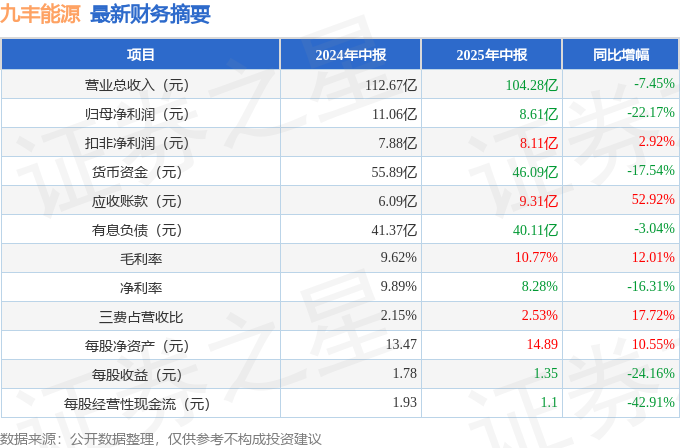
九丰能源2025年中报简析:净利润同比下降22.17%
Zheng Quan Zhi Xing· 2025-08-19 22:59
Core Viewpoint - Jiufeng Energy (605090) reported a decline in net profit by 22.17% year-on-year for the first half of 2025, with total revenue also decreasing by 7.45% compared to the previous year [1] Financial Performance Summary - Total revenue for the first half of 2025 was 10.428 billion yuan, down from 11.267 billion yuan in the same period of 2024, representing a decrease of 7.45% [1] - Net profit attributable to shareholders was 861 million yuan, a decline of 22.17% from 1.106 billion yuan in the previous year [1] - Gross margin improved to 10.77%, an increase of 12.01% year-on-year, while net margin decreased to 8.28%, down 16.31% [1] - Total expenses (selling, administrative, and financial) amounted to 264 million yuan, accounting for 2.53% of revenue, which is an increase of 17.72% year-on-year [1] - Earnings per share decreased to 1.35 yuan, down 24.16% from 1.78 yuan in the previous year [1] Key Financial Metrics - Cash flow from operating activities decreased by 40.48%, attributed to uncollected large sales receivables [4] - The company’s return on invested capital (ROIC) was 13.23%, indicating strong capital returns [5] - The company’s cash assets are reported to be healthy, with a debt ratio of 24.96% for interest-bearing liabilities [5] Changes in Financial Items - Significant changes in financial items included a 3148.27% increase in trading financial assets due to net subscriptions of financial products [3] - Accounts receivable increased by 116.46%, indicating outstanding large sales payments [3] - Inventory decreased by 40.90%, reflecting sales from previously accumulated stock [3] Fund Holdings - The largest fund holding Jiufeng Energy is Tianhong Multi-Asset Bond A, with a current scale of 1.701 billion yuan and a recent net value of 1.3178 [6]


筑牢套保风控之基 护航企业行稳致远
Qi Huo Ri Bao Wang· 2025-08-19 22:27
Group 1 - The 2025 China (Zhengzhou) International Futures Forum emphasized the importance of risk management for industrial enterprises participating in the futures market [1] - Futures and derivatives are financial tools for managing market price volatility, but they come with inherent risks such as leverage and speculation, necessitating robust internal risk control systems [1] - The Shanghai and Shenzhen Stock Exchanges have issued guidelines stressing that companies should engage in futures trading legally and prudently, discouraging speculative trading [1] Group 2 - State-owned enterprises prioritize compliance in hedging activities, viewing internal control as essential for sustainable business operations [2] - Effective incentive mechanisms for futures trading should balance risk control and hedging effectiveness, ensuring alignment with core business objectives [2] - Companies must focus on risk management, compliance, and cost-effectiveness when constructing futures business incentive mechanisms [2] Group 3 - Effective risk control relies on information technology systems, which enhance efficiency and reduce operational risks [3] - Companies should view information technology as a strategic investment to build intelligent risk control platforms for stable hedging operations [3] - Disclosure of hedging activities by listed companies must be complete, timely, and proactive to mitigate negative perceptions of futures trading [3]
郑州国际期货论坛:共探产业企业风险管理新路径
Zhong Guo Xin Wen Wang· 2025-08-19 18:29
Group 1 - The 2025 China (Zhengzhou) International Futures Forum focused on risk management for industrial enterprises and the high-quality development of China's futures and derivatives market [1] - As of July 2025, 1,114 listed companies in the market have engaged in futures and derivatives business, with over 80% (902 companies) involved in foreign exchange hedging and about one-third (364 companies) in commodity futures hedging [1] - The manufacturing sector is the main force in hedging activities, covering industries such as chemicals and agricultural products, facilitating industrial upgrades and overseas expansion [1] Group 2 - Derivatives have become an essential tool in enterprise risk management, and companies are encouraged to establish professional risk management teams to enhance their application capabilities [2] - As of July 2025, the total capital in the futures market reached approximately 1.82 trillion yuan, an increase of 11.6% from the end of 2024 [2] - The number of listed companies announcing hedging activities increased significantly, with 1,383 companies reporting hedging announcements in the first seven months of 2025, a year-on-year growth of 15.7% [2]