
套期保值

Search documents
避险网刘文财:上市公司已形成成本有效套期保值理念
Qi Huo Ri Bao Wang· 2025-08-19 18:17
Core Viewpoint - The concept of effective hedging has been established among listed companies, with a total hedging amount of approximately 3.4 trillion yuan announced by A-share listed companies in 2024 [1] Group 1: Hedging Strategies - Liu Wencai, founder of the Hedging Network, highlighted the initial doubts companies have regarding the effectiveness of futures hedging during normal price fluctuations and the increased capital pressure during extreme price movements [1] - In May 2024, influenced by market sentiment, international copper futures prices reached historical highs, prompting a copper company to use call options instead of futures for hedging [1] Group 2: Practical Application - The copper company closed its futures buy hedge position on May 30, 2024, and opened a position in copper options with a quantity of 1,000 tons at an exercise price of 84,000 yuan/ton, with an average premium of 1,552 yuan/ton [2] - On June 24, 2024, the copper options expired without being exercised, resulting in a premium loss of 1,552 yuan/ton, while the company bought back copper futures at a transaction price of 78,650 yuan/ton, achieving an estimated profit of approximately 3.5 million yuan through this strategy [2] - Liu Wencai emphasized that futures are excellent tools for industrial companies, and the combination of futures and options can significantly enhance profits [2]
套期保值助力上市公司平稳发展
Qi Huo Ri Bao Wang· 2025-08-19 18:17
Core Viewpoint - The development quality of listed companies is crucial for the stability of the capital market, and effective risk management is a key dimension of this quality [1][2]. Group 1: Risk Management Trends - In 2025, from January to July, 1,114 listed companies engaged in futures and derivatives business, with approximately 80% (902 companies) involved in foreign exchange hedging, 33% (364 companies) in commodity futures hedging, and 15% (162 companies) in both [1]. - Manufacturing companies are the main participants in the futures market for hedging, particularly in the chemical and agricultural processing sectors, facilitating industry upgrades and overseas expansion [2]. - There is a growing trend towards systematic, refined, and global risk management among listed companies, with an increasing awareness of proactive hedging [2]. Group 2: Role of Associations and Guidelines - The China Listed Companies Association plays a pivotal role in guiding companies in rational participation in hedging, enhancing their quality of development [3]. - The Shanghai and Shenzhen Stock Exchanges have issued guidelines for the disclosure of hedging business information, leading to improved transparency and understanding of hedging effectiveness among investors [2][3]. Group 3: Recommendations for Companies - Companies are encouraged to establish a strong risk management awareness, avoid both conservative and speculative behaviors, and engage in regulated operations [4]. - It is essential for companies to develop a rigorous and efficient risk control system, including scientific decision-making and risk warning mechanisms [4]. - The cultivation of professional talent in derivatives risk management is critical, requiring a blend of knowledge in spot operations, financial theory, and risk control experience [4].
浙商中拓雷衍升:开展套期保值必须坚守风险对冲初心
Qi Huo Ri Bao Wang· 2025-08-19 18:10
Core Viewpoint - The importance of establishing an internal control and risk management system for futures derivatives business in enterprises is emphasized, highlighting that internal control is essential for effective risk management [1][2]. Group 1: Internal Control and Risk Management - Internal control consists of policies, systems, and processes designed to ensure normal operations, reduce errors, and prevent asset loss [1]. - Risk management is a systematic approach to identify, assess, monitor, and control various risks faced by enterprises, aiming for sustainable development under different risk conditions [1]. - The risk management framework is built upon the internal control framework, making internal control a crucial part of risk management [1]. Group 2: Hedging and Operational Guidelines - The centralized operation and management of futures and derivatives trading should be conducted by the enterprise headquarters, ensuring separation of key roles such as decision-making, order placement, risk control, compliance supervision, and market research [1]. - The primary goal of engaging in futures market hedging is to mitigate market operational risks, necessitating the establishment of a supervision system and checks and balances for operational procedures [1]. - It is essential to standardize operations in decision-making, authorization, and trading processes to enhance the enterprise's risk resistance capabilities in the futures market [1]. Group 3: Trading Motivation and Behavior - The understanding of concepts influences trading motivations, which in turn determines trading behavior; poor trading motivations can amplify trading risks [2]. - Enterprises must adhere to the original intention of risk hedging, focusing on the physical market and avoiding speculation, while accepting imperfect hedging [2]. - Fine management of basis is necessary to optimize the hedging effect [2].

期货新品种纯苯专题报告(三):纯苯与己内酰胺
Tong Hui Qi Huo· 2025-08-19 11:34
Report Summary 1. Report Industry Investment Rating No information is provided regarding the report industry investment rating. 2. Core Viewpoints of the Report - The listing of pure benzene futures/options allows caprolactam (CPL) enterprises to shift from being "passive price takers" to "active cost managers". By focusing on procurement price locking (going long on BZ), combined with rolling position transfers and basis point pricing, and using options to set a cost ceiling, profit fluctuations can be contained within an "operationally acceptable" range [2][3][24]. - The key is to closely align spot plans, futures positions, and profit accounting to form a complete, reviewable, auditable, and optimizable process loop, rather than "guessing price directions" [3][24]. 3. Summary by Relevant Catalogs I. Pure Benzene Industry Chain and Pricing Logic - **Pure Benzene**: It is a basic organic raw material in the petrochemical industry chain with wide - ranging downstream applications. Its price fluctuations significantly impact the cost of CPL production enterprises. Supply is affected by refinery operating rates, import arbitrage windows, and crude oil trends. Demand is mainly from styrene (nearly 50%) and CPL (about 15% - 20%). Its price is highly correlated with crude oil, PX, and styrene, with obvious cyclical fluctuations and relatively limited basis fluctuations in monthly and quarterly dimensions, providing a basis for hedging [4]. - **Caprolactam (CPL)**: It is the core raw material for producing polyamide 6 (PA6). Raw material costs account for over 70% of CPL production costs, with pure benzene having the highest proportion. Its price is driven by pure benzene, energy costs, downstream demand, and industry supply - demand patterns, and there is a certain price - spread transmission relationship with pure benzene [7]. II. Price Linkage Analysis between Pure Benzene and CPL - **Historical Price - Spread Relationship**: Since 2020, the prices of pure benzene and CPL have been highly correlated, with correlation coefficients generally between 0.7 - 0.9, and the CPL - BZ price spread has weakened year by year. In 2025, the average price spread was only 3,201 yuan/ton [8]. - **Profit Transmission**: There are three types of profit transmission: upstream - driven (crude oil price increase leads to reduced CPL profits), downstream - demand - driven (strong demand for spinning and engineering plastics repairs CPL profits), and import - window - driven (opening or closing of the import arbitrage window affects CPL spot pricing) [10]. III. Hedging Strategy Design for Pure Benzene and CPL - **Hedging Principles**: The core goal of hedging is to lock in the enterprise's future production profits. Strategies include full - hedging (maximally hedges raw material price increase risks but loses potential benefits from price drops), proportional - hedging (balances risk hedging and profit elasticity), rolling - hedging (spreads the risk of entry timing but requires high risk - control and fund - management capabilities), and cross - hedging (using other related varieties, but may be ineffective when correlations are insufficient) [11][12][13][14]. - **Calculation of Hedging Lots**: The number of hedging lots = external pure benzene procurement volume ÷ contract unit × hedging ratio. There is a dynamic adjustment mechanism based on production and sales plans, price spreads between spot and futures, and market expectations [15]. - **Key Points of Strategy Implementation**: Select the main contract or near - month contracts with good liquidity, set a margin occupancy cap, and evaluate hedging effectiveness by comparing simulated profits with non - hedged profits [16]. IV. Case Calculation and Profit Scenarios - **Price - Spread Calculation**: Using the "CPL - pure benzene" price spread as an approximate measure of profit can guide hedging ratios and risk management. Different price - spread scenarios are simulated, and a profit warning line of 2,800 yuan/ton is set. Different hedging strategies are recommended based on different price - spread ranges [17][18][19][20]. - **Risk Situations and Strategy Adjustments**: Different risks such as spatial mismatch, time mismatch, excessive basis weakening or strengthening, and simultaneous fluctuations in nominal price spreads and basis are considered, and corresponding strategies are proposed [23].
避险网创始人刘文财:上市公司有效套期保值理念已经形成
Qi Huo Ri Bao Wang· 2025-08-19 09:47
Core Insights - The 2025 China (Zhengzhou) International Futures Forum was held, focusing on risk management in industries, highlighting the growing importance of hedging strategies among listed companies [1] - In 2024, the total hedging amount announced by A-share listed companies in the real economy is approximately 3.4 trillion yuan, with commodity hedging at about 289 billion yuan, foreign exchange hedging at around 3 trillion yuan, and interest rate hedging at 5 billion yuan [1] - Companies are increasingly utilizing futures and options for hedging, with a specific case demonstrating a copper company's successful strategy that resulted in a profit of approximately 3.5 million yuan through effective use of options [2] Summary by Category Hedging Strategies - The concept of effective hedging has been established among listed companies, with a significant total hedging amount reported [1] - The distribution of hedging amounts shows that most companies have hedging amounts between 100 million to 1 billion yuan, with commodity hedging typically below 100 million yuan [1] Market Trends - The copper market experienced historical price highs in May 2023, prompting companies to reconsider their hedging strategies [1] - The combination of futures and options is seen as a beneficial tool for companies to enhance profits and manage risks effectively [2] Case Study - A copper company utilized a strategy involving buying call options instead of futures to hedge against price declines, resulting in a loss of the premium but avoiding larger losses from futures [2] - The specific transaction involved a hedge with an execution price of 84,000 yuan per ton and a premium of 1,552 yuan per ton, leading to a net gain of approximately 3.5 million yuan [2]

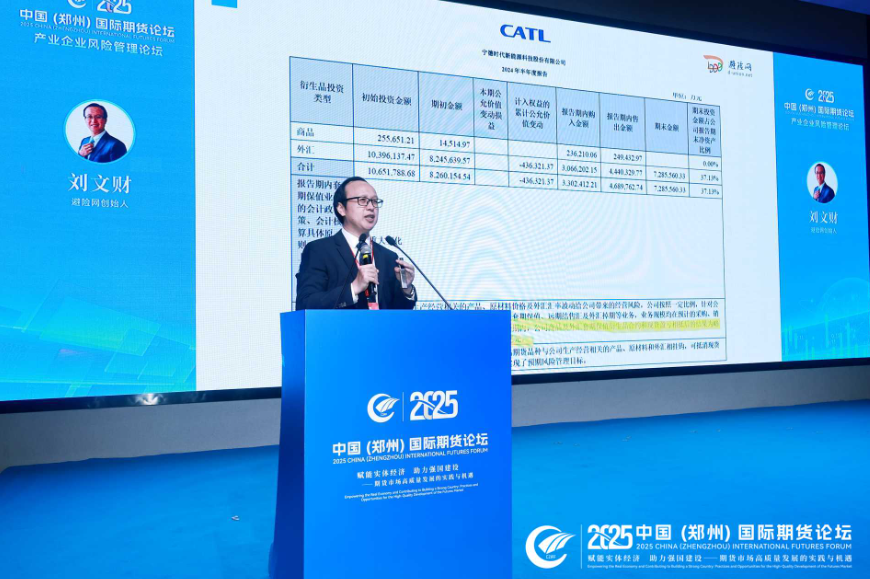
中国上市公司协会纪委书记许国新:制造业上市公司是套保的主力军
Qi Huo Ri Bao Wang· 2025-08-19 07:21
Group 1 - The 2025 China (Zhengzhou) International Futures Forum highlighted new trends in risk management among listed companies, particularly in the manufacturing sector, which is leading in hedging activities across industries such as chemicals and agricultural products [1] - Listed companies are increasingly using derivatives to manage risks related to exchange rates, interest rates, and commodity price fluctuations, with a growing trend towards comprehensive management of financial asset price volatility [1] - There is a noticeable increase in the awareness of proactive risk avoidance among listed companies, with a trend towards systematic, refined, and globalized risk management practices [1] Group 2 - Since the release of the hedging disclosure guidelines, listed companies have been optimizing their disclosure content, providing detailed information on hedging effects and emphasizing the relationship between spot and futures markets [2] - More entities are adhering to hedging accounting standards, aligning more closely with the essence of risk management [2] - Overall, hedging has played a crucial role in ensuring the stable development of listed companies [2]
透明信披还原套保业务,消除“雾里看花”!快来看看金龙鱼是怎么做的
Qi Huo Ri Bao· 2025-08-18 23:33
Core Insights - The article emphasizes the importance of futures hedging for oilseed and oil enterprises to stabilize operations and mitigate risks in the context of increasing price volatility in the commodity market [1][2] - Jinlongyu (金龙鱼) is highlighted as a leader in the industry, showcasing outstanding performance in its futures hedging business and setting a benchmark for information disclosure in the sector [1][2] Group 1: Company Performance - Jinlongyu reported a revenue of 1156.82 billion yuan in the first half of the year, representing a year-on-year growth of 5.67% [2] - The company's net profit attributable to shareholders reached 17.56 billion yuan, a significant increase of 60% compared to the previous year [2] - The non-recurring net profit was 13.89 billion yuan, showing a remarkable growth of 764% year-on-year [2] Group 2: Hedging Strategy and Industry Trends - The hedging strategy has evolved from merely risk defense to becoming a strategic foundation for stable operations, integrating futures tools with spot operations [2][4] - The overall participation rate in hedging within the grain and oil processing industry is high, with both large and small enterprises engaging in hedging activities [3] - The industry is moving towards a phase characterized by comprehensive coverage, refined operations, and strategic enhancement in hedging practices [3] Group 3: Information Disclosure Practices - Jinlongyu has set a standard for transparent information disclosure regarding its hedging activities, allowing investors to understand the effectiveness of risk management [6][8] - The company’s half-year report provided detailed information on hedging tools, their purposes, and the financial impacts, enhancing investor trust [6][7] - The shift towards transparent disclosure is seen as crucial for improving investor confidence and understanding of financial risks and performance [8][9] Group 4: Industry Implications - Jinlongyu's practices serve as a model for other companies in the oilseed and oil sector, highlighting the importance of effective risk management and value creation through hedging [9][10] - The article suggests that companies should recognize the significance of hedging in both risk management and value creation, while also prioritizing accurate and timely information disclosure [9][10] - The future of the industry will likely see continued price volatility, making hedging an essential tool for enterprises to achieve sustainable development [10]

全面透明信披赢得市场广泛信任
Qi Huo Ri Bao Wang· 2025-08-18 16:26
Core Insights - The article discusses the evolution of hedging strategies in the oilseed and oil industry, highlighting how companies like Jinlongyu have transformed hedging from a mere risk management tool into a strategic foundation for stable operations [1][3][7] - The performance of Jinlongyu and Daodaquan demonstrates the effectiveness of hedging, with Jinlongyu reporting a revenue of 115.68 billion yuan and a net profit of 1.76 billion yuan in the first half of the year, while Daodaquan achieved a revenue of 2.79 billion yuan and a net profit of 181 million yuan [1][2] Company Performance - Jinlongyu's revenue for the first half of the year reached 115.68 billion yuan, a year-on-year increase of 5.67%, with a net profit of 1.76 billion yuan, up 60% [1] - Daodaquan reported a revenue of 2.79 billion yuan, reflecting a 1.16% year-on-year growth, and a net profit of 181 million yuan, which is a significant increase of 563.15% [2] Hedging Strategy and Impact - Jinlongyu has successfully integrated hedging into its operational strategy, achieving a total profit of 5.8 billion yuan from hedging tools and underlying projects [3][4] - The hedging business has become a standard practice in the industry, with a high participation rate among grain and oil processing companies, indicating a shift towards comprehensive coverage and strategic enhancement [2][3] Information Disclosure Practices - Jinlongyu has improved its information disclosure regarding hedging activities, providing clear insights into its hedging profits and strategies, which enhances investor understanding and trust [4][5][6] - The company’s transparent reporting practices have set a benchmark in the industry, contrasting with the previous opaque disclosures that left investors confused [4][7] Industry Trends and Recommendations - The article emphasizes the importance of transparent information disclosure and robust risk management strategies for oilseed and oil companies to gain market trust and ensure sustainable development [6][9] - Companies are encouraged to learn from Jinlongyu's practices, focusing on enhancing their hedging strategies and improving information disclosure to foster industry growth [7][9]
陕西化工企业探索风险管理新路径
Qi Huo Ri Bao Wang· 2025-08-18 16:26
Core Viewpoint - The chemical industry in Shaanxi is at a critical juncture for transformation and upgrading, with a focus on risk management solutions through innovative financial tools in response to intensified competition and commodity price volatility [1][4]. Group 1: Industry Context - Shaanxi is a core region of China's energy and chemical industry, with a coal-based olefin industry chain that generates an annual output value exceeding 100 billion [2]. - The DCE is implementing three major initiatives to support the high-quality development of the chemical industry in Shaanxi, including expanding polyethylene delivery areas and innovating product designs [2]. Group 2: Financial Tools and Innovations - The DCE introduced three chemical monthly average price futures, which feature innovative pricing, lower annual volatility, and diverse strategies for risk management [2]. - Monthly average price futures provide enterprises with a smoother price curve, offering a reference for price trends with characteristics of gradual increases and decreases [2]. Group 3: Risk Management Practices - A framework for internal control of hedging was discussed, emphasizing a three-tier approval mechanism involving senior management, risk control, and the board of directors [3]. - Practical applications of futures derivatives in the industry were shared, highlighting how traders can optimize hedging effects and manage risks through various trading models [3]. Group 4: Training Outcomes - The successful training session marked a significant step for the Shaanxi chemical industry in risk management, with futures derivatives becoming essential tools for addressing market volatility [4]. - Innovative financial tools and models, such as monthly average price futures and basis trading, are transforming traditional business practices in the chemical sector [4].
金能科技20250816
2025-08-18 01:00
Summary of Jineng Technology Conference Call Company Overview - **Company**: Jineng Technology - **Date**: August 16, 2025 Key Points Financial Performance - Jineng Technology plans to partially convert convertible bonds, with 9.65 billion yuan remaining unconverted to avoid excessive dilution of equity, and has reserved funds for potential share buybacks, with current cash reserves around 37-38 billion yuan [2][4][7] - The company reported a loss of approximately 49 million yuan in Q2, primarily due to production halts, high propane prices, and tariffs, although the coke business showed improvement [3][16] - Adjustments in accounting policies extended the depreciation period for specialized equipment from 10 years to 20 years, impacting profits by approximately 224 million yuan in 2025 and 267 million yuan in 2026 [2][10] Tariff Impact - Tariffs are expected to negatively affect Jineng Technology's 2025 performance, with estimated losses nearing 200 million yuan due to increased costs from high-priced Middle Eastern propane and reduced profits from U.S. propane sales [2][11] - The company is increasing exports to mitigate tariff impacts, with export profits per ton exceeding domestic sales by 200-250 yuan [2][11] Export and Market Performance - Jineng Technology anticipates achieving an export volume of around 500,000 tons in 2025, with strong performance in polypropylene and carbon black products in the European and American markets, establishing partnerships with major clients like Continental and Bridgestone [2][20] - The company has made significant progress in developing high-performance polypropylene products, with successful certifications and collaborations with well-known domestic enterprises [19] Strategic Decisions - The company is considering partial conversion of convertible bonds due to favorable cash flow and has prepared for market value management, focusing on core business and potential acquisitions [4][5][6] - There are no major capital expenditure projects planned, with ongoing hydrogen cooperation projects being managed by local government [8] Future Outlook - Achieving the 350 million yuan performance target for 2025 is challenging due to tariff impacts and high costs in fine chemical product adjustments, with the need to observe Q4 performance for a clearer outlook [12] - The coke market has shown signs of recovery, with profits around 80 yuan per ton expected in Q4, while the overall market conditions for 2026 are anticipated to improve due to increased propane supply and favorable international oil market conditions [13][14] M&A Plans - Jineng Technology is exploring M&A opportunities primarily in related upstream and downstream sectors, with announcements expected soon [15] Non-Recurring Gains - Non-recurring gains significantly influenced the half-year performance, including government subsidies and asset sales, with expectations for continued support in the second half [17] Energy Management - The company is addressing surplus energy issues through advanced control technologies and is exploring partnerships with the government to optimize production costs and enhance operational efficiency [22] Conclusion - Jineng Technology is navigating a challenging environment with strategic adjustments in financial management, operational focus, and market positioning to enhance resilience and capitalize on growth opportunities in the coming years [2][4][11][20]
