
新发展理念

Search documents
国家统计局:7月份国民经济保持稳中有进发展态势
Guo Jia Tong Ji Ju· 2025-08-15 02:05
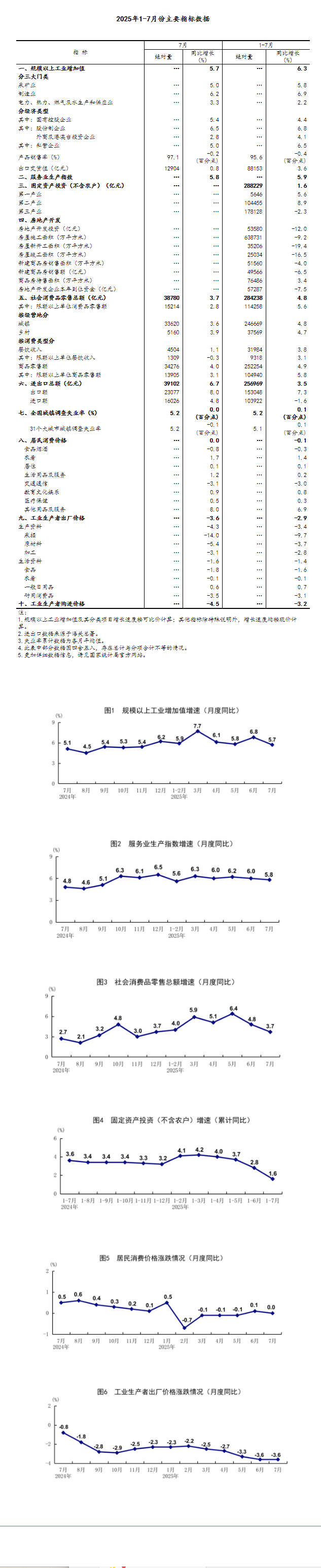
Economic Overview - In July, under the strong leadership of the Central Committee, the national economy maintained a steady growth trend, with production and demand continuing to rise, and overall employment and prices remaining stable [1][10]. Industrial Production - In July, the industrial added value above designated size increased by 5.7% year-on-year and 0.38% month-on-month. The mining industry grew by 5.0%, manufacturing by 6.2%, and electricity, heat, gas, and water production and supply by 3.3% [2]. - The equipment manufacturing industry saw an 8.4% increase, while high-tech manufacturing grew by 9.3%, outperforming the overall industrial growth by 2.7 and 3.6 percentage points respectively [2]. - From January to July, the industrial added value increased by 6.3% year-on-year, with the manufacturing purchasing managers' index at 49.3% in July [2]. Service Sector - The service production index rose by 5.8% year-on-year in July, with significant growth in information transmission, software, and IT services (11.9%), finance (8.7%), and leasing and business services (8.0%) [3]. - From January to July, the service production index increased by 5.9%, and the revenue of large-scale service enterprises grew by 7.5% in the first half of the year [3]. Retail Sales - In July, the total retail sales of consumer goods reached 38,780 billion yuan, a year-on-year increase of 3.7% [4]. - Online retail sales amounted to 86,835 billion yuan, growing by 9.2%, with physical goods online retail sales at 70,790 billion yuan, up 6.3% [4]. Fixed Asset Investment - From January to July, fixed asset investment (excluding rural households) totaled 288,229 billion yuan, a year-on-year increase of 1.6%, with manufacturing investment growing by 6.2% [5]. - Infrastructure investment rose by 3.2%, while real estate development investment fell by 12.0% [5]. Trade and Exports - In July, the total value of goods imports and exports reached 39,102 billion yuan, a year-on-year increase of 6.7%, with exports growing by 8.0% and imports by 4.8% [6][7]. - From January to July, the total value of goods imports and exports was 256,969 billion yuan, up 3.5% year-on-year [6]. Employment - The urban surveyed unemployment rate averaged 5.2% from January to July, with a slight increase of 0.2 percentage points in July compared to the previous month [8]. Consumer Prices - In July, the Consumer Price Index (CPI) remained flat year-on-year, with a month-on-month increase of 0.4% [9]. - The core CPI, excluding food and energy, rose by 0.8% year-on-year, indicating a slight increase in inflationary pressure [9].

习言道丨这八个字,被习近平当作座右铭
Zhong Guo Xin Wen Wang· 2025-08-14 01:52
Core Viewpoint - The phrase "for official duty, benefit the local people" has been adopted by Xi Jinping as a guiding principle throughout his political career, emphasizing the importance of serving the public and prioritizing their welfare [2][4][5]. Group 1: Historical Context - Xi Jinping first referenced the phrase during his tenure as the Secretary of the Zhejiang Provincial Committee in 2003, highlighting its significance in his governance philosophy [2]. - The phrase is rooted in the legacy of Hu Ze, a renowned official from the Northern Song Dynasty, who exemplified the ideals of public service and integrity [3]. Group 2: Political Philosophy - Since the 18th National Congress, Xi has articulated the need for a correct view of political achievements, focusing on serving the people rather than seeking personal glory [5][6]. - Xi emphasizes that the Communist Party must prioritize the well-being of the people, stating that serving the public is the ultimate measure of success [6][9]. Group 3: Practical Application - Xi has called for a balance between "visible achievements" and "hidden contributions," advocating for long-term benefits over short-term gains [10]. - He has criticized the pursuit of GDP growth at the expense of environmental and social consequences, urging a shift towards sustainable development practices [10].
业务丛谈丨找准政治监督切入点着力点
Zhong Yang Ji Wei Guo Jia Jian Wei Wang Zhan· 2025-08-14 00:10
Group 1 - The core viewpoint emphasizes the need for political supervision to be specific, precise, and normalized, as highlighted by General Secretary Xi Jinping [1] - The Anhui Province's Bengbu City is actively exploring effective methods and practical paths to deepen political supervision, aiming to transform supervision results into developmental outcomes [1] - The focus is on ensuring the implementation of the Party's comprehensive leadership and enhancing political discipline, addressing issues such as "two-faced" individuals and "false loyalty" [1][2] Group 2 - There is a strong emphasis on supervising the "key minority," particularly the "one leader" and leadership teams, to ensure accountability in party governance [2] - The city is implementing a system for monitoring the political responsibilities of leaders, including sending reminders about their duties and reporting on violations [2] - The use of electronic integrity archives and big data supervision is being enhanced to improve the precision and effectiveness of political oversight [2] Group 3 - The political supervision must align with the interests of the people, focusing on corruption and issues affecting the public [3] - There is a commitment to addressing prominent issues that impact people's livelihoods and ensuring that corrective actions are taken based on public feedback [3] - The collaboration between disciplinary inspection and functional departments is being strengthened to effectively tackle issues that matter to the community [3]
经济实力:家底更加殷实
Jing Ji Ri Bao· 2025-08-13 22:23
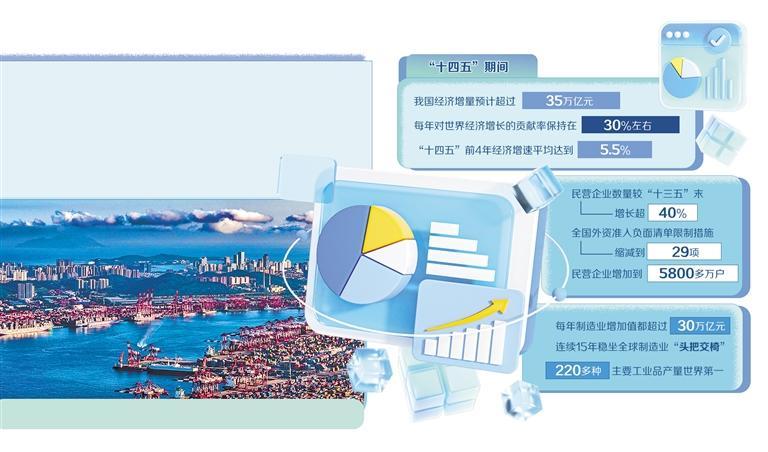
Core Insights - The "14th Five-Year Plan" period is set to conclude in 2025, marking a significant milestone in China's economic and social development, with a focus on achieving high-quality growth and innovation [2][3]. Economic Growth - China's economy has consistently crossed significant thresholds, maintaining its position as the world's second-largest economy, with GDP expected to reach approximately 140 trillion yuan by 2025 [4]. - The average economic growth rate during the "14th Five-Year Plan" is projected at 5.5%, which is notable for an economy of China's size [4]. - The economic increment during this period is expected to exceed 35 trillion yuan, equivalent to recreating the economic output of the Yangtze River Delta region [4]. Manufacturing and Infrastructure - China remains the world's largest manufacturing power, with over 220 products leading in global production [5]. - The country has established the largest power infrastructure system globally, with an energy self-sufficiency rate of over 80% [6]. - Significant advancements in infrastructure have been made, supporting high-quality economic development [5]. Innovation and Technology - China's innovation capabilities are on the rise, with a substantial increase in R&D investment, which grew nearly 50% compared to the end of the "13th Five-Year Plan" [7]. - The number of high-tech enterprises has surpassed 460,000, indicating a robust environment for technological advancement [7]. - Major technological achievements include the successful operation of the Chinese space station and advancements in various high-tech sectors [8]. Domestic Market and Consumption - The domestic market is a crucial pillar for economic stability, with over 1.4 billion people and a growing middle-income population [10]. - Retail sales and fixed asset investments reached 48.8 trillion yuan and 51.4 trillion yuan, respectively, in 2024, highlighting the strength of domestic consumption [10]. - The average contribution of final consumption to economic growth has increased to 56.2%, reflecting a shift towards a consumption-driven economy [11]. Foreign Investment and Trade - China has accelerated its pace of opening up to the world, with a significant reduction in foreign investment restrictions, particularly in the manufacturing sector [12]. - The country has absorbed over 700 billion USD in foreign investment since the beginning of the "14th Five-Year Plan," showcasing its attractiveness as an investment destination [12]. - In 2024, the scale of goods imports reached 2.6 trillion USD, providing new opportunities for international cooperation [12].
银保监会:去年高技术制造业贷款新增5807亿元
Xin Hua Wang· 2025-08-12 06:29
Core Points - The China Banking and Insurance Regulatory Commission (CBIRC) is committed to enhancing financial support for the manufacturing sector, aligning with the decisions of the Central Committee and the State Council [1][2] - A notification was issued outlining 12 measures to improve financial services for manufacturing, emphasizing the need for banks and insurance institutions to increase their support [1] - Financial product innovation is encouraged to meet the specific needs of manufacturing enterprises, focusing on differentiated and comprehensive services [1] - There is a push to optimize the credit structure, with an emphasis on increasing medium- and long-term loans to advanced manufacturing and strategic emerging industries [1][2] - Continued financial support for industries affected by the pandemic is prioritized, with a focus on small and micro enterprises [1] - The regulatory body aims to enhance the incentive mechanisms for banks and insurance institutions to promote lending to manufacturing enterprises [1] Financial Data - By the end of 2021, loans to the manufacturing sector increased by 2.8 trillion yuan, with medium- and long-term loans rising by 2.1 trillion yuan and credit loans by 1.1 trillion yuan [2] - High-tech manufacturing loans saw an increase of 580.7 billion yuan [2]
充分发挥财政职能作用 坚决支持实现“双碳”目标
Xin Hua Wang· 2025-08-12 06:26
Core Viewpoint - The implementation of carbon peak and carbon neutrality is a significant strategic decision made by the Central Committee of the Communist Party of China, emphasizing the need for financial support to achieve these goals [1][2][3]. Group 1: Financial Department's Role - The financial department has a political responsibility to support the carbon peak and carbon neutrality goals, aligning with the central government's decisions [2][3]. - The financial sector is crucial in promoting a green and low-carbon development path, which is essential for sustainable development and addressing environmental constraints [3][4]. - The financial department must enhance its political judgment and execution capabilities to effectively implement the central government's policies [2][4]. Group 2: Principles for Financial Support - The approach to achieving carbon peak and carbon neutrality should balance current needs with long-term goals, emphasizing a strategic and systematic perspective [5][6]. - Financial policies must be tailored to local conditions, avoiding both high-emission projects and abrupt carbon reduction measures [6][7]. - The effectiveness of financial spending should be prioritized, ensuring that funds are allocated to key areas that support carbon neutrality [7][10]. Group 3: Key Actions for Implementation - Financial support should focus on precise and orderly spending, addressing challenges in energy transition and promoting renewable energy [10][11]. - Tax policies should incentivize ecological protection and innovation while imposing constraints on environmentally harmful practices [11][12]. - Market mechanisms should be utilized to direct resources towards green and low-carbon sectors, enhancing the role of social capital in supporting sustainable development [12][13]. Group 4: Accountability and Collaboration - There is a need for clear accountability within the financial system to ensure effective policy implementation at all levels [14]. - Collaboration among various departments is essential to streamline efforts towards achieving carbon peak and carbon neutrality [14][9]. - Continuous training and education for financial personnel on carbon neutrality policies are necessary to enhance their capabilities [14].
数览成绩单|稳中有进!经济高质量发展向优向新
Xin Hua Wang· 2025-08-12 05:50
5月份,各地区各部门认真贯彻落实党中央、国务院决策部署,坚持稳中求进工作总基调,完整准确全 面贯彻新发展理念,加快构建新发展格局,扎实推动高质量发展,加紧实施更加积极有为的宏观政策, 国民经济顶住压力平稳运行,生产需求稳定增长,就业形势总体稳定,新动能成长壮大,高质量发展向 优向新。 【纠错】 【责任编辑:成岚】 新华社音视频部制作 综合新华社记者报道 ...
悟规律 明方向 学方法 增智慧丨按照新发展理念做好经济工作
Zhong Yang Ji Wei Guo Jia Jian Wei Wang Zhan· 2025-08-12 00:50
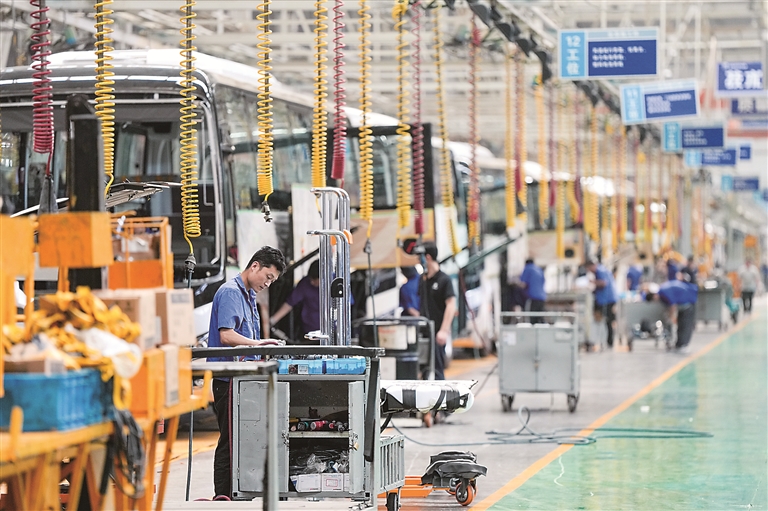
由中国生产出口至阿根廷的纯电动公交车近日在布宜诺斯艾利斯投入运营。图为工人在生产该批电动公交车 的扬州亚星客车公司车间内作业。新华社发 福建省福安市纪委监委把优化营商环境作为监督重点,紧盯惠企政策落实等环节,督促相关部门履职尽责, 提升涉企服务质量。图为近日,该市纪检监察干部在福安经济开发区了解情况。吴其文 摄 中央纪委国家监委网站 郝思斯 8月3日,江西省遂川县田野间村落错落有致,呈现乡村振兴下的蓬勃生机。 图片来源:视觉中国 中共中央政治局7月30日召开会议,分析研究当前经济形势,部署下半年经济工作。会议指出,领导干部要树 立和践行正确政绩观,按照新发展理念做好经济工作。 当前,我国正处在以中国式现代化全面推进强国建设、民族复兴伟业的关键时期。要完整准确全面贯彻新发 展理念,树立和践行正确政绩观,把推动高质量发展的要求贯彻到经济社会发展的全过程各领域。记者就此 采访了复旦大学特聘教授、马克思主义研究院副院长、马克思主义经济学中国化研究中心主任周文。 发展理念是否对头,从根本上决定着发展成效乃至成败 记者:习近平总书记深刻指出:"理念是行动的先导,一定的发展实践都是由一定的发展理念来引领的。""十 五五"时 ...
金观平:城市基础设施建设要量力而行
Jing Ji Ri Bao· 2025-08-12 00:01
Core Viewpoint - The recent Central Urban Work Conference emphasizes the importance of establishing a modern people's city through correct performance views and practical approaches, highlighting five key transformations in urban development [1]. Group 1: Infrastructure Development - Urban infrastructure is crucial for the normal operation and healthy development of cities, significantly improving living conditions, enhancing comprehensive urban capacity, and increasing operational efficiency [1]. - In recent years, China's urban infrastructure construction has accelerated and improved in quality, leading to a significant enhancement in overall standards and increased public satisfaction [1]. - Infrastructure projects require substantial investment, long construction periods, and slow capital recovery, necessitating careful planning to avoid unsustainable public debt [1]. Group 2: Financial Management and Project Viability - There are negative examples of local governments neglecting financial realities and pursuing impractical projects, leading to underutilized facilities and wasted funds [2]. - The financial constraints faced by local governments indicate that excessive spending on superficial projects can detract from essential economic and social development funding [2]. - Future trends suggest ongoing fiscal imbalances, with revenue growth lagging behind expenditure increases, highlighting the need for a focus on outcomes rather than just inputs in infrastructure projects [2]. Group 3: Development Philosophy - Urban infrastructure construction reflects the development and performance views of local governments, necessitating a balanced approach that avoids impulsive actions and prioritizes sustainable development [3]. - The emphasis is on maintaining a long-term perspective in urban planning, ensuring that projects align with urban development principles and high-quality growth requirements [3].
城市基础设施建设要量力而行
Jing Ji Ri Bao· 2025-08-11 22:24
Core Viewpoint - The recent Central Urban Work Conference emphasizes the importance of establishing a modern people's city through correct performance evaluation, practical approaches, and five key transformations, marking a significant theoretical and practical breakthrough in urban work [1] Group 1: Infrastructure Development - Urban infrastructure is crucial for the normal operation and healthy development of cities, significantly improving living conditions, enhancing comprehensive urban capacity, and increasing operational efficiency [1] - In recent years, China's urban infrastructure construction has accelerated and improved in quality, leading to a leap in overall standards and increasing public satisfaction and happiness [1] Group 2: Financial Management and Sustainability - There are negative examples of local governments neglecting financial realities and focusing on superficial projects, leading to underutilized facilities and wasted funds [2] - The financial constraints faced by local governments indicate that excessive investment in "vanity projects" can divert essential funds from economic development and public welfare [2] - The trend of local government fiscal imbalances suggests that the growth rate of fiscal revenue is slower than that of expenditures, highlighting the need for a focus on outcomes rather than just inputs in infrastructure projects [2] Group 3: Development Philosophy - Urban infrastructure construction reflects the development and performance evaluation philosophy, necessitating a balanced approach that avoids impulsive actions and prioritizes sustainable, high-quality development [3] - The emphasis is on maintaining a mindset of long-term contribution while being accountable for immediate results, as highlighted by the need to suppress impatience and focus on solid, modern construction practices [3]