商业航天

Search documents
巨力索具澄清不实传闻 开盘遭12亿元大单封一字跌停
Xin Lang Cai Jing· 2026-02-12 01:32
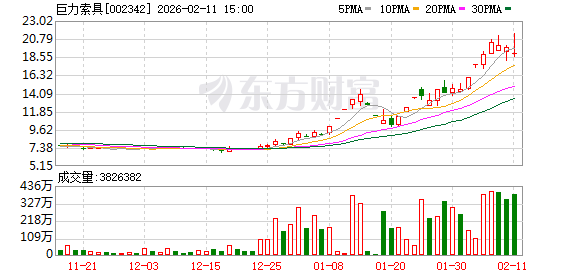
商业航天概念人气股巨力索具开盘封一字跌停,封单金额超12亿元。消息面上,巨力索具公告,未签署 过4.58亿的海南项目,公司2025年度在商业航天领域取得订单累计金额996.51万元。 ...

1月基金月报 | 股债携手上行,公募基金迎来普涨
Morningstar晨星· 2026-02-12 01:02
Macro Economic Overview - The manufacturing PMI for January recorded at 49.3%, down 0.8 percentage points from December's 50.1%, indicating a contraction in manufacturing activity [3] - January's CPI increased by 0.8% year-on-year, while PPI decreased by 1.9%, showing a mixed inflationary trend [3] A-Share Market Performance - A-shares experienced a strong start in January, with the Shanghai Composite Index reaching a high of 4190.9 points, marking a new peak since the September 24 market [4] - The technology growth sectors, particularly AI computing and commercial aerospace, led the market rally due to policy support and increased demand [4] - Major indices showed positive performance in January, with the Shanghai Composite Index and Shenzhen Component Index rising by 3.85% and 5.08%, respectively [4] - Among 31 Shenwan industry sectors, 26 sectors saw gains, with non-ferrous metals, media, and oil & petrochemicals sectors rising over 15% [4] Bond Market Dynamics - The bond market initially showed weakness due to concerns over supply and interest rate expectations but later recovered as liquidity was injected by the central bank [5][6] - The yields on various government bonds decreased in January, with 1-year, 5-year, and 10-year yields falling to 1.30%, 1.58%, and 1.81%, respectively [6] - The overall return of the bond market, as reflected by the China Bond Index, increased by 0.41% in January [6] Global Economic Indicators - The economic conditions in major Western economies remain in the expansion zone, but growth momentum is showing signs of marginal slowdown [7] - The US Markit Composite PMI for January was 52.8, slightly down from December's 53.0, while the Eurozone's PMI fell to 51.5 from 51.9 [7] - Geopolitical tensions, particularly in the Middle East, have driven up international commodity prices, with Brent crude oil prices rising by 14.64% in January [7] Fund Performance Insights - The Morningstar China Open-End Fund Index recorded a 4.77% increase in January, with various fund types showing positive returns [15] - Equity funds, particularly small and mid-cap growth funds, outperformed large-cap funds, with mid-cap balanced and growth funds achieving average returns of 9.74% and 9.13%, respectively [19] - QDII funds also performed well, with commodity funds, global emerging market mixed funds, and Greater China mixed funds recording returns of 17.15%, 13.51%, and 8.69% [20]


联创光电:向新而行厚积薄发,激光+超导双翼齐飞-20260212
Guoxin Securities· 2026-02-12 00:45
Investment Rating - The report initiates coverage with an "Outperform" rating for the company [3][5]. Core Views - The company has achieved a significant improvement in its financial performance, with a notable increase in net profit and revenue in the first three quarters of 2025, indicating a turning point in its business trajectory [1][21]. - The focus on "Laser + High-Temperature Superconductors" is optimizing the company's industrial structure, leading to enhanced profitability and growth potential in high-value sectors [2][14]. - The company is well-positioned to benefit from the growing demand in the laser and high-temperature superconducting markets, particularly in commercial aerospace and defense applications [23][40]. Financial Performance Summary - For the first three quarters of 2025, the company reported a revenue of 2.503 billion yuan, a year-on-year increase of 2.83%, and a net profit of 400 million yuan, up 19.40% year-on-year [1][8]. - The third quarter of 2025 saw a revenue of 856 million yuan, down 3.49% year-on-year but up 1.06% quarter-on-quarter, with a net profit of 137 million yuan, reflecting a 28.04% year-on-year increase [1][21]. - The gross margin for the first three quarters of 2025 was 19.73%, an increase of 3.84 percentage points year-on-year, while the net margin was 16.48%, also reflecting a significant improvement [8][25]. Earnings Forecast and Financial Metrics - The company is projected to achieve net profits of 477 million yuan, 584 million yuan, and 661 million yuan for 2025, 2026, and 2027 respectively, indicating growth rates of 97.9%, 22.3%, and 13.2% [4][3]. - Earnings per share (EPS) are expected to be 1.05 yuan, 1.28 yuan, and 1.45 yuan for the same years, with dynamic price-to-earnings (PE) ratios of 60, 49, and 44 [4][3]. - The report estimates the reasonable stock value to be between 72.4 and 75.1 yuan, suggesting a premium of 14.6% to 18.9% over the current stock price of 63.17 yuan [3][5]. Industry Positioning and Strategic Focus - The company is strategically positioned in the laser and high-temperature superconducting sectors, with a complete industrial chain from core components to system integration [40][47]. - The focus on high-temperature superconductors is expected to drive significant growth, particularly in applications related to controlled nuclear fusion and advanced manufacturing technologies [52][59]. - The company is also exploring opportunities in the commercial aerospace sector, leveraging its technological advancements in electromagnetic launch systems [66][74].

华西证券:商业航天加速落地,推荐低轨卫星相关各组件及芯片供应商
Xin Lang Cai Jing· 2026-02-12 00:31
Core Viewpoint - The current phase of domestic low Earth orbit (LEO) satellite launches has entered a substantial stage, coinciding with the commercial space sector, driven by relevant policies and industry dynamics, indicating strong certainty in the construction of satellite networks as a foundation for 6G network development [1] Group 1: Industry Developments - The preliminary research phase for reusable rockets has commenced with the first launch project, and multiple commercial rocket reusable launch plans are progressing in an orderly manner, marking an acceleration in the realization of commercial space [1] - The development of satellite internet is rapidly gaining momentum, with regular launches of satellite constellations leading to increased communication capacity and reduced latency [1] Group 2: Applications and Recommendations - There is potential for the rapid implementation of applications such as mobile broadband direct connection to satellites and intelligent driving systems linked to low Earth orbit satellite networks [1] - The report emphasizes recommending suppliers of components and chips related to low Earth orbit satellites [1]

A股“火箭回收龙头”?航天订单超2亿元?002342,紧急公告!
Xin Lang Cai Jing· 2026-02-12 00:01
Core Viewpoint - The company, Jili Rigging (002342), has issued a statement addressing a series of false claims circulating in the media regarding its involvement in the commercial aerospace sector and specific project wins [1][4]. Group 1: Company Clarification - The company has clarified that it has never engaged with any media or individuals regarding the claims made and has not expressed any opinions on the matter, labeling the information as false [3][7]. - Jili Rigging's primary products are general lifting rigging products, which have universal applications; the company has not signed any project worth 458 million yuan for the Hainan rocket recovery system [3][7]. - The total order amount obtained by the company in the commercial aerospace sector for 2025 is 996.51 thousand yuan, with the revenue from this sector accounting for less than 0.50% of the company's total revenue for 2025 [3][7]. Group 2: Financial Impact - As of early 2026, the company has secured a cumulative order amount of 128.65 thousand yuan in the commercial aerospace sector, which has minimal impact on its overall business performance [3][7]. - The company has indicated that its fundamental business has not undergone significant changes, but the recent stock price has deviated significantly from its fundamentals, suggesting potential market overheating and irrational speculation risks [3][7].
商业航天迎政策利好 维珍银河股价短期波动
Jing Ji Guan Cha Wang· 2026-02-11 20:16
经济观察网近7天内,商业航天领域迎来政策利好。根据经济观察网的报道,国家航天局设立商业航天 司并发布《推进商业航天高质量安全发展行动计划(2025—2027年)》,同时"十五五"规划建议明确加快 建设航天强国,这一动态可能对维珍银河(代码SPCE.N)等航天公司产生潜在积极影响。 截至2026年02月11日最新数据,维珍银河(SPCE.N)股价为2.59美元,当日下跌4.61%,振幅6.64%;近5 日累计上涨0.58%,但年初至今累计下跌19.47%。所属航天军工板块当日下跌0.74%,大盘纳斯达克指 数近五日上涨0.20%。 以上内容基于公开资料整理,不构成投资建议。 股票近期走势 ...
巨力索具股份有限公司关于市场传闻的澄清及风险提示的公告
Shang Hai Zheng Quan Bao· 2026-02-11 18:21
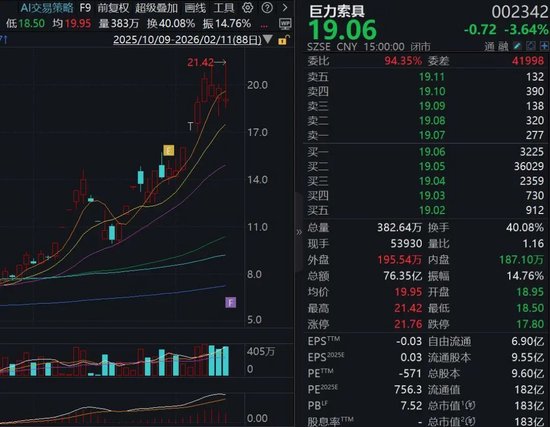
Core Viewpoint - The company clarifies that its stock price has significantly deviated from its fundamentals, indicating potential risks of market overreaction and irrational speculation, with a price increase of 162.90% from December 1, 2025, to February 11, 2026 [2][4]. Group 1: Company Fundamentals - The company's fundamentals have not undergone significant changes, yet its stock price has severely diverged from these fundamentals, leading to potential risks of a rapid price decline [2][4]. - As of February 11, 2026, the company's static price-to-earnings (P/E) ratio is -390.57, and the price-to-book (P/B) ratio is 7.51, which are significantly higher than the industry averages of 46.29 for P/E and 3.38 for P/B [2][4]. Group 2: Order and Revenue Information - In the commercial aerospace sector, the company secured a total order amount of 9.9651 million yuan for the year 2025, with the revenue from these orders accounting for less than 0.50% of the company's total revenue for that year [2][3]. - From the beginning of 2026 until the disclosure date, the company has obtained additional orders amounting to 1.2865 million yuan, which also has a minimal impact on the company's operational performance [2][3]. Group 3: Clarification of Misleading Information - The company has issued a statement to clarify false claims circulating in the media, including assertions that it is a leading player in commercial aerospace and has secured a 458 million yuan project, which the company denies [3][4]. - The company emphasizes that its main products are general lifting slings, and it has not signed any contracts related to the alleged projects mentioned in the media [3].
多家公募机构看好持股过节
Zheng Quan Ri Bao· 2026-02-11 16:17
Group 1 - The core viewpoint of the article emphasizes the debate among investors regarding whether to hold stocks or cash during the upcoming Spring Festival, with many public fund institutions advocating for holding stocks based on historical data and current macroeconomic conditions [1][2]. - Historical data from FuGuo Fund indicates that the A-share market tends to perform weakly before the Spring Festival but shows significant strength afterward, with average returns of -2.20% in the second week before the festival and 2.03%, 0.86%, and 0.83% in the first, second, and third weeks after the festival, respectively [1]. - Public fund managers suggest that the current macro environment supports holding stocks, citing improved liquidity conditions and a stable external environment as key reasons [2]. Group 2 - Fund managers recommend focusing on two main investment directions: technology and domestic demand value, with specific sectors such as food, retail, tourism, and resources being highlighted for their potential benefits from the Spring Festival consumption [3]. - The expectation of a "red envelope market" post-festival is noted, with anticipated strong consumption data and increased market activity due to concentrated capital inflow and positive policy expectations [3]. - Investment strategies should be tailored to individual risk preferences, with higher-risk investors encouraged to maintain higher positions, while lower-risk investors may consider reducing exposure to mitigate potential volatility during the holiday period [3].
周期专场-节后投资主线解读
2026-02-11 15:40
Summary of Key Points from Conference Call Records Industry Overview Commercial Aerospace - Shanghai Port Bay's perovskite technology in collaboration with Dongfang Risen is expected to benefit from the SpaceX supply chain. The increase in satellite launches will boost the demand for solar wings, positively impacting related companies [1][3]. Refractory Materials - Companies like Zhongsen Technology, Luyang Energy, and Zhonggang Nairuo are performing well through business extensions and are considered important targets for investment as the sector begins to rally [1][3]. AI+ Sector - Companies such as China National Materials, Honghe Technology, Feilihua, and China Jushi are benefiting from LDK demand, leading to significant profit increases. Attention is drawn to upstream raw materials like high-end electronic fabrics [1][3]. Construction and Building Materials - New business models in the construction and building materials industry focus on increasing market share and revenue scale, with a clear supply clearing and gradual industry improvement. Sanjias Tree's beautiful countryside business and community stores are rapidly developing, while Yuhong enhances competitiveness through service model innovation [1][4]. Real Estate Market Insights Recent Data and Trends - Recent data indicates a positive trend in the real estate market, particularly in first and second-tier cities where second-hand housing transaction volume has increased year-on-year, and price indices have turned positive. The listing volume has decreased, with demand driven by school district housing improving transaction structure. The new housing market is expected to rebound post-holiday due to supply constraints [1][5]. Investment Strategy - The current rally in real estate stocks is characterized by a mix of speculative and long-term capital, suggesting a more sustainable upward trend. The second quarter may present an opportunity to increase real estate positions, with recommended stocks including China Merchants Shekou, New City Holdings, Jindi Group, and Wo Ai Wo Jia [1][6][8]. Transportation and Logistics Sector Investment Themes - The transportation and logistics sector has four main investment themes: 1. Domestic express logistics is entering a critical consolidation phase, with a focus on leading companies like ZTO Express and YTO Express [2][9]. 2. Cross-border e-commerce and the Belt and Road Initiative, with key companies including SF Holding and JD Logistics [2][9]. 3. Platform transportation through internet platforms like Didi and Cao Cao Mobility, which are expected to enhance profits with the realization of autonomous driving and new energy vehicle replacements [2][10]. 4. Large cycle sectors, including aviation and shipping, are anticipated to see profit growth due to tight supply and recovering demand. Companies like China Merchants Energy and COSCO Shipping are recommended, with significant profit elasticity expected from VLCC operations [2][10]. Additional Considerations - The real estate market's upward speed is not expected to be as rapid as in previous cycles, with a potential long-term upward trend following policy implementation. The core cities' housing prices may stabilize by the end of the year, with real estate stocks likely leading the fundamental bottom by 2 to 3 quarters [1][8]. - Long-term capital movements should be closely monitored to adjust investment strategies accordingly [1][7].
商业航天的新龙头?火箭回收龙头?002342 紧急澄清
Mei Ri Jing Ji Xin Wen· 2026-02-11 15:36
Core Viewpoint - The company, Jieli Rigging (002342.SZ), has issued a statement denying false claims circulating in the media that it is a leader in commercial aerospace and rocket recovery, asserting that it has not engaged with any media or individuals regarding these claims [2]. Group 1: Company Clarification - The company clarifies that its main products are general lifting rigging products, which have universal applications [5]. - The company has not signed any project worth 458 million yuan in Hainan and does not have any orders exceeding 200 million yuan [5]. - As of 2025, the total order amount in the commercial aerospace sector is 9.9651 million yuan, with revenue recognition for 2025 being less than 0.50% of the company's total revenue [5]. Group 2: Financial Performance - From the beginning of 2026 until the disclosure date, the company has received a total of 1.2865 million yuan in commercial aerospace orders, which has minimal impact on its operational performance [5]. - The company's stock price has significantly deviated from its fundamentals, with a cumulative increase of over 170% since December of the previous year, closing at 19.06 yuan per share on February 11, with a decline of 3.64% [5]. - The company expects a net profit attributable to shareholders of 16 million to 21 million yuan for 2025, indicating a turnaround from losses, driven by steady growth in its main business sectors [5].