持股过节

Search documents
春节后6个交易日上涨概率达70%,多家机构乐观建议“持股过节”
Huan Qiu Wang· 2026-02-14 01:13
Group 1 - The core viewpoint indicates that the Shanghai Composite Index has shown a significant increase of 4.85% in the first five trading days after the Spring Festival in 2024, marking the highest growth in nearly a decade, with a general optimistic outlook for the 2025 Spring Festival [1] - Over 60% of private equity firms are inclined to hold substantial or full positions during the holiday, reflecting a strong risk appetite among investors [1] - The trading volume and financing balance are critical indicators for assessing whether capital will flow back into the market, potentially signaling the start of a major upward trend [1] Group 2 - Foreign institutions such as BlackRock China and Fidelity International anticipate a gradual diversification in global asset allocation over the next 3 to 5 years, moving away from a heavy concentration on dollar assets [2] - The Chinese market is regaining vitality, with advantages in complete industrial chains, strong innovation capabilities, and relatively attractive valuations [2] - In the week before the holiday, 65 A-share listed companies participated in institutional research, with 237 institutional investors involved in these surveys [3]


张忆东最新研判:持股过节迎春,黄金长牛依旧
Sou Hu Cai Jing· 2026-02-13 06:06
Group 1 - Zhang Yidong has joined Guotai Junan and will serve as the head of the equity research department and chief economist, focusing on cross-border integration of research business [2] - Zhang Yidong is a highly influential strategist in the sell-side research field, with over 20 years of industry experience and multiple awards from New Fortune [2] Group 2 - The recent volatility in the COMEX gold futures market saw the RSI indicator reach a high of 89.46, followed by a significant price correction due to hawkish policy expectations after the nomination of Powell [3] - The long-term bullish logic for gold remains intact, driven by high debt levels in major economies and ongoing geopolitical tensions, with expectations of a loose monetary policy from the Federal Reserve until 2026 [4] Group 3 - The recommendation to hold stocks during the holiday season aims to capitalize on potential market rebounds in the spring months of February and March, based on historical trends [5] - The overall short-selling ratio in the Hong Kong stock market is approximately 19%, with the Hang Seng Tech Index seeing a rise in short-selling activity to 21%, indicating a potential turnaround [6] Group 4 - Specific investment directions include focusing on technology sectors aligned with the "14th Five-Year Plan" and maintaining value assets while increasing exposure to cyclical industry leaders [8]
私募真金白银“投票”,落袋为安还是持股过年
Xin Jing Bao· 2026-02-13 01:44
Core Viewpoint - The consensus among various brokerages and private equity firms is to "hold stocks during the festival," indicating a positive outlook for the A-share market post-Spring Festival, driven by a stable market environment and potential recovery in economic and profit expectations [3][4][8]. Group 1: Market Sentiment and Strategy - A majority of private equity firms, over 60%, are heavily invested or fully invested for the festival, believing that market fluctuations will not alter structural opportunities [6][7]. - Brokerages like Guotai Junan and Guotou Securities emphasize confidence in the market, suggesting that the post-festival period may see a resurgence in market activity [4][9]. - Historical data shows a higher probability of A-share market gains after the Spring Festival, with many investors expected to complete their positioning before the holiday [8]. Group 2: Economic and Market Conditions - The current market sentiment is characterized by a return to stability, with reduced panic selling and a more balanced investor sentiment compared to previous periods [8]. - Analysts from various firms note that the recent global asset adjustments are more about emotional digestion rather than fundamental changes, suggesting a favorable environment for market recovery [4][5]. - The upcoming Spring Festival is anticipated to improve economic and profit expectations, with liquidity remaining loose and risk preferences stabilizing [4][8]. Group 3: Sector Outlook - Private equity firms are optimistic about sectors such as undervalued blue chips and technology growth, with a preference for a balanced investment strategy [7]. - Approximately 40% of private equity firms favor a combination of low-valuation blue chips and technology growth, while 30% focus solely on technology growth as a core market theme [7]. - There is also interest in resource stocks, with 18% of private equity firms looking for opportunities in sector rotation, indicating a diverse approach to investment strategies [7].
春节“钱线”|私募真金白银“投票”,落袋为安还是持股过年
Bei Ke Cai Jing· 2026-02-13 01:43
Core Viewpoint - The A-share market is experiencing a positive trend, with many institutions advocating for "holding stocks during the festival" as a favorable strategy for investors [3][5][6]. Group 1: Institutional Perspectives - Multiple brokerage firms have reached a consensus that "holding stocks during the festival" is a better choice this year compared to previous years, citing unchanged market fundamentals [6][7]. - Guotai Junan's strategy team emphasizes the importance of confidence and suggests that the market may rebound after the festival [7]. - The spring market outlook is also influencing institutional views, with expectations of improved economic and profit forecasts during the festival period [8]. Group 2: Private Equity Insights - Over 60% of private equity firms are leaning towards heavy or full positions during the festival, indicating a belief in structural opportunities despite market fluctuations [12]. - A survey shows that 70% of private equity firms are optimistic about the post-festival market, expecting stabilization and a resumption of upward trends [14]. - The majority of private equity firms favor low-valuation blue-chip stocks and technology growth sectors, indicating a strategic focus on balanced investment approaches [14]. Group 3: Market Dynamics and Historical Trends - Historical data suggests that the probability of A-share gains post-festival is high, with many investors expected to complete their positioning before the festival and enter the market afterward [15]. - The market has undergone sufficient technical consolidation and chip exchange before the festival, creating conditions for a rebound [15]. - The upcoming policy window and expectations for stable growth policies are likely to refocus the market on economic recovery themes [15][16].
胜率78%,持股过节?
3 6 Ke· 2026-02-12 10:39
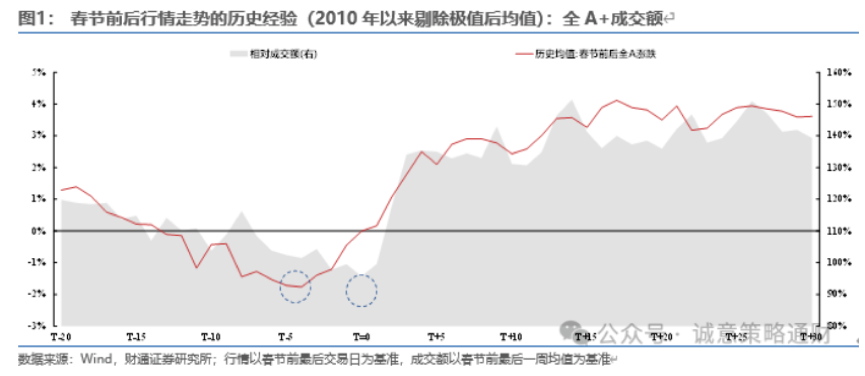
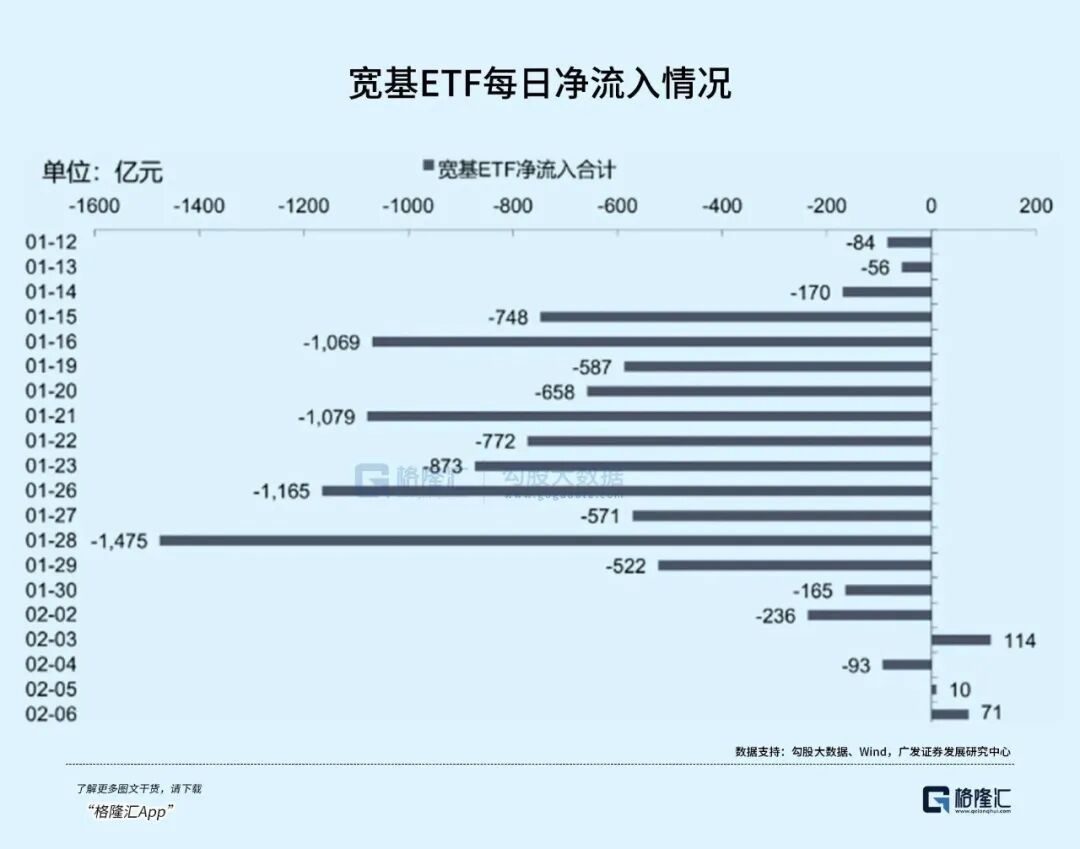
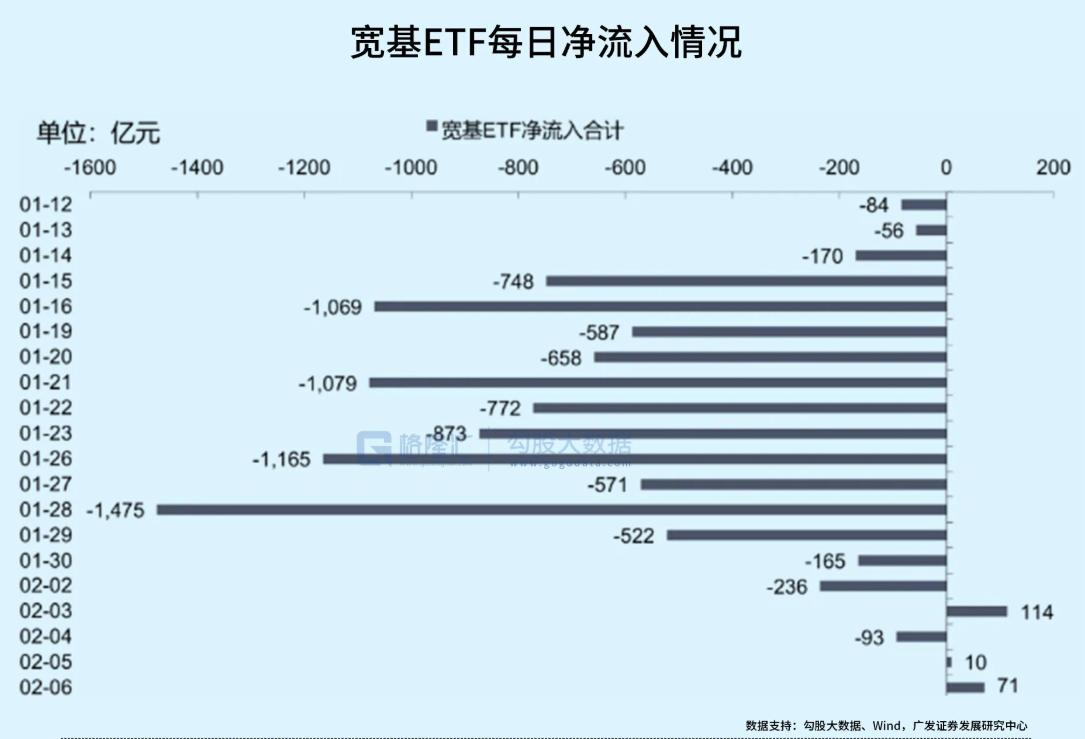
Core Viewpoint - The investment market is currently focused on the choice between "holding stocks during the holiday" or "holding cash during the holiday," with historical data suggesting a higher success rate for holding stocks post-holiday [1][12][13]. Market Trends - The stock index has begun a rebound, driven by AI catalysts, indicating a prelude to the Spring Festival market [2][11]. - The A-share market has shown a significant "pre-holiday effect," with trading volume decreasing to approximately 2.2 trillion yuan, and financing funds experiencing a net outflow for three consecutive weeks [2][18]. - The recent market volatility is attributed to a breakdown of short-term bullish trends and external pressures from commodity price fluctuations [3][4][5]. Investment Sentiment - There is a prevailing cautious sentiment among institutional investors, leading to reduced positions ahead of the long holiday to mitigate risks associated with overseas uncertainties [2][6]. - The recent adjustments in the market have created opportunities for recovery, with many institutions remaining optimistic about post-holiday performance due to unchanged core domestic fundamentals and policies [14][17]. Historical Performance - Historical data from 2017 to 2025 indicates that the average gain for the A-share market in the 10 trading days following the Spring Festival is 3.3%, compared to an average loss of -1.3% in the 10 days prior [13]. - The success rate for the A-share market in the first five and ten trading days after the Spring Festival is 78%, significantly higher than pre-holiday performance [13]. Sector Analysis - The recent market adjustments have led to a rotation among sectors, with notable performances in light communication, computing power chains, commercial aerospace, and cultural media [11]. - The AI sector remains a focal point, with significant developments such as the release of Seedance 2.0, which is expected to enhance the efficiency of AI-generated content production [24][30][32]. Liquidity and Fund Flows - Historical trends show that market liquidity typically contracts before the holiday due to increased cash withdrawal demands, but tends to rebound afterward [18]. - Recent data indicates that the outflow of broad-based ETFs has largely stabilized, with signs of net inflows emerging [7][8]. Future Outlook - The upcoming macroeconomic data releases from both China and the U.S. are anticipated to provide insights into the improvement of fundamentals, which could support market recovery [14]. - The potential for a "spring rally" remains, as historical patterns suggest that early-year market movements do not preclude continued upward trends in February and March [22][23].
胜率78%!持股过节?
Ge Long Hui A P P· 2026-02-12 09:35
Group 1 - The core topic of the article revolves around the investment strategies of "holding stocks during the holiday" versus "holding cash during the holiday," particularly in the context of the upcoming Chinese New Year [1] - Historical data shows that the A-share market has a significant "pre-holiday effect," with trading volumes typically decreasing before the holiday and increasing afterward, indicating a potential for market recovery post-holiday [2][17] - Recent market trends indicate a rebound in stock indices, driven by AI-related catalysts, suggesting a prelude to the holiday market performance [3][14] Group 2 - The article highlights that the cash withdrawal demand during the holiday season leads to a seasonal decline in the banking system's excess reserve ratio, impacting market liquidity [5] - The recent adjustments in the market are seen as a necessary phase for paving the way for post-holiday opportunities, with many institutions remaining optimistic about the market's performance after the holiday [15][34] - The article notes that the recent volatility in the market is influenced by external factors, including adjustments in commodity prices and the performance of major tech companies in the U.S. [8][9] Group 3 - The article discusses the recent performance of various sectors, particularly the rapid rotation among themes such as optical communication, computing power chains, and commercial aerospace, which have shown significant gains [14] - The "spring market" phenomenon has already begun, with indices like the CSI 500, 1000, and 2000 showing early upward trends since late December, indicating a bullish sentiment in the market [19][20] - The introduction of AI models like Seedance 2.0 is expected to catalyze further growth in the A-share market, particularly in the media sector, as it enhances content production efficiency [26][30] Group 4 - The article emphasizes that the upcoming macroeconomic data releases, including domestic inflation and social financing figures, are crucial for validating the improvement in the fundamental outlook [15][17] - The anticipated increase in liquidity post-holiday, combined with policy catalysts, is expected to create a favorable environment for market recovery and growth [22][31] - The article concludes that maintaining a stock position during the holiday is likely to yield higher returns, supported by historical performance data showing a positive trend in the market after the holiday [15][34]
胜率78%!持股过节?
格隆汇APP· 2026-02-12 08:47
Core Viewpoint - The article discusses the investment strategies of "holding stocks during the festival" versus "holding cash during the festival," highlighting the significance of the Spring Festival on market dynamics and investor behavior [1]. Group 1: Market Trends and Performance - Historical data shows that the average return of the entire A-share market in the 10 trading days after the Spring Festival is 3.3%, while the average decline in the 10 trading days before is -1.3%, indicating a stronger post-festival performance [16][17]. - The trading volume in the A-share market has decreased to around 2.2 trillion yuan, with financing funds experiencing a net outflow for three consecutive weeks, consistent with the seasonal "calendar effect" before the Spring Festival [4][24]. - The market has shown a rebound this week, driven by AI catalysts, suggesting a prelude to the Spring Festival market dynamics [3][15]. Group 2: Investor Behavior and Sentiment - Investors tend to lock in profits and reduce positions before the long holiday due to cash withdrawal demands and uncertainties in overseas markets, leading to decreased trading volumes and increased market volatility [5][6]. - The sentiment among institutions remains optimistic regarding the post-festival market, as the recent adjustments present significant recovery opportunities [18][19]. - The recent adjustments have released some risks, and global assets, including Bitcoin and U.S. stocks, have shown signs of stabilization, indicating a gradual recovery in global risk appetite [12]. Group 3: Sector Performance and Opportunities - The recent adjustments in the market have led to a quick rotation among sectors, with notable performances in light communication, computing power chains, commercial aerospace, and cultural media [15]. - The AI sector has been a significant driver of market performance, with the recent launch of ByteDance's AI video generation model, Seedance 2.0, creating a surge in the media sector [30][36]. - The article emphasizes the potential for resource-based sectors, such as non-ferrous metals and chemicals, to recover significantly due to supply-demand fundamentals [43]. Group 4: Future Outlook - The upcoming macroeconomic data releases from both China and the U.S. are expected to provide insights into the improvement of the domestic economy and calibrate monetary policy expectations [19]. - The article suggests that the "Spring Rally" may continue into February and March, supported by ample liquidity and policy catalysts, encouraging investors to participate in the market [29][41].

多家公募机构看好持股过节
Zheng Quan Ri Bao· 2026-02-11 16:17
Group 1 - The core viewpoint of the article emphasizes the debate among investors regarding whether to hold stocks or cash during the upcoming Spring Festival, with many public fund institutions advocating for holding stocks based on historical data and current macroeconomic conditions [1][2]. - Historical data from FuGuo Fund indicates that the A-share market tends to perform weakly before the Spring Festival but shows significant strength afterward, with average returns of -2.20% in the second week before the festival and 2.03%, 0.86%, and 0.83% in the first, second, and third weeks after the festival, respectively [1]. - Public fund managers suggest that the current macro environment supports holding stocks, citing improved liquidity conditions and a stable external environment as key reasons [2]. Group 2 - Fund managers recommend focusing on two main investment directions: technology and domestic demand value, with specific sectors such as food, retail, tourism, and resources being highlighted for their potential benefits from the Spring Festival consumption [3]. - The expectation of a "red envelope market" post-festival is noted, with anticipated strong consumption data and increased market activity due to concentrated capital inflow and positive policy expectations [3]. - Investment strategies should be tailored to individual risk preferences, with higher-risk investors encouraged to maintain higher positions, while lower-risk investors may consider reducing exposure to mitigate potential volatility during the holiday period [3].
春节“红包”行情可期,“持股过节”成机构共识
证券时报· 2026-02-11 13:16
Group 1 - The core viewpoint of the article is the consensus among institutions to "hold stocks during the festival," with a significant majority of private equity firms expressing optimism about the post-holiday market performance [2][4][5]. - A survey indicates that over 60% of private equity institutions prefer to hold a heavy or full stock position during the holiday, with nearly 70% expecting the A-share market to stabilize and rise after the Spring Festival [2][6][8]. - Historical data shows that the A-share market typically performs better after the Spring Festival, with a notable calendar effect where the market tends to recover from pre-holiday declines [4][9]. Group 2 - The article highlights that 62.16% of private equity firms favor a heavy stock position, while 16.22% prefer a moderately heavy position, indicating a general belief in structural opportunities despite potential short-term fluctuations [6][8]. - Specific investment preferences among private equity firms include a focus on undervalued blue-chip stocks and technology growth sectors, with 41.18% favoring a balanced approach and 29.41% concentrating on technology growth as a core market theme [6][8]. - The sentiment towards the post-holiday market is largely optimistic, with 69.23% of private equity firms believing that the market has adequately consolidated before the holiday, setting the stage for a potential upward trend [8][9].
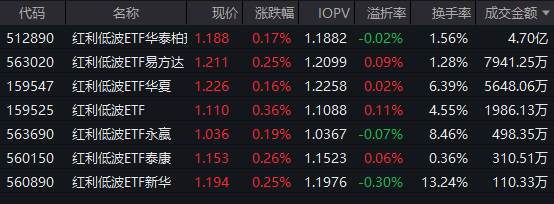
红利低波ETF华泰柏瑞(512890)流通规模突破301亿元 机构建议“持股过节” 高股息板块配置逻辑更清晰
Xin Lang Cai Jing· 2026-02-11 09:02
Market Overview - On February 11, the A-share market exhibited a volatile trend, with the ChiNext Index dropping over 1% and the Shanghai Composite Index slightly rising by 0.09% [1][6] - In this market environment, the Huatai-PB Low Volatility ETF (code: 512890) increased by 0.17%, closing at 1.188 yuan, with a turnover rate of 1.56% and a transaction amount of 470 million yuan, ranking first among similar ETFs in terms of transaction volume [1][6] ETF Performance - As of February 11, the Huatai-PB Low Volatility ETF has accumulated a total transaction volume of 23.061 billion yuan over 28 trading days this year, with an average daily transaction of 824 million yuan [2][7] - Fund flow data indicates that as of February 10, the ETF saw a net inflow of 880 million yuan over the last 10 trading days, 3.472 billion yuan over the last 20 days, and 4.470 billion yuan over the last 60 days, with a circulating scale of 30.128 billion yuan [2][7] Investment Recommendations - Recent recommendations from various institutions suggest a "hold stocks over the holiday" strategy, indicating that the A-share market's performance before the Spring Festival may influence post-holiday trends [4][9] - Huajin Securities noted that the current spring market is not yet over, with expectations for improved economic and corporate profit forecasts during the Spring Festival, and a neutral risk appetite anticipated [4][9] - Zhongtai Securities emphasized that the configuration logic for high-dividend sectors is becoming clearer, with expectations for policy measures related to growth stabilization and consumption promotion to gradually materialize after the Spring Festival [4][9] ETF Characteristics - The Huatai-PB Low Volatility ETF was established on December 19, 2018, with a benchmark of the CSI Low Volatility Index [4][9] - As of February 10, 2026, the ETF has achieved a return of 79.95% over the past five years, outperforming its benchmark and ranking 51st among 909 funds [4][9] - Investors can participate through a systematic investment plan to smooth out volatility risks, and those without stock accounts can access it through its off-market linked funds [4][9]