
量子科技

Search documents
港股市场策略周报:2025.12.22-2025.12.28-20251230
Zhe Shang Guo Ji Jin Rong Kong Gu· 2025-12-30 06:09
Market Performance Review - The Hong Kong stock market experienced a narrow upward fluctuation during the week due to the Christmas holiday, with the Hang Seng Index, Hang Seng Tech Index, and Hang Seng Composite Index rising by 0.44%, 0.5%, and 0.37% respectively [5][15] - Most primary industry sectors saw gains, with notable declines in the information technology, telecommunications, and healthcare sectors, which fell by 0.77%, 1.09%, and 1.76% respectively [5][15] - The materials sector surged by 4.3%, driven by strong international precious and industrial metal prices and geopolitical risks that heightened macro risk aversion [15] Valuation Levels - As of the end of the week, the 5-year PE (TTM) valuation percentile for the Hang Seng Composite Index was 82.56%, indicating that the valuation level is close to one standard deviation above the 5-year average [5] Buyback Statistics - The buyback market cooled down this week, with 66 companies participating, a decrease of 9 from the previous week [27] - The total buyback amount for the week was 30.67 billion HKD, down by 19.54 billion from the previous week [27] - Tencent Holdings (0700.HK) led the buybacks with an amount of 1.907 billion HKD, followed by Xiaomi Group (1810.HK) with 444 million HKD [27] Macro Environment Tracking and Outlook - The overall profitability of the Hong Kong stock market is heavily reliant on Chinese state-owned enterprises, with over 80% of profits coming from mainland China, indicating a close correlation with the economic conditions in China [39][40] - Key economic indicators show that industrial profits in November fell by 13.1% year-on-year, significantly down from the previous value of -5.5%, reflecting weak domestic demand in consumption and real estate [45] - The People's Bank of China announced a new digital currency management framework set to launch on January 1, 2026, which may influence future financial transactions [39] - The government plans to continue supporting consumption through fiscal policies, focusing on sectors like artificial intelligence, biopharmaceuticals, and quantum technology [39] Sector Allocation Outlook - The report suggests a favorable outlook for sectors benefiting from policy support, including new energy, innovative pharmaceuticals, and AI technology [5][45] - Low-valuation state-owned enterprises are expected to perform well due to stable earnings and stock prices, alongside local Hong Kong banks, telecommunications, and utility dividend stocks that are relatively independent of broader economic fluctuations [5][45]
一图看懂!面向脑机接口、AI,工信部明确中试标准建设指南
Di Yi Cai Jing· 2025-12-30 05:48
Core Viewpoint - The Ministry of Industry and Information Technology (MIIT) of China has issued the "Manufacturing Industry Pilot Standard System Construction Guide (2025 Edition)" to accelerate the efficient transformation and application of major technological achievements, emphasizing the establishment of pilot verification and testing platforms [1][3]. Group 1: Standard System Construction - The guide aims to revise and establish over 50 standards by 2027 and 100 standards by 2030, creating an advanced manufacturing pilot standard system that includes basic general, key technology, and industry application standards [1][11]. - The manufacturing pilot is a transitional test that connects the technology chain, innovation chain, and industry chain, facilitating the flow of technological innovation to market application [7][1]. Group 2: Structure of the Standard System - The manufacturing pilot standard system consists of three parts: basic general standards, key technology standards, and industry application standards [2][13]. - Basic general standards provide the foundational support for the pilot system, while key technology standards define requirements for equipment, materials, platforms, validation, and outcome evaluation [2][13]. Group 3: Industry Application Focus - The guide emphasizes the need for industry-specific and actionable pilot standards, particularly in emerging and future industries such as brain-computer interfaces, the metaverse, artificial intelligence, quantum technology, and clean hydrogen [2][3]. - The industry application standards ensure that pilot activities are conducted scientifically within specific industries, covering sectors like raw materials, equipment manufacturing, consumer goods, and information technology [2][13]. Group 4: Development Status and Future Goals - China has established over 2,400 pilot platforms, with 241 selected as key cultivation platforms by MIIT, which have undertaken 25,000 pilot service projects [3][4]. - By the end of 2027, the goal is to further strengthen high-level pilot platforms and establish a modern pilot platform system with a nationwide service network [3][4].


“网上链博”平台升级为企业提供精准供需匹配 让全球观众随时随地“云参展”
Yang Shi Wang· 2025-12-30 05:23
Group 1 - The Fourth Global Supply Chain Promotion Expo will be held in Beijing from June 22 to June 26, 2026, with preparations underway and a new AI section being introduced for the first time [1] - The expo will continue the previous edition's focus on innovation, showcasing a complete ecosystem for the transformation and application of innovative achievements, with emphasis on future economic growth points such as quantum technology, biomanufacturing, hydrogen energy, nuclear fusion, brain-machine interfaces, embodied intelligence, and sixth-generation mobile communication [5] - The AI section will feature leading domestic and international AI enterprises and their ecosystem partners, presenting a comprehensive view of the AI industry from data collection to intelligent analysis and practical applications [8] Group 2 - The expo will also focus on the development of strategic emerging industries such as new energy, new materials, aerospace, and low-altitude economy, organizing domestic and international leading enterprises for concentrated displays in advanced manufacturing sectors [9] - The event aims to showcase China's development of new productive forces driven by technological innovation and guided by high quality, while upgrading the "Online Chain Expo" platform to provide precise supply-demand matching and decision support for enterprises, allowing global audiences to participate remotely [9]
中证1000ETF(159845)盘中成交7.59亿元,公募基金总规模再创历史新高
Mei Ri Jing Ji Xin Wen· 2025-12-30 04:03
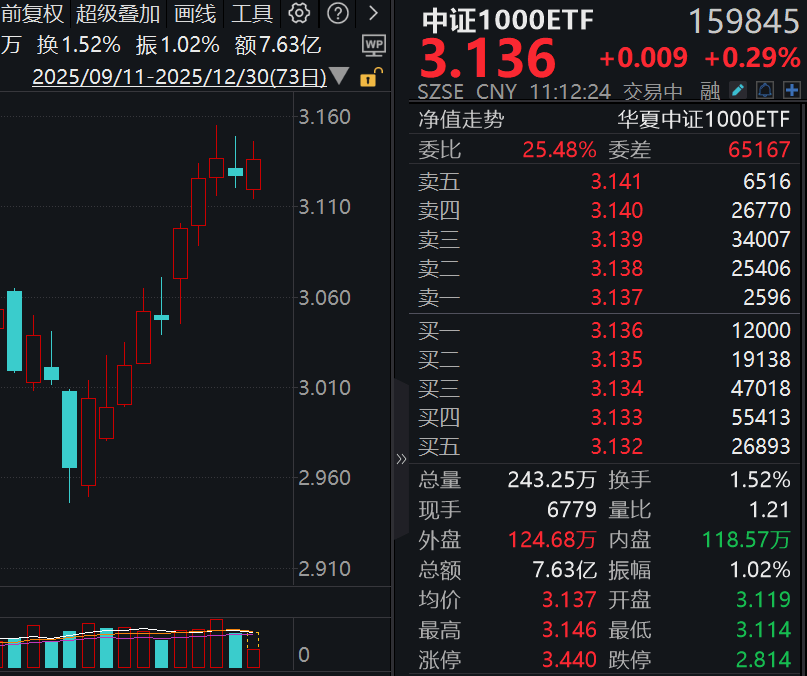
行业表现来看,中证1000ETF前几大重仓行业中,电子上涨0.21%,电力设备下跌0.6%,医药生物下跌 0.54%,计算机上涨0.43%,机械设备上涨0.84%。 从资金面来看,中证1000ETF(159845)近五个交易日资金净流入19.85亿元,近十个交易日净流入27.99亿 元。最新规模达502.15亿元,近一个月规模增长56.44亿元。今日盘中成交额7.59亿元,近一周日均成交高达14.76 亿元,流动性在同标的指数ETF中领先。 近日,中基协最新发布的公募基金市场数据显示,截至2025年11月底,我国公募基金总规模为37.02万亿元, 这是我国公募基金总规模今年以来第八次创下历史新高。 12月30日临近午盘,A股三大指数走势分化,其中沪指下跌0.11%。截至11:12,中证1000ETF(159845)上涨 0.29%。其他宽基指数中,上证50跌0.08%,中证500涨0.25%。 银河证券表示,短期依然关注防御性板块配置机会,重视明年政策红利与产业景气方向布局。(1)主线一: 全球百年未遇之大变局加速演进,国内经济底层逻辑转向新质生产力,人工智能、具身智能、新能源、可控核聚 变、量子科技、航空航 ...
中原证券晨会聚焦-20251230
Zhongyuan Securities· 2025-12-30 00:14
Core Insights - The report highlights the positive performance of various sectors in the A-share market, particularly in financial, petrochemical, and aerospace industries, indicating a slight upward trend in the market [5][9][10] - The central economic work conference emphasizes a shift in policy focus from total expansion to quality and sustainability, with a strong emphasis on technology and industry [8][12][14] - The report suggests that the average price-to-earnings ratios for the Shanghai Composite Index and the ChiNext Index are above their three-year median levels, indicating a favorable environment for medium to long-term investments [9][10][12] Domestic Market Performance - The Shanghai Composite Index closed at 3,965.28 with a slight increase of 0.04%, while the Shenzhen Component Index decreased by 0.49% to 13,537.10 [3] - The A-share market has shown resilience with a trading volume of 21,578 billion, indicating strong investor interest [8][10] - The report notes that various sectors such as banking, petrochemical, and software development have performed well, while sectors like energy metals and pharmaceuticals have lagged [5][9] Industry Analysis - The humanoid robot sector is expected to become a key focus in the U.S. technology strategy, with recommendations to continue monitoring humanoid robots and AIDC supporting equipment [14] - The power sector is experiencing a collaboration between the largest power company and Google for AI initiatives, although the sector's performance has been below market expectations [16] - The solar industry is witnessing significant price increases in silicon wafers and batteries, with a focus on leading companies in the segment [18][19] Investment Recommendations - The report suggests focusing on companies with stable fundamentals, high dividends, and strong growth potential in sectors such as engineering machinery and high-speed rail equipment [15] - In the animation film industry, the report recommends attention to companies like Light Chaser Animation, which have a strong project pipeline and IP management capabilities [26][28] - The automotive sector is advised to focus on companies with innovative driving technologies and those positioned for growth in the intelligent and connected vehicle market [31]

蓄力破局 量子科技迎接产业化关键一跃
Zhong Guo Zheng Quan Bao· 2025-12-29 22:13
Core Insights - Quantum technology is positioned as a key component of national strategy and is becoming a focal point in global competition among major powers [2][3][4] - The next five to ten years are critical for the industrialization of quantum technology, with significant investments and strategic initiatives from countries like the US, UK, and Canada [2][3][4] Investment and Policy Landscape - The US plans to increase quantum research funding from $1.8 billion to $2.7 billion for the fiscal years 2025-2029, emphasizing practical applications [3] - The UK has allocated £10.13 billion for quantum technology over the next four years, continuing its investment since 2014 [3] - Canada has initiated the "Canadian Quantum Champions Program" with an investment of CAD 92 million to support local quantum computing firms [4] Technological Advancements - China has made significant strides in quantum communication and computing, achieving global leadership and entering a phase of scale expansion [6][7] - Quantum communication technology is being applied in major projects like the "Beijing-Shanghai trunk line" and national quantum secure communication networks [6] - The quantum computing sector is expected to exceed $800 billion by 2035, with ongoing developments in superconducting, ion trap, and photonic technologies [7] Challenges and Opportunities - The industry faces challenges such as talent shortages, insufficient application scenarios, and limited developer scale, which hinder the acceleration of industrialization [9] - There is a need for a more robust educational framework to produce the necessary interdisciplinary talent for quantum technology [9] - The lack of sufficient downstream companies for algorithm development and application exploration is a significant bottleneck [9] Future Outlook - The integration of quantum computing with artificial intelligence is anticipated to unlock new application spaces and drive further innovation [7][8] - The focus is shifting from merely increasing quantum bit counts to ensuring technology meets market demands and usability [8] - Building a collaborative ecosystem and fostering technological innovation are essential for quantum technology to become a new engine for high-quality economic development [10]
量子产业地标炼成记——合肥“量子大道”链起创新生态圈
Zhong Guo Zheng Quan Bao· 2025-12-29 22:06
Core Insights - Hefei's "Quantum Avenue" has become a global landmark for quantum technology, housing over 30 leading quantum enterprises and attracting one-third of the world's core quantum companies [1] - The city has implemented a comprehensive policy framework to support the long-term development of the quantum industry, emphasizing the importance of sustained capital and top-level design [2][3] - Hefei aims to cultivate two publicly listed companies and achieve a quantum industry scale of 5 billion by 2027, showcasing its commitment to building a robust quantum ecosystem [5] Policy and Support - Hefei has established a "policy toolbox" since 2020, including the "Hefei Quantum Information Industry Development Plan (2020-2030)" to accelerate the transformation of quantum technology from research to application [2] - The city has increased the risk tolerance for angel and seed funds to 40% and 50%, respectively, and introduced unique financial products to support the growth of small and medium-sized quantum enterprises [3] Application and Innovation - Hefei is actively creating a "city of all-domain scene innovation," providing extensive application scenarios for quantum technology, which serves as a catalyst for technological iteration [4] - The integration of quantum technology into various sectors, such as e-government and industrial applications, is evident, with significant projects like the first operational substation in China incorporating quantum measurement, communication, and computing technologies [4] Future Prospects - The strategic collaborations between quantum companies and industries such as biomedicine and intelligent driving are paving the way for new applications and breakthroughs in quantum computing [4] - Hefei's approach combines policy support, capital investment, and broad application scenarios to solidify its position as a leader in the quantum industry [5]
量子产业地标炼成记
Zhong Guo Zheng Quan Bao· 2025-12-29 21:13
Core Insights - Hefei's "Quantum Avenue" has become a global hub for quantum technology, housing over 30 leading quantum enterprises and attracting one-third of the world's core quantum companies [1][2] - The city has implemented a comprehensive policy framework to support the long-term development of the quantum industry, emphasizing sustained investment and support rather than short-term tax contributions [1][2] - Hefei aims to cultivate two publicly listed companies and achieve a quantum industry scale of 5 billion yuan by 2027, showcasing its commitment to building a robust quantum ecosystem [3] Policy and Support - Hefei has established a "policy toolbox" since 2020, including the "Hefei Quantum Information Industry Development Plan (2020-2030)" to accelerate the commercialization of quantum technology [1][2] - The city has increased the risk tolerance for angel and seed funds to 40% and 50%, respectively, and introduced unique financial products like "Spark Loan" and "USTC Alumni Entrepreneurship Loan" to support small and medium-sized quantum tech companies [2] - Nearly 10 billion yuan has been invested by Hefei's municipal finance to support quantum technology research, commercialization, and enterprise development [2] Application and Innovation - Hefei is actively creating an "all-domain scenario innovation city" to provide practical applications for quantum technology, integrating it into various sectors such as e-government and industrial power stations [2] - The Hefei quantum metropolitan area has been integrated into the electronic government external network, and a 220 kV substation is set to become the first operational substation in China to incorporate quantum measurement, communication, and computing technologies [2] - Strategic collaborations between quantum technology firms and industries like biomedicine and intelligent driving are accelerating the transition from laboratory research to practical applications [3] Future Prospects - By 2027, Hefei plans to nurture two publicly listed companies and achieve a quantum industry scale of 5 billion yuan, indicating a strong growth trajectory for the sector [3] - The integration of quantum technology into various fields is expected to open new avenues for innovation and application, enhancing the overall ecosystem [3]

蓄力破局量子科技迎接产业化关键一跃
Zhong Guo Zheng Quan Bao· 2025-12-29 21:13
Core Insights - Quantum technology is positioned as a key driver of future industries in China's 14th and 15th Five-Year Plans, indicating a strategic focus on its industrialization and application [1][2] - The global competition in quantum technology is intensifying, with major countries like the US, UK, and Canada significantly increasing their investments and policy support to secure leadership in this field [2][3] Investment and Funding - The US plans to increase quantum research funding from $1.8 billion to $2.7 billion for the fiscal years 2025-2029, emphasizing practical application development [2] - The UK has allocated £10.13 billion for quantum technology over the next four years, building on previous investments exceeding £1 billion since 2014 [3] - Canada has initiated the "Canadian Quantum Champions Program" with an investment of CAD 92 million to support local quantum computing firms [3] Technological Advancements - China has made significant strides in quantum communication and computing, achieving a leading position globally with projects like the "Micius" satellite and the "Zuchongzhi" superconducting quantum computer [3][4] - Quantum precision measurement is entering the commercialization phase, with the cold atom quantum gravity meter being a notable example of practical application [5][6] Market Potential - The global quantum computing market is projected to exceed $800 billion by 2035, driven by advancements in quantum technology and its integration with artificial intelligence [6] - The development of specialized quantum computers is progressing, with companies like Boson Quantum delivering the first 1000-qubit coherent optical quantum computer [6] Challenges and Bottlenecks - The industry faces challenges such as a shortage of skilled talent, insufficient application scenarios, and limited developer scale, which hinder the acceleration of quantum technology commercialization [7][8] - The lack of downstream companies for algorithm development and application exploration is a significant barrier to creating a positive feedback loop for technology iteration [8] Ecosystem Development - The successful industrialization of quantum technology requires a collaborative ecosystem that fosters innovation and addresses market needs, emphasizing the importance of patience and strategic investment in talent and infrastructure [8]
多地积极培育未来产业 10只潜力股浮现
Zheng Quan Shi Bao· 2025-12-29 19:15
Group 1 - The core focus of the news is on the development and support of future industries in China, as highlighted by the "14th Five-Year Plan" which emphasizes nurturing emerging industries and exploring diverse technological routes and business models [3] - Various cities, including Beijing, Shenzhen, and Shanghai, are actively promoting future industries through initiatives and financial measures, with Beijing supporting 83 potential future industry companies and facilitating over 2 billion yuan in financing for 60 companies [4][5] - The future industries mentioned have significantly outperformed the market, with specific indices showing substantial annual growth, such as the nuclear fusion index rising over 83% and the 6G index increasing by more than 80% [5] Group 2 - Future industries are characterized by strong growth momentum, driven by disruptive technologies, with a projected median net profit of over 650 billion yuan for related companies by 2025, indicating a year-on-year growth of over 20% [6] - Specific companies within the future industries are expected to see remarkable profit increases, with over 60 companies projected to achieve net profit growth exceeding 100% by 2025, including notable firms like Foton Motor and Sino Medical [6][7] - A subset of companies has shown a decrease in shareholder numbers, indicating potential for price recovery, with 10 companies identified as having significant rebound potential due to their stock performance being below 19% for the year [8][9]
