智能体

Search documents
QuestMobile 2025年AI应用市场半年报:移动端达6.8亿,三类形态应用此消彼长,手机厂商亟需提升生态整合能力……
QuestMobile· 2025-08-05 02:01
Core Insights - The article emphasizes the rapid growth of AI applications in the mobile internet sector, highlighting the resilience of the internet industry and the importance of finding new scenarios and technology applications to meet user demands [2][3]. Group 1: AI Application Market Overview - As of June 2025, the AI application market has developed into four tiers, with the first tier consisting of AI search engines and comprehensive assistants, boasting monthly active users (MAU) of 685 million and 612 million respectively [3]. - The second tier includes AI social interaction and professional advisors, with MAUs of 126 million and 111 million [3]. - The third tier comprises AI efficiency tools and image processing applications, with MAUs of 69 million and 49 million [3]. - The fourth tier includes applications like AI creative design and educational tools, each around 20 million MAUs [3]. Group 2: User Engagement and Application Types - The growth of "In-App AI" reflects users' preference for scenario-based tools, with 630 million users engaging with mobile app plugins, while native apps saw a decline of 20 million users [4][10]. - The report indicates that 74.5% of plugin applications maintained positive growth, although there is significant structural differentiation in growth rates across different scales [30][32]. Group 3: Competitive Landscape and Trends - The AI search and comprehensive assistant sectors are experiencing a dual oligopoly, with a notable shift towards service integration and practical solutions [13][39]. - The report highlights that 67.4% of native apps experienced negative growth in the first half of the year, indicating a challenging environment for smaller applications [27]. - The article notes that the average app with AI integration has 2.1 AI applications, confirming that plugin forms are currently the most effective path for AI deployment [17]. Group 4: Key Players and Performance Metrics - Major players in the AI application market include Baidu AI, which leads the search engine segment with 29.4 million MAUs, and Tencent's AI applications, which have shown significant growth rates [22][63]. - The report identifies that the average growth rate for Tencent's Yuanbao app was 55.2%, indicating strong user engagement [29][66]. - The performance of AI applications is closely tied to their ability to integrate deeply into user workflows, with companies needing to enhance their AI capabilities to remain competitive [61][47]. Group 5: Future Outlook and Strategic Recommendations - The future of AI applications will depend on the ability to either become the "only option" in users' minds or to embed deeply into essential workflows [61][61]. - Companies are encouraged to focus on enhancing model capabilities and cross-modal interaction to drive future growth in the AI sector [58][61].





上证早知道|事关基础研究,上海大动作!智元机器人预告,8月21日将“上新”!公募“新基”,持续升温
Shang Hai Zheng Quan Bao· 2025-08-04 23:09
Group 1 - Shanghai Municipal Government issued measures to support enterprises in enhancing basic research and high-quality development [4][5] - Hainan Provincial Government released a three-year action plan to accelerate the construction of a modern industrial system with distinctive advantages [4] - Shanghai Science and Technology Committee introduced management measures for the "Explorer Program" to encourage enterprises to invest in basic research [4] Group 2 - AI agent concept gained traction with several companies experiencing significant stock price increases following the certification of an AI customer service agent [9] - The global first organic solvent testing standard for footwear was officially released, addressing a critical global issue [6] - The electric vehicle industry is witnessing advancements with the announcement of the world's first mass-produced semi-solid battery vehicle [14][15] Group 3 - The innovative drug sector remains active, with several companies experiencing stock price surges due to strategic partnerships and clinical trial advancements [12][13] - Public fund issuance continues to rise, with 36 new funds launched this week, marking a 5.88% increase from the previous week [26] - Foreign investment in A-shares is increasing, with four stocks having over 24% of their shares held by foreign investors [27]

ISC.AI 2025将于8月6日在北京开幕 解锁智能体时代新升级
Zheng Quan Shi Bao Wang· 2025-08-04 11:18
此外,ISC.AI 2025大会还将打造20余场技术及产业论坛,输出国家、经济、社会、企业的观点,助力 智能体时代数字安全的跃迁升级。 ISC.AI一直致力于行业未来新质人才的培育,践行产教融合的发展理念。本届大会覆盖从底层技术认知 到前沿应用实战的全流程,打造"讲、训、练"三位一体的完整生态链条,通过系统化设计实现知识传 授、技能培训与实战演练的衔接。 8月6日至7日,ISC.AI 2025第十三届互联网安全大会将在北京启幕。作为全球"安全+AI"领域规格高、 规模大、影响力深远的行业盛会,本届ISC.AI以"ALL IN AGENT"为主题。 据悉,ISC.AI 2025大会设置一场全天候未来峰会,汇聚全球顶尖的AI与安全专家,从学术界的权威学 者到企业界的创新领袖,从知名机构的专业分析师到政府智库的战略专家,或深耕理论研究,或引领技 术突破,或提供决策参考,共同推动着行业变革与知识创新。 届时,ISC名誉主席邬贺铨,中国工程院院士、英国皇家工程院院士陈清泉,俄罗斯工程院外籍院士、 苏州大学机电学院院长孙立宁,教育部高等学校网络空间安全专业教学指导委员会秘书长封化民等学术 领军人物将分享前沿行业洞见;36 ...
裁员与外迁,我在Manus工作的200多天
创业邦· 2025-08-04 10:24
Core Viewpoint - The article discusses the rise and fall of Manus, an AI company, highlighting the rapid changes in the industry and the personal experiences of an intern who witnessed the company's journey from success to turmoil [6][26]. Group 1: Company Background and Development - Manus was founded by Xiao Hong, who aimed to create a revolutionary AI product, and the company gained significant attention in the AI community [6][19]. - The intern, He Si, joined Manus as an intern after self-learning AI application development and connecting with Xiao Hong through a tech community [14][18]. - The company experienced a rapid rise in popularity after launching its product, which was described as a "disruptive" and "global first" AI tool [27][28]. Group 2: Challenges and Changes - In June, the company announced plans to relocate to Singapore for international expansion, leading to significant layoffs of domestic employees [8][12]. - The internal atmosphere became tense as employees sensed the impending move, with management's absence contributing to uncertainty [9][11]. - Following the product launch, Manus faced intense scrutiny and criticism for not developing its own large model, leading to accusations of being a "shell" company [29][32]. Group 3: Personal Experience and Reflection - The intern experienced a rollercoaster of emotions, from excitement during the product launch to anxiety over the company's challenges and public perception [33][34]. - Despite the turmoil, the intern recognized the valuable lessons learned during the internship, including the complexities of entrepreneurship beyond just product development [33]. - The experience at Manus provided the intern with opportunities for future employment in major tech companies, although the initial excitement had diminished [34].

在WAIC耳朵听出茧子的「智能体」,是时候系统学一下了
机器之心· 2025-08-04 07:05
Core Insights - The article emphasizes the shift in perception of AI large models from simple chatbots to intelligent agents capable of proactive thinking, planning, and task execution [1][2]. Group 1: LLM and Its Capabilities - Standard LLMs generate text responses based on given prompts, showcasing their versatility as a significant advantage [5]. - The integration of reasoning and external API interactions into LLMs is crucial for developing advanced AI agents [6]. Group 2: Tool Utilization - The ability to teach LLMs to integrate and use external tools has become a hot topic in AI research, with examples including calculators, calendars, and search engines [7]. - LLMs can act as "commanders" that coordinate various specialized tools to solve problems effectively [8]. Group 3: Reasoning Models - Reasoning capabilities have been a core focus in LLM research, with the ability to break down complex problems into smaller tasks and determine which tools to use being essential [21][23]. - The Chain of Thought (CoT) method enhances LLMs' reasoning by guiding them to generate a reasoning process before arriving at a final output [24][25]. Group 4: ReAct Framework - The ReAct framework allows LLM-driven agents to autonomously decompose and solve complex problems through a sequential process that integrates reasoning and action [41]. - The framework expands the action space to include language as a form of action, enabling agents to "think" in addition to executing actions [46][49]. Group 5: Applications and Performance - ReAct has been applied in knowledge-intensive reasoning tasks and decision-making scenarios, demonstrating its effectiveness in various contexts [63][64]. - Performance comparisons show that ReAct consistently outperforms other models, highlighting the importance of reasoning during action execution [77]. Group 6: Future of AI Agents - The development of reliable AI agent systems is crucial, as current systems may fail if any step in the sequential problem-solving process goes wrong [114]. - Ongoing research aims to enhance the capabilities and reliability of AI agents, indicating significant advancements in the near future [115].

世纪恒通:为腾讯智能体相关业务提供内容审核服务
Jin Rong Jie· 2025-08-04 04:00
Core Viewpoint - The company is currently not involved in the development or training of Tencent's intelligent agent systems but provides content review services as a partner in Tencent's ecosystem [1] Group 1 - The company has received inquiries from investors regarding its participation in Tencent's recent launch of 12 vertical intelligent agent products [1] - The company confirmed its role as a content review service provider for Tencent's intelligent agent-related business, ensuring compliance in operations [1] - The company has not yet engaged in collaborative development or model training for Tencent's intelligent agent systems but will disclose any future cooperation in accordance with information disclosure rules [1]

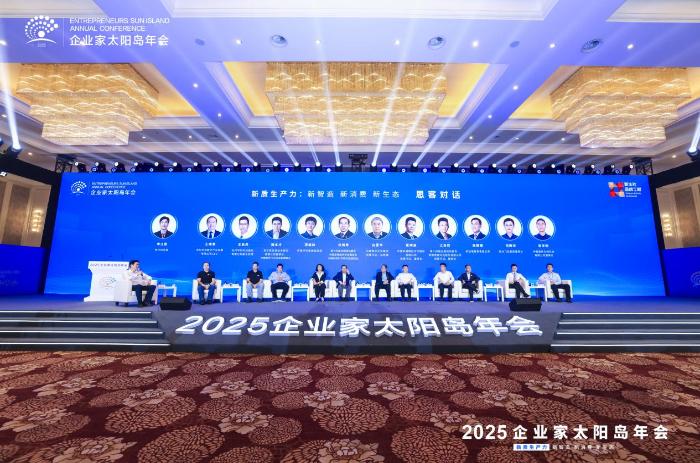
太阳岛思客对话丨聚焦“三新”驱动,共话发展新质生产力创新实践
Xin Hua She· 2025-08-04 03:28
Core Viewpoint - The 2025 Entrepreneur Sun Island Annual Conference emphasizes the importance of developing new quality productivity as a strategic choice for gaining competitive advantages and seizing development opportunities in the context of a global technological revolution and industrial transformation [3][6]. Group 1: New Quality Productivity - The development of new quality productivity is crucial for building new competitive advantages in China, which requires tailored strategies based on local resources and conditions [6][8]. - Local governments should focus on deepening reforms and creating a favorable business environment, while entrepreneurs need to innovate business models to attract innovative elements and generate new technological achievements [8][10]. Group 2: New Intelligent Manufacturing - China has the largest and most complete manufacturing system globally, but transitioning from "manufacturing" to "intelligent manufacturing" necessitates technological innovation as a core element [13][15]. - Key technological breakthroughs, particularly in embodied intelligent robotics, are driving a new wave of industrial innovation and intelligent manufacturing [13][15]. Group 3: New Consumption - The Chinese consumption market is undergoing significant changes, with a notable increase in service-oriented consumption driven by technology [21][23]. - New consumption trends are expected to stimulate domestic demand, with platforms like Alibaba aiming to create new service-oriented e-commerce models [21][23]. Group 4: New Ecosystem - Developing new quality productivity requires a complex system that promotes efficient allocation of resources, with stable financial support being essential for high-risk, long-cycle industries [27][29]. - Attracting both state and private capital to invest in new quality productivity sectors is crucial, along with improving investment exit mechanisms to encourage long-term investments [27][29].
世纪恒通:该专利是公司在 AI + 教育领域的驾考细分赛道进行 AI 应用的…
Zheng Quan Zhi Xing· 2025-08-01 21:14
Core Viewpoint - Century Hengtong is actively exploring AI applications in the education sector, particularly in the driving examination field, through the development of a patented multimodal intelligent Q&A robot [2]. Group 1: AI Applications - The company has developed a patent for an AI application in the driving examination sector, aiming to enhance learning efficiency through technological innovation [2]. - Century Hengtong has integrated open-source large models like DeepSeek in certain business scenarios to improve the intelligence level of driving exam learning [2]. Group 2: Business Development - In the smart agriculture sector, the company is exploring support for local agricultural brand building and e-commerce operations, although these efforts have not yet integrated AI or large model capabilities [2]. - The company's advertising business related to Tencent is still in its early development stages, with ongoing exploration of incorporating AI models for optimizing advertising strategies and content generation [2].
OpenAI护城河被攻破,AI新王Anthropic爆赚45亿,拿下企业级LLM市场
3 6 Ke· 2025-08-01 12:18
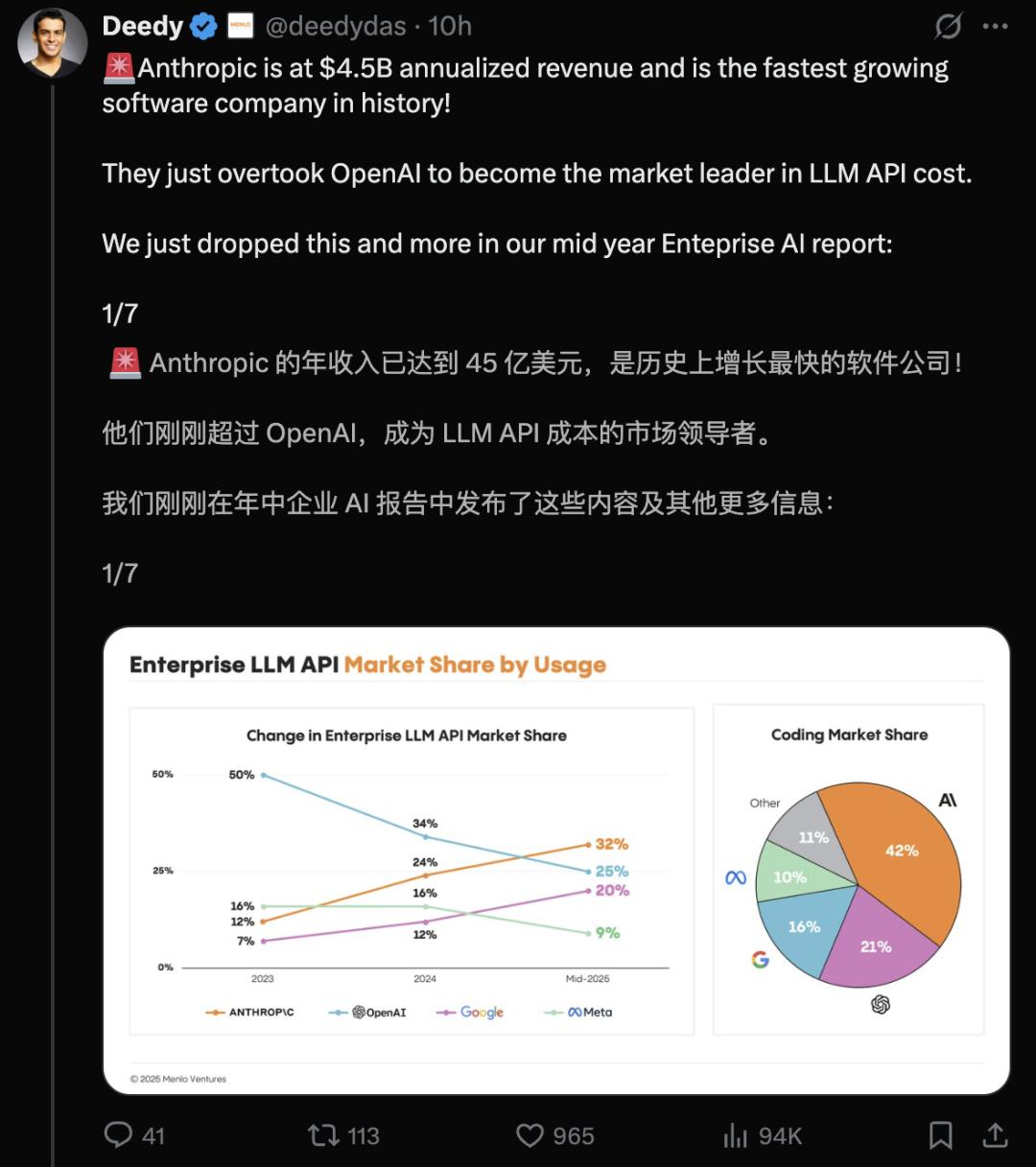
Core Insights - OpenAI's market share in the enterprise LLM sector has dramatically declined, with Anthropic surpassing it as the new leader [1][13][21] - Anthropic's annual revenue has reached $4.5 billion, making it the fastest-growing software company in history [1][4] - The shift in enterprise LLM usage indicates a significant change in the competitive landscape, with Anthropic capturing 32% of the market compared to OpenAI's 25% [13][14] Group 1: Market Dynamics - Anthropic has overtaken OpenAI in enterprise usage, marking a pivotal shift in the LLM landscape [4][10] - The enterprise spending on foundational model APIs has surged to $8.4 billion, more than double last year's total [6][9] - The report indicates that the enterprise LLM market is entering a "mid-game" phase, with new trends emerging [5][12] Group 2: Trends in LLM Commercialization - The report outlines four major trends in LLM commercialization: 1. Anthropic's usage in enterprises has surpassed that of OpenAI [4] 2. The trend of enterprises adopting open-source technology is slowing down [4] 3. Enterprises prioritize performance improvements over cost advantages when switching models [5] 4. Investment in AI is shifting from model training to practical application and inference [5][44] Group 3: Competitive Landscape - OpenAI's market share has plummeted from 50% at the end of 2023 to 25% by mid-2024, while Anthropic has risen to 32% [13][14] - Google has shown strong growth, capturing 20% of the market, while Meta holds only 9% [14][13] - The rise of Anthropic is attributed to the release of Claude Sonnet 3.5, which significantly boosted its market position [17][20] Group 4: Performance and Adoption - Code generation has emerged as a key application, with Claude capturing 42% of the developer market, compared to OpenAI's 21% [22] - Developers are increasingly focused on performance, with 66% upgrading models within their existing supplier ecosystem [36][39] - The shift in spending from model training to inference is evident, with 74% of developers in startups indicating that their workloads are primarily inference-based [44][47] Group 5: Future Outlook - The LLM market is undergoing a reshuffle, with a silent elimination process underway [50] - The report suggests that while 2023 may have belonged to OpenAI, the future remains uncertain, with potential winners yet to be determined [50]
三天超150亿!WAIC 2025上海收官;M50芯片 10W功耗干翻英伟达;OpenAI深夜引爆学习革命 | 混沌AI一周焦点
混沌学园· 2025-08-01 12:06
Core Trends - Chinese AI giants such as Zhipu, Qwen, and Tencent are dominating the Hugging Face leaderboard with all top 10 positions held by open-source models, indicating a shift in the global AI landscape towards China and promoting innovation accessibility [2] - OpenAI has launched a new Study Mode for ChatGPT, aimed at enhancing interactive learning and user engagement in the education sector, potentially reshaping the educational technology competition [3] Investment Highlights - The WAIC 2025 event showcased a significant investment of 15 billion yuan, with over 350,000 attendees, highlighting a transition from parameter competition to practical applications of AI, emphasizing productivity [4] - Anthropic's valuation has surged to $170 billion after a $5 billion funding round, with projected revenues of $35 billion by 2027, indicating a major shift in the AI competitive landscape [6] Business Developments - Surge AI has achieved $1 billion in annual revenue without external funding, surpassing competitors by emphasizing the value of high-quality human data over synthetic data [8] - PixelBloom has successfully completed a Series B funding round, aiming to capture a share of the global office market projected to reach $700 billion [15] AI Agent Innovations - Microsoft has introduced the Copilot mode in its Edge browser, enhancing user interaction through AI capabilities, which may challenge Chrome's dominance [9] - Lovart has launched the first global AI design agent, ChatCanvas, which automates the design process and allows real-time collaboration between users and AI [12] - Navos, a marketing AI agent from Titanium Technology, has demonstrated significant efficiency improvements in marketing cycles and ROI for clients [13] Open Source and Model Development - Zhipu's GLM-4.5 model has been released as an open-source project, achieving state-of-the-art performance and significantly lowering the cost of AI deployment for enterprises [10] AI Chip Advancements - The release of the M50 chip by Houmo Intelligent, featuring low power consumption and high computational efficiency, is set to disrupt the edge computing market [11]