
通货膨胀

Search documents
Wholesale Prices Rose in September, Filling in Some Data for the Fed
WSJ· 2025-11-25 13:59
Wholesale prices moved higher in September, the Labor Department said, data likely to leave the Federal Reserve's preferred inflation metric stubbornly above target when the central bank meets next month. ...


US Retail Sales Growth Slows in September, PPI Increases 0.3%
Youtube· 2025-11-25 13:56
Retail Sales Data - Retail sales in September increased by 0.2%, a decline from the 0.6% rise in August, and below the expected 0.4% increase [1] - Excluding automobiles, retail sales rose by 0.3%, aligning with forecasts, while the control group data is pending [1] - The control group for retail sales showed a decrease of 0.1% after a 0.6% increase in August [2] Inflation Indicators - The headline Producer Price Index (PPI) rose by 0.3%, following a decline of 0.1% in August, indicating inflationary pressures [2] - The core PPI increased by 0.1% month-over-month, with a year-over-year increase of 2.7%, which is a slight uptick from August [2] - The year-over-year core PPI fell to 2.6% from 2.8%, indicating a mixed inflation trend [2] Market Influences - Weaker-than-expected retail sales and slightly higher inflation suggest that rising gasoline, energy, and car prices may have influenced these trends [3]
人民币黄金最新价格:2025年11月24日金市行情分析
Sou Hu Cai Jing· 2025-11-25 02:56
Core Insights - The recent fluctuations in gold prices have sparked interest among investors, particularly regarding the potential for investment opportunities as of November 24, 2025 [1][3] - The domestic gold price on this date was reported at 932.03 CNY per gram, reflecting an increase of 9.35 CNY, or 1.013% from the previous day [1][3] - Gold is viewed as a stable asset, often chosen for investment during times of economic uncertainty, providing a hedge against inflation and currency depreciation [3][8] Price Fluctuations - On November 24, 2025, the Shanghai Gold Exchange reported a trading range for gold, with a high of 935.02 CNY per gram and a low of 922.96 CNY per gram, indicating significant price volatility [3] - Short-term price fluctuations can present opportunities for long-term investors to optimize their holdings, as these changes do not typically affect their overall investment strategy [3][8] Gold Purity and Market Preferences - The majority of gold in the domestic market is of 99.99% purity, known as "four nines gold," which is favored for its aesthetic qualities and suitability for jewelry and bullion [5] - Investors should consider factors such as purity and weight in addition to price when making purchasing decisions, as these elements directly impact potential investment returns [6] Currency Influence - The price of gold in CNY is influenced by the exchange rate of the Chinese yuan against the US dollar; a stronger yuan can lead to lower gold prices in local currency terms, while a weaker yuan can increase prices [6] - This relationship explains why investors may turn to gold during periods of significant currency fluctuation, as it offers a stable value against currency depreciation [6][8] Investment Strategies - For investors focused on long-term holdings, short-term price movements are less concerning and can be leveraged for strategic entry points [6][8] - Conversely, those seeking short-term gains may find the current price fluctuations provide actionable opportunities for profit [8]

中经评论:日本经济难突重围
Jing Ji Ri Bao· 2025-11-25 00:02
Economic Overview - Japan's economy has entered a phase of negative growth, with a reported GDP decline of 1.8% in Q3, marking a return to negative growth since Q1 2024, primarily due to a sharp contraction in external demand [1] - The contribution of external demand to Japan's economic growth in Q3 was -0.2 percentage points, exacerbated by increased tariffs on Japanese goods, particularly automobiles, which saw tariffs rise from 2.5% to 15% [1] Domestic Demand Challenges - Domestic demand remains weak, with personal consumption, which accounts for over half of Japan's economy, showing only a slight increase of 0.1% quarter-on-quarter, while residential investment fell by 9.4% [1] - High inflation and declining real wages have led to a persistent decrease in consumer spending willingness [1] Political and Economic Response - In response to the economic downturn, the government approved a stimulus package worth 21.3 trillion yen (approximately 135.4 billion USD) aimed at addressing rising prices and boosting investment in sectors like semiconductors and AI [2] - However, the stimulus plan relies heavily on fiscal expansion and monetary easing without addressing necessary structural reforms [2] Structural Issues - Japan's government debt has reached approximately 263% of GDP, limiting the effectiveness of further spending and increasing long-term interest rates, which could pressure government debt repayment and reduce investment in innovation [3] - The aging population, with 29% aged 65 and above, contributes to labor shortages and a shrinking consumer market, while the automotive industry struggles to adapt to the shift towards electric vehicles [3] Market Sentiment and Future Outlook - The recent tensions in Japan-China relations, exacerbated by controversial statements from Prime Minister Kishi, have led to a potential loss of 11.5 billion to 14 billion USD in tourism revenue, further impacting GDP growth by 0.29 to 0.36 percentage points [2] - Analysts suggest that Japan's economy may continue to oscillate around the growth line without effective reforms, and the current government strategies may only provide temporary relief without addressing deeper structural issues [4]
Consumers are 'very much out there spending,' says Mastercard's Michelle Meyer
Youtube· 2025-11-24 17:15
Despite tariffs, stick to inflation, and the lack of key data, the outlook for spending remains bullish, according to the Mastercard Economics Institute. Here with us now at Post9 is chief economist of the Mastercard Economics Institute, Michelle Meyer. It's good to have you back.Welcome. >> Thank you. >> So, what do you guys expect. >> Well, exactly what you said.I mean, the consumer is still very much engaged despite all of these different headlines. They're trying to navigate relative price differentials ...

KG: September PPI & Retail Sales Prominent, DELL & DE Key Earnings This Week
Youtube· 2025-11-24 16:30
Economic Indicators - Retail sales for September are expected to show a month-over-month increase of 0.4%, indicating a healthy consumer environment, while core retail sales are estimated at 0.3% [3][4] - The Producer Price Index (PPI) is anticipated to show a headline CPI of 0.3% and core CPI of 0.2%, which would be a positive sign for inflation trends [4][5] Market Activity - The trading volume in E-Mini S&P 500 futures is low, with over 500,000 contracts traded, suggesting a light trading week due to the holiday [6][8] - Volatility is expected to remain elevated, with the S&P 500 testing the 20-week moving average and potential resistance at the 50-day moving average of 5,712 [7] Company Earnings - Key earnings reports to watch include Alibaba, which is expected to report soon, and Dell, which will report on Wednesday amid discussions about high memory prices [9][10] - Deere & Company is also highlighted, with recent trends showing a potential bullish crossover in its MACD, indicating a possible catch-up trade against its peer Caterpillar [12][13] Geopolitical Factors - Ongoing peace talks between Russia and Ukraine are affecting commodity prices, particularly crude oil, which saw a recent decline but is now trading flat [17][20] - The EU's concerns about concessions to Russia in the peace deal could impact energy markets, with low inventory levels in the U.S. for diesel and gasoline [20][21]


刚刚,降息25个基点!
Zhong Guo Ji Jin Bao· 2025-11-24 15:10
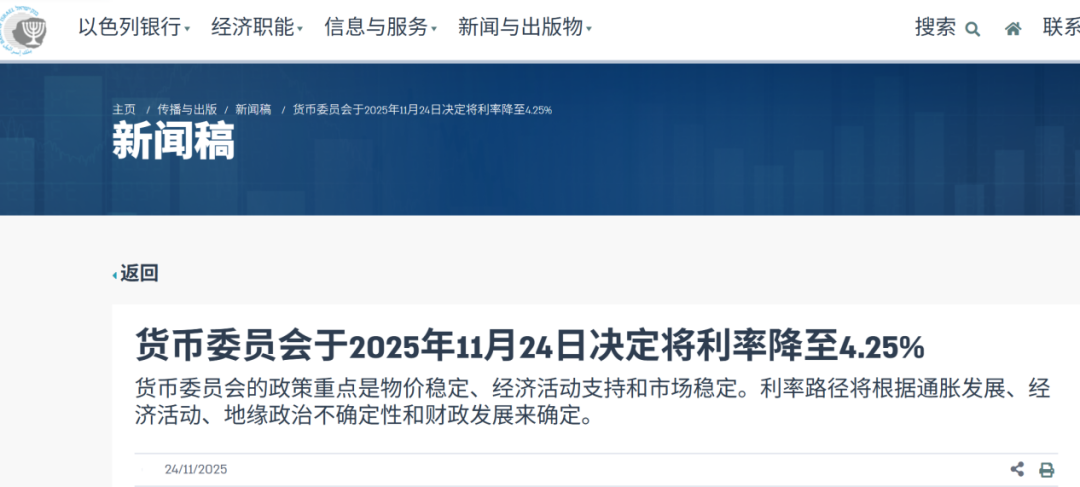
Core Viewpoint - The Bank of Israel has lowered its interest rate by 25 basis points to 4.25%, marking the first rate cut since January 2024, indicating a shift towards a more accommodative monetary policy [1][5]. Economic Indicators - The decision to cut rates aligns with market expectations, as 13 out of 14 economists predicted a reduction to 4.25% [5]. - The annual inflation rate in Israel has eased, stabilizing at 2.5% in October, with expectations for a slight increase by year-end before stabilizing within target ranges [5]. - The labor market remains tight, with a high ratio of job vacancies to unemployment and ongoing wage growth [5]. Market Reactions - The Israeli stock market has shown positive performance, with indices rising and risk premiums slightly above pre-war levels [5]. - The New Israeli Shekel has appreciated against the US dollar by 1.3% and against the euro by 2.9% since the last rate decision [6]. Economic Growth - Israel's GDP grew by 12.4% year-on-year in Q3 2025, significantly surpassing the expected 7.3%, driven by strong private consumption, exports, and fixed asset investment [6]. - Private consumption increased by 23%, fixed asset investment rose by 36.9%, and exports of goods and services grew by 23.3% in Q3 [6]. Future Outlook - The Bank of Israel's monetary policy will focus on price stability, supporting economic activity, and maintaining market stability, with future rate decisions influenced by inflation, economic activity, and geopolitical uncertainties [5].
危中有机!美财长爆料:政府停摆损失千亿,但超级大礼包在路上!
Sou Hu Cai Jing· 2025-11-24 07:35
Core Viewpoint - US Treasury Secretary Bessent publicly refuted recession concerns, expressing strong confidence in the economic outlook and depicting a robust growth scenario for the future [1][2]. Economic Growth and Legislative Impact - Bessent attributed his optimistic forecast largely to a significant bill passed in July, which includes various stimulus measures such as substantial tax cuts and tax credits for auto loan interest income [2]. - He highlighted that due to this legislation, working families are expected to receive substantial tax refunds in the first quarter of next year, which will directly increase household disposable income and effectively stimulate consumer market growth [4]. Trade Agreements and External Stability - The government’s efforts in achieving multiple trade agreements and international peace accords are expected to provide a stable external environment for economic development [4]. Current Economic Challenges - Bessent acknowledged existing challenges in the economy, particularly in the real estate sector and certain interest-sensitive industries that are currently stagnant [5]. - He clarified that the weakness in these sectors is localized and not indicative of a broader economic crisis [7]. Inflation and Tariff Analysis - On inflation and tariffs, Bessent noted that recent price increases are primarily driven by the service sector, particularly rising labor costs, while inflation levels for imported goods remain stable [7]. - He explained the recent decision to eliminate tariffs on over 200 food items, including coffee, tea, and beef, as a result of trade negotiations with Latin American countries, aimed at enhancing trade relations rather than responding to inflationary pressures [7]. Government Operations and Public Confidence - Bessent mentioned the significant negative impact of previous government shutdowns on the US GDP [8]. - He announced an upcoming initiative aimed at reducing health insurance premiums, which is seen as a measure to stabilize living conditions for the public [9]. - The coordinated messaging from economic leaders follows recent electoral setbacks for their party, aiming to reassure the market and public regarding the economic outlook [9].
美财长贝森特豪言2026年经济“光明论” 民调却显示低收入群体信心不足
Zhi Tong Cai Jing· 2025-11-24 02:00
Group 1 - The U.S. Treasury Secretary Scott Bessenet stated that there is no risk of recession in 2026 and expressed optimism about the economic benefits of the Trump administration's trade and tax policies [1] - The "Great Beautiful Act," a large spending plan by the Republican Party, is still being implemented, and its economic effects have not fully materialized [1] - The new law makes the tax cuts from Trump's 2017 policy permanent and provides subsidies for seniors to offset Social Security taxes, while also increasing the deductibility of state and local taxes [1] Group 2 - Healthcare costs are expected to become more affordable, with further announcements from the Trump administration anticipated on this topic [1] - There are signs of distress in certain sectors of the economy, particularly in housing and interest-sensitive industries, although lower energy prices are expected to help reduce inflation [1] - The Director of the White House National Economic Council, Kevin Hassett, indicated that economic data for the fourth quarter may show weakness due to the government shutdown, which lasted 43 days, marking the longest in U.S. history [1] Group 3 - A poll revealed that about two-thirds of registered voters believe the Trump administration has not met expectations regarding the economy and cost of living [2] - According to a recent cost of living survey by JPMorgan, Americans' perceptions of the economy largely depend on their income levels [2] - High-income respondents had an average confidence index score of 6.2 (out of 10), while low-income consumers averaged only 4.4 [2]