净息差收窄

Search documents
国有大行“期中考”答卷: 扩规模、稳息差、向中间收入要效益
经济观察报· 2025-08-30 12:17
Core Viewpoint - The six major state-owned banks in China reported growth in asset scale but showed a divergence in operational indicators, with three banks experiencing a decline in net profit [2][7]. Group 1: Asset Scale Growth - All six major state-owned banks demonstrated growth in asset scale, with specific figures indicating significant increases: - Industrial and Commercial Bank of China (ICBC) reached total assets of 52.32 trillion yuan, up 7.2% from the previous year [5]. - Agricultural Bank of China (ABC) reported total assets of 46.86 trillion yuan, an increase of 8.37% [5]. - China Construction Bank (CCB) had total assets of 44.43 trillion yuan, growing by 9.52% [5]. - Bank of China (BOC) reached total assets of 36.79 trillion yuan, up 4.93% [6]. - Postal Savings Bank of China (PSBC) reported total assets of 18.19 trillion yuan, increasing by 6.47% [6]. - Bank of Communications (BoCom) had total assets of 15.44 trillion yuan, a growth of 3.59% [6]. Group 2: Operational Performance Divergence - The operational performance of the six banks varied, with ABC, BoCom, and PSBC achieving positive growth in both operating income and net profit: - ABC's operating income was 3699.37 billion yuan, up 0.85%, with a net profit of 1399.43 billion yuan, growing by 2.53% [9]. - BoCom's operating income reached 1333.68 billion yuan, increasing by 0.77%, and net profit was 460.16 billion yuan, up 1.61% [10]. - PSBC reported operating income of 1794.46 billion yuan, a 1.50% increase, and net profit of 494.15 billion yuan, growing by 1.08% [11]. - In contrast, ICBC, BOC, and CCB saw declines in net profit despite positive growth in operating income: - ICBC's operating income was 4270.92 billion yuan, up 1.6%, but net profit fell by 1.5% to 1688.03 billion yuan [12]. - CCB reported operating income of 3942.73 billion yuan, a 2.15% increase, while net profit decreased by 1.45% to 1626.38 billion yuan [12]. - BOC's operating income was 3290.03 billion yuan, up 3.76%, but net profit declined by 0.31% to 1261.38 billion yuan [12]. Group 3: Net Interest Margin Pressure - The net interest margin (NIM) for the major banks remained under pressure, with specific figures indicating declines: - ICBC's NIM was 1.30%, down 13 basis points year-on-year [15]. - CCB's NIM was 1.40%, down 14 basis points [15]. - ABC's NIM was 1.32%, down 13 basis points [15]. - BOC's NIM was 1.26%, down 18 basis points [15]. - PSBC's NIM was 1.70%, down 21 basis points [15]. - BoCom's NIM was 1.21%, down 8 basis points [15]. Group 4: Non-Interest Income Growth - In response to the pressure on interest income, several banks have shifted focus to non-interest income: - BOC's non-interest income accounted for over one-third of its operating income, with a growth of over 70% in non-interest income from overseas institutions [19]. - BOC's non-interest income was 1141.87 billion yuan, up 26.43%, increasing its share of operating income from 28.48% to 34.71% [20]. - ICBC's non-interest income was 1135.16 billion yuan, growing by 6.5%, with its share of operating income rising from 25.34% to 26.58% [21]. - ABC's non-interest income totaled 874.64 billion yuan, up 15.1%, increasing its share from 20.71% to 23.64% [22]. - CCB's non-interest income was 1075.64 billion yuan, a 19.64% increase, raising its share to 27.28% [22]. - PSBC's non-interest income reached 403.88 billion yuan, growing by 19.09%, with its share increasing from 19.18% to 22.51% [23].





国有大行“期中考”答卷: 扩规模、稳息差、向中间收入要效益
Jing Ji Guan Cha Wang· 2025-08-30 10:21
Core Insights - The six major state-owned banks in China reported their mid-year performance for 2025, indicating a growth in asset scale but a mixed performance in operating indicators, with three banks experiencing a decline in net profit [2][4] Asset Growth - Industrial and Commercial Bank of China (ICBC) total assets reached 52.32 trillion yuan, up 7.2% from the end of the previous year [3] - Agricultural Bank of China (ABC) total assets reached 46.86 trillion yuan, an increase of 8.37% [3] - China Construction Bank (CCB) total assets reached 44.43 trillion yuan, growing by 9.52% [3] - Bank of China (BOC) total assets reached 36.79 trillion yuan, up 4.93% [3] - Postal Savings Bank of China (PSBC) total assets reached 18.19 trillion yuan, increasing by 6.47% [3] - Bank of Communications (BoCom) total assets reached 15.44 trillion yuan, a rise of 3.59% [3] Operating Performance - ABC, BoCom, and PSBC reported positive growth in both operating income and net profit [5] - ABC achieved operating income of 369.94 billion yuan, a year-on-year increase of 0.85%, and net profit of 139.94 billion yuan, up 2.53% [6] - BoCom reported operating income of 133.37 billion yuan, a 0.77% increase, and net profit of 46.02 billion yuan, up 1.61% [6] - PSBC's operating income was 179.45 billion yuan, growing by 1.50%, with net profit at 49.42 billion yuan, an increase of 1.08% [7] - In contrast, ICBC, BOC, and CCB saw declines in net profit despite positive growth in operating income [7] Net Interest Margin Pressure - The net interest margin (NIM) for major state-owned banks remains under pressure, with declines noted across the board [9] - ICBC's NIM was 1.30%, down 13 basis points year-on-year; CCB's NIM was 1.40%, down 14 basis points; ABC's NIM was 1.32%, down 13 basis points; BOC's NIM was 1.26%, down 18 basis points; PSBC's NIM was 1.70%, down 21 basis points; BoCom's NIM was 1.21%, down 8 basis points [9] Non-Interest Income Growth - Non-interest income is becoming a more significant part of revenue for several banks as they adjust their income structure [12][13] - BOC's non-interest income accounted for over one-third of its total revenue, with a year-on-year growth exceeding 70% in its overseas operations [13][14] - ICBC's non-interest income was 113.52 billion yuan, up 6.5%, representing 26.58% of total revenue [15] - ABC's non-interest income totaled 87.46 billion yuan, a 15.1% increase, making up 23.64% of total revenue [16] - CCB's non-interest income was 107.56 billion yuan, up 19.64%, comprising 27.28% of total revenue [16] - PSBC's non-interest income reached 40.39 billion yuan, a 19.09% increase, accounting for 22.51% of total revenue [17]

投资收益暴增111%撑起非息“亮点”?郑州银行转型之路仍待考验
Jing Ji Guan Cha Wang· 2025-08-30 06:15
Core Viewpoint - Zhengzhou Bank's 2025 mid-year report indicates stable growth in assets and income, but faces challenges from narrowing net interest margins and potential asset quality pressures [1][2][4]. Financial Performance - As of June 30, 2025, total assets reached 719.738 billion yuan, a 6.41% increase from the previous year [1] - Operating income was 6.690 billion yuan, up 4.64% year-on-year [1] - Net profit attributable to shareholders was 1.627 billion yuan, reflecting a 2.10% increase [1] - Net interest income was 5.351 billion yuan, a slight increase of 1.04% [1][2] - Non-interest income totaled 1.339 billion yuan, a significant increase of 22.02% [1][3] Asset Quality - The non-performing loan (NPL) ratio stood at 1.76%, a decrease of 0.03 percentage points from the previous year [1][4] - Credit impairment losses increased by 10.86% year-on-year, indicating a cautious approach to potential risks [1][2] - The total amount of non-performing loans rose by 2.42 million yuan to 7.165 billion yuan [4][5] - Overdue loans increased by 1.550 billion yuan to 21.088 billion yuan, with an overdue loan ratio of 5.19% [5] Revenue Structure - Interest income accounted for 79.98% of total income, indicating a traditional banking model [3] - Non-interest income growth was primarily driven by investment income, which surged by 111.10% to 1.229 billion yuan [3] - Fee and commission income decreased by 11.94%, highlighting challenges in traditional intermediary business [3] Regulatory Indicators - The bank's provision coverage ratio was 179.20%, and the loan provision ratio was 3.16%, both within industry standards [1][4] - The bank's capital adequacy ratios met regulatory requirements, indicating a stable financial position [1] Strategic Outlook - The bank's future growth is closely tied to its ability to adapt to digital transformation and optimize its asset and client structure [6] - Current market valuations are low, reflecting pessimism about industry challenges, but may offer opportunities for long-term investors [6]
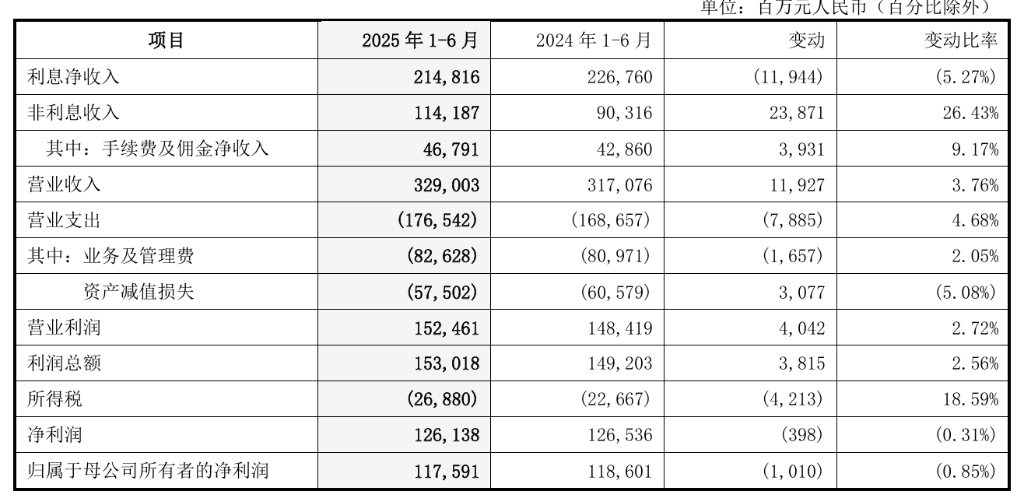
中国银行上半年营收同比增长3.61%,净息差收窄拖累净利息收入降5.27% | 财报见闻
Hua Er Jie Jian Wen· 2025-08-29 10:43
Core Insights - China Bank reported a slight decline in net profit attributable to shareholders, amounting to 117.59 billion RMB, a decrease of 0.85% year-on-year [1][6] - The bank's net interest income decreased by 5.27% to 214.82 billion RMB, while non-interest income surged by 26.43% to 114.19 billion RMB, increasing its share of total revenue to 34.71% [1][3] Financial Performance - Total operating income reached 329.00 billion RMB, reflecting a year-on-year growth of 3.76% [1][6] - Operating expenses increased by 4.68% to 176.54 billion RMB, with business and management fees rising by 2.05% [1] - The bank's total assets grew by 4.93% to 36.79 trillion RMB by the end of June [6] Interest Margin and Income - The net interest margin narrowed to 1.26%, down 18 basis points from the previous year, primarily due to lower loan market rates and adjustments in existing mortgage rates [2] - Interest income from loans and advances decreased by 10.47%, contributing to a total decline in net interest income of 11.94 billion RMB [2] Non-Interest Income Growth - Non-interest income reached 1,141.87 billion RMB, with significant contributions from agency services and other fiduciary businesses, leading to a 9.17% increase in fee and commission income [3] - Other non-interest income saw a remarkable increase of 42.02%, driven by favorable market conditions and gains from foreign exchange and precious metals [3] Asset Quality and Risk Management - The non-performing loan ratio stood at 1.24%, slightly down from the end of the previous year, with a provision coverage ratio of 197.39% [4] - The bank has been actively managing credit risk, particularly in the real estate sector, while also supporting local debt risk mitigation [4] Capital Position and Strategic Focus - China Bank successfully raised 165 billion RMB through A-share issuance and issued 50 billion RMB in subordinated debt, enhancing its capital base [5] - The capital adequacy ratio reached 18.67%, with a core Tier 1 capital ratio of 12.57%, providing a solid foundation for future growth [5] - The bank is focusing on its "Five Major Articles" strategy, with significant growth in technology and inclusive finance sectors [5][8]

中信银行上半年净利润365亿元同比增长2.78% 零售业务税前利润翻倍
Jing Ji Guan Cha Wang· 2025-08-28 03:21
Core Viewpoint - CITIC Bank demonstrated strong profit resilience in the first half of 2025, achieving a net profit of 36.478 billion yuan, a year-on-year increase of 2.78%, despite a 2.99% decline in operating income to 105.762 billion yuan, maintaining a revenue scale of over 100 billion yuan in a complex external environment [1][2] Financial Performance - The bank's total assets reached 9.858466 trillion yuan, a growth of 3.42% compared to the end of the previous year, with total loans and advances amounting to 5.8019 trillion yuan, up 1.43%, and total customer deposits at 6.106907 trillion yuan, increasing by 5.69% [2] - The non-performing loan (NPL) ratio remained stable at 1.16%, with a provision coverage ratio of 207.53%, indicating strong risk resistance capabilities [1] - The bank plans to increase its 2025 interim dividend payout ratio to 30.7%, distributing 1.88 yuan per share (before tax), enhancing investor return expectations [2] Interest Margin and Income Structure - The net interest margin narrowed to 1.63%, down 14 basis points from 1.77% in the same period of 2024, reflecting the challenges faced by the banking sector due to declining asset yields and rigid liability costs [3] - Interest income decreased by 1.94% to 71.201 billion yuan, despite a 6.78% increase in the average balance of interest-earning assets [3] - Non-interest income fell by 5.08% to 34.561 billion yuan, primarily due to a decline in investment income, although fee and commission income increased by 3.38% [4] Retail Banking Growth - Retail banking emerged as a new growth engine, with pre-tax profit soaring by 109.2% to 5.595 billion yuan, significantly outpacing the overall pre-tax profit growth of the bank [5][6] - Wealth management business showed robust performance, with retail wealth management product balances reaching 1.45 trillion yuan, a 4.11% increase, and private banking assets averaging 1.28 trillion yuan, up 9.33% [6][7] Governance and Strategic Direction - The bank underwent significant personnel adjustments in its board and senior management, maintaining stability at the chairman level while introducing new management talent to navigate complex market conditions [8][9] - The bank is focusing on a "five leading" strategy, emphasizing wealth management, comprehensive financing, transaction settlement, foreign exchange services, and digital banking [8][10] - The increase in interim dividend payout reflects the bank's financial health and long-term confidence, aligning with the trend of banks focusing on customer lifecycle understanding and capital efficiency [10]

“优等生”遇新烦恼 江苏银行“广种”而“薄收”
Shang Hai Zheng Quan Bao· 2025-08-27 18:32
Core Viewpoint - Jiangsu Bank has demonstrated strong asset growth and improved asset quality in the first half of the year, but its revenue growth remains modest, indicating a "wide planting, thin harvest" situation [2][5][6]. Asset Growth - As of June 30, Jiangsu Bank's total assets reached 4.79 trillion yuan, a year-on-year increase of 21.16%, with a growth rate exceeding 26% [3]. - The bank's non-loan assets have significantly contributed to its asset expansion, with increases in derivative and financial investments, cash, and interbank assets of 23.1%, 37.8%, and 41.95% respectively [3]. - The bank's corporate loans grew by 23.30% year-on-year, with infrastructure loans up by 31% and manufacturing loans by 18.90% [4]. Revenue and Profitability - Jiangsu Bank reported operating income of 448.64 billion yuan, a year-on-year growth of 7.78%, and a net profit of 202.38 billion yuan, up 8.05% [6]. - Interest income increased significantly, with net interest income rising by 19.10% to 329.39 billion yuan, but the growth in loan interest income was only 0.55% [6][7]. - The bank's net interest margin decreased to 1.78%, down 12 basis points year-on-year, primarily due to a decline in asset yield [6][7]. Asset Quality - The non-performing loan (NPL) ratio fell to 0.84%, the lowest since the bank's listing, with a decrease in the proportion of special mention loans to 1.24% [8]. - The bank's NPL generation and write-off rates have decreased, with NPL net increase and write-off amounts at 116 billion yuan and 99 billion yuan respectively [8][9]. - The bank's provision coverage ratio stands at 331.02%, indicating strong risk mitigation capacity [8]. Capital Adequacy - Jiangsu Bank's capital adequacy ratios have declined, with total capital adequacy at 12.36%, down from 12.99% at the end of the previous year [9]. - To address capital pressure, the bank issued two perpetual bonds totaling 300 billion yuan in the first half of the year [10].

降,降,降…贵阳银行各项业绩指标全线下降 董事长去年领31万激励工资
凤凰网财经· 2025-08-27 14:01
Core Viewpoint - Guiyang Bank reported a decline in both operating income and net profit for the first half of 2025, indicating ongoing challenges in profitability and asset quality [2][3][15]. Financial Performance - As of June 30, 2025, Guiyang Bank's total assets reached 741.54 billion RMB, an increase of 35.87 billion RMB or 5.08% from the beginning of the year [3]. - The bank's operating income for the first half of 2025 was 6.50 billion RMB, down 12.22% year-on-year, while net profit attributable to shareholders decreased by 7.20% to 2.47 billion RMB [4][15]. - The bank's interest income from loans and advances accounted for 56.1% of total income, amounting to 758.52 million RMB, reflecting a decline of 9.16% [5][6]. Profitability Indicators - Key profitability metrics showed a downward trend, with the net interest margin decreasing by 0.28 percentage points to 1.53% and the net profit margin dropping by 0.20 percentage points to 1.55% [7][9]. - The return on total assets fell by 0.04 percentage points to 0.35% [8][9]. Asset Quality - The non-performing loan (NPL) ratio increased by 0.12 percentage points to 1.70%, surpassing the industry average of 1.49% [11][14]. - The bank's provision coverage ratio decreased by 18.43 percentage points to 238.64%, although it remains above the industry average of 211.97% [13][14]. Revenue Composition - The bank's revenue structure showed significant declines across various income sources, with interest income from interbank placements down 39.01% and from trust and asset management plans down 37.67% [6][7]. - The only revenue categories with declines below 5% were other income and fee and commission income, which fell by 2.10% and 2.83%, respectively [7]. Historical Performance Trends - The decline in operating income and net profit is not a new trend, as the bank has experienced a continuous downturn for two and a half years, with previous years also showing declines in revenue and profit [15][16].

业绩连续两年下滑!贵阳银行上半年净息差收窄,资产质量承压
Bei Ke Cai Jing· 2025-08-26 13:40
Core Viewpoint - Guiyang Bank reported a decline in both revenue and net profit for the first half of 2025, continuing a trend of "double decline" for three consecutive years [2][4]. Financial Performance - In the first half of 2025, Guiyang Bank achieved revenue of 6.501 billion yuan, a year-on-year decrease of 12.22%, and a net profit attributable to shareholders of 2.474 billion yuan, down 7.2% year-on-year [2]. - The bank's net interest income fell from 5.806 billion yuan in the same period last year to 4.920 billion yuan, a decline of 15.26% [3]. - The fair value change income from trading financial assets turned negative at -511 million yuan, a decrease of 853 million yuan year-on-year [3]. Revenue Sources - Non-interest income for the first half of 2025 was 1.580 billion yuan, a decrease of 1.22% year-on-year [6]. - The bank's revenue primarily comes from within Guizhou Province, with 93.77% of income generated there, and 33.46% from Guiyang City alone [12]. Asset and Loan Growth - As of mid-2025, Guiyang Bank's total assets reached 741.536 billion yuan, an increase of 5.08% from the beginning of the year, with total loans amounting to 343.461 billion yuan, up 1.27% [8]. - The bank's non-performing loan balance increased to 5.824 billion yuan, with a non-performing loan ratio of 1.70%, up 0.12 percentage points from the beginning of the year [10]. Capital Adequacy - The bank's provision coverage ratio decreased to 238.64%, down 18.43 percentage points, while the capital adequacy ratio was 14.97%, a decrease of 0.23 percentage points [11].
多家中小银行下调存款利率!新一轮“降息”或开启?
Jing Ji Wang· 2025-08-21 08:25
Core Viewpoint - Recent adjustments in deposit interest rates by several village and town banks in regions such as Zhejiang, Guizhou, and Jilin indicate a trend of rate cuts primarily among small and medium-sized banks, aimed at stabilizing net interest margins in response to declining profitability [1][4] Summary by Sections Deposit Rate Adjustments - Multiple village and town banks have announced reductions in deposit rates, with decreases ranging from 10 to 20 basis points [1][3] - For instance, Jiangsu Bank has lowered its three-year fixed deposit rate from 1.85% to 1.75%, a reduction of 10 basis points [2] Market Response and Trends - The trend of lowering deposit rates is primarily seen in small and medium-sized banks, which are actively managing their funding costs to address the pressure from narrowing net interest margins [4][6] - Despite the overall downward trend in deposit rates, some banks have introduced large-denomination certificates of deposit (CDs) with interest rates exceeding 2%, attracting market attention [4] Future Outlook - Analysts predict that the downward trend in deposit rates will continue, with expectations of a new round of rate cuts in the third and fourth quarters of the year [5][6] - The necessity for small and medium-sized banks to optimize their deposit structures and reduce reliance on high-interest deposits is emphasized, as this could lead to unsustainable business practices in the long term [4][7]
业绩亮眼背后:江阴银行如何靠投资收益“对冲”息差压力?
Jing Ji Guan Cha Wang· 2025-08-17 04:01
Core Viewpoint - Jiangyin Rural Commercial Bank reported steady growth in assets and profits for the first half of 2025, driven by significant increases in investment income and improved asset quality [2][3][6]. Financial Performance - As of June 30, 2025, total assets reached 207.58 billion, a 3.67% increase from the previous year, while total liabilities grew by 3.86% to 188.38 billion [2]. - The bank's operating income for the first half of 2025 was 2.40 billion, reflecting a year-on-year growth of 10.45%, with net profit attributable to shareholders rising by 16.69% to 846 million [2][3]. - Investment income surged by 81.44% to 882 million, becoming the main driver of profit growth, while net interest income remained stable at 1.41 billion [2][3]. Income Composition - Non-interest income saw rapid growth, with investment income accounting for 36.72% of total operating income, up from 22.35% in the previous year [3]. - The bank's trading financial assets increased by 28.58% to 25.33 billion, with government bonds showing a remarkable growth of 267.27% [3]. - Fee and commission income decreased by 35.15% to 50.85 million, primarily due to market conditions affecting intermediary business revenues [3]. Asset and Liability Management - Total loans and advances amounted to 131.42 billion, a 5.87% increase, with over 80% allocated to corporate loans, particularly in manufacturing, wholesale retail, and construction [5]. - Total deposits reached 164.83 billion, growing by 6.35%, with a stable liability structure where deposits accounted for 87.49% of total liabilities [5]. Asset Quality - The overdue loan balance decreased significantly by 16.63% to 1.40 billion, indicating improved asset quality management [6]. - However, a substantial portion of overdue loans (68.69%) were overdue for more than three months, suggesting potential risks of conversion to non-performing loans [6]. - Credit impairment losses were 868 million, down 3.27% year-on-year, reflecting effective risk management and asset disposal efforts [6]. Industry Challenges - The bank faces challenges common to regional banks, including narrowing net interest margins and reliance on traditional lending models [6][7]. - There is a need for regional banks to enhance digital capabilities and explore wealth management and transaction banking to adapt to increasing competition and regulatory pressures [7]. - The concentration of loans in specific regions may amplify risks associated with economic fluctuations, necessitating a cautious approach to business expansion [7].