
原始创新

Search documents
安徽“十五五”规划建议:以超常规举措加强关键共性技术、前沿引领技术、现代工程技术、颠覆性技术创新
Zheng Quan Shi Bao Wang· 2025-12-19 00:29
Core Viewpoint - The proposal from the Anhui Provincial Committee emphasizes the need for original innovation and breakthroughs in key core technologies, aiming to enhance technological capabilities in various critical sectors [1] Group 1: Key Technological Focus Areas - The initiative aims to strengthen common key technologies, frontier-leading technologies, modern engineering technologies, and disruptive technological innovations [1] - A dynamic list of "bottleneck" technologies will be compiled to drive significant breakthroughs in areas such as integrated circuits, new displays, industrial mother machines, high-end instruments, basic software, advanced materials, biomanufacturing, and core seed sources [1] Group 2: Strategic Implementation - The proposal highlights the importance of goal-driven and demand-oriented approaches, establishing mechanisms for identifying and publishing major scientific research tasks [1] - A focus will be placed on implementing several provincial-level technology innovation initiatives to tackle key challenges [1] Group 3: Research and Development Enhancement - There will be an exploration of a non-consensus project selection mechanism based on expert recommendations [1] - The strategy includes a systematic layout for basic research that is strategic, forward-looking, and comprehensive, with an increased proportion of investment in basic research [1] - Long-term stable support for original innovation in scientific research and technology development will be emphasized, aiming to create an environment conducive to original and disruptive innovations, leading to more landmark original achievements [1]
探索新时期高校科创平台发展路径
Xin Hua Ri Bao· 2025-12-18 21:37
Core Viewpoint - The article emphasizes the importance of higher education institutions' technology innovation platforms as a crucial part of the national strategic technological force, highlighting their role in original innovation, key technology development, and high-level talent cultivation [1] Group 1: Development Paths for Innovation Platforms - The development of higher education technology innovation platforms requires a systematic approach that integrates five paths: research paradigm transformation, organizational methods, investment mechanisms, evaluation orientation, and open ecosystems [1] - The platforms should focus on transforming research paradigms to prioritize original supply and interdisciplinary collaboration, identifying scientific problems that can lead to paradigm shifts based on real-world needs [2] - A proactive approach to national strategic needs is essential, targeting critical technology areas and integrating foundational principles with key hardware and software technology routes [2] Group 2: Enhancing International Influence - The ability to propose scientific problems and establish standards is crucial for enhancing international discourse power, moving away from a model of merely following established Western research frameworks [3] - Higher education technology innovation platforms should actively participate in large scientific projects and lead standard-setting and open-source governance to increase their global influence [3] Group 3: Organizational Restructuring - A shift towards a "small core, large collaboration" organizational model is necessary to overcome structural bottlenecks and clarify roles within collaborative networks [4] - Establishing unified directories and open rules around major resources will facilitate data sharing and improve operational efficiency [4] Group 4: Institutional Support and Long-term Investment - A combination of mechanisms such as milestone assessments and flexible funding is needed to support high-risk original research, recognizing that foundational research often requires 7-10 years for significant breakthroughs [5] - Institutions should promote a culture of openness regarding negative results and data sharing to enhance research quality and support disruptive technologies [5] Group 5: Integration of Industry and Academia - The integration of industry and academia should focus on creating platforms for joint research and pilot testing, driven by significant real-world demands [6] - Mechanisms like "first-stage transformation" and "pre-incubation" should be promoted to address systemic barriers to technology transfer and commercialization [7] - The article outlines a closed-loop approach that connects strategic foresight, international participation, platform integration, institutional reform, and industry-academia collaboration to enhance the overall effectiveness of technology innovation platforms [7]
支持探索科研“无人区”!首批3个重大非共识基金项目拟获资助
Xin Hua She· 2025-12-18 06:57
Core Viewpoint - The National Natural Science Foundation of China has launched a pilot program for major non-consensus projects, selecting three initial funding proposals to support researchers in exploring innovative research directions in international scientific competition "no man's land" [1] Group 1: Project Focus Areas - The selected projects will focus on new particle detection in atomic nucleus transitions, the synthesis of artificial cells, and the mechanisms of early solar system particle generation [1] - The aim is to produce high-level original innovative results through in-depth research in these fields [1] Group 2: Research Encouragement and Selection Mechanism - The 20th National Congress of the Communist Party of China emphasized the encouragement of high-risk, high-value fundamental research and the establishment of a real-name recommendation system for non-consensus project selection [1] - The selection process for major non-consensus projects will utilize an unconventional model of "in-depth interactive discussions + expert committee deliberation," allowing for unlimited discussion time to ensure thorough communication between the defense team and experts [1] Group 3: Future Implementation and Goals - The National Natural Science Foundation of China plans to further implement and continuously optimize the selection mechanism for major non-consensus projects [1] - The goal is to guide researchers to focus on high-level original scientific research, fostering a favorable research ecosystem for original innovation and promoting high-quality development in fundamental research to support the establishment of a strong technological nation [1]
第九届中国学术评价论坛召开 聚焦原创研究方法与自主知识体系建构
Zhong Guo Jing Ji Wang· 2025-12-16 14:23
Core Viewpoint - The Ninth China Academic Evaluation Forum emphasizes the construction of an independent knowledge system in Chinese philosophy and social sciences, focusing on originality in academic evaluation [1][2] Group 1: Forum Overview - The forum was held at Shenzhen University and co-hosted by several institutions including Renmin University of China and Fudan University [1] - The theme of the forum is "Original Research Methods in Chinese Philosophy and Social Sciences and the Construction of an Independent Knowledge System" [1] Group 2: Academic Evaluation System - The academic evaluation system developed by Renmin University is based on a four-tier structure aimed at promoting originality [1] - The first tier is a preprint platform for philosophy and social sciences to stimulate innovation among young scholars [1] - The second tier focuses on disseminating high-quality Chinese academic papers through selected reprinted materials [1] - The third tier is a main literature platform that curates essential and classic papers [1] - The fourth tier is the "Three Movements" of originality-oriented academic evaluation, which analyzes original academic concepts, theories, and research methods [1] Group 3: Originality in Research - The report presented at the forum highlights that original innovation is characterized by high levels of breakthrough and leadership in knowledge innovation [2] - The core elements of the knowledge system, including academic concepts, theories, and research methods, reflect the originality of the independent knowledge system in China [2] - Previous reports in the "Three Movements" series have been published, contributing to the "Blue Book of Independent Knowledge System" [2]
中央明确北京、上海国际科创中心扩围,目的何在
Di Yi Cai Jing· 2025-12-14 10:26
Core Insights - The central government aims to accelerate the formation of original innovation sources in China by establishing three major international technology innovation centers in Beijing, Shanghai, and the Guangdong-Hong Kong-Macau Greater Bay Area [1][2] Group 1: Strategic Importance - The three international technology innovation centers are increasingly recognized as key strategic points for building a strong technological nation [1] - These centers have significantly improved their global innovation index rankings, with Shenzhen-Hong Kong-Guangzhou cluster surpassing Tokyo-Yokohama to become the top innovation cluster globally [2] Group 2: Regional Innovation Development - Beijing ranks second nationally in comprehensive technology innovation level, with R&D expenditure intensity reaching 6.73%, the highest in the country [3] - Shanghai has seen a rise in its comprehensive ranking to first place, with R&D expenditure intensity ranked second [3] - The Guangdong-Hong Kong-Macau Greater Bay Area is recognized as the most influential innovation cluster globally [2] Group 3: Collaborative Innovation Efforts - Recent meetings have outlined key tasks for the development of these innovation centers, emphasizing the integration of technology and industry innovation [4][5] - The Shanghai government has initiated measures to enhance collaborative innovation, focusing on high-risk and high-value basic research [5] - The Guangdong provincial government is leveraging the "One Country, Two Systems" advantage to strengthen collaboration with Hong Kong and Macau, aiming to create a tighter innovation community [5]
习言道|追求实实在在、没有水分的增长
Zhong Guo Xin Wen Wang· 2025-12-14 00:51
Group 1 - The core message emphasizes the pursuit of substantial and genuine growth without exaggeration, aiming for high-quality and sustainable development [11] - The meeting highlighted the importance of strengthening confidence, leveraging advantages, and addressing challenges to maintain a stable and positive economic momentum [6] - The expansion of the Beijing and Shanghai international innovation centers aims to accelerate the formation of China's primary sources of original innovation, contributing to the strategic guidance for building a technology-driven nation [9] Group 2 - The central government calls for a more unified effort from the entire party and society to achieve the economic and social development goals for the coming year, ensuring a good start for the 14th Five-Year Plan [14] - There is a focus on optimizing planning tasks by reducing redundancy and ensuring that all plans are practical and realistic [11] - The overall outlook for China's economy remains positive in the long term, with supporting conditions and fundamental trends unchanged [5][6]

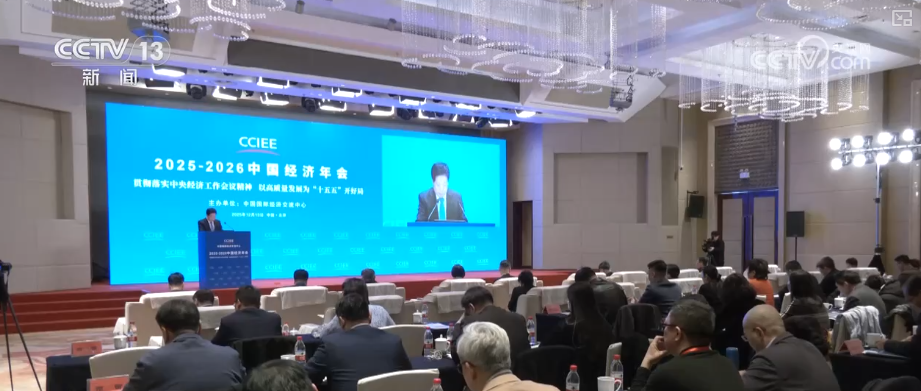
开好局、起好步!透过中国经济年会 多角度感知中国经济蓬勃“脉动”
Yang Shi Wang· 2025-12-13 10:19
央视网消息:12月13日,在中国国际经济交流中心举办的2025—2026中国经济年会上,中央财办分管日常工作的副主任、中央农办主任韩文秀 表示,2025年是中国式现代化进程中具有重要意义的一年,是很不平凡的一年。全年经济社会发展主要预期目标将顺利实现,"十四五"即将圆 满收官。 中央财办分管日常工作的副主任、中央农办主任韩文秀表示,一年来,我国经济顶压前行,向新向优发展,展现出了强大的韧性和活力。主要 经济指标表现好于预期,许多机构预测,全年经济增长5%左右,我国仍然是全球经济增长的最大引擎。我们的就业形势总体稳定,外贸较快 增长,出口多元化成效明显,现代化产业体系建设加快推进。新质生产力稳步发展,人工智能、生物医药、机器人等研发和应用处在全球第一 梯队。改革开放迈出新步伐,纵深推进全国统一大市场建设,综合整治内卷式竞争,光伏等行业的供求关系和价格走势出现积极的变化。资本 市场交投活跃,国内外投资者信心增强,自主开放有序推进,安全、稳定、自信、包容的中国形象展现在世界的面前。 重点领域风险化解取得积极进展 在12月13日举行的中国经济年会上,韩文秀表示,2025年以来,重点领域风险化解取得积极进展。 韩文秀表 ...
深圳经济生机勃勃 向“新”向“高”发展活力奔涌
Zhong Guo Fa Zhan Wang· 2025-12-11 09:28
Economic Performance - In 2024, Shenzhen's R&D investment reached 245.307 billion yuan, ranking second among major cities in China [1] - Shenzhen's total foreign trade import and export volume ranked first in the country, achieving 32 consecutive months of export growth [1] - By the end of 2024, Shenzhen's industrial output value and industrial added value ranked first in the country for three consecutive years [1] - The GDP of Shenzhen for the first three quarters was 27,896.44 billion yuan, with a year-on-year growth of 5.5% [1] Innovation and R&D - Shenzhen's R&D investment intensity reached 6.67%, the highest among major cities in China [2] - Basic research funding in Shenzhen grew by 21.2% in 2024, with a total of 11.591 billion yuan, outpacing overall R&D funding growth by 11.5 percentage points [3] - The city has established a scientific alliance with Dongguan to promote collaborative innovation in the Guangdong-Hong Kong-Macao Greater Bay Area [3] Industrial Development - Shenzhen has over 74,000 companies related to robotics, leading the nation, with 34 listed companies in this sector [5] - The city is recognized as a global leader in the low-altitude economy, having implemented the first national legislation on low-altitude economic development [4] - Shenzhen's policies have fostered a complete ecosystem for robotics, from core components to application scenarios [5] Foreign Investment - Since the 14th Five-Year Plan, Shenzhen has seen the establishment of 34,600 foreign-invested enterprises, accounting for 14.7% of the national total [7] - The actual utilization of foreign capital reached approximately 274.23 billion yuan, 1.2 times that of the previous five-year period [7] - Shenzhen has become a strategic hub for foreign investment, with over 200 active foreign R&D centers and more than 30,000 R&D personnel [7]


广东省“十四五”期间研发投入等指标领跑全国
Zhong Guo Fa Zhan Wang· 2025-12-08 07:16
大湾区综合性国家科学中心是全国五大综合性国家科学中心之一,是建设粤港澳大湾区国际科技创新中 心的重要支撑。广东省大湾区办专职副主任祝永辉介绍说,"十四五"期间,广东全面推动大湾区综合性 国家科学中心先行启动区建设,较好完成第一阶段目标任务。具体体现在光明科学城、松山湖科学城、 南沙科学城三大科学城协同发力,构筑起创新空间核心载体;布局建设10个国家重大科技基础设施,数 量位居全国第三,其中大湾区综合性国家科学中心先行启动区建设了5个,夯实原始创新底座;在人工 智能、生物制造、低空经济等领域,推动产业科技互促双强,打造高质量发展产业高地。 中国发展网讯 鲁利韦 记者罗勉报道 12月3日,广东省人民政府新闻办召开第三场"'十四五'广东成就"系 列主题新闻发布会,聚焦"高水平科技自立自强"主题,广东省科技厅等单位相关负责人出席发布会。据 了解,"十四五"期间,广东省加快构建全过程创新链,推动科技创新和产业创新互促双强,"十四五"规 划各项指标任务顺利完成。 区域创新综合能力 连续9年居全国首位 广东省科技厅厅长王月琴在发布会上说,"十四五"期间,广东省推动高水平科技自立自强工作呈现'六 个继续领先''六个跃升前列' ...
投身“卡脖子”技术攻坚 做“顶天立地”的真科研
Ren Min Ri Bao Hai Wai Ban· 2025-12-08 01:00
Core Insights - The successful launch of the CXPD (Cosmic X-ray Polarization Detector) CubeSat marks a significant advancement in China's observational capabilities for gamma-ray bursts and other transient X-ray sources, showcasing the country's progress in key technological areas [1] - The research and development efforts at Guangxi University are aligned with national strategic needs, focusing on deep space exploration and new energy, which are critical for future scientific advancements [2] - The innovative educational model at Guangxi University emphasizes the integration of strategic demands and cutting-edge research, fostering a new generation of talented physicists dedicated to overcoming technological challenges [4] Group 1: Research and Development Achievements - The CXPD project, led by Guangxi University's Physics Department, represents a decade-long effort to develop key technologies, achieving full-chain independent research from core components to onboard intelligent algorithms [1] - The research team has made significant breakthroughs, including the first observation of X-ray polarization from the PSR B1509-58 pulsar, which has been recognized in top international journals [5] - The development of high-melting-point optical crystals and other advanced materials has direct applications in national key projects, demonstrating the practical impact of the research [6] Group 2: Educational and Collaborative Framework - Guangxi University has established an open "innovation ecosystem" that enhances students' original innovation capabilities through innovative course structures and practical engineering training [4] - The "double mentor" system allows students to collaborate with leading researchers from both Guangxi University and other prestigious institutions, fostering a collaborative research environment [3] - The integration of national and local industrial needs into the curriculum has led to the emergence of a new generation of researchers who are actively contributing to significant scientific advancements [2][5] Group 3: Recognition and Future Prospects - The Physics Department at Guangxi University has achieved a significant milestone by ranking in the top 1% globally in the ESI (Essential Science Indicators) [6] - The department's commitment to original innovation and talent cultivation is expected to continue driving advancements in technology and contribute to regional scientific independence [6] - The recognition of the physics team as part of the "National College Huang Darnian-style Teacher Team" demonstrates the department's excellence in education and research [6]