
多模态大模型

Search documents
顶尖AI竟输给三岁宝宝,BabyVision测试暴露多模态模型硬伤
机器之心· 2026-01-12 05:01
Core Viewpoint - The article discusses the limitations of current large models in visual understanding, emphasizing that while they excel in language and text reasoning, their visual capabilities remain underdeveloped, akin to that of a three-year-old child [3][4][49]. Group 1: BabyVision Overview - UniPat AI, in collaboration with Sequoia China and various research teams, has launched a new multimodal understanding evaluation set called BabyVision to assess visual capabilities of AI models [3][4]. - BabyVision aims to create a new paradigm for AI training, evaluation, and application in real-world scenarios, focusing on generating measurable and iterative visual capabilities [4][49]. Group 2: Evaluation Methodology - BabyVision includes a direct comparison experiment with 20 vision-centric tasks given to children of different ages (3, 6, 10, 12 years) and top multimodal models [7]. - The evaluation strictly controls language dependency, requiring answers to be derived solely from visual information [8]. Group 3: Results and Findings - The results reveal that most models score significantly below the average performance of three-year-old children, with the best model, Gemini3-Pro-Preview, only achieving 49.7%, which is still 20 percentage points below the performance of six-year-olds [15][21]. - Human participants scored an impressive 94.1% accuracy on the BabyVision-Full test, highlighting the substantial gap between human and model performance [20][21]. Group 4: Challenges Identified - The study identifies four core challenges in visual reasoning for AI models: observing non-verbal details, maintaining visual tracking, lacking spatial imagination, and difficulty in visual pattern induction [27][30][36][39]. - These challenges indicate a systemic lack of foundational visual capabilities in current models, rather than isolated deficiencies [23]. Group 5: Future Directions - The article suggests that transitioning visual reasoning tasks to visual operations, as demonstrated in BabyVision-Gen, may help bridge the gap in visual understanding [42]. - The ongoing development of BabyVision aims to guide the evolution of multimodal large models by breaking down visual understanding into 22 measurable atomic capabilities [49].


多模态大模型输给三岁宝宝?xbench x UniPat联合发布新评测集BabyVision
Xin Lang Cai Jing· 2026-01-12 01:57
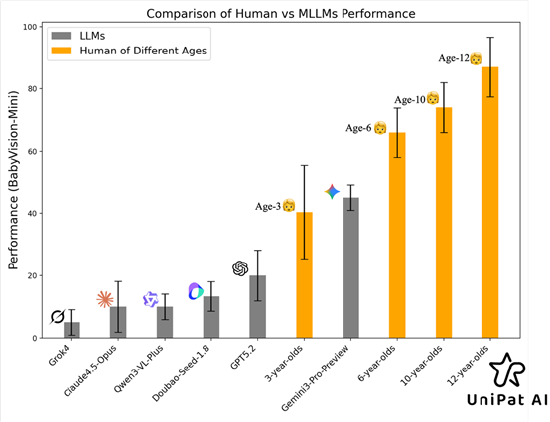
Core Insights - The core issue is the significant gap in visual understanding capabilities of multimodal large models when not relying on language prompts, with performance levels comparable to that of a three-year-old child [2][34] - The BabyVision assessment framework dissects visual capabilities into four main categories (fine-grained discrimination, visual tracking, spatial perception, visual pattern recognition) comprising 22 sub-tasks to identify specific weaknesses in model performance [2][34] - Evaluation results reveal a stark contrast between human and model performance, with human baseline accuracy at 94.1%, while the best closed-source model, Gemini3-Pro-Preview, achieved only 49.7%, followed by GPT-5.2 at 34.8%, Doubao-1.8 at 30.2%, and the best open-source model, Qwen3VL-235B-Thinking, at 22.2% [2][34] - A key reason for this disparity is that many tasks cannot be fully expressed in language, leading to the concept of "unspeakable" tasks where critical visual details are lost when compressed into tokens [2][34] - BabyVision introduces a new direction by allowing models to generate visual outputs, with BabyVision-Gen re-labeling 280 tasks suitable for generative responses, achieving a 96% consistency rate with human evaluations [2][34] Assessment Framework - The BabyVision framework aims to break down the understanding of the world into measurable, diagnosable, and iterative atomic capabilities, providing a roadmap for enhancing visual shortcomings in multimodal and embodied intelligence [3][35] - A direct comparison experiment was conducted where 20 vision-centric tasks were given to children of various ages and top multimodal models, revealing that most models scored significantly below the average performance of three-year-old children [4][36] - The only model to consistently exceed the three-year-old baseline was Gemini3-Pro-Preview, which still lagged approximately 20 percentage points behind six-year-old children [4][36] Visual Capability Breakdown - The visual capabilities were categorized into four core areas, each with several sub-tasks: - Fine-grained Discrimination: 8 sub-tasks focused on distinguishing subtle visual differences - Visual Tracking: 5 sub-tasks aimed at following paths, lines, and motion trajectories - Spatial Perception: 5 sub-tasks related to understanding three-dimensional structures and their relationships - Visual Pattern Recognition: 4 sub-tasks for identifying logical and geometric patterns [10][42] - The data collection process involved strict adherence to copyright regulations, ensuring that only suitable images were used, and each question underwent a rigorous double-blind quality check [11][43] Challenges Identified - The research identified four typical challenges faced by models in visual tasks: 1. Non-verbal details: Models struggle with tasks requiring subtle visual distinctions that are easily recognized by humans [14][48] 2. Tracking errors: Models often misinterpret paths and connections, leading to incorrect answers [16][51] 3. Lack of spatial imagination: Models fail to accurately visualize and manipulate three-dimensional structures [19][53] 4. Difficulty in pattern induction: Models tend to focus on superficial attributes rather than underlying structural rules [23][55] Future Directions - BabyVision-Gen represents a promising new approach, allowing models to perform visual reasoning through drawing and tracing, which may help address existing shortcomings [24][60] - The importance of BabyVision lies in its potential to guide the development of multimodal models by identifying gaps in visual understanding and suggesting areas for improvement [29][61]
智源2026十大趋势发布会-获取你的2026年AI发展路线图
2026-01-12 01:41
Summary of Key Points from the Conference Call Industry and Company Overview - The conference focused on the advancements and future trends in the **Artificial Intelligence (AI)** industry, particularly through the lens of **ZhiYuan Research Institute**. The discussions highlighted the transition of AI into commercial applications and the evolution of AI technologies. Core Insights and Arguments 1. **AI Development Trends**: AI is accelerating towards commercial applications, with AI agents evolving towards specialization and unified protocols. Machine intelligence is shifting from superficial imitation to understanding and modeling the laws of the physical world, entering a new paradigm of "state space prediction" which enables forecasting future trends [1][2][3]. 2. **Technological Achievements**: Significant progress has been made in areas such as world models, scaling laws, and AI agents. Large models have shown rapid advancements in language and visual understanding, with AI for Science becoming an essential tool in research [1][4]. 3. **Multimodal World Models**: The development of multimodal world models is progressing through pre-training with multimodal data, learning real-world dynamics. This evolution from Next Token Prediction to Next Day Prediction signifies a leap in capabilities [1][14]. 4. **Growth in the AI for Science Sector**: The transition from traditional methods to AI-driven approaches in scientific research is evident, with AI for Science becoming integral to research workflows. The U.S. "Genesis Project" aims to integrate resources across the entire scientific process [1][18][19]. 5. **Challenges in the AI Industry**: The AI industry faces challenges such as data quality, the maturity of multi-agent systems, and high costs. A potential disillusionment phase is anticipated in early 2026, but a rebound is expected later in the year [22][46]. 6. **Synthetic Data Utilization**: The reliance on high-quality data is diminishing, leading to a rise in synthetic data and reinforcement learning. The synthetic data market is projected to surpass real data by 2030, indicating a shift in data sourcing strategies [23][35]. 7. **AI Super Applications**: The emergence of AI super applications is being driven by direct productization of AI technologies, with expectations for new dominant players in the market. These applications are expected to integrate multiple industry APIs to enhance functionality [21][42]. 8. **Future of AI Agents**: Multi-agent systems are anticipated to become mainstream in enterprise applications, with protocols like MCPASA potentially revolutionizing interactions between agents [20][26]. Other Important but Overlooked Content 1. **AI's Societal Impact**: The development of AI is reshaping scientific innovation, transitioning from traditional research methods to AI-driven approaches, which could help address systemic risks that humanity faces [6]. 2. **Community Support for Researchers**: The ZhiYuan community is actively supporting researchers by providing access to a vast array of AI papers and facilitating collaboration through various initiatives [8]. 3. **Safety and Security in AI**: The increase in AI applications has led to a rise in reported safety incidents, emphasizing the need for robust safety measures and research into AI behavior [62]. 4. **Future AI Research Directions**: The focus is shifting towards solving specific problems rather than merely accumulating knowledge, with expectations for AI to enhance research efficiency significantly [40][56]. This summary encapsulates the key points discussed during the conference, highlighting the advancements, challenges, and future directions of the AI industry as presented by ZhiYuan Research Institute.
多模态大模型输给三岁宝宝?xbench x UniPat联合发布新评测集BabyVision
红杉汇· 2026-01-12 01:04
Core Insights - The article discusses the advancements in large models in language and text reasoning, highlighting the need for models to understand visual information without relying on language. The introduction of the BabyVision evaluation set aims to assess this capability [1][2]. Group 1: Evaluation of Visual Understanding - BabyVision conducted a direct comparison between children of various ages (3, 6, 10, 12 years) and top multimodal models on 20 vision-centric tasks, revealing that most models scored below the average of 3-year-old children [2][4]. - The only model that consistently exceeded the 3-year-old baseline was Gemini3-Pro-Preview, which still lagged approximately 20 percentage points behind 6-year-old children [4]. Group 2: Breakdown of Visual Abilities - The research team categorized visual abilities into four core categories: Visual Pattern Recognition, Fine-grained Discrimination, Visual Tracking, and Spatial Perception, with a total of 22 sub-tasks designed to quantify foundational visual skills [9][11]. - BabyVision was developed using a rigorous data collection process, referencing children's cognitive materials and visual development tests, resulting in 388 high-quality visual questions [10][11]. Group 3: Performance Results - In the BabyVision-Full evaluation, human participants achieved an accuracy rate of 94.1%, while the best-performing model, Gemini3-Pro-Preview, scored only 49.7%, with most models falling in the 12-19% range [13]. - The performance gap was consistent across all four categories, indicating a systemic lack of foundational visual capabilities in the models [13]. Group 4: Challenges Identified - The article identifies several challenges faced by models, including the inability to process visual information without losing details, leading to errors in tasks that require spatial imagination and visual pattern induction [15][23][26]. - Many tasks in BabyVision are described as "unspeakable," meaning they cannot be fully captured in language without losing critical visual information [15]. Group 5: Future Directions - BabyVision-Gen was introduced to explore whether models can perform visual tasks like children by generating images or videos as answers, showing some improvement in human-like behavior but still lacking consistent accuracy [27][28]. - The importance of BabyVision lies in its ability to break down visual understanding into measurable components, guiding the development of multimodal models towards achieving true general intelligence and embodied intelligence [31].

陪伴机器人,正在改写9亿人的孤独经济
机器人大讲堂· 2026-01-11 09:39
Core Insights - The article discusses the rise of companion robots, driven by the dual forces of emotional consumption and AI technology, transforming from toys to essential companions in various life scenarios [1][3]. Group 1: Market Demand - The "loneliness economy" is emerging, with 900 million people creating a strong demand for companionship. As basic needs are met, higher-level needs such as belonging and self-actualization are becoming central to consumption, with "emotional value" being key to product pricing [4][5]. - By 2025, the online market for AI toys in China is expected to surge by 394.9%, with emotional companionship products growing the fastest, increasing their market share from 7.0% to 15.7% [4]. Group 2: Target Demographics - Over 120 million young adults aged 18-35 live alone, showing a strong demand for anthropomorphic interaction products. Women aged 25-30 represent 72% of the consumer base for companion robots, willing to pay for aesthetics and empathy [7]. - The elderly population in China has reached 280 million, with over 50% being empty nesters. High-end companion robots are becoming essential in the elderly care market, despite their higher price points [7]. Group 3: Market Growth Projections - The global AI companionship market is projected to grow from $30 million to between $70 billion and $150 billion by 2030. The domestic market is expected to reach approximately $1 billion in 2024 and $3.86 billion by 2030, with a compound annual growth rate of 75% [9]. Group 4: Technological Advancements - The rise of companion robots is attributed to advancements in AI technology, enabling a shift from passive responses to active empathy. New generation robots can understand context, emotions, and subtleties in conversation, providing personalized interactions [10][11]. - Multi-modal sensors are being integrated into companion robots, allowing them to perceive voice, visual, tactile, and environmental cues, enhancing user interaction [14]. Group 5: Market Structure - The companion robot market is attracting three types of players: traditional toy manufacturers, tech startups, and IP holders, leading to differentiated competition [17]. - Traditional toy companies leverage established supply chains and IPs to transition into the AI space, while tech firms focus on high-end markets with advanced emotional interaction capabilities [19][21]. Group 6: Product Evolution - Companion robots are categorized into three price tiers: entry-level (100-500 RMB), mid-range (500-3000 RMB), and high-end (over 3000 RMB), catering to different user needs [26][28][30]. - Entry-level products focus on basic interactions and are popular among cost-conscious parents, while mid-range products are favored by urban professionals seeking emotional support [27][29]. Group 7: Future Trends - The market for companion robots is expected to transition from "conceptual popularity" to "demand-driven" growth, with four key trends: precision in emotional computing, deeper IP integration, diversified scene expansion, and service-oriented monetization models [31][34][35]. - Companies are exploring subscription services and dual revenue models to enhance profitability beyond single sales [36]. Group 8: Challenges and Opportunities - Despite the promising market outlook, challenges such as technology integration and safety risks remain prevalent. The industry must address issues related to data privacy and user dependency on technology [37][39]. - The reduction in computing costs and advancements in AI capabilities present significant opportunities for improving the cost-effectiveness of companion robots [40].
在谷歌深耕14年,华人研究员创立视觉AI公司,计划融资5000万美元
机器之心· 2026-01-11 02:17
Core Insights - Two former Google researchers are founding a new visual AI company named Elorian, aiming to develop advanced AI models that can understand and process text, images, videos, and audio simultaneously [1][8] - The company is currently in discussions to raise approximately $50 million in seed funding, with Striker Venture Partners potentially leading the investment round [1] Group 1: Founders' Background - Andrew Dai, a former senior AI researcher at Google DeepMind, has 14 years of experience in AI research and management, contributing to the development of the Gemini large AI model [3] - Yinfei Yang, a former AI researcher at Apple, has extensive experience in multimodal models and has worked at Google Research, Amazon, and Redfin, focusing on visual-language representation and multimodal learning [5] Group 2: Company Vision and Goals - Elorian's primary goal is to create a multimodal AI model capable of visual understanding and analysis of the real world by processing images, videos, and audio [8] - While robotics is a potential application area, the company envisions a broader range of applications that have not yet been disclosed [8]


诚迈科技与联想车计算联合发布座舱AI算力方案Auto AI Box
Zheng Quan Shi Bao Wang· 2026-01-06 14:39
Core Viewpoint - Chengmai Technology (300598) and Lenovo Vehicle Computing jointly launched the Auto AI Box, an AI computing solution for vehicle cockpits based on NVIDIA's latest platform, NVIDIA DRIVE AGX Thor [1] Group 1: Product Features - The Auto AI Box integrates Lenovo's hardware capabilities and is equipped with Chengmai Technology's FusionOS 4.0, which is the latest Agentic based AI operating system [1] - It incorporates a multimodal large model that supports natural language interaction and provides standardized hardware interfaces [1] - The solution can support the smooth operation of multimodal large models up to 13 billion parameters, offering robust, efficient, and scalable core computing support for next-generation intelligent cockpits [1]

海尔消费金融2025年“特征英雄”落下帷幕,数智化风控质效显著
Sou Hu Cai Jing· 2026-01-06 07:50
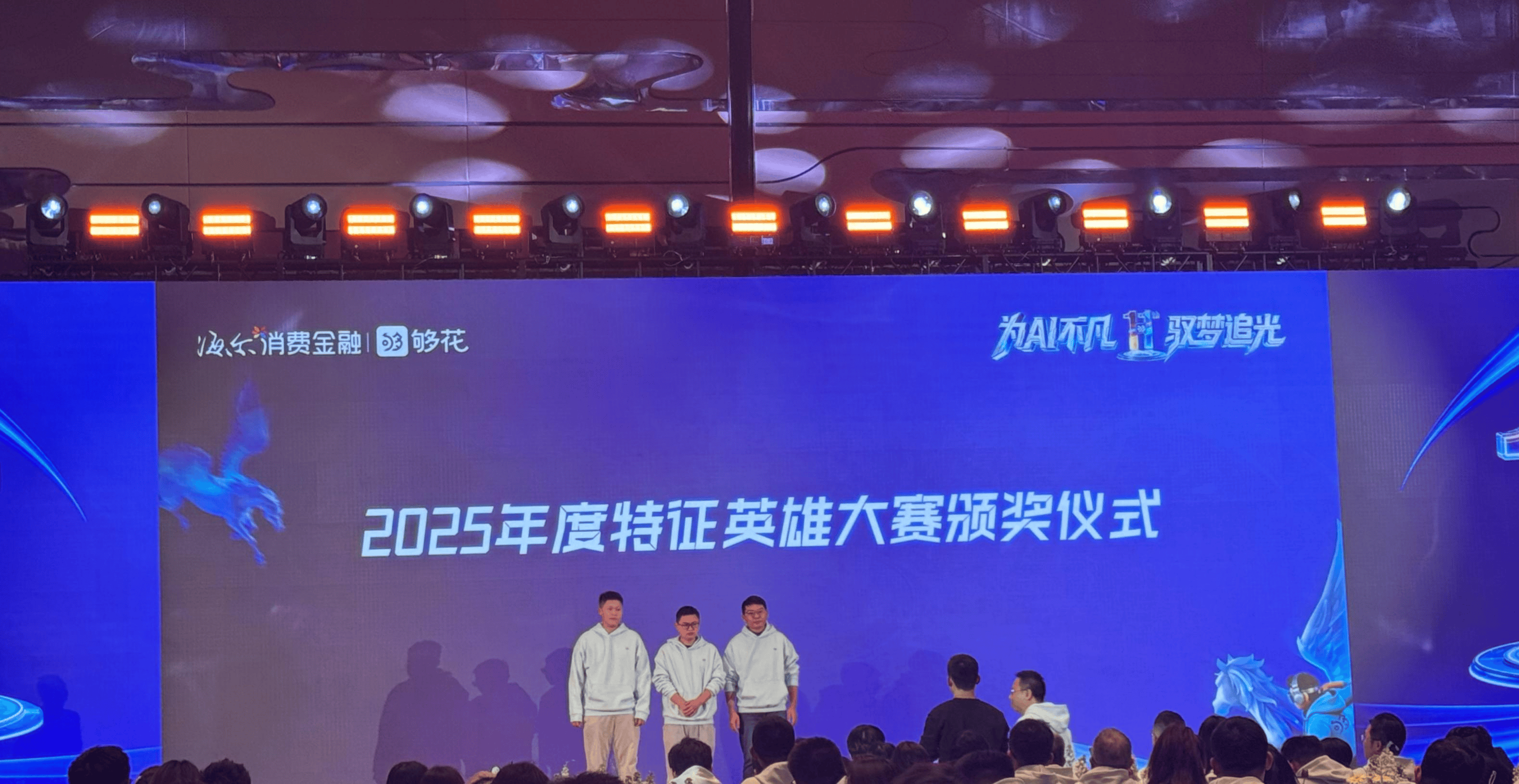
Core Insights - Haier Consumer Finance successfully concluded its 2025 "Feature Hero" initiative, aimed at enhancing data-driven value in financial services and expanding multi-dimensional data samples [1][6] - The initiative emphasizes the importance of data and features in risk control, with advanced models and algorithms striving to approach the risk identification "ceiling" determined by data [1] Group 1: Feature Hero Competition - The first prize of the "Feature Hero" competition was awarded to the Risk Management Center, which innovatively utilized large models to replace manual processing of voice data, aiding in credit risk control strategies [5] - The competition attracted 32 employees, resulting in the extraction of 2,023 high-quality features from vast data, significantly enhancing the risk control system [5] Group 2: Intelligent Risk Control System - By 2025, Haier Consumer Finance's intelligent risk control system had launched a total of 10,427 real-time features, a 70% increase year-on-year [6] - The company emphasizes the importance of continuous competitions like "Feature Hero" to foster an AI-driven culture and enhance data asset exploration [6] Group 3: AI Integration and Industry Trends - The integration of deep learning technologies such as large models, graph learning, and natural language processing is transforming credit risk control models, showcasing a trend of multi-technology application in the field [6] - Haier Consumer Finance's AI-driven risk control system significantly reduces fraud risk and improves credit approval efficiency, achieving a dual advantage of controllable risk and efficient service [6] Group 4: Future Developments - Future advancements in technologies like federated learning, reinforcement learning, and AGI are expected to further enhance risk control models in areas such as data privacy protection and dynamic strategy optimization [7] - The company plans to deepen its AI First strategy, continuously strengthening data governance and technical application capabilities for high-quality development in credit business [7]
简历直推 | 清华大学全国重点实验室招聘工程师/博后/实习生(世界模型/重建/感知等)
自动驾驶之心· 2026-01-06 06:52
自动驾驶车端世界模型方向 招工程师/博后/实习生 点击下方 卡片 ,关注" 自动驾驶之心 "公众号 戳我-> 领取 自动驾驶近30个 方向 学习 路线 清华大学智能绿色车辆与交通全国重点实验室招聘工程师/博后/实习生,感兴趣的可以联系柱哥投递简历或邮 箱自行投递简历。 【岗位目标】 面向端到端自动驾驶核心技术需求,从事车端世界模型的研究与工程化落地。构建融合物理先验、时序一致 性与行为预测能力的世界模型架构,实现复杂驾驶场景的理解、预测与生成,支撑自动驾驶系统的感知、预 测、规划一体化能力建设,推动端到端自动驾驶技术的工程化应用。 【核心职责及次要职责】 核心职责: 次要职责: 1. 研究与开发车端世界模型核心架构,融合物理先验、因果推理、时序一致性与行为预测能力; 2. 构建驾驶场景时空表征与预测模型,实现交通参与者行为预测、场景演化推理与长期规划; 3. 研发基于Transformer、Diffusion、Neural Fields等前沿架构的场景生成与仿真模型; 4. 设计多模态输入融合方案,实现图像、点云、地图、轨迹等多源信息的统一编码与推理; 5. 完成世界模型在车端平台的部署优化,满足实时性与资源 ...

行业周报:昆仑芯启动港股IPO,关注MiniMax多模态机会-20260104
KAIYUAN SECURITIES· 2026-01-04 06:06
Investment Rating - The industry investment rating is "Positive" (maintained) [1] Core Insights - The report highlights the ongoing growth in domestic AI chip demand, with Kunlun Core initiating its Hong Kong IPO process, indicating a strong market potential for domestic AI solutions [5][15] - The upcoming listings of major AI model companies, such as MiniMax, are expected to attract significant investment interest, with MiniMax's projected fundraising between 3.83 to 4.19 billion HKD [21][24] - The report emphasizes the accelerating commercialization of Robotaxi services in China, driven by technological advancements, cost reductions, and supportive policies [7][42] Summary by Sections Internet - Kunlun Core has started its Hong Kong listing process, indicating a sustained growth in domestic computing power demand. The report recommends stocks such as Alibaba-W, Baidu Group-SW, and Pinduoduo, with Tencent Holdings identified as a beneficiary [5][14][67] - The Hang Seng Internet Technology Index rose by 4.3% during the week of December 29, 2025, to January 2, 2026, outperforming other indices [14][16] AI - Major AI model stocks, including MiniMax, are set to list soon, with MiniMax's share price range between 151-165 HKD and an expected market capitalization of 46.12 to 50.40 billion HKD. The company has shown significant revenue growth, achieving 53.44 million USD in revenue for the first three quarters of 2025, a 175% year-on-year increase [21][24][24] - MiniMax's diverse revenue model includes subscription services, virtual goods, and online marketing services, indicating a robust business strategy [30][24] Smart Driving - The report notes that the L3 level of autonomous driving in China has received trial approval, marking a significant step towards commercialization. The Robotaxi market is expected to grow rapidly due to technological maturity and policy support [7][42][44] - Various business models for Robotaxi are emerging, including partnerships between manufacturers, autonomous driving companies, and ride-hailing services, which are expected to accelerate commercialization [44][49] Weekly Data Update - The Hang Seng Index increased by 2.01% during the week, with significant gains in the media, automotive, and technology sectors [53][59]