房地产市场调控

Search documents
企业月报 | 单月销售维持低位,投融资均环比下降(2025年10月)
克而瑞地产研究· 2025-11-09 01:06
Core Insights - In October 2025, the top 100 real estate companies achieved a sales turnover of 253 billion yuan, a month-on-month increase of 0.1% but a year-on-year decrease of 41.9%. Cumulatively, the sales turnover from January to October 2025 reached 25,766.6 billion yuan, reflecting a year-on-year decline of 16%, with the decline rate widening by 4.2 percentage points compared to the first nine months of the year [2][3]. Group 1: Contract Sales - The top 100 real estate companies achieved a sales turnover of 253 billion yuan in October [3]. - The sales threshold for each tier of companies has further decreased compared to the same period last year, with the top 10 companies' sales threshold dropping by 9.4% to 67.89 billion yuan [6]. Group 2: Land Acquisition - In October, the investment amount for land acquisition decreased by nearly 30% compared to the average monthly amount in the first three quarters, with over half of the companies not acquiring any land [10][12]. - The average land price in October fell to 19,809 yuan per square meter, a significant decrease of 54% month-on-month [12]. Group 3: Financing - In October 2025, the total financing amount for 65 typical real estate companies was 34.907 billion yuan, a month-on-month decrease of 9.6% but a year-on-year increase of 4.8% [17]. - The financing cost for newly issued bonds by 65 typical real estate companies averaged 2.92%, a slight decrease from the previous year [19][21]. Group 4: Organizational Dynamics - In October 2025, there was a significant turnover in key positions within the real estate industry, including changes in leadership at major companies such as Vanke and Kincor [23][24]. - Vanke's chairman position changed hands from Xin Jie to Huang Liping, reflecting a strategic continuity amid risk management [24]. - Kincor completed a board restructuring, forming a new management team aimed at stabilizing operations and facilitating strategic transformation [25].







深圳楼市“银十”遇冷,一二手房成交双降!11月开局强劲?
Nan Fang Du Shi Bao· 2025-11-03 12:52
Core Insights - The Shenzhen real estate market experienced a decline in both new and second-hand residential transactions in October, marking a cooling trend during the traditional peak season [1][3] - The decrease in transactions is attributed to several factors, including the impact of the National Day holiday, a reduction in attractive property options, and a high base effect from the previous year's market activity [1][3] - Despite the downturn in October, there are signs of recovery in November, driven by positive news such as the selection of Shenzhen as the host city for the 2026 APEC meeting, which has stimulated buyer interest [4][5] New Housing Market - In October, Shenzhen's new housing transactions totaled 3,352 units, reflecting a 29% month-on-month decline, with residential sales at 2,651 units, down 14.1% [1][2] - The supply of new homes was active, with 4,143 new units approved for sale, a 2.3% increase from the previous month, and residential supply surged by 37.9%, reaching the highest level in three months [2] - High-end market segments saw notable activity, with several luxury projects experiencing strong sales and new developments set to enter the market by year-end [2] Second-Hand Housing Market - The second-hand housing market also showed a month-on-month decline, with 5,276 transactions recorded, down 6.8%, and residential sales at 4,196 units, down 7.7% [3] - The decline was influenced by the holiday season and a decrease in buyer urgency following a busy September, leading to a need for more time to compare properties [3] - Despite the overall decline, the second-hand market maintained a robust performance, with transaction volumes exceeding 5,500 units for eight consecutive months, and prices showing a slight increase [3] Market Outlook - November began with a strong performance in the Shenzhen real estate market, attributed to the APEC announcement, which has led to increased buyer activity in both new and second-hand markets [4][5] - Recent policy signals from central and local governments indicate a focus on high-quality real estate development and risk management, with over 510 policy measures introduced this year [6] - The market is expected to face pressure due to high base effects from the previous year, but new supply and ongoing demand may support sales in the coming months [6]
10月百强销售和基本面解读
2025-11-03 02:36
Summary of Real Estate Market Conference Call Industry Overview - The real estate market in October faced significant pressure, with new home transactions down 36% year-on-year, and the cumulative year-on-year decline expanded to 7% [1][10] - Supply side showed a notable decline, with new supply at the second-lowest level of the year, down approximately 20% year-on-year [1][5] - First-tier cities experienced diminishing effects from new policies, with Beijing and Guangzhou performing relatively well, while Shanghai and Shenzhen saw declines [1][11] Key Insights and Arguments - **Sales Performance**: The overall sales situation in October showed pressure, with the top 100 real estate companies' operational amounts flat month-on-month but down 41.9% year-on-year [3][4] - **Supply Dynamics**: In October, the average opening sales rate for 30 key cities was about 37%, down 3 percentage points month-on-month and 1 percentage point year-on-year [13] - **Market Conditions**: The supply-demand ratio fell to 0.61, with inventory area decreasing by 1% month-on-month and 7% year-on-year [16] - **Land Market**: The land market was subdued, with transaction area and amount down 13% and 20% month-on-month, and year-on-year declines of 25% and 33% respectively [18] Additional Important Points - **First-tier vs. Second/Third-tier Cities**: First-tier cities like Beijing and Shanghai saw a significant drop in opening sales rates, while second and third-tier cities struggled with low sales rates, often below 20% [14][15] - **Future Predictions**: The real estate market is expected to show a front-low, back-high trend in 2026, with overall transaction volumes likely to remain flat or slightly fluctuate compared to 2025 [22][23] - **Market Resilience**: Some state-owned enterprises and local state-owned enterprises demonstrated resilience, maintaining relative stability in growth despite the overall market downturn [8] Conclusion - The real estate market is under considerable stress, with declining sales and supply, particularly in first-tier cities. The outlook for the coming months suggests continued low transaction volumes, with potential for stabilization in core cities in the longer term.
楼市“银十”成色不足?百强房企操盘金额同比降4成 环比微增0.1%
Xin Lang Cai Jing· 2025-10-31 14:36
Group 1 - The core viewpoint of the article indicates that the sales performance of the top 100 real estate companies in October 2025 shows a slight month-on-month increase but a significant year-on-year decline, reflecting a market still in a low-level consolidation phase [1][4] - In October 2025, the sales amount of the top 100 real estate companies reached 253 billion yuan, with a month-on-month growth of 0.1% and a year-on-year decrease of 41.9% [1][3] - The year-on-year decline is attributed to the high base from the previous year, particularly after the policy changes in September 2024 that boosted market activity [1][2] Group 2 - Among the top 100 real estate companies, 48 companies reported month-on-month sales growth in October 2025, with 20 companies experiencing growth exceeding 30% [2] - The cumulative sales of the top 100 real estate companies from January to October 2025 amounted to 2896.71 billion yuan, representing a year-on-year decline of 16.3% [3] - The number of companies in different sales tiers has changed, with 7 companies exceeding 100 billion yuan in sales, while the second tier saw a decrease of 2 companies compared to the previous year [3] Group 3 - In October 2025, various policies were implemented to stimulate the market, including optimizing supply and demand measures, such as improving housing construction regulations and adjusting public housing loan policies [4][5] - Analysts predict that new home transaction volumes in November 2025 will continue to fluctuate at low levels, with potential for further year-on-year declines due to last year's high base [4][5] - The central government is expected to implement more comprehensive measures to stabilize the real estate market, focusing on improving financing conditions and regulatory frameworks [6]
房价死撑,不允许下跌,释放出了什么信号?答案来了
Sou Hu Cai Jing· 2025-10-31 05:58
Core Viewpoint - The article discusses the complex reasons behind developers' reluctance to significantly lower housing prices and the local governments' frequent easing of real estate policies, emphasizing the need for market stability rather than drastic fluctuations [1][9]. Market Background - Since the second half of last year, the domestic housing market has shown a downward trend, with the average national housing price dropping from 11,000 yuan per square meter to 9,560 yuan per square meter, a decline of over 15%. As of August this year, only 29 out of 100 key cities saw new housing prices increase, while 69 cities experienced price declines [3]. - The second-hand housing market is even more challenging, with only 23 cities seeing price increases, while 74 cities reported declines [3]. Current Housing Prices - Despite the overall decline, housing prices remain high, with the average price in 60 key cities at 17,593 yuan per square meter. Purchasing an ordinary commodity house often costs two to three million yuan, while first-tier cities like Beijing, Shanghai, and Shenzhen have average prices reaching 60,000 to 70,000 yuan per square meter, leading to costs of six to seven million yuan [5]. Developer and Government Actions - Many developers are choosing to "hold the line" on prices, with promotional discounts rarely exceeding 10%. Concurrently, local governments have introduced numerous policies to ease the real estate market, with 299 regulatory measures implemented in the first half of 2022, including relaxed purchase restrictions, loan limits, and housing subsidies [6]. - Some cities have even introduced "price drop limits" to prevent developers from significantly lowering prices [6]. Reasons for Price Stability - A sudden drop in housing prices could exacerbate market hesitation, making it harder for developers to sell existing inventory, as buyers tend to wait for lower prices [8]. - Significant price reductions could lead to dissatisfaction among previous buyers, potentially resulting in compensation claims and social instability [8]. - A drastic decline in prices could diminish developers' willingness to acquire land, negatively impacting local government revenues from land sales, which are crucial for infrastructure projects and economic growth [8]. - A cooling real estate market would also affect numerous related industries, including steel, cement, and home furnishings, which employ a large workforce, thus threatening job stability [8]. Conclusion - The easing of real estate policies and developers' reluctance to lower prices significantly stem from a desire to avoid drastic fluctuations in housing prices, which could lead to social and economic instability. Stability is currently the primary goal of real estate market regulation [9].
信号强烈,2025房地产完全明牌了!国家首次明确稳住楼市
Sou Hu Cai Jing· 2025-10-25 17:42
Group 1 - The 5-year LPR has remained at 3.5% for five months, leading to a significant reduction in banks' net interest margins, which now stand at 1.42%, below the 1.8% warning line [1] - Economic data shows a steady GDP growth of 5.4% in Q1, 5.2% in Q2, and 4.8% in Q3, indicating a stable economic environment despite the banking sector's struggles [3] - The real estate market has shifted from a rescue phase to a stabilization phase, with the central bank's language changing from "promoting recovery" to "consolidating stability" [3][5] Group 2 - The nationwide inventory of unsold residential properties is at 769 million square meters, with a land inventory turnover period of 54 months, indicating a significant oversupply [5] - In 2025, the national residential land supply plan was cut by 20%, with second-tier cities seeing a 30% reduction, reflecting a strategy to control land supply and prevent market bubbles [5][7] - Local governments are implementing various strategies to reduce inventory, such as housing vouchers and acquiring existing properties for rental purposes [7][9] Group 3 - The real estate market is experiencing a split, with first-tier cities seeing new home sales increase while third-tier cities face a nearly 20% drop in second-hand home prices [9] - Demand has shifted to a selective model, with buyers favoring properties with good amenities and locations, leading to a change in developers' strategies towards quality over quantity [11] - The logic of home buying has evolved, with rental yields now comparable to mortgage rates, indicating a shift from speculative investment to durable consumer goods [13]
上海前三季度房地产数据出炉 “沪六条”后新房成交环比大涨
Di Yi Cai Jing· 2025-10-22 04:57
Core Insights - Shanghai's economy shows a stable and improving trend in the first three quarters of 2023, with steady growth in production supply and orderly release of market demand [1] Real Estate Development and Investment - Real estate development investment in Shanghai increased by 2.2% year-on-year from January to September 2023 [1] - The total construction area of commercial housing reached 155.91 million square meters, a slight increase of 0.1% [1] - Residential construction area was 72.37 million square meters, growing by 0.9% [1] Completion and Sales of Commercial Housing - The completion area of commercial housing was 10.04 million square meters, up by 11.7% [2] - Residential completion area was 4.88 million square meters, increasing by 6.0% [2] - The sales area of commercial housing decreased by 0.3% to 12.02 million square meters, with residential sales down by 3.8% to 9.57 million square meters [3] Policy Impact and Market Response - The decline in sales area showed a narrowing trend compared to previous months, indicating the effectiveness of the "Six Policies" released on August 25, which aimed to optimize real estate regulations [3] - In September, commercial housing sales area increased by 64.22% month-on-month, while residential sales rose by 73.47% [3] Market Activity and Trends - High-end residential projects in Shanghai have seen significant demand, with some properties selling out on the first day of sales, such as the Jinling Huating project with a total value exceeding 9.8 billion yuan [4] - The second-hand housing market also showed recovery, with over 20,000 transactions in September, and daily registrations exceeding 1,000 in early October [4] - The recent land auction in Shanghai set a record for the highest land price in the city's history, indicating strong land value resilience [4]
9月昆明新房交易量稳价跌,二手房市场稳中有升
Sou Hu Cai Jing· 2025-10-21 07:19
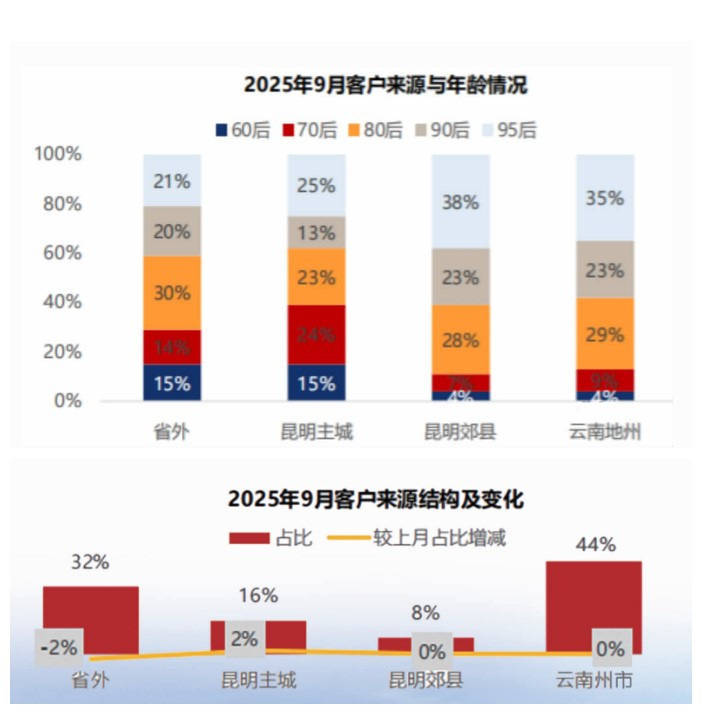
Core Insights - The new housing market in Kunming shows a trend of "stable volume and declining prices" in September, while the second-hand housing market demonstrates a positive trend with stable growth in both volume and price [1][5]. New Housing Market - In September, the supply of new homes increased by 12% compared to the previous month, with a total supply area of 346,200 square meters and a transaction area of 297,000 square meters [5]. - The average transaction price for new homes decreased by 6% month-on-month to 11,566 yuan per square meter, influenced by low-price promotions from some high-density projects [5]. - The inventory in Kunming's market reached 12.8396 million square meters, with a slight increase of 60,000 square meters and a stable absorption period of 32.3 months [5][6]. Second-Hand Housing Market - The second-hand housing market showed stronger performance in September, with a total of 68,000 listings, a 1.57% increase month-on-month, and an average listing price of 11,360 yuan per square meter, down 1.56% [7]. - The transaction volume for second-hand homes reached 4,166 units in September, a 6% increase month-on-month and a 2% increase year-on-year, with a total transaction area of 432,500 square meters [7][8]. - The average transaction price for second-hand homes was 8,157 yuan per square meter, with a slight increase of 0.02%, narrowing the price gap with new homes to 3,400 yuan per square meter [8]. Market Dynamics - The proportion of out-of-province buyers decreased by 2 percentage points to 32%, while local buyers in Kunming's main city increased by 2 percentage points [6]. - The customer conversion rate improved by 0.4 percentage points, indicating increased market activity and enhanced consumer confidence [8].
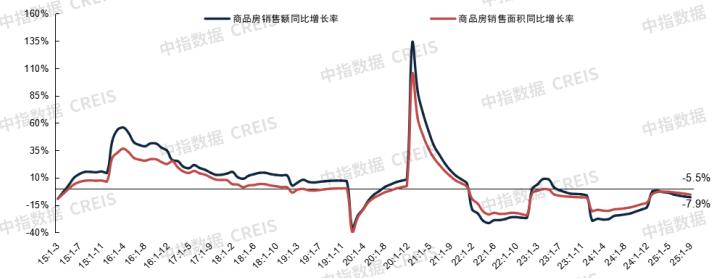
全国新房销售面积同比下降5.5%,销售额下降7.9%
3 6 Ke· 2025-10-21 02:50
Core Insights - The real estate market in China is experiencing significant declines in both sales area and sales revenue for the first nine months of 2025, with a year-on-year decrease of 5.5% in sales area and 7.9% in sales revenue, indicating a worsening trend compared to previous months [1][2][5] - The upcoming 20th Central Committee's Fourth Plenary Session is expected to provide guidance for the real estate sector's development over the next five years, particularly in the context of the "14th Five-Year Plan" [1][17] Demand - From January to September, the total sales area of new commercial housing reached 658 million square meters, down 5.5% year-on-year, with residential sales area declining by 5.6% [2] - The sales revenue for new commercial housing was 6.30 trillion yuan, a decrease of 7.9% year-on-year, with residential sales revenue falling by 7.6% [2] Supply - The total investment in real estate development for the first nine months was 6.77 trillion yuan, reflecting a year-on-year decline of 13.9%, which is an increase in the rate of decline compared to the previous month [5] - The construction area for new housing was 4.54 million square meters, down 18.9% year-on-year, although the decline rate has slightly narrowed [8] Funding Sources - The total funds available to real estate developers amounted to 7.23 trillion yuan, a decrease of 8.4% year-on-year, with domestic loans falling by 1.4% [12][14] - Self-raised funds decreased by 9.3% year-on-year, while pre-sale deposits also saw a decline of 10.3% [13] Policy Dynamics - Recent policy measures include the approval of pilot programs for market-oriented allocation of land resources and local governments implementing measures to stimulate housing demand, such as relaxing purchase restrictions and optimizing property tax policies [16] Outlook - The overall economic growth in China remains stable, with GDP growth of 5.2% year-on-year for the first three quarters, but there are signs of slowing consumption and investment growth [17] - The fourth quarter is expected to see the implementation of policies aimed at stabilizing market expectations and stimulating demand, including potential interest rate cuts and measures to activate the housing market [17][18]
潘石屹预言应验!若无意外,未来3年,楼市或大概率迎来3大走向
Sou Hu Cai Jing· 2025-10-15 22:14
Core Insights - The real estate market is experiencing significant volatility, with predictions made by Pan Shiyi in 2018 regarding risks in the market being increasingly validated over time [1] - Key factors influencing the market include exchange rate differences, supply-demand balance, and sustainability of returns [3] Market Trends - The first trend observed is price fluctuations caused by supply disruptions, particularly as many buyers who utilized business loans during the peak period of 2020-2021 face risks due to falling property prices [5] - The second trend is the divergence in property prices across different cities and locations, with first-tier cities maintaining stable or rising prices while third and fourth-tier cities face downward pressure [5] - The third trend involves increasing difficulty in property demolition, as the market faces oversupply and government efforts focus on reducing inventory rather than increasing housing stock [7] Economic and Policy Environment - The Chinese economy is expected to maintain steady growth, but global economic uncertainties may impact the real estate market [7] - Government regulations aimed at stabilizing market expectations and prices continue to be enforced, including measures like purchase restrictions and lending limits [9] - Urbanization trends are leading to increased population movement towards first and second-tier cities, posing challenges for the real estate markets in third and fourth-tier cities [9] Market Sentiment and Challenges - The real estate market is characterized by uncertainty, with ongoing sales difficulties for developers and agents despite frequent policy interventions [11] - Issues such as unfinished projects (known as "rotten buildings") significantly undermine buyer confidence and contribute to market hesitance [11] - Buyers are encouraged to adopt a rational approach and avoid being misled by misleading promotions, emphasizing the importance of informed decision-making in the current market landscape [13]