投资于物

Search documents
郑栅洁详解“十五五”扩内需举措,实施一批重大标志性工程项目
2 1 Shi Ji Jing Ji Bao Dao· 2025-11-07 10:33
Group 1: Core Strategy on Domestic Demand - The article emphasizes the importance of expanding domestic demand as a strategic foundation during the 14th Five-Year Plan period, focusing on enhancing consumer spending and optimizing the consumption environment [1][4] - Key measures include removing unreasonable restrictions in the consumption sector and improving mechanisms for paid leave to address the issue of "difficulties in taking leave" [1][4] - The long-term goal is to increase residents' consumption capacity and raise the proportion of residents' income in national income distribution [1][4] Group 2: Investment Expansion - The article outlines the need to actively expand effective investment, optimizing the investment structure to stimulate private investment and enhance government investment's role [2][7] - It highlights the importance of improving investment efficiency and addressing issues of "heavy investment, light returns" in certain sectors [2][9] - The focus is on deepening investment and financing system reforms, utilizing new policy financial tools, and enhancing the role of public-private partnerships [2][9] Group 3: Investment in People and Infrastructure - The article discusses the integration of investment in physical assets and human capital, emphasizing the need for investment in education, healthcare, and skills training to enhance human capital [3][4] - It points out that while there is still significant potential for investment in physical assets, the urgency of investing in human capital is increasing due to declining returns on physical capital investments [4][6] - The article stresses the necessity of addressing the needs of a diverse population and improving the quality of life through targeted investments in services like elderly care and healthcare [4][5] Group 4: Government and Private Investment Dynamics - The article calls for a clear delineation between government and private investment roles, aiming to enhance the effectiveness of both [7][9] - It suggests that government investment should focus on public service shortfalls and strategic areas, while also stimulating private investment through improved market conditions [8][12] - The need for a supportive environment for private enterprises is highlighted, including fair competition and risk management assistance [11][12]
宏观纵览 | “投资于人”紧迫性凸显,官方详解发力点与新机遇
Sou Hu Cai Jing· 2025-11-04 08:01
Core Viewpoint - The importance and urgency of investing in people during the "14th Five-Year Plan" and beyond is increasingly highlighted, emphasizing the need to combine investments in material and human resources for sustainable economic growth [2][3]. Investment in People - The "14th Five-Year Plan" proposes that investment in people is a crucial direction, aiming to enhance development momentum, expand domestic demand, and promote comprehensive human development [2][3]. - Investment in people refers to enhancing capabilities and potential across the entire population and lifecycle, including areas such as childcare, elderly care, health, education, and skills training [2]. Economic Transition - The shift from capital-intensive to talent-intensive global industrial competition necessitates increased investment in human capital to drive innovation and demand, thereby establishing long-term competitive advantages for the economy [3][4]. - There has been insufficient investment in areas related to people's well-being and comprehensive development, making it essential to increase funding for education, healthcare, and elderly care to ensure high-quality population development [3][4]. Key Directions for Investment - Key areas for investment in people include: 1. Improving income distribution systems to ensure fair compensation based on contribution [3]. 2. Promoting equal access to basic public services and reducing disparities across regions and demographics [3]. 3. Increasing government investment in public welfare sectors such as childcare, education, healthcare, vocational training, and cultural sports [4]. 4. Enhancing human resource development, particularly for leading talents in technology and innovation [4]. 5. Establishing a long-term mechanism for investing in people, optimizing fiscal responsibilities, and encouraging various stakeholders to invest in human capital [4]. Government Investment Strategy - The National Development and Reform Commission emphasizes the need to better allocate government funds to address pressing development needs and improve people's livelihoods [4][5]. - The government aims to optimize investment structures, increase the proportion of welfare-related investments, and enhance the overall management of government investments to maximize their effectiveness [5]. Economic Outlook - The investment in people is seen as a logical mainline of the "14th Five-Year Plan," addressing systemic challenges and enhancing both social welfare and development quality [5][6]. - Future investments will focus on education, healthcare, and elderly care, as well as emerging technologies crucial for national competitiveness [6].


拓展增量 提升效益 畅通循环——锚定三方面重点任务 建设强大国内市场
Zhong Guo Zheng Quan Bao· 2025-11-03 02:39
Core Viewpoint - The "15th Five-Year Plan" emphasizes the importance of a strong domestic market as a strategic foundation for China's modernization, focusing on expanding domestic demand and enhancing the interaction between supply and demand to boost economic resilience [1][2]. Group 1: Consumer Demand - The plan prioritizes boosting consumption as a key task for building a strong domestic market, leveraging the potential of over 800 million middle-income individuals in China [2]. - Measures include increasing public service spending and implementing inclusive policies to enhance consumer capacity, with a focus on improving employment as a fundamental aspect [2][3]. - The strategy involves both demand-side and supply-side efforts to stimulate consumption, with an emphasis on creating a favorable consumption environment through institutional guarantees [3]. Group 2: Investment Focus - The concept of "investing in people" is highlighted as crucial for economic and social structural transformation, with a call for optimizing investment structures and enhancing investment efficiency [4][5]. - The plan suggests increasing investments in public services and human capital, particularly in education, healthcare, and emerging technologies, to support sustainable economic growth [4][5]. - Specific measures include improving government investment management and reforming investment approval processes to ensure effective allocation of resources [5]. Group 3: Market Barriers - The plan aims to eliminate various market barriers to facilitate the efficient aggregation of domestic and international resources, thereby unlocking China's market potential [6][7]. - Significant progress has been made in cleaning up regulations that hinder market unity, with a reduction in market access restrictions and policies obstructing resource flow [6][7]. - The establishment of a unified national market is seen as essential for enhancing market efficiency and promoting coordinated regional development [6][7].
专访迟福林:拉动内需,全面“投资于人”是关键
3 6 Ke· 2025-10-31 10:40
Core Viewpoint - The current focus of China's economic development is to boost consumption, creating a model driven by domestic demand and endogenous growth, with "investment in people" being crucial for enhancing consumer capacity, confidence, and expectations [1][2]. Group 1: Investment in People - "Investment in people" is essential for addressing uncertainties and establishing new development advantages, serving as a foundation for stable economic growth over the next decade [4]. - Enhancing public services and social security through "investment in people" can fundamentally resolve issues of insufficient consumer willingness and weakened confidence, unlocking the consumption potential of over 1.4 billion people [4][5]. - The combination of "China manufacturing" and "China consumption" is vital for a strong domestic market, with high-quality development requiring both a modern industrial system and a service-oriented consumption system [4]. Group 2: Economic Projections - If China's final consumption reaches the same global share as its manufacturing, it could create an additional consumption market of no less than $10 trillion, positioning consumption as a key driver of economic growth over the next decade [5]. - In 2023, China's economic output accounted for approximately 17% of the global total, with projections indicating that by 2024, its share in global manufacturing will rise to 28% [4]. Group 3: Focus Areas for Investment - "Investment in people" should concentrate on key areas that enhance human capital and ensure social equity, particularly in sectors like education, healthcare, elderly care, and community development, which are closely linked to improving quality of life [6]. - Recommendations include reforming the fiscal system to prioritize effective investment in education, healthcare, and social security, while removing barriers to labor and talent mobility across regions and ownership types [6]. - The role of state-owned capital should be emphasized as a strategic leader and resource provider in "investment in people," facilitating broader societal benefits from capital appreciation [6].
党的二十届四中全会精神权威学习辅导材料:将对人的投资纳入统计核算范围 调动全社会各方面的积极性主动性创造性
Zheng Quan Shi Bao Wang· 2025-10-31 08:08
Group 1 - The article emphasizes the importance of combining investments in physical assets and human capital, which is a significant enhancement of China's investment philosophy and direction, crucial for boosting development momentum and expanding domestic demand [1] - Investment in physical assets has played a vital role in China's rapid economic development, including infrastructure, housing, and machinery, which have strengthened the material and technical foundation for economic and social development [1][2] - The article highlights that while investment in physical assets has been effective, there remains substantial potential for further investment, particularly in key industries and technological advancements [2] Group 2 - The urgency of investing in human capital is increasingly recognized, focusing on enhancing capabilities and potential across the entire population and life cycle, including education, healthcare, and skills training [3] - The article notes that the return on investment in physical assets has been declining, necessitating a shift towards human capital investment to drive economic growth and innovation [3] - Key directions for human capital investment include improving income distribution systems, promoting equal access to public services, and increasing government investment in areas such as education and healthcare [4]
“十五五”投资:“投资于人”成为主线,“投资于物”布局未来
2 1 Shi Ji Jing Ji Bao Dao· 2025-10-30 00:12
Group 1 - The core idea of the article emphasizes the importance of "investing in people" as a key focus in China's 14th Five-Year Plan, highlighting the need to combine investments in material and human capital to enhance people's livelihoods and promote consumption [1][3][4] - Fixed asset investment in China has reached 50 trillion yuan, with a shift from physical capital to human capital investment being deemed necessary due to declining returns on traditional investments [3][4] - The article outlines specific measures to enhance human capital, including improving population quality through education and healthcare investments, and implementing supportive policies for population growth [3][4][6] Group 2 - The article discusses the strategic emphasis on "investing in material" to layout future industries, with a focus on emerging sectors such as new energy, aerospace, and advanced manufacturing, which are expected to create trillion-yuan markets [5][6] - It highlights the role of technological innovation in driving new industries and enhancing productivity, with a call for deeper integration of technology and industry to support high-quality development [6][7] - The article notes that while fixed asset investment growth has slowed, there is a trend towards optimizing the industrial structure, with significant growth in high-tech sectors [7][8] Group 3 - Effective investment is defined as directing funds towards areas with positive returns and consumer willingness, with a focus on enhancing living standards and fostering new industries [8] - The relationship between central and local government investments is discussed, emphasizing the need for government investments to create a conducive environment for private sector participation and enhance overall investment effectiveness [8]
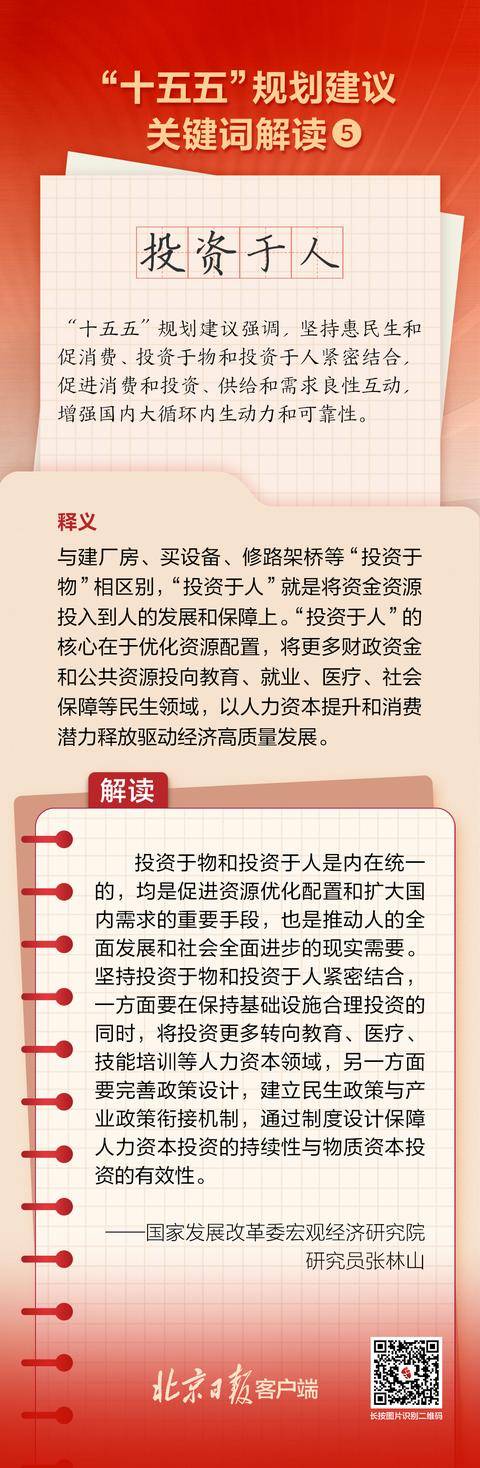
“十五五”规划建议关键词解读 | 投资于人
Sou Hu Cai Jing· 2025-10-29 06:42
Core Insights - The "14th Five-Year Plan" emphasizes the integration of investments in both material and human resources to enhance domestic circulation and reliability [1][2]. Group 1: Investment Focus - The plan distinguishes between "investment in material," such as infrastructure, and "investment in people," which focuses on human development and welfare [2]. - "Investment in people" aims to optimize resource allocation by directing more public funds towards education, employment, healthcare, and social security, thereby driving high-quality economic development through human capital enhancement and consumption potential release [2][3]. Group 2: Resource Optimization - Both "investment in material" and "investment in people" are essential for optimizing resource allocation and expanding domestic demand, addressing the need for comprehensive human development and societal progress [3]. - The plan advocates for a balanced approach, maintaining reasonable investment in infrastructure while increasing funding for education and healthcare [3].
【“十五五”规划建议 未来五年有哪些关键部署?】专家解读:扩内需和投资于人 两方面都特别重要
Yang Shi Wang· 2025-10-25 21:32
Core Viewpoint - The Central Committee's press conference on October 24 emphasized the importance of combining "benefiting people's livelihoods and promoting consumption" with "investing in goods and investing in people" during the 14th Five-Year Plan period [1] Group 1 - The 20th Central Committee's Fourth Plenary Session report highlights that expanding domestic demand and investing in people are two sides of the same coin, both being critically important [1]
投资于物和投资于人并举 扩大内需战略新部署意味着什么
2 1 Shi Ji Jing Ji Bao Dao· 2025-10-23 23:42
Core Viewpoint - The Fourth Plenary Session of the 20th Central Committee of the Communist Party of China emphasizes the construction of a strong domestic market and the acceleration of a new development pattern, focusing on expanding domestic demand and enhancing the interaction between consumption and investment [1][3]. Group 1: Strong Domestic Market - The market is identified as a scarce resource, with China's large-scale market being a significant advantage. The resilience of the domestic market is highlighted in the face of complex external environments, with domestic demand contributing an average of 86.8% to economic growth from 2021 to 2024 [3]. - The emphasis on expanding domestic demand is seen as a strategic foundation for establishing a new development pattern that promotes both domestic and international circulation [3]. - The document stresses the importance of the domestic market, which covers over 1.4 billion people, aiming to enhance China's role as a significant consumer market globally [3][4]. Group 2: Investment in Goods and People - The 2025 Government Work Report advocates for increased investment in human capital and services to improve livelihoods, support employment, and stimulate consumption, creating a virtuous cycle of economic development and social improvement [5]. - The combination of investment in tangible assets and human capital is emphasized as essential for sustainable growth, with a call for a balanced approach to enhance skills and participation in the economic cycle [6]. - The need for policies that support human capital investment is highlighted, covering areas such as healthcare, education, and social security, in response to the demands of the new industrial and technological revolution [5][6].
四中全会重要部署,释放关键信号
2 1 Shi Ji Jing Ji Bao Dao· 2025-10-23 14:53
记者丨周慧 中国共产党第二十届中央委员会第四次全体会议,于2025年10月20日至23日在北京举行。 全会提出,建设强大国内市场,加快构建新发展格局。坚持扩大内需这个战略基点,坚持惠民生和促消费、投资于物和投资于 人紧密结合,以新需求引领新供给,以新供给创造新需求,促进消费和投资、供给和需求良性互动,增强国内大循环内生动力 和可靠性。要大力提振消费,扩大有效投资,坚决破除阻碍全国统一大市场建设卡点堵点。 21世纪经济报道记者就此采访了商务部研究院、北京大学经济学院等专家进行解读。 图:2025年初,沈阳棋盘山滑雪场游客扎堆 拍摄:周慧 商务部研究院研究员白明表示,公报提出坚持扩大内需的这个战略基点,将坚持扩大内需提到了重要的位置,只有夯实了这个 基点,中国才能得以构建以国内大循环为主体、国内国际双循环相互促进的新发展格局,这是具有长远眼光的宏观战略。从发 展格局来看,中国双循环并重,有了这个基点做支撑,中国在外循环上才能占据主动和更自信。 商务部研究院研究员周密表示,公报将建设强大国内市场提到了很重要的位置,强调了国内市场的重要性,中国市场覆盖14亿 多人口,市场规模和潜力是非常大的,这个目标是希望能够对全球 ...